


Earlier in the week I noted the stark difference in price from this week’s ‘hawkish’ Kazuo Ueda and what we saw in January. A few months ago when the BoJ head highlighted that more rate hikes might be on the way, USD/JPY unfurled to the tune of 700 pips over a three-day period, eventually finding support at the 151.95-152.50 zone.
This week, however, any pullback was short-lived and buyers simply ramped price back up to the 160.00 handle, which gave way to breakout on Wednesday morning even before the FOMC meeting. In an usual manner it’s already been confirmed by Nikkei that Japan has intervened overnight, helping to drive the pair down by more than 400 pips at peak. Normally after an intervention, Japanese authorities like to keep markets guessing as to whether or not they did actually intervene. So we’ll often end up with a situation like we had a few months ago where there’s a lot of smoke but no clear evidence of fire, at least until we get money market data far after the fact.
But this time it seems that the Finance Ministry wanted to make a statement and this comes after the stern warning last night that they wouldn’t hesitate to take ‘bold action’ on the matter.
Perhaps more interesting is the US component to this, as there’s been multiple claims that Japan had checked with the US before making such a move and logically speaking, a weaker USD/JPY spot rate is something that both parties would want to see, so that makes sense. But more to the point, if Japan wants this intervention to actually succeed, and by the definition we would mean creating a larger movement than just a 400-pip pullback, they would likely need some help.
Solo interventions from Japan traditionally have not fared well, and the 1998 episode shows that when there is assistance from the US side of the matter there’s higher odds of ‘success.’
The challenge with such situations seemingly flies at odds with comments from Japanese policymakers, who often say that they’re intervening because market moves do not mirror the fundamentals at the time. But when there’s massive rate divergence, that’s precisely what is happening, as market participants are simply buying the high yielder while selling the low yielder.
Or in actual terms, if a hedge fund can borrow capital in Japan at a low rate and then invest it in the US at a higher rate, well, it makes sense for them to do that. The only problem in that scenario is that they’re now essentially long a weak currency, so to remove the risk of watching any gains be siphoned away by a leaking currency, they hedge the currency risk by selling Yen and buying Dollars (or Euros, GBP, etc).
If Japan actually wanted to ‘fix’ the situation, they need to hike rates, narrow the rate divergence in the pair and just the prospect of that could be enough to compel unwind of what’s been a massive carry trade over the past five years.
But, realistically, that has consequence, as well, and with the Takaichi government being elected on the prospect of economic growth ad pro-growth initiatives, it doesn’t seem like a hawkish path is ahead of the BoJ, at least until inflation becomes something that they can no longer ignore. To this point, Takaichi has framed inflation as something that can be addressed by government reforms. She’s previously called rate hikes ‘stupid.’ And in December, when the BoJ did hike, it was as if her administration had to give the move a blessing.
Now with oil prices running there could be another factor of consideration in the coming months as higher oil prices aren’t only inflationary for energy, as there’s a flow-through effect that could put upper pressure even on core inflation, such as we’ve started to see in the US as Core PCE just printed at its highest level in more than two years.
For USD/JPY, this means that there could eventually be change on the horizon but it’s going to come with some strife as rate hikes in Japan aren’t a popular topic and it’s seemingly at odds with the current government. More likely, it seems, we’re looking at a pullback that bulls can pounce on, similar to the January episode, or like the April of 2024 episode that produced a week of Yen-weakness before buyers jumped on a 151.95 re-test.
The other item that could ‘solve’ the issue is what helped in July of 2024. That was the last time that the BoJ intervened and that one ended up working a bit too well. But they had some help, as it was worsening US data building odds for the Fed to cut rates, narrowing rate differentials between the two economies, that compelled longs to close positions as prices spiraled lower.
There was collateral damage, however, as many of the levered trades that had been funded by cheap Yen, like tech stocks, were quickly selling out. It didn’t take long for global headlines to point the finger at the BoJ and the JPY intervention as reason for the volatility, which drove the third highest ever spike in the VIX index.
USD/JPY Levels
At this point the recent range has been broken and price has spilled down to a familiar support of 155.54, but there’s a bigger zone just below at 154.45-155.00 that’s of note and as we go into next week, that zone is confluent with a bullish trendline taken from a group of swing lows from last year.
Below that, it’s the zone that held two attempts from sellers in January and February and that spans from 151.95-152.50.
For lower-high resistance potential, there’s a level at 156.76 before the 157.51-157.97 zone comes into play.
USD/JPY Daily Price Chart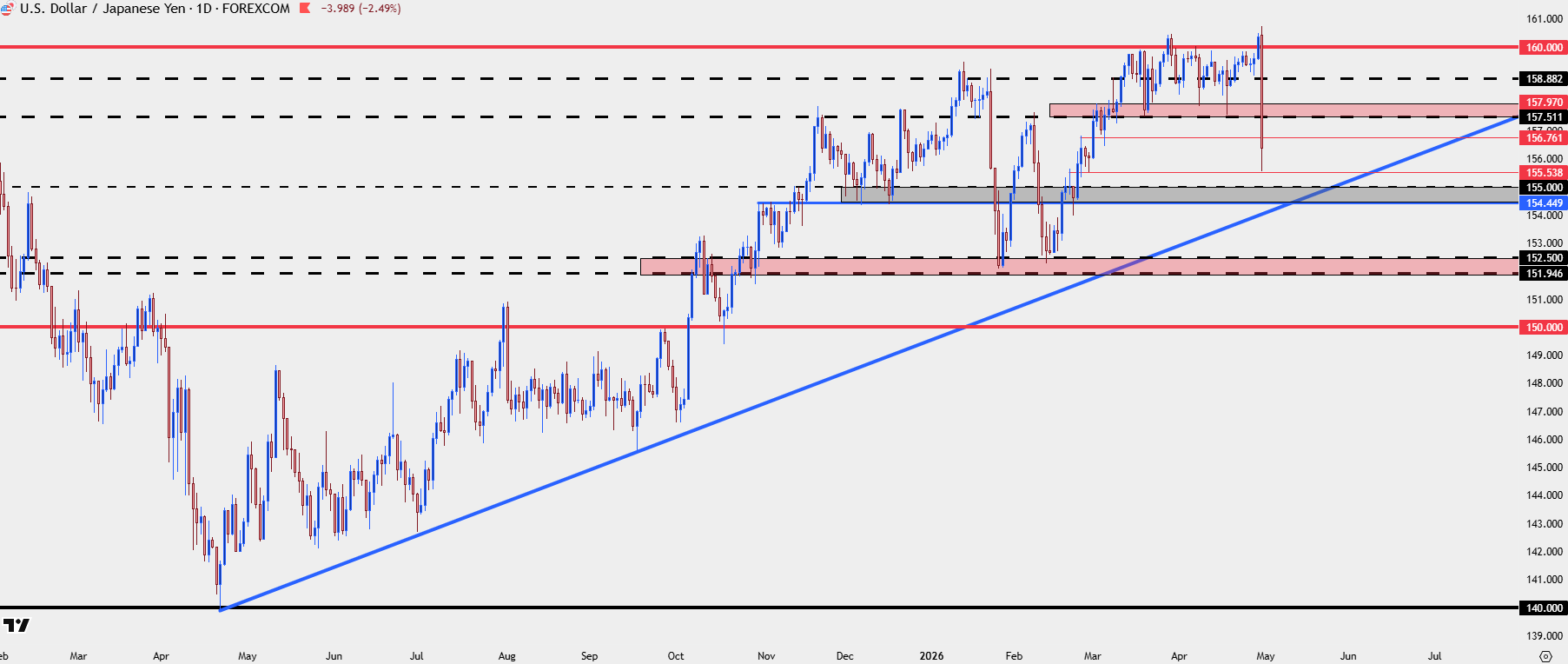
Chart prepared by James Stanley; data derived from Tradingview
--- written by James Stanley, Senior Market Analyst, Global Macro