



USD/CAD Forecast: Canadian dollar weakens as tariff fears return
The week continues to move in favor of the US dollar against its main rivals, and this is also reflected in USD/CAD price action. Over the last three trading sessions, the pair has gained more than 0.6%, showing that the Canadian dollar continues to lose ground in a meaningful way.
Share this:

The week continues to move in favor of the US dollar against its main rivals, and this is also reflected in USD/CAD price action. Over the last three trading sessions, the pair has gained more than 0.6%, showing that the Canadian dollar continues to lose ground in a meaningful way.
Buying pressure has remained in place mainly because the US dollar had already started to stabilize amid confusion around the Middle East. However, during today’s session, new updates around potential US tariffs also emerged, bringing renewed attention to dollar strength. If these uncertainty-driven dynamics remain in place, buying pressure could continue to be relevant in USD/CAD.


Are tariff fears coming back?
The trading session brought back short-term uncertainty after some comments from the US administration once again raised the possibility of new tariffs. The new plan considers tariffs of at least 10% on 16 economies globally, including Canada, England, and the European Union. There was also mention of more aggressive 12.5% tariffs for countries such as China and Japan.
Although these measures would not take effect immediately, the proposal brings back concerns over a possible trade war, like the tensions that shaped much of 2025. Hearings are expected over the coming weeks to clarify the scope of these measures. In Canada’s case, the key detail is that products complying with the USMCA trade agreement would be exempt from these tariffs. However, this does not fully remove global trade uncertainty or rule out renewed friction between Canada and the United States.
This event has once again become relevant for market risk perception. The broader backdrop was already marked by confusion around the Middle East conflict, which had helped stabilize demand for US dollars in the short term. Now, new comments around potential trade tensions may be reinforcing that stability, as the dollar often acts as one of the market’s preferred liquidity safe-haven currencies during periods of geopolitical or trade uncertainty.
In fact, after the latest tariff updates, DXY, which measures the dollar’s strength against its main rivals, is trading above the 99.5-point area and is moving closer to the 100-point reference level. It also maintains a short-term upward slope, suggesting that demand for dollars has stabilized meaningfully, likely as a response to the latest uncertainty across markets.

Source: Marketwatch
With this in mind, the potential return of trade tensions is important and helps explain the stronger stability in the US dollar. This effect may be making it harder for the Canadian dollar to recover ground in the short term. For this reason, if the uncertainty environment persists, the buying pressure seen in USD/CAD could remain relevant over the coming trading sessions.
The bond market also remains relevant
In recent sessions, both US and Canadian bond markets have shown a similar dynamic. 10-year yields have recovered, with a daily increase of 0.88% in Canada and 1.17% in the United States. This shows that both bond markets are moving in a relatively similar way at the moment.
However, the key factor is that US 10-year Treasuries are still offering a yield close to 4.5%, well above Canadian 10-year bonds, which are trading around 3.5%. Therefore, even though both markets have recently moved in the same direction, the fixed income advantage still favors the United States.
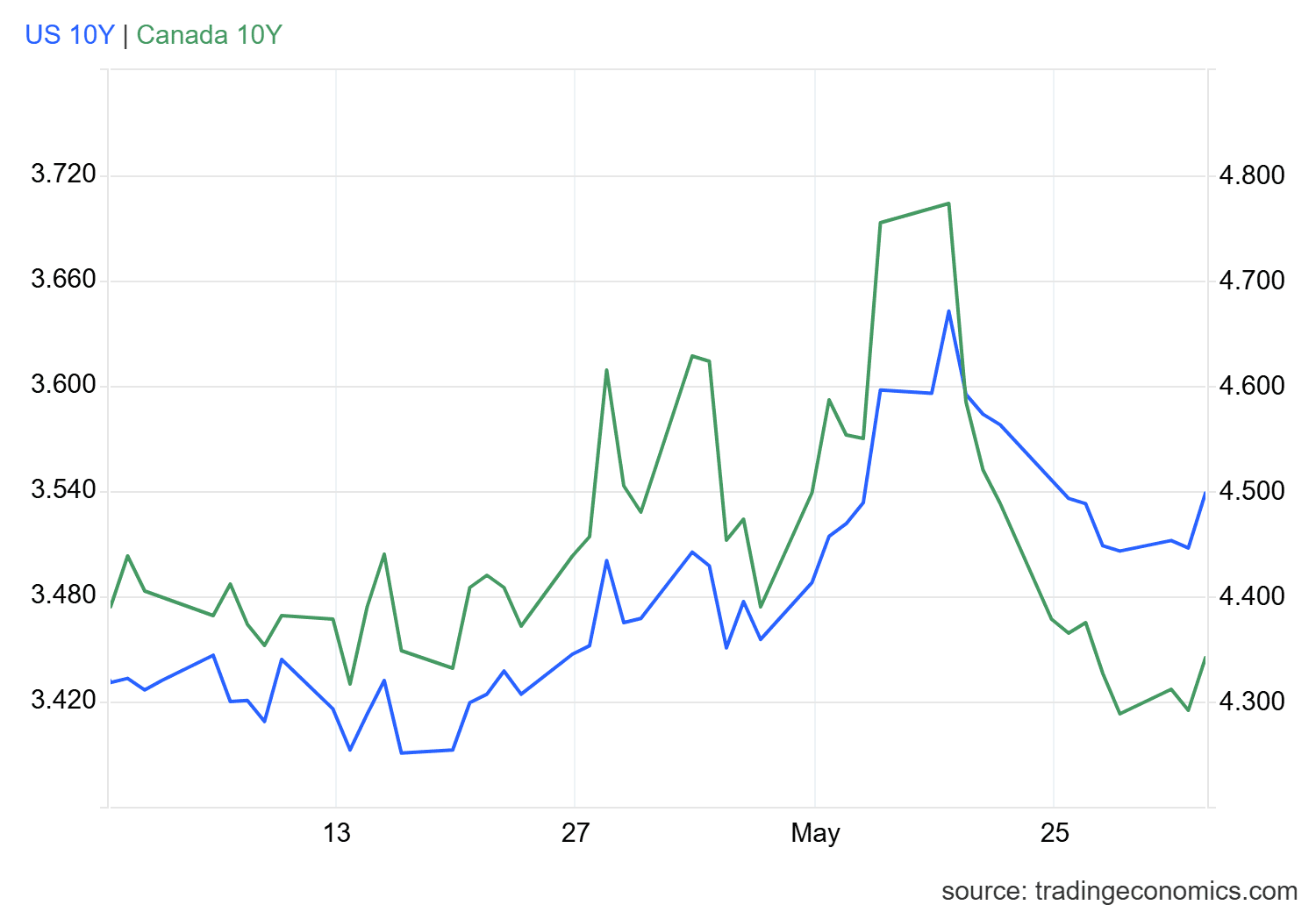
Source: TradingEconomics
This matters because, if the US bond market continues to offer a more attractive yield, it may keep drawing international capital flows into these instruments. Higher US yields can help sustain demand for dollar-denominated securities and, at the same time, support demand for the US currency.
In contrast, Canada’s lower bond yields could limit the relative appeal of its fixed income instruments. This comparative advantage has previously supported USD strength against the CAD, and if the yield differential remains in place, it could continue to be an important factor behind buying pressure in USD/CAD over the coming sessions.
Technical outlook for USD/CAD

Source: StoneX, Tradingview
- Major bearish trendline enters a risk zone: Although the dominant structure on the daily chart has remained a long bearish trendline for several months, the recent price recovery has started to challenge this formation in the short term. If buying pressure continues to stabilize over the coming sessions, this bearish structure could lose relevance and open the door to a stronger buying bias in the pair’s price action.
- RSI: The RSI continues to move consistently above the neutral 50 area, indicating that average bullish momentum over the last 14 sessions remains dominant. As long as this behavior holds, the buying bias could remain relevant over the medium term. However, it is also important to note that the indicator is now close to the overbought 70 level, which could warn of a possible excess of short-term bullish strength and leave room for mild selling corrections over the coming sessions.
- MACD: A similar scenario can be seen in the MACD, as the histogram remains above the neutral 0 level. This suggests that the average strength of short-term moving averages continues to show a bullish bias, which could remain relevant in USD/CAD price action over the medium term.
Key levels:
- 1.39215 – Relevant resistance: An important high level located above the 50- and 200-period moving averages. Price movements toward this level would begin to reflect a more consistent buying bias and could generate a full breakout of the long-term bearish trendline, opening the door to a more relevant bullish structure over the coming weeks.
- 1.38129 – Near-term barrier: A neutral zone that coincides with the 200-period simple moving average. This level could act as the first tentative barrier if bearish corrections begin to appear in the short term.
- 1.37503 – Crucial support: A nearby support level that corresponds to the area marked by the 50-period moving average. Price action that manages to break below this level could reactivate a selling bias and give continuity to the bearish trendline as the dominant chart structure over the following weeks of trading.
Written by Julian Pineda, CFA, CMT – Market Analyst
Follow him on: @julianpineda25

Open an account today
Experience award-winning platforms with fast and secure execution.
Economic calendar
Web Trader platform
Our sophisticated web-based platform is packed with features.
Related articles

How FX Majors Stack Up Against US Dollar Weakness in December
December has historically favoured a weaker US dollar. We compare the seasonal performance and timing of the major currency pairs.


USD/JPY Weekly Outlook: Fed Hikes, AI Volatility and a Sleeping Yen
USD/JPY is tracking the direction of US rates without responding with its usual magnitude. Can Jensen Huang and the payrolls lottery wake the pair from its slumber?

USD/MXN Forecast: Mexican Peso Weakness Persists as Year-End Approaches
These continue to be challenging sessions for the Mexican peso. The currency has remained under pressure in recent weeks, a trend clearly reflected in USD/MXN, which has now posted seven consecutive bullish sessions, gaining more than 7.0% over that period.
From time to time, StoneX Financial Pty Ltd (“we”, “our”) website may contain links to other sites and/or resources provided by third parties. These links and/or resources are provided for your information only and we have no control over the contents of those materials, and in no way endorse their content. Any analysis, opinion, commentary or research-based material on our website is for information and educational purposes only and is not, in any circumstances, intended to be an offer, recommendation or solicitation to buy or sell. You should always seek independent advice as to your suitability to speculate in any related markets and your ability to assume the associated risks, if you are at all unsure. No representation or warranty is made, express or implied, that the materials on our website are complete or accurate. We are not under any obligation to update any such material.
As such, we (and/or our associated companies) will not be responsible or liable for any loss or damage incurred by you or any third party arising out of, or in connection with, any use of the information on our website (other than with regards to any duty or liability that we are unable to limit or exclude by law or under the applicable regulatory system) and any such liability is hereby expressly disclaimed.