

In the last trading session of the week, USD/JPY recorded a moderate variation of 0.12%, but has once again begun to show a slight bearish bias as market indecision grows. This behavior reflects the influence of recent central bank decisions throughout the week. The bullish momentum of the U.S. dollar has stalled, while comments from the Bank of Japan (BoJ) highlight a growing division of opinions within the institution. If the central bank raises expectations of potential interest rate hikes in the short term, the selling pressure that had been sidelined could return and gain relevance for the pair.

Bank of Japan Decision
In today’s early session, the BoJ officially announced that it would keep its interest rate unchanged at 0.5%, as expected. However, the most noteworthy development came shortly after: the bank revealed it will begin to sell part of its ETF holdings, currently valued at around $250 billion, as part of a plan to unwind the massive monetary stimulus applied in recent years. This marks a new approach, suggesting that the BoJ may not rely solely on maintaining low rates to support the economy in the short term.
Another key point was that during the meeting, at least two board members proposed raising the rate to 0.75%, indicating the emergence of internal disagreement. This shows that not everyone agrees on keeping rates so low compared to other major central banks worldwide, which could be an early sign that a more hawkish perspective is developing within the BoJ.
Regarding inflation, the official target remains at 2%. Although it has declined steadily this year, from 4% at the start of 2025 to 2.7% in August, it is still not low enough to eliminate the risk of prices rising again. This highlights the need to adjust monetary policy to prevent inflation from re-accelerating if excessive stimulus continues.
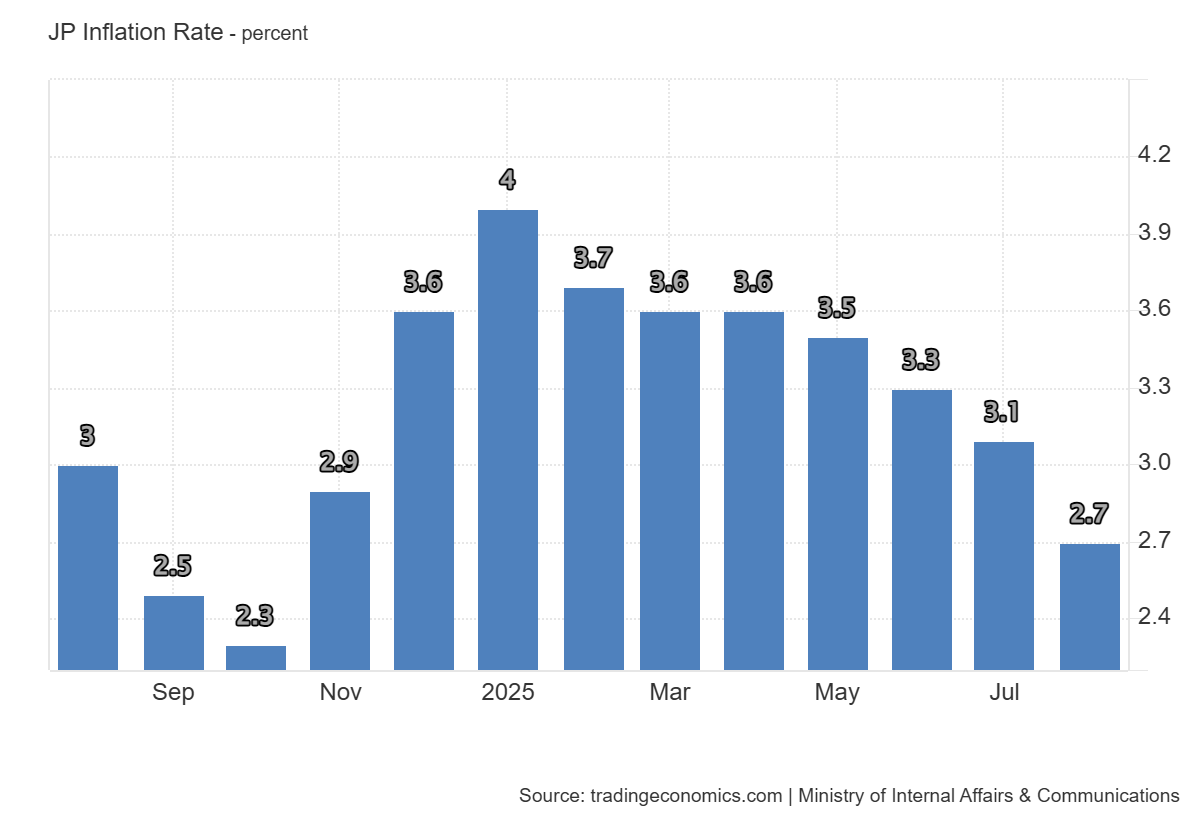
Source: TradingEconomics
Overall, inflation remains a central concern for the BoJ. The division of opinions could bring interest rate hikes into future discussions. While Japan’s current rate (0.5%) is far below that of the U.S. (4.25%), if the Fed continues its rate-cutting cycle and the BoJ adopts a more aggressive stance, the differential could narrow. In such a scenario, yen-denominated assets would become more attractive, potentially increasing selling pressure on USD/JPY.
Is the U.S. Dollar Recovering?
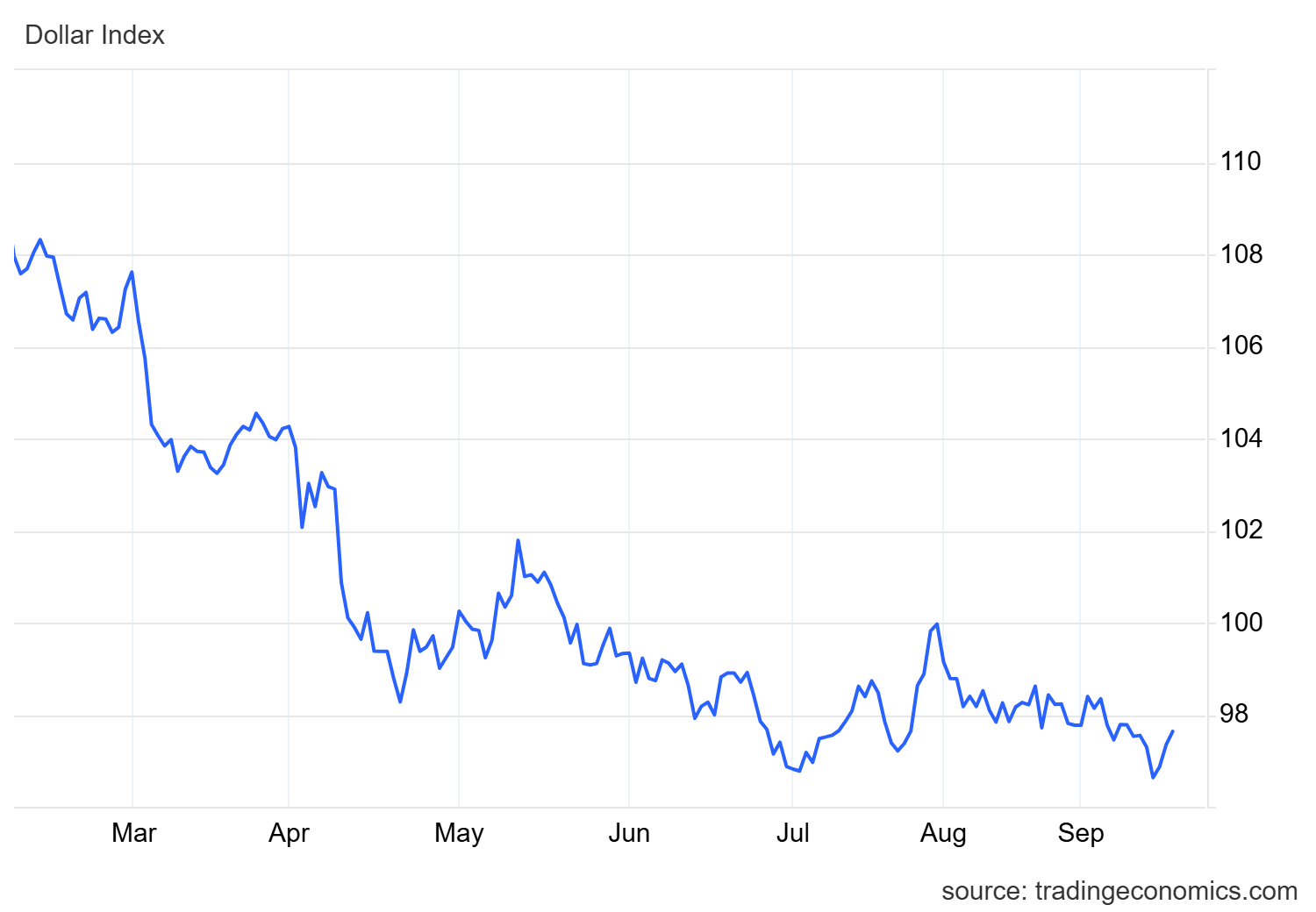
Following the Fed’s long-awaited decision, the U.S. dollar has shown some relief. Since the rate cut was already priced in, speculation eased, allowing fresh bullish positions to enter the market. The DXY index has rebounded, moving closer to the 98-point level in the short term.
Source: TradingEconomics
This rebound suggests that, after several weeks of declines, the dollar has found support. However, despite the recovery, the yen has not yielded as much as expected, which shows that the DXY still needs stronger confidence to fully dominate the yen. As a result, the recent buying pressure on USD/JPY may not remain fully consistent in the coming sessions.
USD/JPY Technical Forecast
Source: StoneX, Tradingview
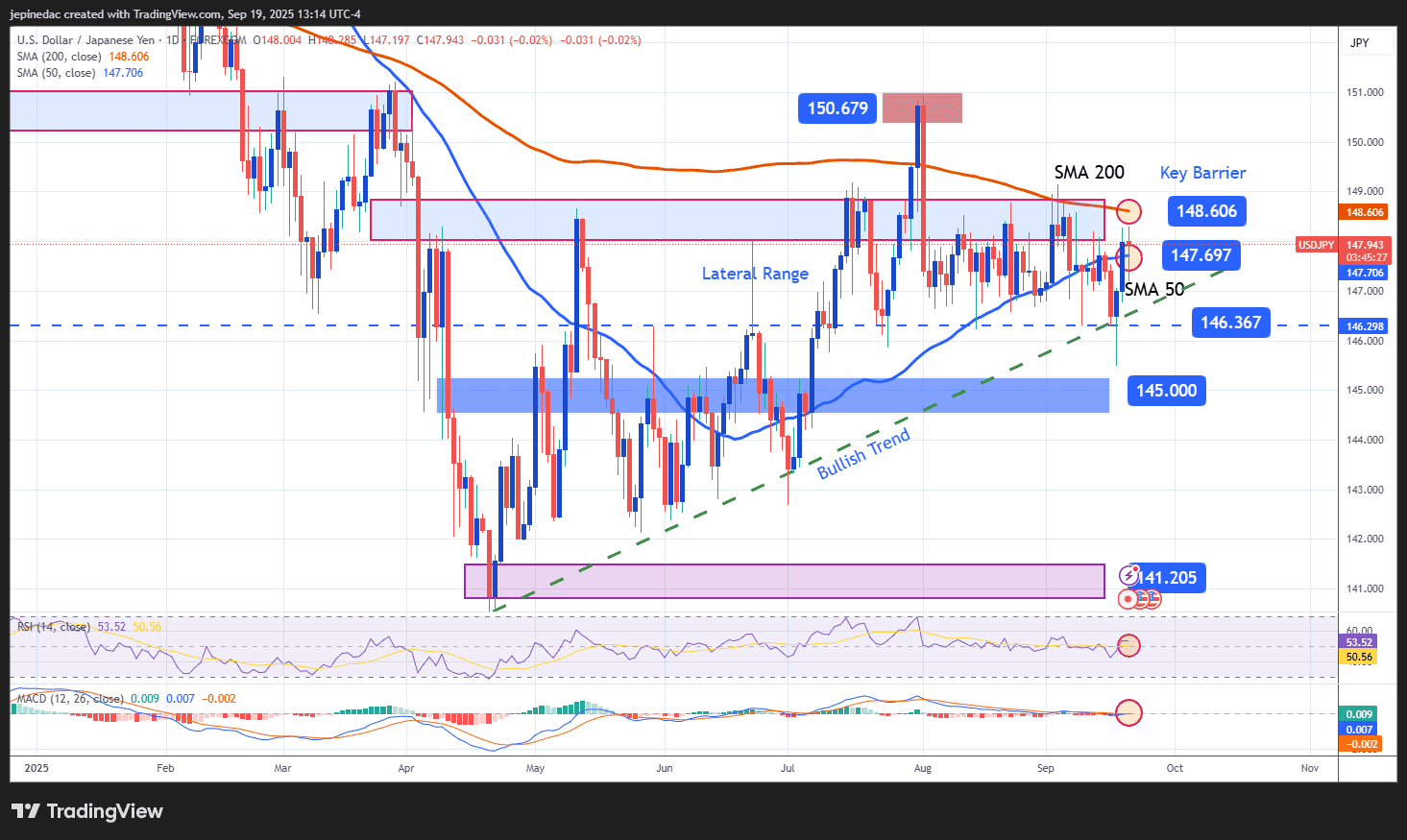
- Sideways range gains importance: Since early July, USD/JPY has remained within a lateral channel between 148.606 and 146.367. This structure has limited clear directional moves. In the coming sessions, this range will remain the key technical reference, and only a firm breakout could trigger a more decisive move.
- RSI: The RSI line shows a flat slope and oscillates near the neutral 50 level, reflecting a balance between buying and selling forces. This suggests that the neutral bias could persist in the short term.
- MACD: The MACD histogram stays very close to the zero line, indicating neutrality in short-term moving averages. As long as this continues, the market is likely to remain in a phase of indecision.
Key Levels:
- 148.606 – Main Resistance: Coincides with the 200-period simple moving average, making it the most significant barrier for buyers. A clear, sustained breakout above this level would reinforce the long-term uptrend.
- 147.697 – Nearby Barrier: Aligns with the 50-period simple moving average and acts as a neutral level. Price oscillations here would prolong the current short-term sideways channel.
- 146.367 – Final Support: Marks recent lows. A sustained drop to this area would put the current bullish structure at risk and open the door to a stronger bearish bias.
Written by Julian Pineda, CFA – Market Analyst
Follow him: @julianpineda25