

As the week approaches its close, USD/JPY is extending a four-session winning streak in favor of the U.S. dollar, posting gains of more than 1% in the short term. Buying pressure has gained relevance as the yen shows persistent weakness following the release of U.S. employment data, which has reinforced confidence in the dollar. As long as this bias remains in place, buying pressure is likely to continue dominating USD/JPY price action in the coming trading sessions.

NFP Data Fails to Support the Yen
Earlier today, the U.S. Non-Farm Payrolls (NFP) report was released. Although the headline figure came in at 50,000 jobs added in December, below the forecast of 66,000, the result was not strong enough to signal a meaningful slowdown in the labor market in the short term. On the contrary, it suggests that employment continues to show moderate growth, without pointing to a scenario that would require an aggressive response from either the government or the central bank.
This outcome has been key for market expectations, as it has begun to reshape probabilities around upcoming Federal Reserve decisions for the first quarter of 2026. According to CME Group data, there is now a probability of over 95% that interest rates will remain unchanged at the January 28 meeting. In addition, the likelihood that the Fed maintains a neutral rate stance stands at 70.9% for March and 57.7% for April. This suggests that, for now, employment is not seen as a factor that would justify near-term rate cuts.

Source: CMEGROUP
This backdrop has been particularly supportive for U.S. dollar strength, as expectations of several consecutive neutral rate decisions have increased the appeal of the U.S. fixed-income market. This, in turn, may be driving foreign capital inflows in search of stable returns, strengthening demand for the dollar. This dynamic is already visible in the DXY index, which measures the dollar’s strength against other currencies and is currently showing a clear upward slope, moving above the 99 level and approaching the psychological 100 mark—a move that intensified following the NFP release.
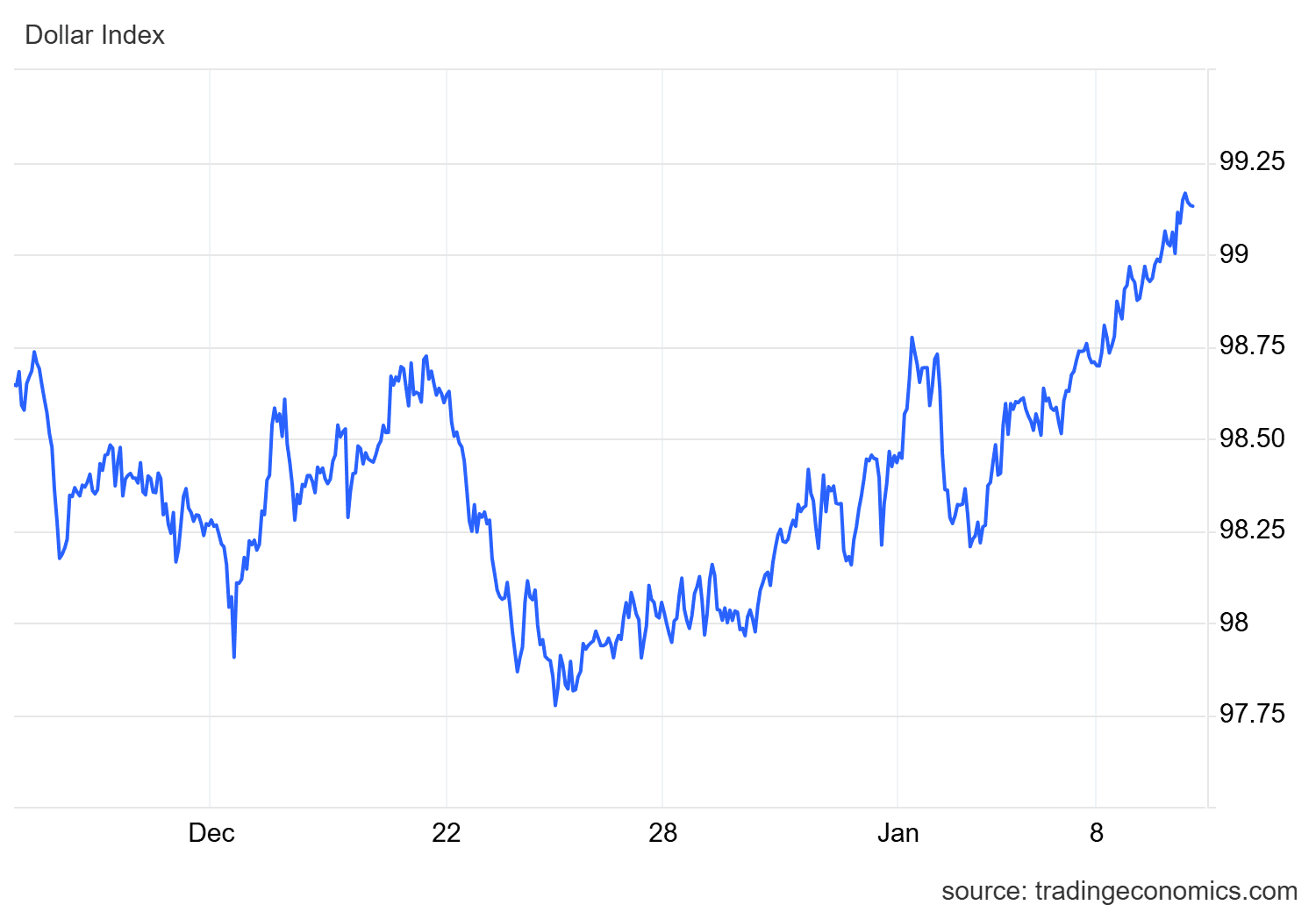
Source: TradingEconomics
Taking all of the above into account, market expectations following the employment data appear to be supporting the U.S. dollar and, as a result, pressuring the yen toward the end of the week. If this dynamic persists and fundamental catalysts continue to favor the dollar, more consistent buying pressure could develop in USD/JPY over the coming sessions.
USD/JPY Technical Outlook
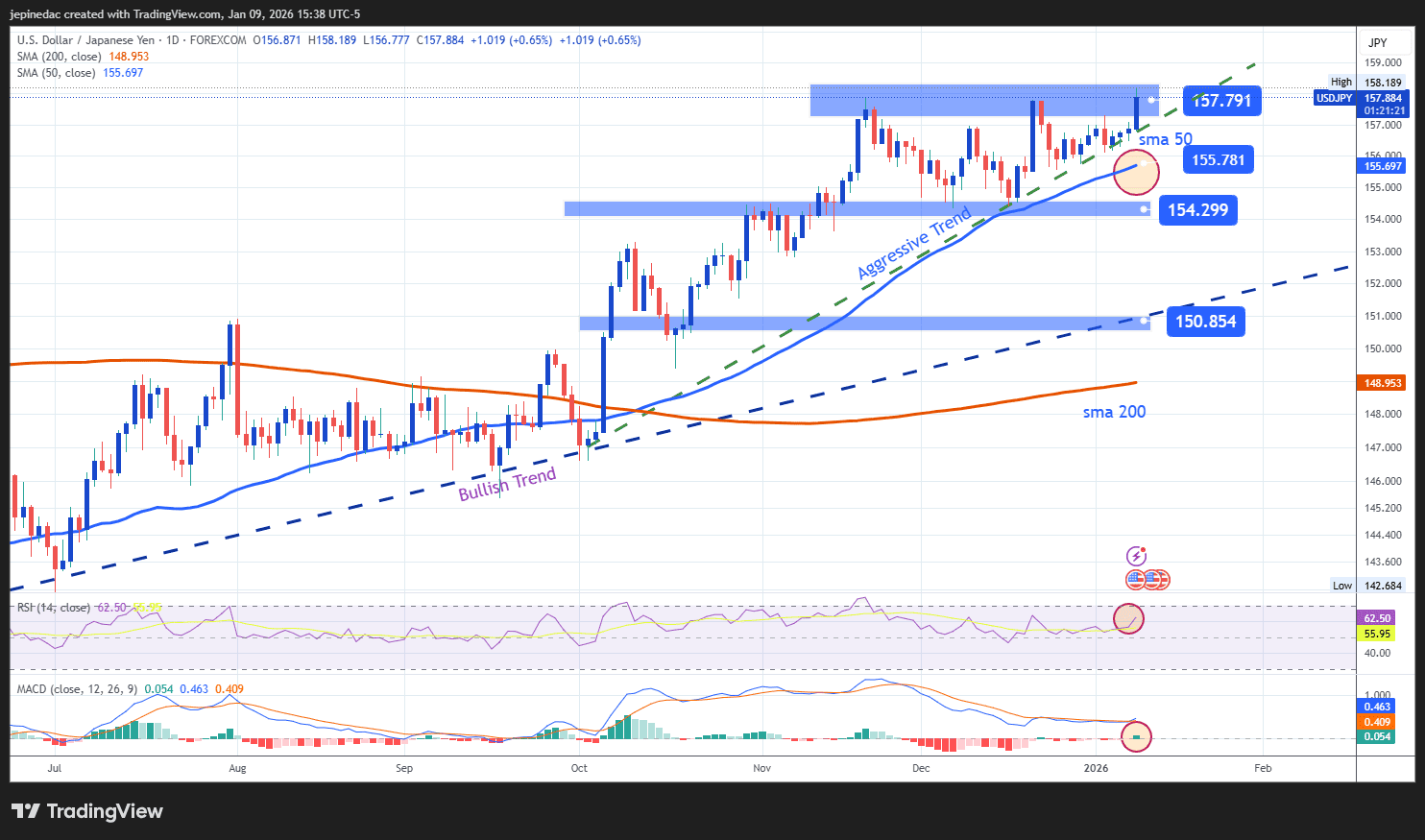
Source: StoneX, Tradingview
- The bullish trend becomes more aggressive: Since the early days of October 2025, USD/JPY has displayed dominant bullish momentum, leading to the formation of a more aggressive uptrend that has pushed price back toward the highs seen in 2025. If this strength holds, it could pave the way for an even more dominant bullish structure in the short term. That said, current resistance zones may also give rise to periods of neutral consolidation or short-term bearish corrections in the sessions ahead.
- RSI: The RSI maintains an upward trajectory above the neutral 50 level, indicating that buying momentum continues to dominate in the short term. However, as the indicator approaches the overbought zone near 70, it may begin to warn of excessive buying pressure, opening the door to potential corrective pullbacks.
- MACD: The MACD histogram continues to expand above the neutral zero line, suggesting that moving average momentum remains firmly in bullish territory. As long as this behavior persists, it could reinforce additional upside pressure in USD/JPY over the short term.
Key Levels:
- 157.791 – Key resistance: This area corresponds to the 2025 highs and stands out as the most relevant upside barrier at present. A sustained move above this level could confirm a dominant bullish bias and extend the current uptrend.
- 155.781 – Nearby barrier: A recent neutrality level aligned with the 50-period simple moving average. Pullbacks toward this zone would not threaten the prevailing uptrend but could serve as a short-term consolidation area.
- 154.299 – Major support: A level corresponding to the lows of recent weeks. Selling pressure that pushes price toward this area could put the current bullish structure at risk and open the door to a more relevant bearish bias in the weeks ahead.
Written by Julian Pineda, CFA, CMT – Market Analyst
Follow him on: @julianpineda25