



USD/JPY Update: Yen tries to recover after Fed decision
Near the end of the session, the Japanese yen has started to show a slight recovery against the U.S. dollar. This movement is reflected in USD/JPY, which is down nearly -0.3% during the session.
Share this:

Near the end of the session, the Japanese yen has started to show a slight recovery against the U.S. dollar. This movement is reflected in USD/JPY, which is down nearly -0.3% during the session.
For now, selling pressure on the pair remains in place after the comments following the Fed decision did not confirm new rate hikes for the coming months. However, in the broader daily chart outlook, a relevant phase of indecision still stands out and could remain important over the next few trading sessions.


Fed decision arrives
During the session, the Federal Reserve decided to keep interest rates unchanged in the 3.50% - 3.75% range. In the statement after the decision, the central bank noted that the economy continues to grow at a solid pace and that the labor market still shows signs of strength. However, it also highlighted that inflation remains above the 2.00% target, partly due to shocks from current geopolitical pressures.
In the comments after the decision, Federal Reserve Chair Kevin Warsh emphasized the importance of reaching the 2.00% inflation target. He also explained the reduction in forward guidance, noting that he does not want the market to react to potential signals from the central bank, but rather to the actual economic data that is published.
This message suggests that, in some scenarios, markets may be overreacting to Fed comments. Warsh also mentioned that it is appropriate for the central bank to act, but he did not provide clear signals of a possible rate hike in September or reinforce the idea of a more aggressive monetary policy stance in the short term.
This has partially reduced expectations of a more restrictive Fed for the upcoming meetings. In fact, the CME Group probability table still shows a probability slightly above 50% of a 0.25% rate hike at the September 16 decision. However, after today’s comments, the probability of keeping rates unchanged increased to more than 46%, compared with 24% in the previous session.
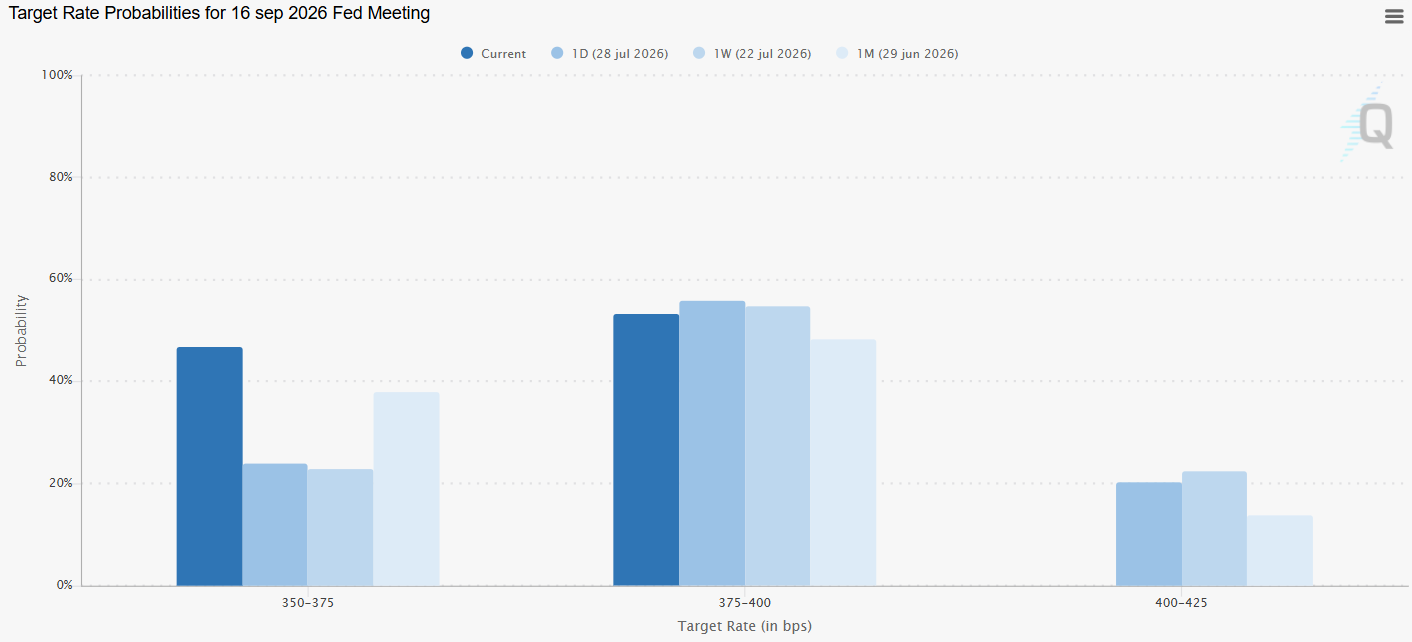
Source: CMEGROUP
This dynamic is relevant because lower expectations of interest rate increases can reduce the appeal of U.S. dollar-denominated investments. This, in turn, can weaken demand for the dollar in the short term.
This behavior has already started to be reflected in the DXY index, which measures the strength of the U.S. dollar against its main peers. After the central bank decision, the index showed a new bearish move, moving away from 2026 highs and approaching the psychological 100-point level again. This suggests that demand for the dollar has started to lose strength in the short term.
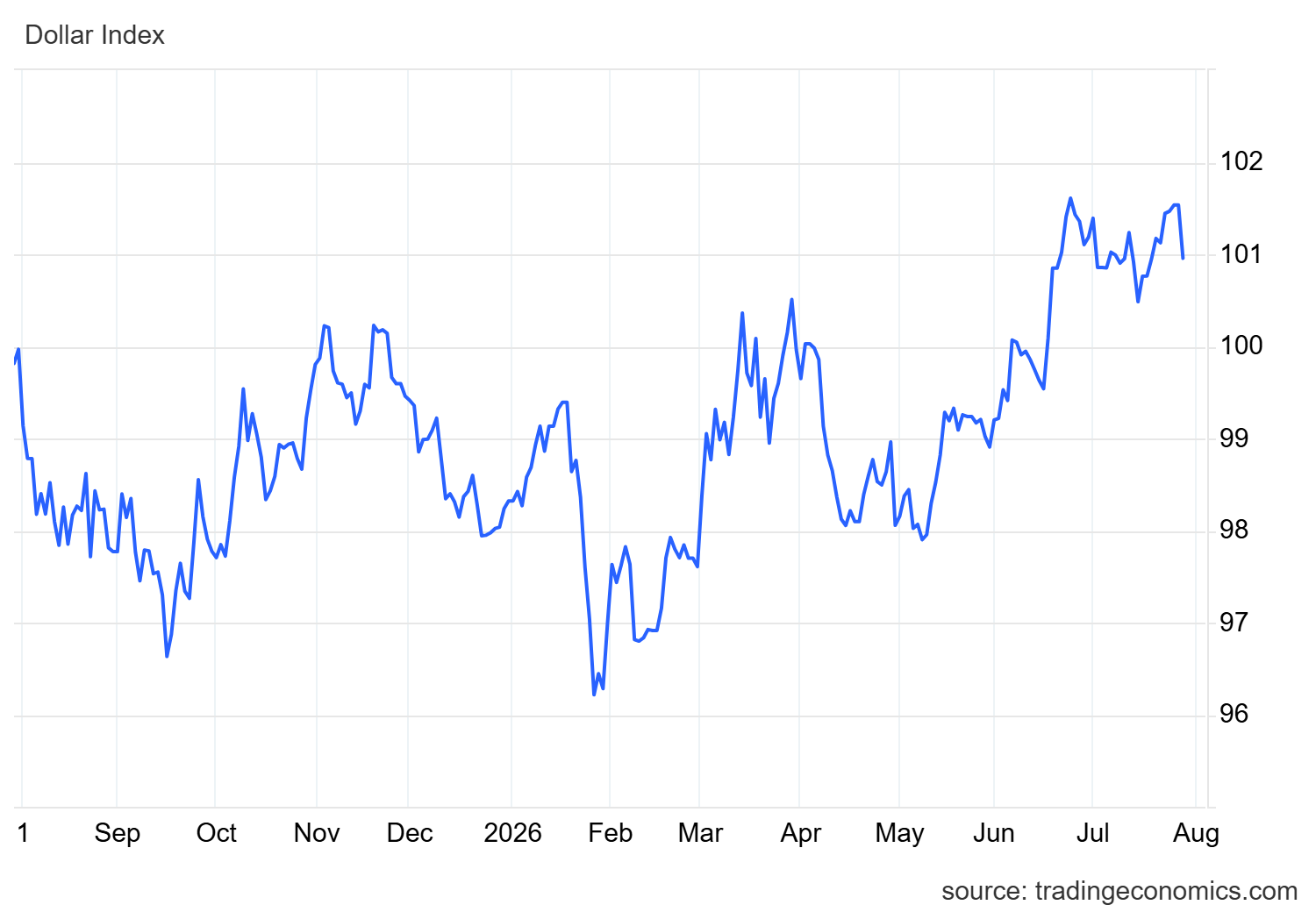
Source: TradingEconomics
However, when looking at the situation in Japan, the outlook does not change completely. The Japanese economy still maintains one of the lowest rates among major central banks, near 1.00%. In addition, although the Japanese central bank decision is also expected this week, forecasts point to a possible scenario of unchanged rates.
For this reason, even though the U.S. dollar is showing some loss of strength, the rate differential still favors dollar-denominated investments over yen-denominated investments. This means that the recent weakness in the dollar does not necessarily clear the way for a strong recovery in the yen.
Instead, this scenario could reinforce a phase of indecision in USD/JPY, which could be key over the next few trading sessions.
Technical forecast for USD/JPY
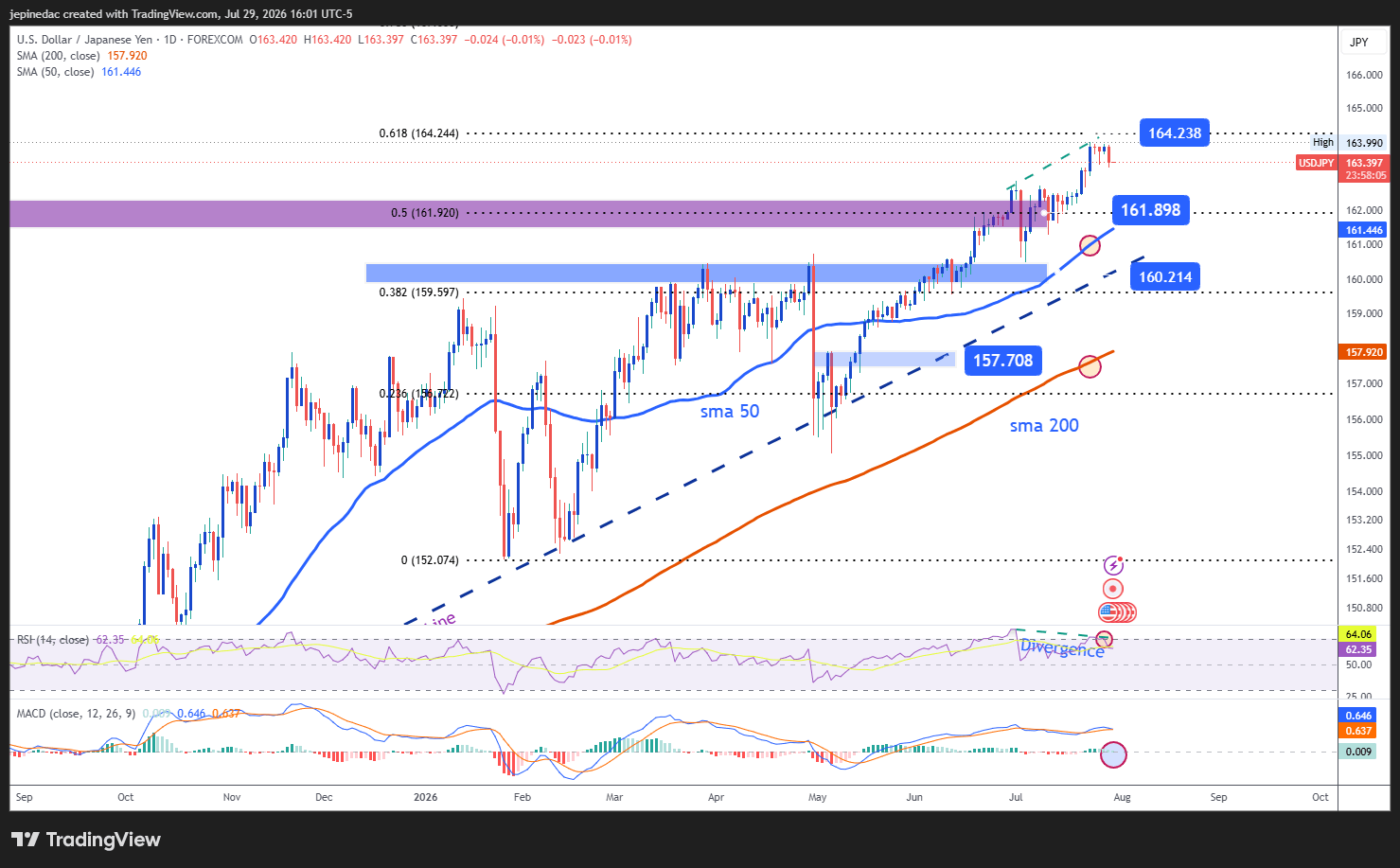
Source: StoneX, Tradingview
- The bullish trend remains relevant: Despite the yen’s recovery attempts during the session, the daily USD/JPY chart still maintains a long-term bullish trend line. This structure remains the most important technical pattern to watch. As long as a more dominant selling bias does not appear, the bullish trend could continue to be the main structure over the coming trading weeks.
- RSI: The RSI remains above the neutral 50 level, reflecting dominance of buying impulses in the short term. However, the indicator has started to mark lower highs, while USD/JPY price registers higher highs. This dynamic has formed a possible bearish divergence, which could warn of excessive recent buying strength and open room for eventual short-term corrections.
- MACD: The MACD shows a histogram increasingly close to the neutral 0 area. This suggests that the strength of short-term moving averages is beginning to balance out. For this reason, the indicator could also be anticipating a phase of greater neutrality on the chart over the next few sessions.
Key levels:
- 164.238 – Key resistance: Given the lack of relevant references from previous years, this level coincides with the 61.8% area of a trend-based Fibonacci extension. If price manages to approach this zone again, it could reinforce the buying bias and maintain the bullish trend line as the dominant structure over the coming weeks.
- 161.898 – Near-term barrier: This area works as an important technical reference, as it coincides with highs recorded in previous weeks. It could also act as a tentative barrier in the event of possible short-term corrections.
- 160.214 – Main support: This area remains the most relevant support on the chart. In addition to coinciding with recent pullbacks and acting as a psychological market level, it also aligns with the base of the major bullish trend line. Moves toward this level could put the bullish structure at risk and open room for a more relevant selling bias over the coming trading weeks.
Written by Julian Pineda, CFA, CMT – Market Analyst
Follow him on: @julianpineda25
Related tags:



Open an account today
Experience award-winning platforms with fast and secure execution.
Economic calendar
Web Trader platform
Our sophisticated web-based platform is packed with features.
Related articles

Gold Outlook: Can XAU/USD Sustain Its Recent Rebound?
The trading week is coming to an end, and gold continues to exhibit a lack of clear direction in the short term. Although the precious metal spent most of the week under pressure, it managed to recover more than 2.3% heading into the close, reclaiming part of its recent losses. Even so, the rebound remains insufficient to sustain consistent moves above the $3,700 per ounce level.

EUR/USD Recovers as Markets Fully Price in Fed Hike
EUR/USD outlook turns on Fed pricing, as the euro recovers while strong U.S. data fails to lift a dollar that has already priced in Fed tightening.

How FX Majors Stack Up Against US Dollar Weakness in December
December has historically favoured a weaker US dollar. We compare the seasonal performance and timing of the major currency pairs.

From time to time, StoneX Financial Pty Ltd (“we”, “our”) website may contain links to other sites and/or resources provided by third parties. These links and/or resources are provided for your information only and we have no control over the contents of those materials, and in no way endorse their content. Any analysis, opinion, commentary or research-based material on our website is for information and educational purposes only and is not, in any circumstances, intended to be an offer, recommendation or solicitation to buy or sell. You should always seek independent advice as to your suitability to speculate in any related markets and your ability to assume the associated risks, if you are at all unsure. No representation or warranty is made, express or implied, that the materials on our website are complete or accurate. We are not under any obligation to update any such material.
As such, we (and/or our associated companies) will not be responsible or liable for any loss or damage incurred by you or any third party arising out of, or in connection with, any use of the information on our website (other than with regards to any duty or liability that we are unable to limit or exclude by law or under the applicable regulatory system) and any such liability is hereby expressly disclaimed.