

- What are stocks
- Why companies offer shares
- How the stock market works
- Why trade stocks?
- Popular stocks
- How to start trading stocks
What are stocks?
Stocks are units that make up the ownership of a business. If you own a stock, you technically own a part of the company. This means that if the company increases in value, your stocks increase in value too.
For example, if Company XYZ splits its ownership into 500 million stock units and you own 500 stocks, then you have a 0.0001% stake in the business.
The value of a listed company is shown in its stock price. This tells you how much you’d need to pay to buy a single stock in the business today. If you multiply a stock’s price by the number of stocks it has divided its ownership into, you calculate its total value: known as its market capitalisation (or market cap for short).
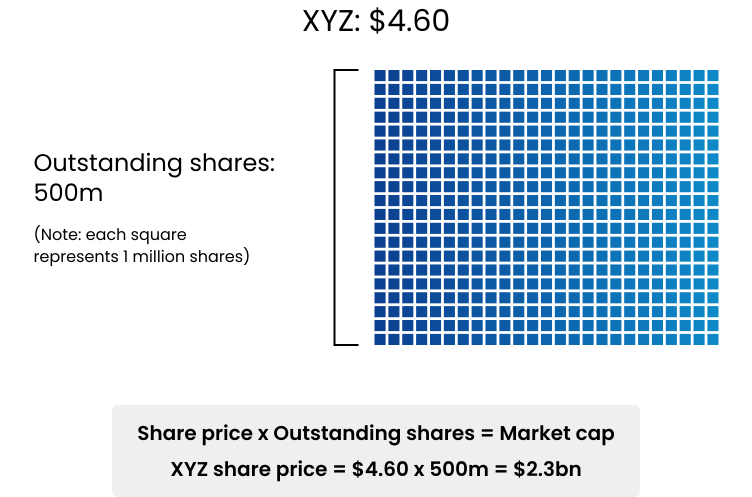
Let’s say that Company XYZ has a stock price of $4.60. It has 500 million outstanding stocks, giving it a market cap of $2.3 billion ($4.60 x 500,000,000).
Why companies offer stocks
You may wonder why a company would want to give away part of its ownership. Generally speaking, it is so that they can raise capital.
Companies need capital to grow. Now, offering stocks isn’t the only way of raising capital. They could, for example, borrow cash from a bank or by offering corporate bonds. Or, they could sell a large stake in the business to one or more investors.
But both of these methods come with drawbacks:
- Loans need to be paid back and incur interest that eats into your bottom line
- Selling a large chunk of your ownership at once increases the risk that someone else could end up controlling your company
By breaking down their ownership into lots of tiny shares, companies can raise a huge amount of capital that they never have to pay back – and keep control of their business in the process.
However, listing stocks comes with drawbacks too, so lots of companies choose to remain private. Household names like Mars, Bloomberg and IKEA are all privately owned.
How the stock market works
We’ve covered what stocks are and why companies offer them, but how does the buying and selling of stocks work? You invest in stock via the stock market – a network of exchanges around the world that are home to some of the world’s biggest businesses.
Let’s examine three key aspects of stock markets: exchanges, IPOs and brokers. For an in-depth look, head to our guide on how the stock market works.
Stock exchanges
Stock exchanges are where shares are bought and sold, and where companies are listed. Notable examples include the New York Stock Exchange (NYSE), NASDAQ, London Stock Exchange (LSE) and Frankfurt Stock Exchange (FSE).
Companies tend to have a primary listing on a single exchange. Apple, for example, is listed on the NASDAQ. Volkswagen, on the other hand, is listed on the Frankfurt Stock Exchange. Sometimes, a stock will also have a secondary listing on another exchange – such as Unilever, which is present on both the LSE and the Euronext Amsterdam exchange.
IPOs
The process to list on an exchange is called an initial public offering (IPO).
IPOs can be a long, arduous process for a company, as many exchanges have strict rules for which businesses can join them. Once the firm is ready to list, stocks will be offered to investors ahead of its first day of trading. Then, traders get to find how much the markets think a new stock is worth.
Stockbrokers
Exchanges aren’t just strict about who can list on them; they also have rules about who can trade on their order books. Because of this, most retail investors will buy and sell stocks using a stockbroker.
Stockbrokers execute orders on your behalf. There are several different types, depending on how much control you want over your investments. Discretionary brokers, for instance, choose your stocks for you. Execution-only brokers, on the other hand, will only act under your specific instructions.
You don’t have to trade via a stockbroker. With derivatives like CFDs, you never own the stocks you're trading, so you don’t need a broker. We’ll cover them in more detail on the how to trade share CFDs page.
Why are stocks popular?
In most cases, investors choose to buy stocks because they believe a company’s value will go up.
For instance, if you think that Company XYZ has a superior business model, a unique product or an advantage over its competition, you might want to buy stocks in it. Then, if the business starts to make money, its value will rise – which means its stock price will rise too.
When its stock price has risen, you can sell your stock and collect the difference as profit.
That’s not the only way to earn from stocks, though. You might also be eligible for a dividend: a portion of a company’s profits that they pay back to investors. Not every stock pays a dividend, but high-dividend stocks are highly prized for the regular return they generate.
You can also trade stocks using CFDs which allows you to benefit from falling prices as well as rising prices.
What are the most popular stocks and top companies?
The most popular stocks differ around the world and a number of US stocks are widely traded in many countries.
Top 5 Stocks traded in Australia in 2021 (by volume) |
|---|
| Boeing |
| Wells Fargo |
| AMD |
| Market Vectors Oil Service ETF |
| Energy Select SPDR |
In Australia Boeing, Wells Fargo and Advanced Micro Devices were among the most-traded stocks in 2021 by volume, while in the US, Amazon, Apple and Tesla have been hugely popular in recent years.
There can be many reasons why certain stocks are more popular than others. The proactive nature of their business, the frequency of dividend payments and specific market and macroeconomic events can all play a part.
To see our analyst’s insight on some of the most popular stocks, read our market commentary.
Types of stocks
In this guide, we’ve mostly stuck to standard stocks. There are, however, a few other types you might hear about. These can include:
- Preference shares. Also known as preferred stock, these come with special dividend rights that ordinary shareholders don’t access
- Share options. Instead of giving you stocks directly, these give you the right to buy stock at a fixed price – up until the option expires
- Advisory shares. Stock that is given to company advisors, usually instead of giving them cash
- Bearer shares. This type of stock isn’t registered to any person or business. Whoever holds the stock certificate owns the stocks
- Class A shares. Some companies split their stock into Class A and Class B stocks. Class A typically have more voting rights, but aren’t sold to the public
- Fractional shares. Portions of one stock, typically created by a stock split
How do you start share CFD trading?
You can start share CFD trading today by opening a FOREX.com CFD trading account. Or if you want to test out trading risk free, you can start out with a demo.
Either option gives you access to 1000s of share CFDs in the US, UK, Europe and beyond. The only difference is that you add your own funds to a live account, so you’ll collect any profits and pay any losses.
With a demo, the funds are virtual – so you can’t make or lose any money.
For a step-by-step guide to open your first position, take a look at our how to trade share CFDs.
Trade with confidence

Go to our Trading Academy
