




Core PCE Previewing the planets new most important economic release
There may be upside risks to this week’s core PCE report as higher prices start to become psychologically entrenched...
Share this:

You can’t get through the front page of any business newspaper without reading about the risks of rising inflation, and that trend has only become more dramatic since last week’s hawkish surprise from the Federal Reserve. With the central bank essentially telegraphing that it’s looking to announce a plan for tapering asset purchases in the next couple of months, the market is laser-focused on the Fed’s preferred inflation measure: Core Personal Consumption Expenditures (PCE).
According to the Bureau of Economic Analysis, “the core PCE price index measures the prices paid by consumers for goods and services without the volatility caused by movements in food and energy prices to reveal underlying inflation trends.” Unlike the more widely-followed consumer price index (CPI) of inflation, core PCE measures price changes for all households and nonprofit institutions serving households, not just urban households, making a broader measure for the country as a whole.
Last month’s core PCE report came in at 0.7% m/m and 3.1% y/y, marking the highest year-over-year rate in nearly 30 years. For Friday’s release, traders and economists are expecting a 0.6% m/m rise, which would raise the y/y inflation rate to 3.4%.
While most economists and the majority of the Federal Reserve still believe any increases in inflation will be transitory, that argument will become more tenuous if hotter-than-expected inflation readings continue to pile up. Notably, this month’s University of Michigan Consumer Sentiment survey showed that consumers expect prices to rise 4.6% over the next year and 3.0% on average over the next five years, suggesting that there may be upside risks to this week’s core PCE report as higher prices start to become psychologically entrenched.
Technical view: EUR/USD
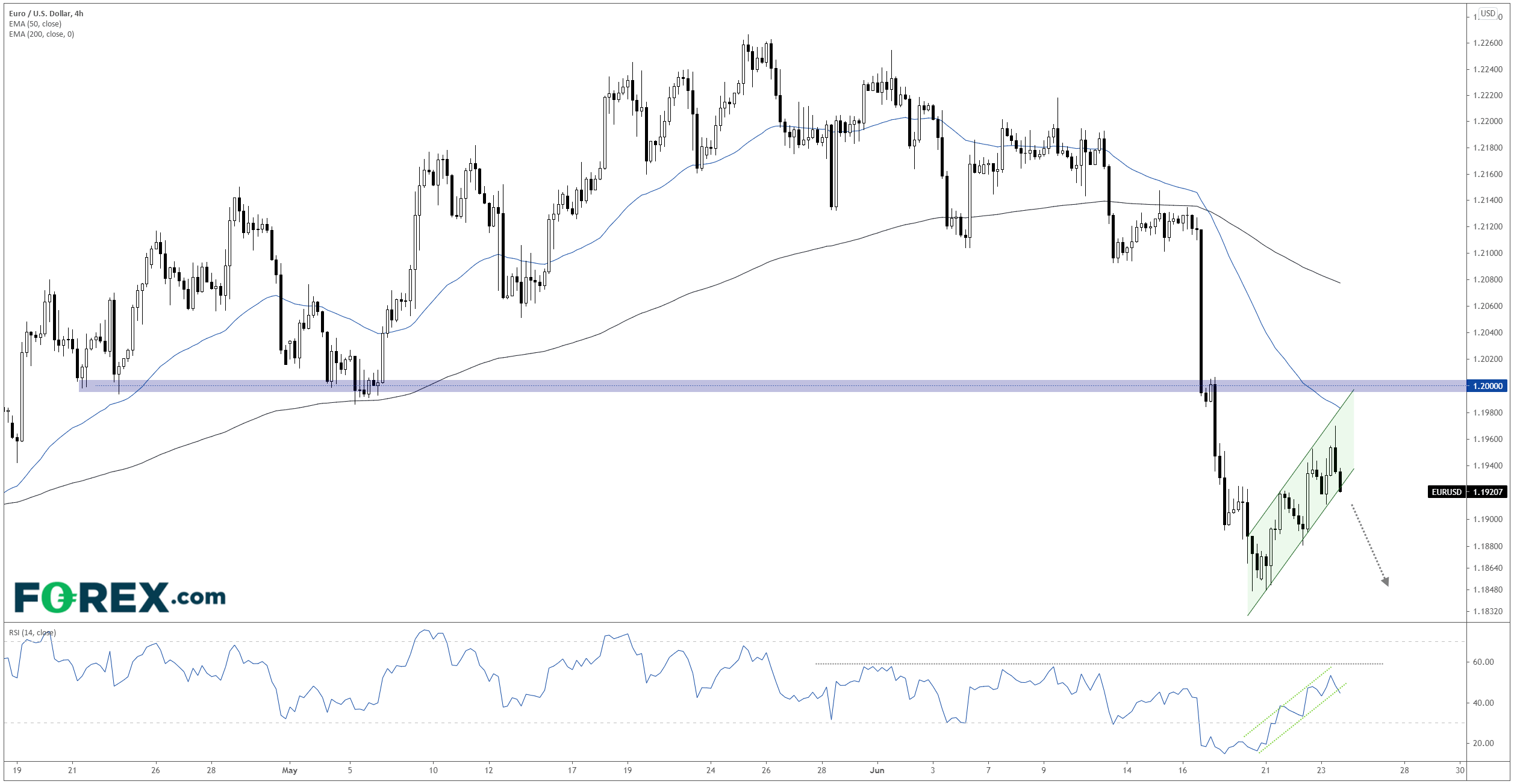
With investors betting on a widening policy divergence between the Fed and the European Central Bank, EUR/USD will be a pair worth watching closely around the core PCE report release. The world’s most widely-traded currency pair is trading higher on the week after dropping to a two-month low last week, but the recovery looks more like a counter-trend correction than a sustainable trend change at this point.
As long as prices remain below previous-support-turned-resistance in the 1.20 zone and the 4-hour RSI indicator remains in bearish territory (below 60), readers can view the current pattern as a bearish flag pattern, signaling a likely resumption of the recent downtrend with potential for a drop back to 1.1850 or 1.1800 in the coming days.
Source: StoneX, TradingView
How to trade with City Index
Follow these easy steps to start trading with City Index today:
- Open a City Index account, or log-in if you’re already a customer.
- Search for the market you want to trade in our award-winning platform.
- Choose your position and size, and your stop and limit levels.
- Place the trade.
You can’t get through the front page of any business newspaper without reading about the risks of rising inflation, and that trend has only become more dramatic since last week’s hawkish surprise from the Federal Reserve. With the central bank essentially telegraphing that it’s looking to announce a plan for tapering asset purchases in the next couple of months, the market is laser-focused on the Fed’s preferred inflation measure: Core Personal Consumption Expenditures (PCE).
According to the Bureau of Economic Analysis, “the core PCE price index measures the prices paid by consumers for goods and services without the volatility caused by movements in food and energy prices to reveal underlying inflation trends.” Unlike the more widely-followed consumer price index (CPI) of inflation, core PCE measures price changes for all households and nonprofit institutions serving households, not just urban households, making a broader measure for the country as a whole.
Last month’s core PCE report came in at 0.7% m/m and 3.1% y/y, marking the highest year-over-year rate in nearly 30 years. For Friday’s release, traders and economists are expecting a 0.6% m/m rise, which would raise the y/y inflation rate to 3.4%.
While most economists and the majority of the Federal Reserve still believe any increases in inflation will be transitory, that argument will become more tenuous if hotter-than-expected inflation readings continue to pile up. Notably, this month’s University of Michigan Consumer Sentiment survey showed that consumers expect prices to rise 4.6% over the next year and 3.0% on average over the next five years, suggesting that there may be upside risks to this week’s core PCE report as higher prices start to become psychologically entrenched.
Technical view: EUR/USD
With investors betting on a widening policy divergence between the Fed and the European Central Bank, EUR/USD will be a pair worth watching closely around the core PCE report release. The world’s most widely-traded currency pair is trading higher on the week after dropping to a two-month low last week, but the recovery looks more like a counter-trend correction than a sustainable trend change at this point.
As long as prices remain below previous-support-turned-resistance in the 1.20 zone and the 4-hour RSI indicator remains in bearish territory (below 60), readers can view the current pattern as a bearish flag pattern, signaling a likely resumption of the recent downtrend with potential for a drop back to 1.1850 or 1.1800 in the coming days.
Source: StoneX, TradingView
How to trade with FOREX.com
Follow these easy steps to start trading with FOREX.com today:
- Open a Forex.com account, or log-in if you’re already a customer.
- Search for the pair you want to trade in our award-winning platform.
- Choose your position and size, and your stop and limit levels.
- Place the trade.
Related tags:

Open an account in minutes
Experience award-winning platforms with fast and secure execution, and enjoy tight spreads from 0.5 pts on FX and 0.3 pts on indices.
Economic calendar
Web Trader platform
Our sophisticated web-based platform is packed with features.
Related articles

USD/JPY outlook: Hawkish Fed recalibration pressures the yen
Stronger US growth momentum and rising Treasury yields are keeping USD/JPY pointed higher, even as Japanese policymakers try to limit the pressure building across domestic markets.


Gold, silver slammed as hawkish Fed repricing reignites dollar upside
Gold and silver had held up surprisingly well against surging US yields. Wednesday’s DXY breakout may have changed that equation.

AUD/USD Crushed Ahead of Jobs Report as US Dollar, Yields Surge
AUD/USD slumps towards 70c as surging US yields and a stronger dollar overshadow Australian jobs data and the RBA outlook.
This report is intended for general circulation only. It should not be construed as a recommendation, or an offer (or solicitation of an offer) to buy or sell any financial products. The information provided does not take into account your specific investment objectives, financial situation or particular needs. Before you act on any recommendation that may be contained in this report, independent advice ought to be sought from a financial adviser regarding the suitability of the investment product, taking into account your specific investment objectives, financial situation or particular needs.
StoneX Financial Pte. Ltd., may distribute reports produced by its respective foreign entities or affiliates within the StoneX group of companies or third parties pursuant to an arrangement under Regulation 32C of the Financial Advisers Regulations. Where the report is distributed to a person in Singapore who is not an accredited investor, expert investor or an institutional investor (as defined in the Securities Futures Act), StoneX Financial Pte. Ltd. accepts legal responsibility to such persons for the contents of the report only to the extent required by law. Singapore recipients should contact StoneX Financial Pte. Ltd. at 6826 9988 for matters arising from, or in connection with the report.
In the case of all other recipients of this report, to the extent permitted by applicable laws and regulations neither StoneX Financial Pte. Ltd. nor its associated companies will be responsible or liable for any loss or damage incurred arising out of, or in connection with, any use of the information contained in this report and all such liability is hereby expressly disclaimed. No representation or warranty is made, express or implied, that the content of this report is complete or accurate.
StoneX Financial Pte. Ltd. is not under any obligation to update this report.
Trading CFDs carries a high level of risk that may not be suitable for some investors. Consider your investment objectives, level of experience, financial resources, risk appetite and other relevant circumstances carefully. The possibility exists that you could lose some or all of your investments, including your initial deposits. If in doubt, please seek independent expert advice. Visit www.forex.com/en-sg/terms-and-policies for the complete Risk Disclosure Statement.