




Currency Pair of the Week DXY
There is a lot to look forward to in the US this week which could affect the US Dollar
Share this:

As we have mentioned before, the US Dollar index isn’t necessarily a currency pair, however it is important to look at in order to determine the overall direction of the US Dollar and its currency counterparts.
There is a lot to look forward to in the US this week which could affect the US Dollar, including the first US Presidential Debate between current Republican President Donald Trump and Democratic Nominee Joe Biden on Tuesday. This will give each candidate the opportunity to address their views on some of the most pressing issues facing the US today. The topics for discussion include the following:
- The Trump and Biden records
- The Supreme Court
- COVID-19
- The economy
- Race and violence in our cities
- The integrity of the election
In addition, there has been some murmurings of potential talks between Treasury Secretary Mnuchin and Democratic House Leader Nancy Pelosi regarding a potential fiscal stimulus bill. The two parties still seem far apart on the amount of the package, with Democrats looking for a package near $2.2 trillion (down from $3.4 trillion), while Donald Trump has said he will sign a bill up to $1.3 trillion and Senate Republicans have said they will only pass a bill worth $1 trillion. Regardless, both sides have said they will continue talk this week in good faith with hopes that a deal can be reached before the election on November 3rd.
With the passing of Supreme Court Justice Ruth Bader Ginsburg on September 18th, this leaves the Supreme Justice with 8 Justices. President Trump is eager to for his nominee, Amy Coney Barrett, to be confirmed by the Senate before the election, in order to bring the number on the Supreme Court back to 9. Discussions will begin this week, however, recall that in 2016 President Obama had nominated Merrick Garland to replace Justice Scalia, only to have the proceedings pushed back by the Republican controlled Senate until after the election. This time, the Republican controlled Senate is eager to push through Barrett before the election. As we know, things are “different” this year, with mail-in voting for elections in many states. It could take days or weeks until we know the outcome of the election, and if the results are contested, it may end up at the Supreme Court. Having 9 members guarantees a decision.
Also, there is a plethora of US economic data this week, culminating with Non-Farm payrolls on Friday. Expectations are for 850,000 new jobs created vs 1,371,000 in August. Expectations for the unemployment rate are for 8.2% vs 8.4% last. Does this mean that the economy is beginning to slow after the burst of activity in the early summer? Data has shown that manufacturing has continued to pick up, however activity in the service sector has been declining. If job creation continues to slow, this could weigh on the markets.
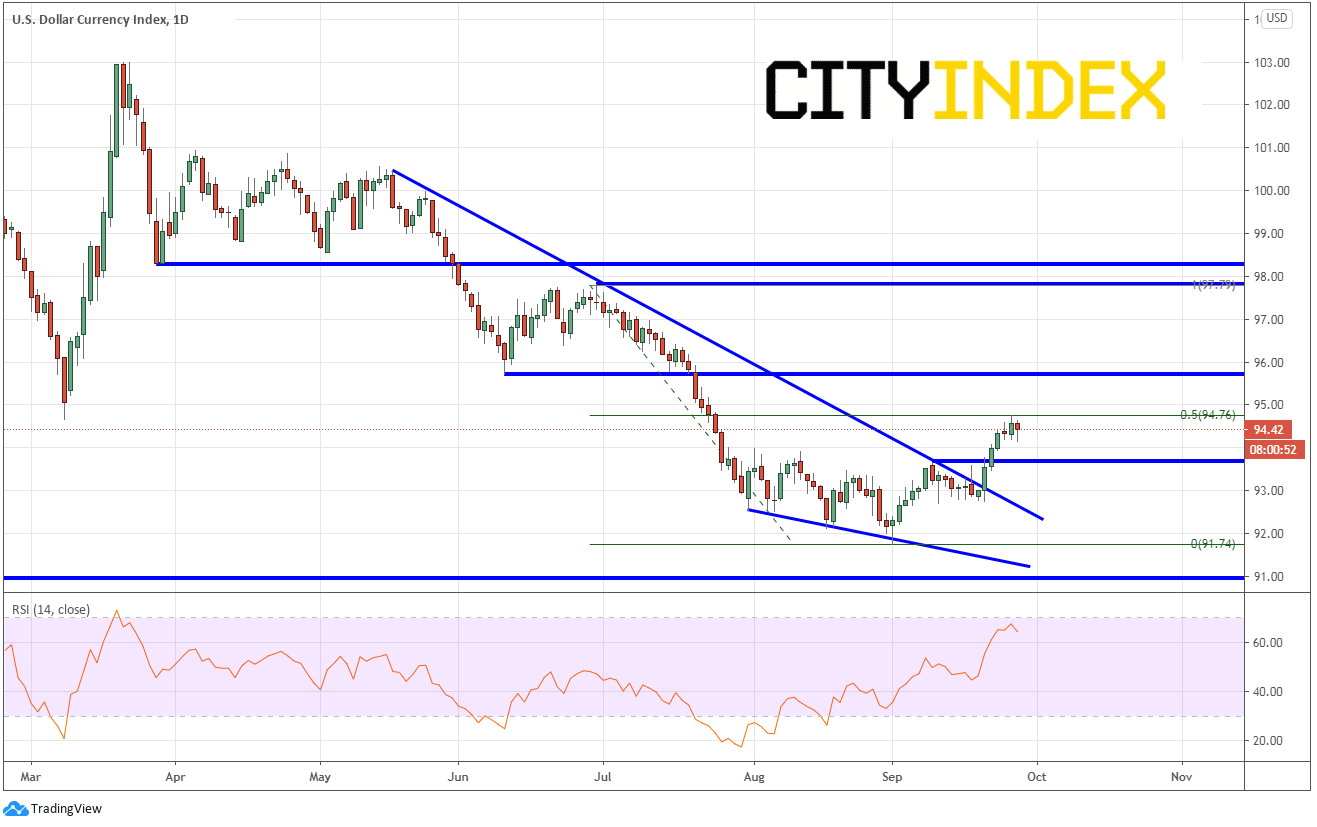
With all the US activity this week, there is potential for volatility in the DXY. As noted in the Week Ahead, last week the US Dollar Index broke out of a descending wedge dating back to May. Upon the breakout, DXY retraced 50% of the move from the highs on June 30th to the lows of September 1st. However, it stalled there on Monday and could pull back to horizontal support near the September 9th 93.66. The next support level below there is the downward sloping trendline of the descending triangle near 92.50/92.60. First resistance is last Friday’s highs near 94.75. Above there is horizontal resistance near 95.72.
Source: Tradingview, City Index
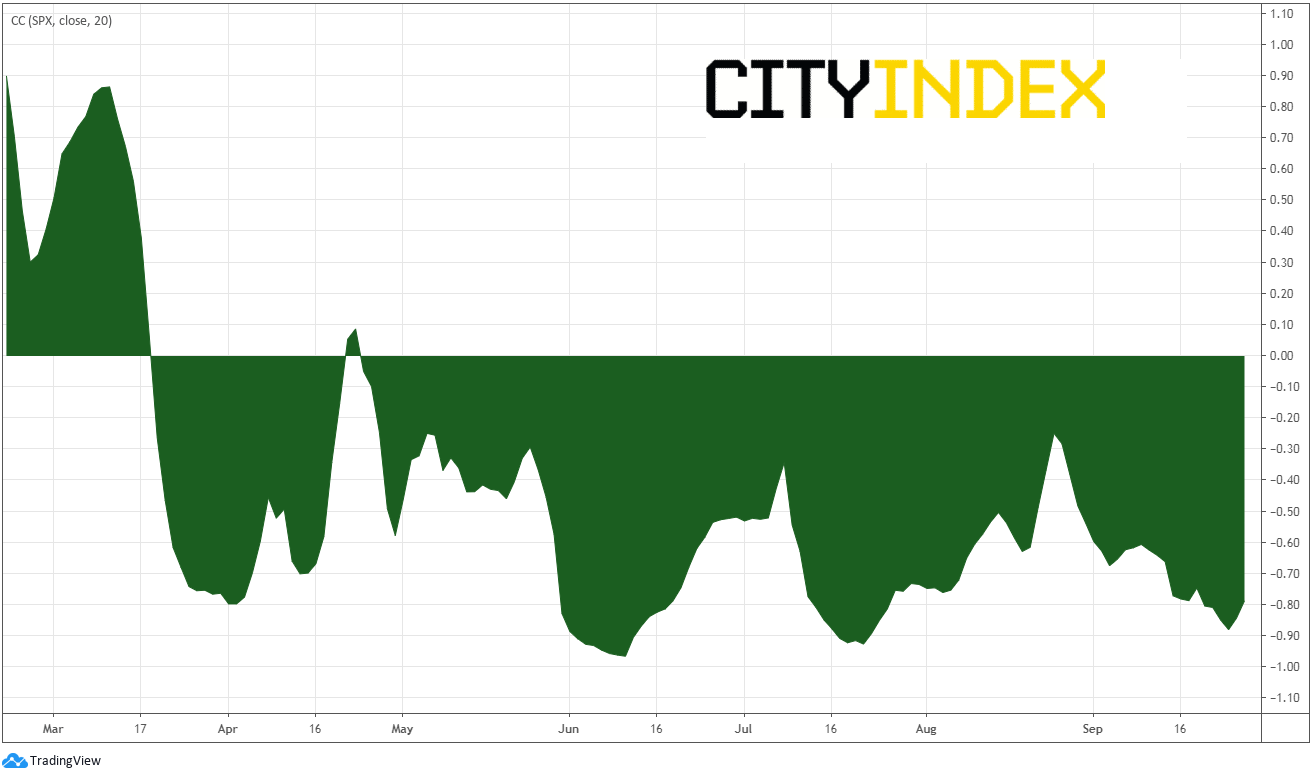
There is one more chart that is important to help determine direction for DXY: the correlation coefficient of DXY and the SPX. Notice how, except for a brief few days in April, the correlation has been negative since the market volatility near the beginning of the coronavirus in March. More importantly, the current correlation coefficient is -.79, just off its lows last week at -.87. A negative correlation coefficient means that the 2 assets move in opposite directions. The closer the negative correlation is to -1.00, the more the 2 assets tend to move in the opposite direction. Watching this correlation coefficient is another tool traders can use to help determine the possible direction of the DXY.
Source: Tradingview, City Index
As we have mentioned before, the US Dollar index isn’t necessarily a currency pair, however it is important to look at in order to determine the overall direction of the US Dollar and its currency counterparts.
There is a lot to look forward to in the US this week which could affect the US Dollar, including the first US Presidential Debate between current Republican President Donald Trump and Democratic Nominee Joe Biden on Tuesday. This will give each candidate the opportunity to address their views on some of the most pressing issues facing the US today. The topics for discussion include the following:
- The Trump and Biden records
- The Supreme Court
- COVID-19
- The economy
- Race and violence in our cities
- The integrity of the election
In addition, there has been some murmurings of potential talks between Treasury Secretary Mnuchin and Democratic House Leader Nancy Pelosi regarding a potential fiscal stimulus bill. The two parties still seem far apart on the amount of the package, with Democrats looking for a package near $2.2 trillion (down from $3.4 trillion), while Donald Trump has said he will sign a bill up to $1.3 trillion and Senate Republicans have said they will only pass a bill worth $1 trillion. Regardless, both sides have said they will continue talk this week in good faith with hopes that a deal can be reached before the election on November 3rd.
With the passing of Supreme Court Justice Ruth Bader Ginsburg on September 18th, this leaves the Supreme Justice with 8 Justices. President Trump is eager to for his nominee, Amy Coney Barrett, to be confirmed by the Senate before the election, in order to bring the number on the Supreme Court back to 9. Discussions will begin this week, however, recall that in 2016 President Obama had nominated Merrick Garland to replace Justice Scalia, only to have the proceedings pushed back by the Republican controlled Senate until after the election. This time, the Republican controlled Senate is eager to push through Barrett before the election. As we know, things are “different” this year, with mail-in voting for elections in many states. It could take days or weeks until we know the outcome of the election, and if the results are contested, it may end up at the Supreme Court. Having 9 members guarantees a decision.
Also, there is a plethora of US economic data this week, culminating with Non-Farm payrolls on Friday. Expectations are for 850,000 new jobs created vs 1,371,000 in August. Expectations for the unemployment rate are for 8.2% vs 8.4% last. Does this mean that the economy is beginning to slow after the burst of activity in the early summer? Data has shown that manufacturing has continued to pick up, however activity in the service sector has been declining. If job creation continues to slow, this could weigh on the markets.
With all the US activity this week, there is potential for volatility in the DXY. As noted in the Week Ahead, last week the US Dollar Index broke out of a descending wedge dating back to May. Upon the breakout, DXY retraced 50% of the move from the highs on June 30th to the lows of September 1st. However, it stalled there on Monday and could pull back to horizontal support near the September 9th 93.66. The next support level below there is the downward sloping trendline of the descending triangle near 92.50/92.60. First resistance is last Friday’s highs near 94.75. Above there is horizontal resistance near 95.72.
Source: Tradingview, FOREX.com
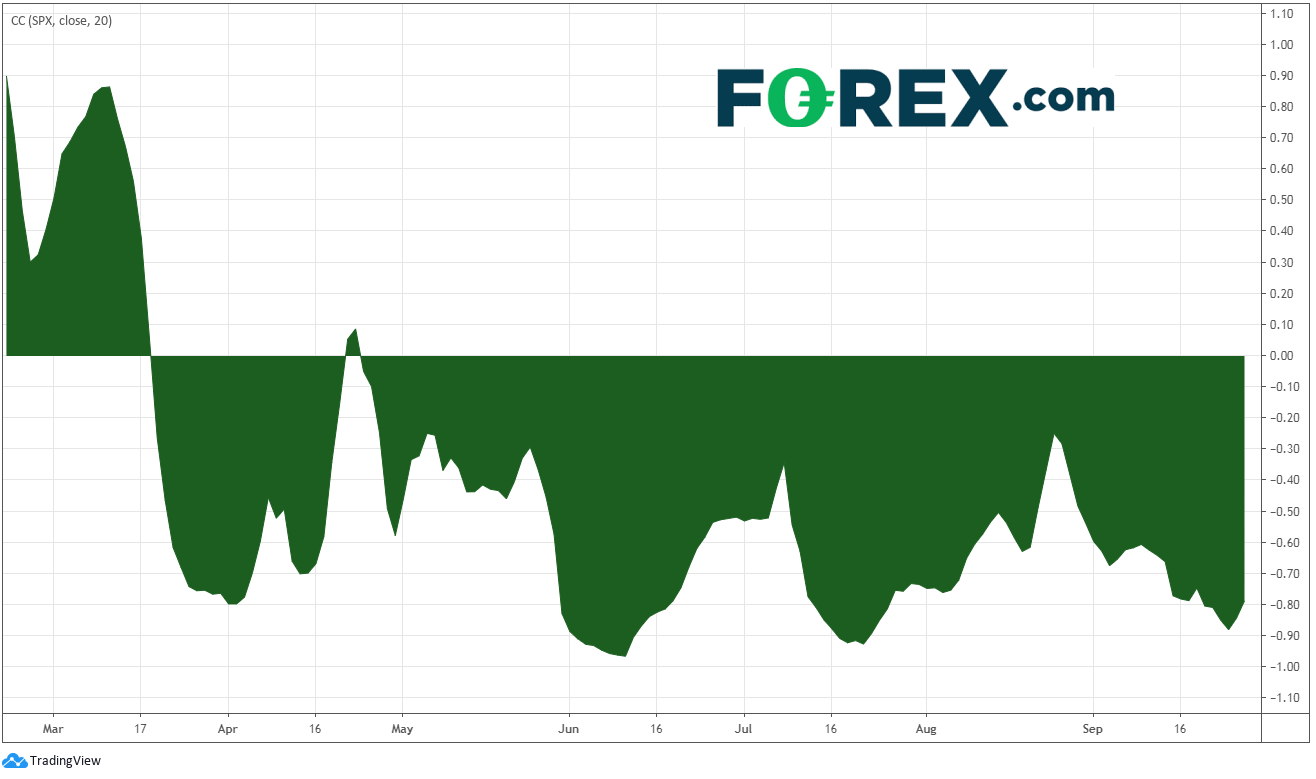
There is one more chart that is important to help determine direction for DXY: the correlation coefficient of DXY and the SPX. Notice how, except for a brief few days in April, the correlation has been negative since the market volatility near the beginning of the coronavirus in March. More importantly, the current correlation coefficient is -.79, just off its lows last week at -.87. A negative correlation coefficient means that the 2 assets move in opposite directions. The closer the negative correlation is to -1.00, the more the 2 assets tend to move in the opposite direction. Watching this correlation coefficient is another tool traders can use to help determine the possible direction of the DXY.
Source: Tradingview, FOREX.com
Related tags:



Open an account in minutes
Experience award-winning platforms with fast and secure execution, and enjoy tight spreads from 0.5 pts on FX and 0.3 pts on indices.
Economic calendar
Web Trader platform
Our sophisticated web-based platform is packed with features.
Related articles

Gold, silver slammed as hawkish Fed repricing reignites dollar upside
Gold and silver had held up surprisingly well against surging US yields. Wednesday’s DXY breakout may have changed that equation.


EUR/USD, Nasdaq Price Outlook: Reversal Risks Build
EUR/USD and Nasdaq Price Outlook: Overbought/oversold momentum on hourly and daily time frames is raising reversal risks across the U.S. dollar, EUR/USD and Nasdaq after a strong weekly advance.


Gold Holds Firm Despite Stronger US Dollar and Hawkish Fed
Gold remains resilient despite a stronger US dollar and hawkish Fed rhetoric, while DXY momentum shows signs of fading near resistance.
This report is intended for general circulation only. It should not be construed as a recommendation, or an offer (or solicitation of an offer) to buy or sell any financial products. The information provided does not take into account your specific investment objectives, financial situation or particular needs. Before you act on any recommendation that may be contained in this report, independent advice ought to be sought from a financial adviser regarding the suitability of the investment product, taking into account your specific investment objectives, financial situation or particular needs.
StoneX Financial Pte. Ltd., may distribute reports produced by its respective foreign entities or affiliates within the StoneX group of companies or third parties pursuant to an arrangement under Regulation 32C of the Financial Advisers Regulations. Where the report is distributed to a person in Singapore who is not an accredited investor, expert investor or an institutional investor (as defined in the Securities Futures Act), StoneX Financial Pte. Ltd. accepts legal responsibility to such persons for the contents of the report only to the extent required by law. Singapore recipients should contact StoneX Financial Pte. Ltd. at 6826 9988 for matters arising from, or in connection with the report.
In the case of all other recipients of this report, to the extent permitted by applicable laws and regulations neither StoneX Financial Pte. Ltd. nor its associated companies will be responsible or liable for any loss or damage incurred arising out of, or in connection with, any use of the information contained in this report and all such liability is hereby expressly disclaimed. No representation or warranty is made, express or implied, that the content of this report is complete or accurate.
StoneX Financial Pte. Ltd. is not under any obligation to update this report.
Trading CFDs carries a high level of risk that may not be suitable for some investors. Consider your investment objectives, level of experience, financial resources, risk appetite and other relevant circumstances carefully. The possibility exists that you could lose some or all of your investments, including your initial deposits. If in doubt, please seek independent expert advice. Visit www.forex.com/en-sg/terms-and-policies for the complete Risk Disclosure Statement.