



EUR/USD forecast: Can yen intervention force a trend change?
Joint US-Japan intervention has distorted some of the dollar's strongest relationships this year. That leaves EUR/USD testing major resistance under highly unusual circumstances.
Share this:

- Joint intervention distorts dollar's strongest macro relationships
- EUR/USD tests January downtrend amid intervention threat
- Euro area data surprises strongest since early 2023
- July payrolls to decide if dollar weakness persists
EUR/USD is testing long-running downtrend resistance in early Asian trade on Monday, reacting to an artificial, and potentially temporary, slide in the dollar late last week. Rather than the economic calendar or technicals, it's likely the Japanese yen that determines whether resistance holds or snaps, with the threat of further joint intervention by Japanese and US authorities likely to dominate proceedings.
Yen intervention remains the dominant FX driver
Markets widely expect Japan to announce on Monday that it coordinated with the US to support the yen last week, marking the first joint intervention by the two nations in decades. But the bigger question is whether authorities have finished.
As outlined in our USD/JPY week ahead report released over the weekend, prior intervention episodes suggest there's a strong chance of further action should yen weakness re-emerge. With USD/JPY already rebounding from the earlier session lows, the risk of additional intervention cannot be overlooked on Monday.
That points to further artificial downside in the dollar, driven by factors other than fundamental market forces. Should the intervention episode continue, it would likely provide another tailwind for EUR/USD, increasing the risk the recent rebound extends further.
However, whether that weakness lasts beyond the short term is another matter entirely. A heavy slate of US economic data, including Friday's non-farm payrolls report, will likely determine whether the move can grow into something more sustainable.
Traditional dollar relationships weaken
Source: TradingView
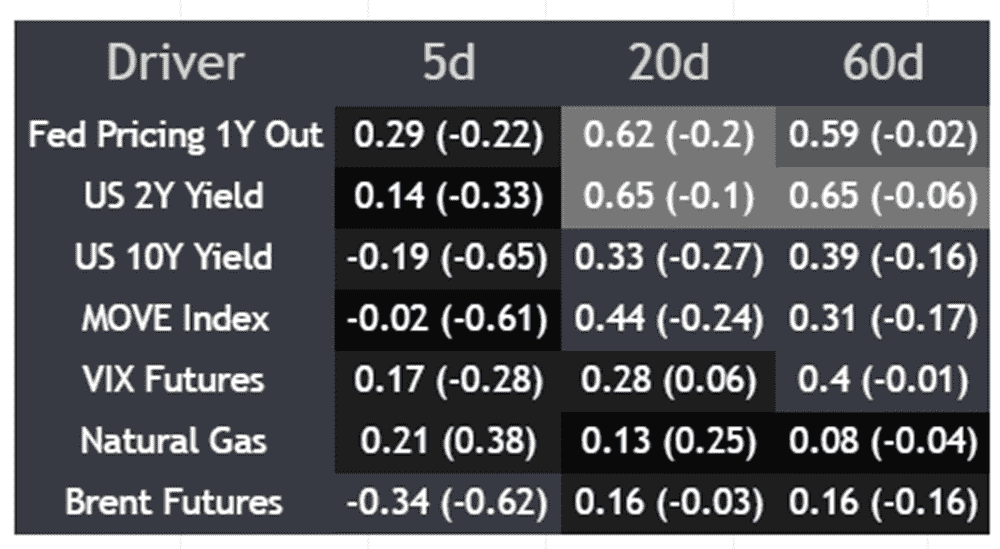
Assessing whether dollar weakness can be sustained is more difficult because some of this year's strongest relationships have weakened sharply over the past week. Over the past month, the US Dollar Index has continued to display a reasonably strong relationship with the Fed funds futures curve, reflecting market expectations for Fed rate hikes between June this year and June next year, along with US two-year Treasury yields, with 20-day correlation coefficients of 0.62 and 0.65 respectively.
However, over the past five sessions those relationships have deteriorated sharply. The correlation with the Fed funds futures curve has fallen to just 0.29, while the relationship with US two-year Treasury yields has weakened to only 0.14. Correlations with other drivers, including energy prices, have also deteriorated over the same period.
While month-end flows may explain part of the shift, the intervention episode unfolding in Japan also appears to be distorting the broader market message. What has driven the dollar for much of this year isn't necessarily what's driving it right now.
Euro data turns a corner
Source: LSEG Workstation
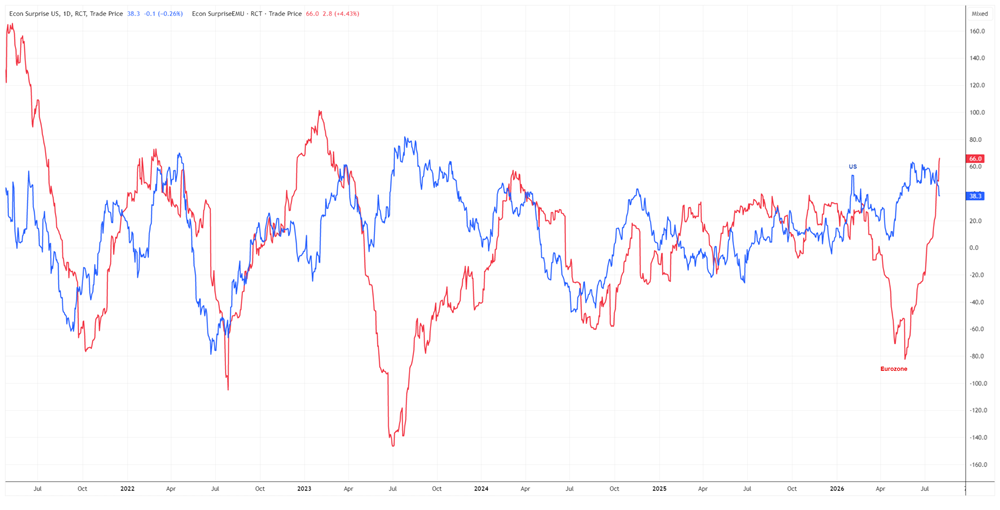
While intervention may be helping propel EUR/USD higher in the short term, it's not the only factor at work. Euro area economic data has staged a remarkable turnaround in recent months, with the Citi Economic Surprise Index, which measures whether data is beating or missing economists' forecasts, rebounding sharply from the lows seen during the early stages of the Iran conflict.
The recovery has been nothing short of V-shaped. Having languished in deeply negative territory in April, the index has surged to its highest level since early 2023, pointing to a growing prevalence of upside surprises across the euro area. Friday's inflation report only reinforced that trend, with both headline and underlying inflation accelerating, strengthening the case for another ECB rate hike.
By contrast, while the US economy continues to outperform, it is finding it harder to deliver upside surprises relative to elevated market expectations. That suggests EUR/USD's rebound is not solely a by-product of intervention-driven dollar weakness, with improving relative fundamentals also helping underpin the move.
The calendar takes a back seat
Source: TradingView
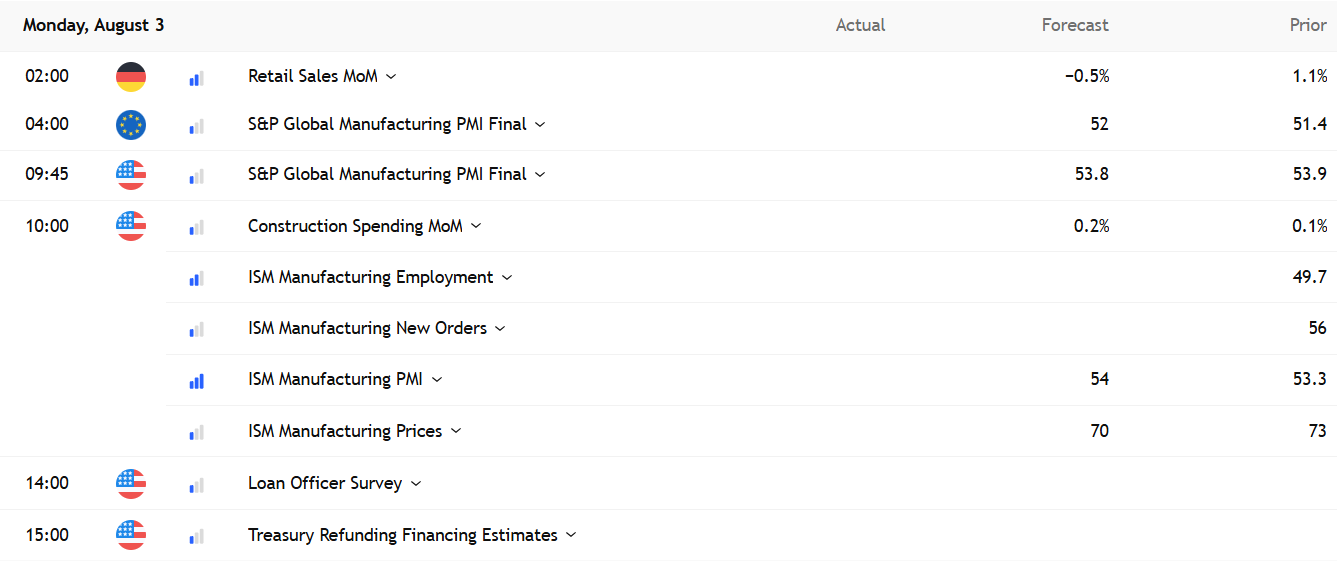
Speculation surrounding further intervention, along with the associated flows through the Japanese yen, are likely to remain the dominant influence on EUR/USD during Monday's session. As a result, the economic calendar may struggle to generate sustained moves unless it delivers a surprise.
Of the scheduled releases, US ISM services PMI looks the most likely candidate to spark a fundamentally driven move, although even that may be giving it too much credit in the current environment. The US Treasury's quarterly refunding announcement will also attract attention, but it's typically Wednesday's release detailing the composition of debt issuance that has the greater market impact.
The Senior Loan Officer Opinion Survey rounds out the calendar. While it has influenced markets before, it's a backward-looking report and, against this unique backdrop, its ability to generate meaningful volatility looks extremely limited.
Trendline showdown
Source: TradingView
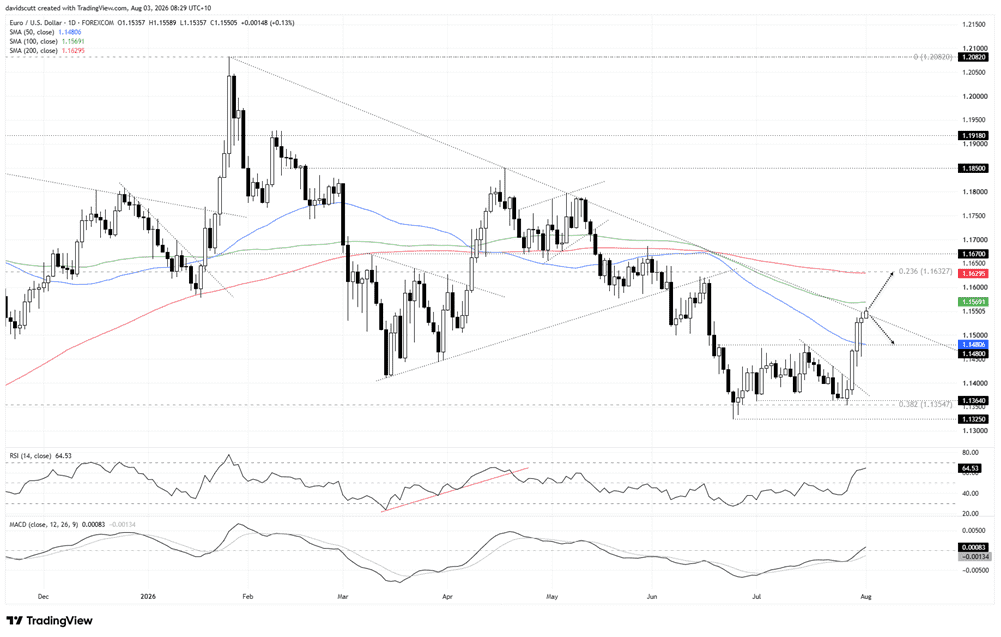
Looking at EUR/USD on the daily timeframe, the technical stakes today are high with the pair now trading through downtrend resistance that's been in place since the highs set in late January.
The descending triangle structure that had contained price action last week was shattered following the Fed decision last Wednesday, delivering a breakout that saw EUR/USD push not only through former resistance at 1.1480, but also the 50-day simple moving average, extending the move into a test of the long-running downtrend. That becomes the key level to watch today, along with the 100-day simple moving average sitting marginally above at 1.1569.
A clean break and close above the trendline would strengthen the view that a trend change may be taking place, opening the door towards the 23.6% Fibonacci retracement of the January 2025 to January 2026 bull move at 1.1633, which also coincides with the 200-day simple moving average. Beyond that, 1.1670 is the next level to watch, with a break above opening the door towards 1.1800 and 1.1850.
On the downside, should the downtrend continue to cap gains, a reversal back towards the confluence of the 50-day simple moving average and former resistance at 1.1480 may be on the cards. A break beneath that would open the door for a retest of the support zone comprising the 38.2% Fibonacci retracement of the January 2025 to January 2026 bull move, horizontal support at 1.1364, and the June 24 swing low at 1.1325.
The oscillators continue to favour further upside. RSI (14) continues to push above the neutral 50 level without entering overbought territory at 64, while MACD has confirmed the bullish signal with a crossover above the signal line and a move back into positive territory. However, that message comes with the caveat that artificial factors have played a significant role in the latest bout of euro strength.
Latest market news




Open an account in minutes
Experience award-winning platforms with fast and secure execution, and enjoy tight spreads from 0.5 pts on FX and 0.3 pts on indices.
Economic calendar
Web Trader platform
Our sophisticated web-based platform is packed with features.
Related articles
EUR/USD Q4 2026 Outlook: Euro at a Crossroads as Fed, ECB Tighten 9 25 2026
EUR/USD enters Q4 at a pivotal inflection point as competing Fed-ECB policy paths and persistent inflation risks collide with major technical support.
AUD/USD Q4 Outlook: RBA and Fed Hikes Set the Tone
AUD/USD enters Q4 with RBA and Fed hikes in focus as sticky inflation, rising unemployment and US dollar strength shape the Australian dollar.

USD/JPY Q4 2026 Outlook: Hawkish Fed Pricing Clashes With Intervention Risk
The year-end tug-of-war is clear: hawkish Fed pricing supports USD/JPY, while intervention risk limits the upside.
This report is intended for general circulation only. It should not be construed as a recommendation, or an offer (or solicitation of an offer) to buy or sell any financial products. The information provided does not take into account your specific investment objectives, financial situation or particular needs. Before you act on any recommendation that may be contained in this report, independent advice ought to be sought from a financial adviser regarding the suitability of the investment product, taking into account your specific investment objectives, financial situation or particular needs.
StoneX Financial Pte. Ltd., may distribute reports produced by its respective foreign entities or affiliates within the StoneX group of companies or third parties pursuant to an arrangement under Regulation 32C of the Financial Advisers Regulations. Where the report is distributed to a person in Singapore who is not an accredited investor, expert investor or an institutional investor (as defined in the Securities Futures Act), StoneX Financial Pte. Ltd. accepts legal responsibility to such persons for the contents of the report only to the extent required by law. Singapore recipients should contact StoneX Financial Pte. Ltd. at 6826 9988 for matters arising from, or in connection with the report.
In the case of all other recipients of this report, to the extent permitted by applicable laws and regulations neither StoneX Financial Pte. Ltd. nor its associated companies will be responsible or liable for any loss or damage incurred arising out of, or in connection with, any use of the information contained in this report and all such liability is hereby expressly disclaimed. No representation or warranty is made, express or implied, that the content of this report is complete or accurate.
StoneX Financial Pte. Ltd. is not under any obligation to update this report.
Trading CFDs carries a high level of risk that may not be suitable for some investors. Consider your investment objectives, level of experience, financial resources, risk appetite and other relevant circumstances carefully. The possibility exists that you could lose some or all of your investments, including your initial deposits. If in doubt, please seek independent expert advice. Visit www.forex.com/en-sg/terms-and-policies for the complete Risk Disclosure Statement.