






Euro Forecast: EUR/USD Faces Pressure with Dollar Tailwinds Building
EUR/USD has snapped its multi-month uptrend, with sentiment swinging back in favour of the U.S. dollar on trade optimism and firming economic data. Can the euro hold key support or is a deeper pullback ahead?
Share this:

- EUR/USD breaks February–April uptrend support
- Trade optimism revives demand for U.S. assets
- Eurozone data surprise advantage has faded
- Key support at 1.1276–1.1200 now in play
- Fed speakers, jobless claims may guide next move
Summary
EUR/USD may have arrived at the start of a new trend, breaking the uptrend it had been trading in since late February. Assuming it sticks, the question now is whether it will be sideways or lower?
The key swing factor behind the U.S. dollar’s recovery has undoubtedly been sentiment regarding trade negotiations between the U.S. administration and other nations, with markets shifting from pricing peak pessimism in early April to something more akin to persistent optimism that the worst outcome will be avoided.
With relative economic data performance no longer providing tailwinds for the euro, any hint of a lasting trade truce in the near term may be enough to swing directional risks for EUR/USD lower.
Trade Deals Key for EUR/USD Direction
Whether you believe it or not, consensus across markets remains that trade tensions are far more negative for the U.S. economy and markets than for other nations, be they developed or emerging. It’s meant that we’ve seen an extreme period of headline-driven volatility, with escalating tensions driving capital away from the U.S., and vice versa when the opposite occurs.
You could see that firsthand on Tuesday when news broke that informal talks between the U.S. and China will take place in Switzerland this weekend. The market reaction far exceeded that seen less than 24 hours later following the FOMC rate decision. The U.S. dollar, Treasuries, and stock futures all immediately went bid.
While you shouldn’t be under the illusion that these talks will deliver something meaningful, you can’t escape the fact that—for now—trade tensions are on a de-escalation trend. Yes, there will be fits and starts, and plenty of disappointment, but that’s now the direction of travel. It also suggests further declines in the U.S. dollar—beyond those already seen—may be far more difficult to achieve moving forward.
Talk of the dollar having embarked on a structural decline seems premature, just like the consensus view a few months ago that the euro was destined for a lengthy stint below parity. Narrative fitting immediately comes to mind. If trade deals are struck and the U.S. administration shifts focus to tax cuts and deregulation, would you really want to be underweight the U.S.? That’s a question to ponder.
Waning Data Edge Leaves EUR/USD Vulnerable
It’s not just trade negotiations that may be swinging in favour of the big dollar, but also relative economic performance. Citi’s economic surprise index is shown below, with euro area data in blue and U.S. in red. As a reminder, the index looks at how economic data prints relative to forecasts and then weights each release by market impact. A figure above zero indicates more positive surprises than not, and vice versa.
Source: Refinitiv
As opposed to earlier this year—when most European data was exceeding expectations while that in the U.S. was undershooting—the divergence between the two economic heavyweights has narrowed noticeably in recent weeks. It should also be noted that positivity in Europe during Q1 may have been due to front-loading of demand ahead of formal tariff negotiations.
In the States, most of the negativity during the same period was driven by soft survey data rather than actual readings on activity. Hard data has been holding up well, even with elevated levels of uncertainty. That helps explain why expectations for Fed rate cuts in 2025 have been diminishing recently, with market pricing shifting from more than four cuts to fewer than three.
Source: TradingView
Obviously, that may not remain the case as we move further into the year, but the elevated risk of a U.S. recession is now consensus—not some extreme tail risk. If a serious downturn were to be avoided, that could provide tailwinds for a dollar recovery.
In Europe, despite plenty of excitement about a German-led economic recovery underpinned by increased fiscal spending, the optics of Friedrich Merz failing to secure enough votes on the first attempt to become German Chancellor earlier this week served as a timely reminder that bureaucracy and political infighting often act as headwinds to European growth. If Merz struggled to get enough support to lead, will he be able to push through difficult reforms?
Hard Data Key for USD
While the questions posed above are focused on the medium term, right now what matters most for EUR/USD traders—aside from tariff headlines—is the performance of the U.S. economy, especially hard economic data. As the Fed made clear on Wednesday, while it remains ready to act if activity rolls over, until it does, there’s simply no need to adjust policy settings in either direction.
Source: TradingView (Times U.S. EDT)
Over the remainder of this week, the cupboard is almost bare on that front, with only jobless claims carrying the potential to move markets. After a big increase the prior week, another similar outcome would stoke concern that labour market conditions are weakening sharply and likely work against the U.S. dollar. But if we see a reversal—which has often been seen when big increases have occurred earlier in the cycle—it would likely do the opposite.
In the absence of a bearish outcome, markets are about to be bombarded by a wave of Fed speakers, all of whom are likely to be singing from the same neutral hymnbook as Chair Jerome Powell given the policy rate vote was unanimous at the May FOMC meeting. That could provide further tailwinds for the dollar ahead of the trade meeting in Switzerland.
EUR/USD: Start of New Trend?
Source: TradingView
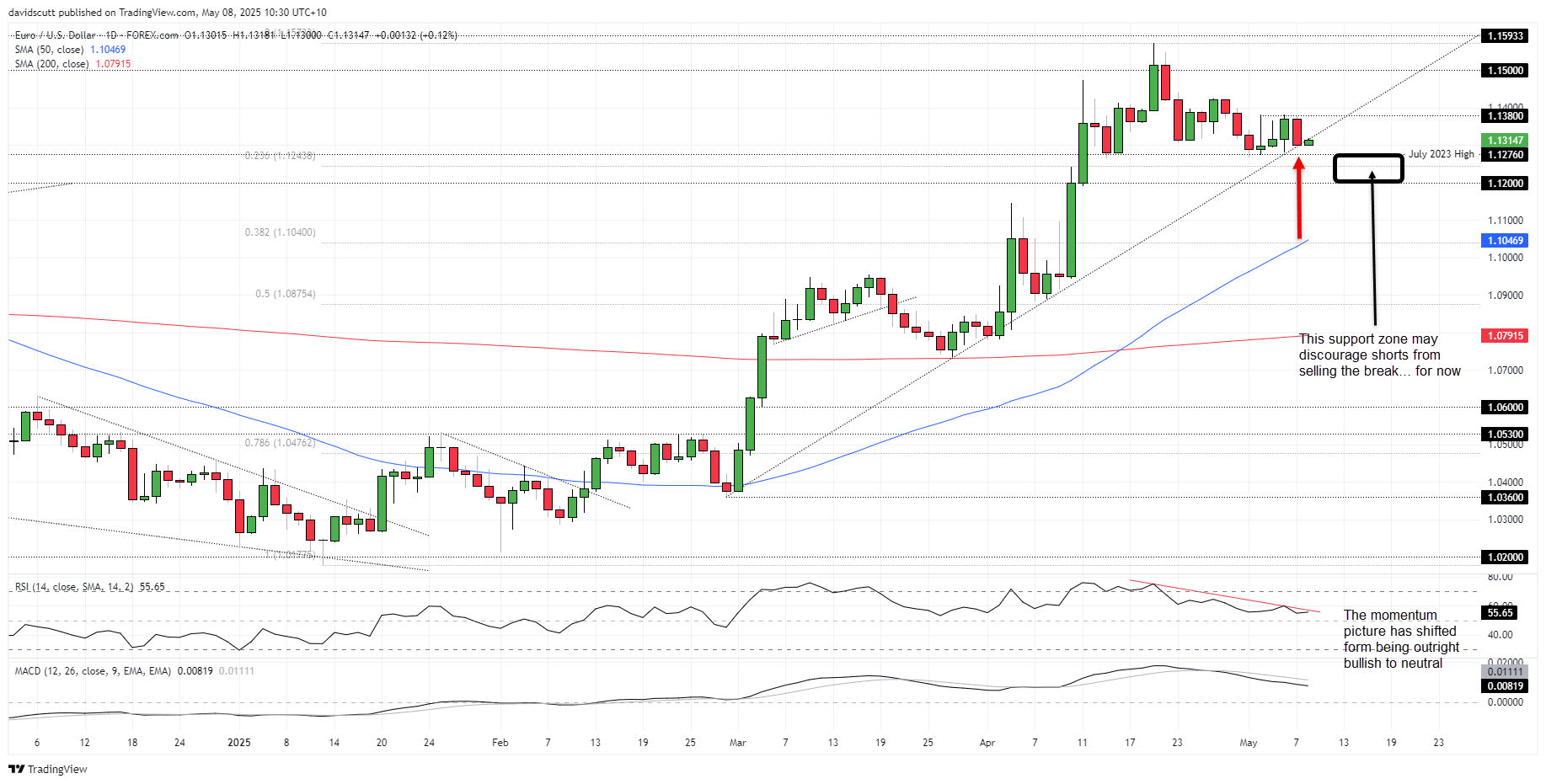
The EUR/USD break of uptrend support on Wednesday can be seen clearly on the daily chart, with the bearish engulfing candle warning of growing downside risk. However, sitting just above a support zone from 1.1276 down to 1.1200, it could be a hard slog for shorts near term without a definitive bullish U.S. dollar catalyst.
Beneath 1.1200, initial downside levels of note include the April 3 high of 1.1145, along with the intersection of the 50-day moving average and the 38.2% Fib retracement of the January–April move around 1.1040.
Overhead, sellers at 1.1380 capped gains earlier this week, making that level the initial focus for longs. Above, 1.1425 is a minor resistance level, with a far tougher test awaiting any move back above 1.1500.
Momentum signals now screen as neutral rather than outright bullish, with MACD and RSI (14) still in positive territory but clearly trending lower. If this continues, it would amplify downside risks for price. For now, the best bet is to put greater emphasis on price action.
-- Written by David Scutt
Follow David on Twitter @scutty
How to trade with City Index
You can trade with City Index by following these four easy steps:
- Open an account, or log in if you’re already a customer
• Open an account in the UK
• Open an account in Australia
• Open an account in Singapore
- Search for the market you want to trade in our award-winning platform
- Choose your position and size, and your stop and limit levels
- Place the trade
Related tags:
Latest market news




Open an account in minutes
Experience award-winning platforms with fast and secure execution, and enjoy tight spreads from 0.5 pts on FX and 0.3 pts on indices.
Economic calendar
Web Trader platform
Our sophisticated web-based platform is packed with features.
Related articles
Gold outlook: XAU/USD hammered, stretched and vulnerable to a sharp rebound
Gold is getting hammered for solid fundamental reasons, but history suggests extreme four-hourly oversold conditions can produce violent countertrend rallies.
EUR/USD, USD/JPY Outlook: Oil, yields and an FX identity crisis
Crude oil is setting the tone across rates and FX, leaving EUR/USD vulnerable and USD/JPY caught between higher Treasury yields and the growing threat of intervention
AUD/USD Analysis: What's Next for the Australian Dollar After the RBA Decision?
Recent trading sessions have reflected a more neutral tone around the Australian dollar. This can be seen in AUD/USD price action, which has posted moves of roughly 0.2% over the last two sessions without establishing a clear direction. Much of this lack of momentum is linked to expectations surrounding the next policy moves from both the Reserve Bank of Australia (RBA) and the Federal Reserve.

This report is intended for general circulation only. It should not be construed as a recommendation, or an offer (or solicitation of an offer) to buy or sell any financial products. The information provided does not take into account your specific investment objectives, financial situation or particular needs. Before you act on any recommendation that may be contained in this report, independent advice ought to be sought from a financial adviser regarding the suitability of the investment product, taking into account your specific investment objectives, financial situation or particular needs.
StoneX Financial Pte. Ltd., may distribute reports produced by its respective foreign entities or affiliates within the StoneX group of companies or third parties pursuant to an arrangement under Regulation 32C of the Financial Advisers Regulations. Where the report is distributed to a person in Singapore who is not an accredited investor, expert investor or an institutional investor (as defined in the Securities Futures Act), StoneX Financial Pte. Ltd. accepts legal responsibility to such persons for the contents of the report only to the extent required by law. Singapore recipients should contact StoneX Financial Pte. Ltd. at 6826 9988 for matters arising from, or in connection with the report.
In the case of all other recipients of this report, to the extent permitted by applicable laws and regulations neither StoneX Financial Pte. Ltd. nor its associated companies will be responsible or liable for any loss or damage incurred arising out of, or in connection with, any use of the information contained in this report and all such liability is hereby expressly disclaimed. No representation or warranty is made, express or implied, that the content of this report is complete or accurate.
StoneX Financial Pte. Ltd. is not under any obligation to update this report.
Trading CFDs carries a high level of risk that may not be suitable for some investors. Consider your investment objectives, level of experience, financial resources, risk appetite and other relevant circumstances carefully. The possibility exists that you could lose some or all of your investments, including your initial deposits. If in doubt, please seek independent expert advice. Visit www.forex.com/en-sg/terms-and-policies for the complete Risk Disclosure Statement.