




EURUSD New 2019 low likely despite disappointing US data
The EUR/USD has been limping since it made a post-ECB high of 1.1110 nearly two weeks ago.
Share this:

The EUR/USD has been limping since it made a post-ECB high of 1.1110 nearly two weeks ago. After rallying on the back of ECB’s expected decision to re-introduce QE and cut rates to negative, rates have struggled to show any further bullish momentum. It all makes sense. After all, Germany is on the brink of a recession. Inflationary pressures are falling. Brexit uncertainty is rising. Need we any more reasons? Today, though, there was a bit of relief for the single currency as the latest German data was not too bad, while US macro pointers disappointed expectations. The bulls would also take heart from the fact the exchange rate hasn’t broken sharply lower in the face of those very poor German PMI numbers form yesterday. On balance, however, the path of least resistance still remains to the downside because of greater macro concerns over the Eurozone than the US economy.
The exchange rate tested waters above the $1.10 handle in reaction to the German IFO survey, which beat on the “current assessment” front (which came in at 98.5 vs. 96.9 expected and 97.4 prior), but the “expectations” index disappointed (falling to 90.8 vs. 92 expected, down from 91.3 previously). On top of this, the Richmond Fed Manufacturing Index came in sharply below expectations at -9 for September versus +1 expected and last. What’s more, the Conference Board reported a sharp drop in consumer confidence: to 125.1 from 135.1 when a reading of 134.1 was expected.
But with the Eurozone PMIs and German Ifo survey out of the way, there isn’t much in the way of major Eurozone data left for this popular pair this week. However, we will have more second-tier US macro numbers to look forward to as the week progresses. If, on the whole, these figures suggest the US economy is continuing to expand at a steady pace, then the greenback could find renewed bullish momentum and that could undermine the EUR/USD exchange rate. However, if today’s data is anything to go by and we further soft US macro pointers, then in that case the EUR/USD could find some much-needed support.
Source: eSignal and City Index.
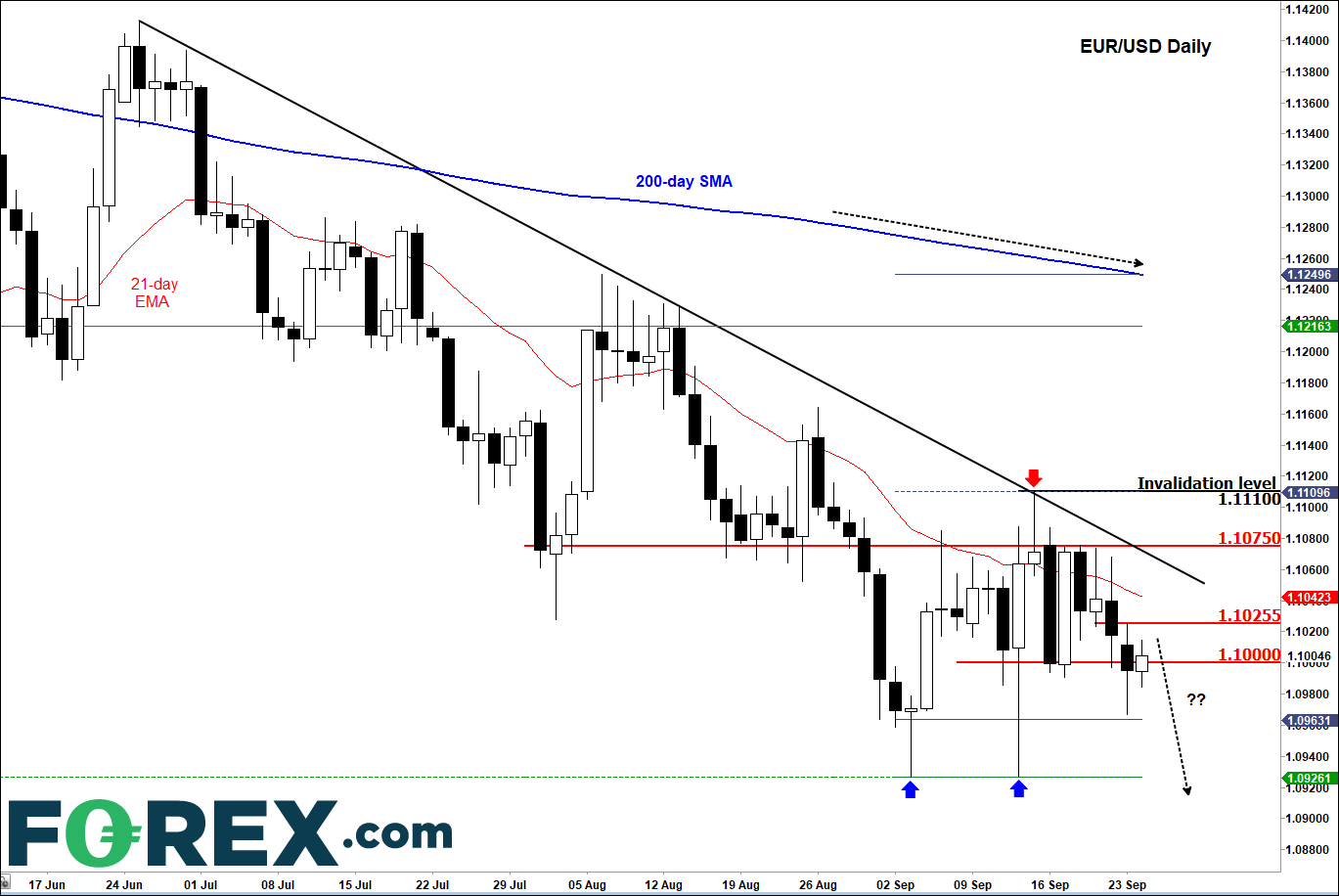
From a technical point of view, the fact that the EUR/USD is struggling to show any sort of strength is not exactly bullish is it? With rates continuing to make lower lows and lower highs, the pressure is growing. You get a feeling that all it needs is just a little push to trigger a few stops and ignite momentum selling. I continue to believe that liquidity below the post-ECB low at 1.0925 will be taken out soon. For avoidance of doubt, I am bearish until told otherwise by bullish price action.
The EUR/USD has been limping since it made a post-ECB high of 1.1110 nearly two weeks ago. After rallying on the back of ECB’s expected decision to re-introduce QE and cut rates to negative, rates have struggled to show any further bullish momentum. It all makes sense. After all, Germany is on the brink of a recession. Inflationary pressures are falling. Brexit uncertainty is rising. Need we any more reasons? Today, though, there was a bit of relief for the single currency as the latest German data was not too bad, while US macro pointers disappointed expectations. The bulls would also take heart from the fact the exchange rate hasn’t broken sharply lower in the face of those very poor German PMI numbers form yesterday. On balance, however, the path of least resistance still remains to the downside because of greater macro concerns over the Eurozone than the US economy.
The exchange rate tested waters above the $1.10 handle in reaction to the German IFO survey, which beat on the “current assessment” front (which came in at 98.5 vs. 96.9 expected and 97.4 prior), but the “expectations” index disappointed (falling to 90.8 vs. 92 expected, down from 91.3 previously). On top of this, the Richmond Fed Manufacturing Index came in sharply below expectations at -9 for September versus +1 expected and last. What’s more, the Conference Board reported a sharp drop in consumer confidence: to 125.1 from 135.1 when a reading of 134.1 was expected.
But with the Eurozone PMIs and German Ifo survey out of the way, there isn’t much in the way of major Eurozone data left for this popular pair this week. However, we will have more second-tier US macro numbers to look forward to as the week progresses. If, on the whole, these figures suggest the US economy is continuing to expand at a steady pace, then the greenback could find renewed bullish momentum and that could undermine the EUR/USD exchange rate. However, if today’s data is anything to go by and we further soft US macro pointers, then in that case the EUR/USD could find some much-needed support.
Source: eSignal and FOREX.com.
From a technical point of view, the fact that the EUR/USD is struggling to show any sort of strength is not exactly bullish is it? With rates continuing to make lower lows and lower highs, the pressure is growing. You get a feeling that all it needs is just a little push to trigger a few stops and ignite momentum selling. I continue to believe that liquidity below the post-ECB low at 1.0925 will be taken out soon. For avoidance of doubt, I am bearish until told otherwise by bullish price action.


Open an account in minutes
Experience award-winning platforms with fast and secure execution, and enjoy tight spreads from 0.5 pts on FX and 0.3 pts on indices.
Economic calendar
Web Trader platform
Our sophisticated web-based platform is packed with features.
Related articles

EUR/USD Q4 2026 Outlook: Euro at a Crossroads as Fed, ECB Tighten 9 25 2026
EUR/USD enters Q4 at a pivotal inflection point as competing Fed-ECB policy paths and persistent inflation risks collide with major technical support.


AUD/USD Q4 Outlook: RBA and Fed Hikes Set the Tone
AUD/USD enters Q4 with RBA and Fed hikes in focus as sticky inflation, rising unemployment and US dollar strength shape the Australian dollar.


USD/JPY Q4 2026 Outlook: Hawkish Fed Pricing Clashes With Intervention Risk
The year-end tug-of-war is clear: hawkish Fed pricing supports USD/JPY, while intervention risk limits the upside.

This report is intended for general circulation only. It should not be construed as a recommendation, or an offer (or solicitation of an offer) to buy or sell any financial products. The information provided does not take into account your specific investment objectives, financial situation or particular needs. Before you act on any recommendation that may be contained in this report, independent advice ought to be sought from a financial adviser regarding the suitability of the investment product, taking into account your specific investment objectives, financial situation or particular needs.
StoneX Financial Pte. Ltd., may distribute reports produced by its respective foreign entities or affiliates within the StoneX group of companies or third parties pursuant to an arrangement under Regulation 32C of the Financial Advisers Regulations. Where the report is distributed to a person in Singapore who is not an accredited investor, expert investor or an institutional investor (as defined in the Securities Futures Act), StoneX Financial Pte. Ltd. accepts legal responsibility to such persons for the contents of the report only to the extent required by law. Singapore recipients should contact StoneX Financial Pte. Ltd. at 6826 9988 for matters arising from, or in connection with the report.
In the case of all other recipients of this report, to the extent permitted by applicable laws and regulations neither StoneX Financial Pte. Ltd. nor its associated companies will be responsible or liable for any loss or damage incurred arising out of, or in connection with, any use of the information contained in this report and all such liability is hereby expressly disclaimed. No representation or warranty is made, express or implied, that the content of this report is complete or accurate.
StoneX Financial Pte. Ltd. is not under any obligation to update this report.
Trading CFDs carries a high level of risk that may not be suitable for some investors. Consider your investment objectives, level of experience, financial resources, risk appetite and other relevant circumstances carefully. The possibility exists that you could lose some or all of your investments, including your initial deposits. If in doubt, please seek independent expert advice. Visit www.forex.com/en-sg/terms-and-policies for the complete Risk Disclosure Statement.