



Risk-off in stocks flows into safe haven currencies
The Swiss Franc and the Japanese Yen are considered safe haven currencies
Share this:
There has been quite a bit of volatility in the stocks since the S&P 500 made new all-time highs of 4744.6 on the day of the release of the Core PCE Price Index for October last week, which was 4.1% YoY vs 3.7% YoY in September. Add to that, Omicron, a hawkish Fed Chairman, and the first cases of Omicron in the US, and stock markets are a bit worried. And rightly so! What are the 2 main reasons stocks have been going bid since the start of the pandemic: Stimulus and control of the coronavirus. Well, Powell told us on Tuesday that they will discuss increasing the pace of tapering when the FOMC meets on December 15th and 16th, and the Omicron variant of the coronavirus has surfaced in nearly 20 countries so far, including the US, UK, parts of Europe, and Australia. So, stocks are concerned!

Source: Tradingview, Stone X
What does all that uncertainty mean for forex? It means a flight to safety. More specifically, it means buying Swiss Francs and Japanese Yen. Both Switzerland and Japan are considered to own a substantial amount of foreign debt. If the wheels fall off the cart, they can always sell these assets if needed to raise capital. Therefore, owning Swiss Francs and Japanese Yen are considered owning safe haven currencies.
Everything you should know about the Japanese Yen
GBP/JPY has been moving lower since October 21st, however the pair accelerated lower on November 4th when the Bank of England failed to raise interest rates after giving numerous signals they would do so. The pair then consolidated in a flag formation between 152.50 and 155.75. On November 26th, the first day the Omicron variant was “announced” by UK Health Secretary Sajid Javid, the pair broke lower out of the flag formation near the 50 Day moving Average at 153.69 and is on its way towards the flag target near 148.53. There is also horizontal support and the 50% retracement level from the January 2021 lows to the October 21st highs near that level. If stocks continue lower (FTSE may gap lower below 7000), GBP/JPY may be near the flag target quickly. Horizontal resistance and the 200 Day Moving Average above aren’t until 152.50.

Source: Tradingview, Stone X
Trade GBP/JPY now: Login or open a new account!
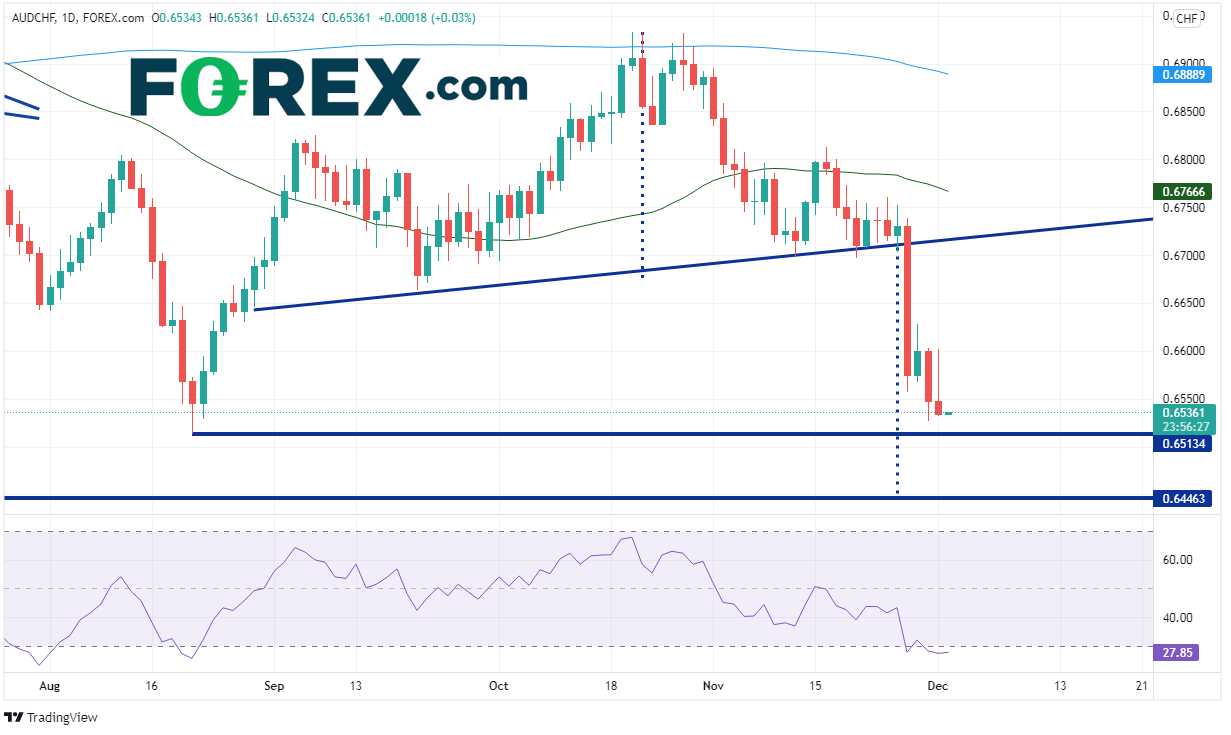
AUD/CHF is a great pair to look at when determining risk-on/risk-off. Aussie is considered a “risky” currency, whereas the Swiss France is a “safe” currency. If the pair if moving higher, its usually risk-on. If it is moving lower, its usually risk-off. AUD/CHF has also been moving lower since late October after forming a ‘funny looking” head and shoulders pattern from the lows on August 20th near 0.6513. Price moved higher and spiked through the 200 Day Moving Average several times near 0.6925, forming the Head of the pattern. As price moved lower, AUD/CHF traded between the 50 Day Moving Average at 0.6700 and the neckline of the pattern at 0.6800. The reason this is a “funny looking” Head and Shoulders pattern is because the right shoulder is much shorter in duration than the left shoulder. However, on November 26th, AUD/CHF broke aggressively lower through the neckline of 0.6710 and is nearing its target at horizontal support of 0.6646. The only level in its way is August 20th low!
Source: Tradingview, Stone X
Trade AUD/CHF now: Login or open a new account!
The Swiss Franc and the Japanese Yen are considered safe haven currencies. When there is risk-off in stocks, there tends to be a flight to safety into them. Watch these currencies to help determine risk-on and risk-off moves.
Learn more about forex trading opportunities.
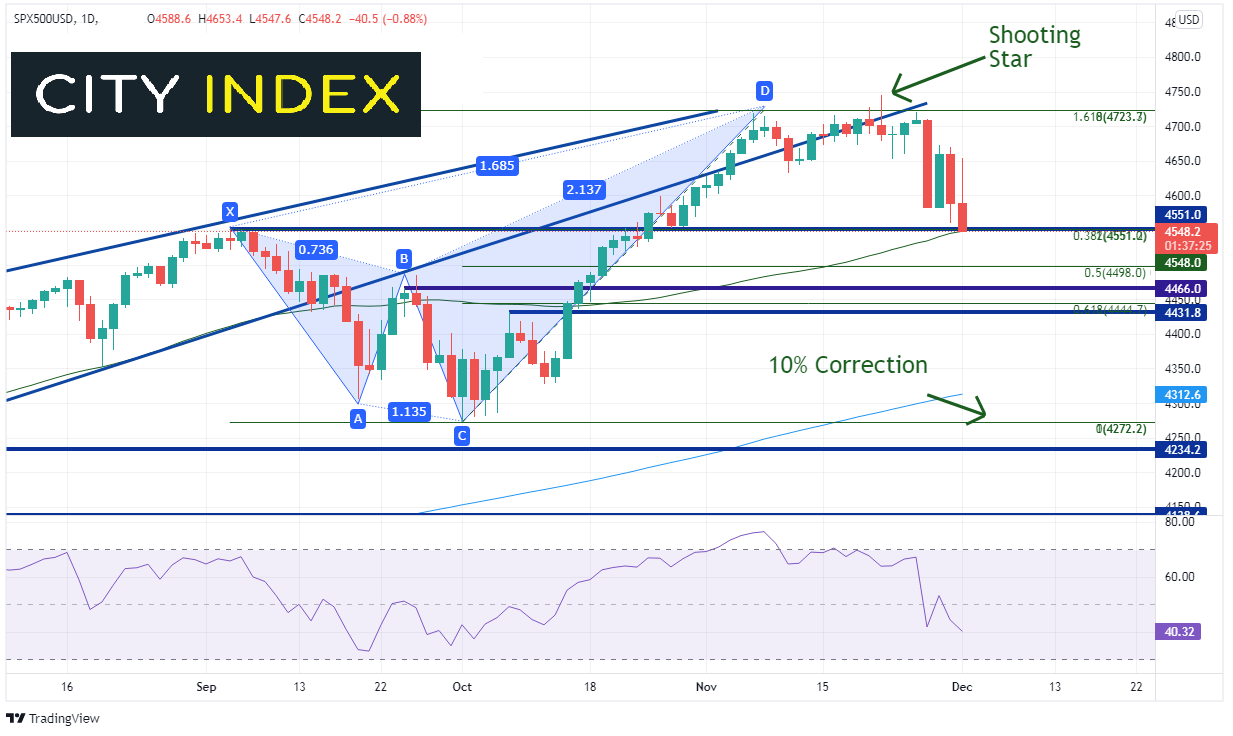
There has been quite a bit of volatility in the stocks since the S&P 500 made new all-time highs of 4744.6 on the day of the release of the Core PCE Price Index for October last week, which was 4.1% YoY vs 3.7% YoY in September. Add to that, Omicron, a hawkish Fed Chairman, and the first cases of Omicron in the US, and stock markets are a bit worried. And rightly so! What are the 2 main reasons stocks have been going bid since the start of the pandemic: Stimulus and control of the coronavirus. Well, Powell told us on Tuesday that they will discuss increasing the pace of tapering when the FOMC meets on December 15th and 16th, and the Omicron variant of the coronavirus has surfaced in nearly 20 countries so far, including the US, UK, parts of Europe, and Australia. So, stocks are concerned!
Source: Tradingview, Stone X
What does all that uncertainty mean for forex? It means a flight to safety. More specifically, it means buying Swiss Francs and Japanese Yen. Both Switzerland and Japan are considered to own a substantial amount of foreign debt. If the wheels fall off the cart, they can always sell these assets if needed to raise capital. Therefore, owning Swiss Francs and Japanese Yen are considered owning safe haven currencies.
Everything you should know about the Japanese Yen
GBP/JPY has been moving lower since October 21st, however the pair accelerated lower on November 4th when the Bank of England failed to raise interest rates after giving numerous signals they would do so. The pair then consolidated in a flag formation between 152.50 and 155.75. On November 26th, the first day the Omicron variant was “announced” by UK Health Secretary Sajid Javid, the pair broke lower out of the flag formation near the 50 Day moving Average at 153.69 and is on its way towards the flag target near 148.53. There is also horizontal support and the 50% retracement level from the January 2021 lows to the October 21st highs near that level. If stocks continue lower (FTSE may gap lower below 7000), GBP/JPY may be near the flag target quickly. Horizontal resistance and the 200 Day Moving Average above aren’t until 152.50.

Source: Tradingview, Stone X
Trade GBP/JPY now: Login or Open a new account!
• Open an account in the UK
• Open an account in Australia
• Open an account in Singapore
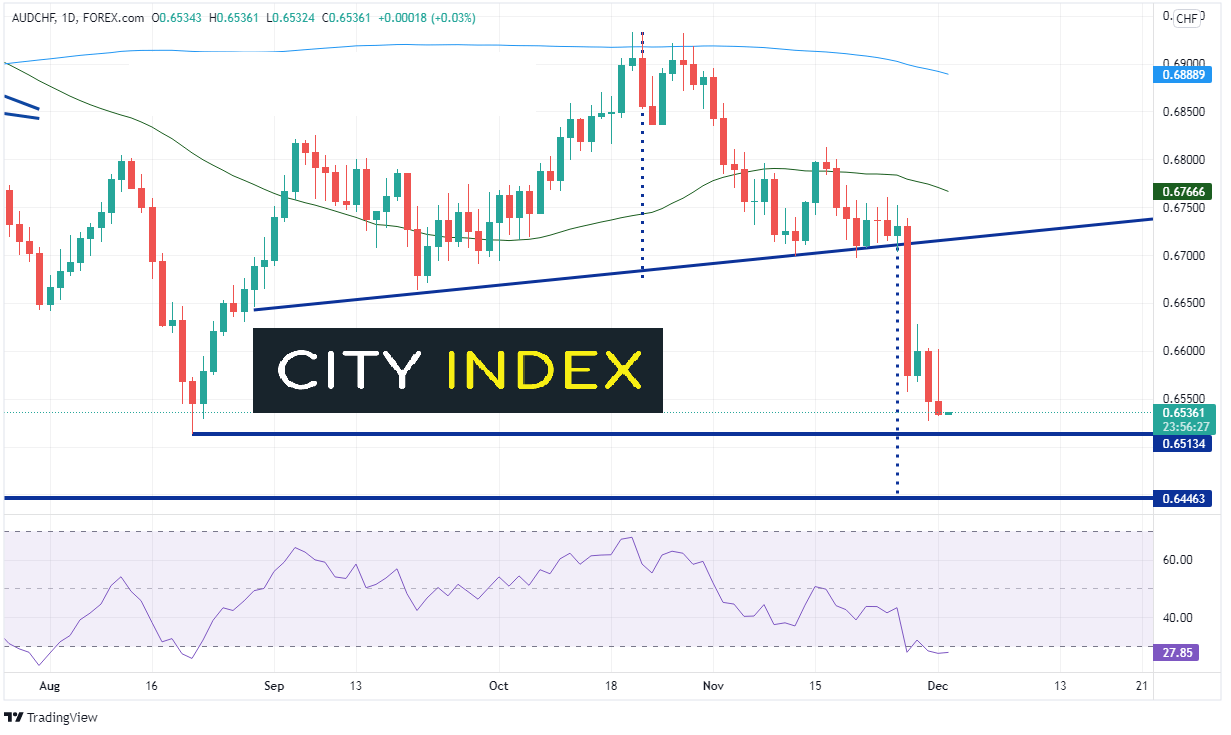
AUD/CHF is a great pair to look at when determining risk-on/risk-off. Aussie is considered a “risky” currency, whereas the Swiss France is a “safe” currency. If the pair if moving higher, its usually risk-on. If it is moving lower, its usually risk-off. AUD/CHF has also been moving lower since late October after forming a ‘funny looking” head and shoulders pattern from the lows on August 20th near 0.6513. Price moved higher and spiked through the 200 Day Moving Average several times near 0.6925, forming the Head of the pattern. As price moved lower, AUD/CHF traded between the 50 Day Moving Average at 0.6700 and the neckline of the pattern at 0.6800. The reason this is a “funny looking” Head and Shoulders pattern is because the right shoulder is much shorter in duration than the left shoulder. However, on November 26th, AUD/CHF broke aggressively lower through the neckline of 0.6710 and is nearing its target at horizontal support of 0.6646. The only level in its way is August 20th low!
Source: Tradingview, Stone X
Trade AUD/CHF now: Login or Open a new account!
• Open an account in the UK
• Open an account in Australia
• Open an account in Singapore
The Swiss Franc and the Japanese Yen are considered safe haven currencies. When there is risk-off in stocks, there tends to be a flight to safety into them. Watch these currencies to help determine risk-on and risk-off moves.
Learn more about forex trading opportunities.
Related tags:

Open an account in minutes
Experience award-winning platforms with fast and secure execution, and enjoy tight spreads from 0.5 pts on FX and 0.3 pts on indices.
Economic calendar
Web Trader platform
Our sophisticated web-based platform is packed with features.
Related articles

USD/JPY outlook: Hawkish Fed recalibration pressures the yen
Stronger US growth momentum and rising Treasury yields are keeping USD/JPY pointed higher, even as Japanese policymakers try to limit the pressure building across domestic markets.


Gold, silver slammed as hawkish Fed repricing reignites dollar upside
Gold and silver had held up surprisingly well against surging US yields. Wednesday’s DXY breakout may have changed that equation.

AUD/USD Crushed Ahead of Jobs Report as US Dollar, Yields Surge
AUD/USD slumps towards 70c as surging US yields and a stronger dollar overshadow Australian jobs data and the RBA outlook.
This report is intended for general circulation only. It should not be construed as a recommendation, or an offer (or solicitation of an offer) to buy or sell any financial products. The information provided does not take into account your specific investment objectives, financial situation or particular needs. Before you act on any recommendation that may be contained in this report, independent advice ought to be sought from a financial adviser regarding the suitability of the investment product, taking into account your specific investment objectives, financial situation or particular needs.
StoneX Financial Pte. Ltd., may distribute reports produced by its respective foreign entities or affiliates within the StoneX group of companies or third parties pursuant to an arrangement under Regulation 32C of the Financial Advisers Regulations. Where the report is distributed to a person in Singapore who is not an accredited investor, expert investor or an institutional investor (as defined in the Securities Futures Act), StoneX Financial Pte. Ltd. accepts legal responsibility to such persons for the contents of the report only to the extent required by law. Singapore recipients should contact StoneX Financial Pte. Ltd. at 6826 9988 for matters arising from, or in connection with the report.
In the case of all other recipients of this report, to the extent permitted by applicable laws and regulations neither StoneX Financial Pte. Ltd. nor its associated companies will be responsible or liable for any loss or damage incurred arising out of, or in connection with, any use of the information contained in this report and all such liability is hereby expressly disclaimed. No representation or warranty is made, express or implied, that the content of this report is complete or accurate.
StoneX Financial Pte. Ltd. is not under any obligation to update this report.
Trading CFDs carries a high level of risk that may not be suitable for some investors. Consider your investment objectives, level of experience, financial resources, risk appetite and other relevant circumstances carefully. The possibility exists that you could lose some or all of your investments, including your initial deposits. If in doubt, please seek independent expert advice. Visit www.forex.com/en-sg/terms-and-policies for the complete Risk Disclosure Statement.