
Oil prices jumped yesterday afternoon after it became clear the Islamabad talks were not going to happen, with Tehran refusing to engage unless the US lifted its blockade in the Strait of Hormuz. That immediately raised supply concerns and pushed prices higher. However, we then saw Trump cave in to pressure and crude gave back around $4 after the US President unexpectedly, but unsurprisingly, chose to extend the ceasefire, buying Tehran more time to present a proposal to end the conflict. With no clear deadline attached, markets are left in limbo. This slight upward drift could persist until talks gain traction again. But if tensions flare up again then we could see much bigger moves. In the meantime, as long as the Strait of Hormuz remains restricted, a geopolitical risk premium is likely to stay embedded in prices. This should prevent oil from falling meaningfully on any jawboning from Trump. The risks to our crude oil analysis and forecast remain tilted to the upside.
Analysis: How high can oil go?
This morning, sentiment found some support after reports that Iran had received “some sign” the US may be willing to ease the blockade. That lifted broader risk appetite—equities and crypto held firm, while the dollar edged slightly lower. Still, the bid in oil quickly returned, with Brent pushing back towards the $100 mark. For now, the market remains headline driven. Developments between the US and Iran will continue to dictate direction until there’s a clear resolution. As it stands, the path of least resistance points higher, with traders watching closely for any signs of escalation that could drive the next move.
With the ceasefire deadline extended indefinitely by the US, there is hope for an eventual resolution. But any signs of a major re-escalation could send prices spiking higher. There is also another scenario: Given the prolonged closure of the Strait of Hormuz, this is going to continue increasing the supply deficit.
Indeed, the global economy remains heavily reliant on energy imports from the Gulf region, which cannot be fully or easily compensated for from raised supplies elsewhere. The market imbalance is only going to increase the longer the strait remains shut. While fuel rationing by some energy-importing nations could ease demand, this is not nearly enough to balance the market. It is also very unlikely we will ever see another demand destruction on the scale of COVID lockdowns.
The only way for prices to go down therefore, is no just jawboning from Trump or governments forcing people to use less fuel, but actual resumption of oil shipment through the Strait of Hormuz.
Technical crude oil analysis and levels to watch on Brent
Brent oil broke out of its consolidation pattern yesterday, ahead of Trump’s ceasefire deadline extension, as investors began pricing in the risk of a breakdown in talks—which, as it turned out, was the correct call. Prices then rallied sharply, briefly touching the $100 per barrel mark before easing lower following Trump’s announcement of a ceasefire extension.
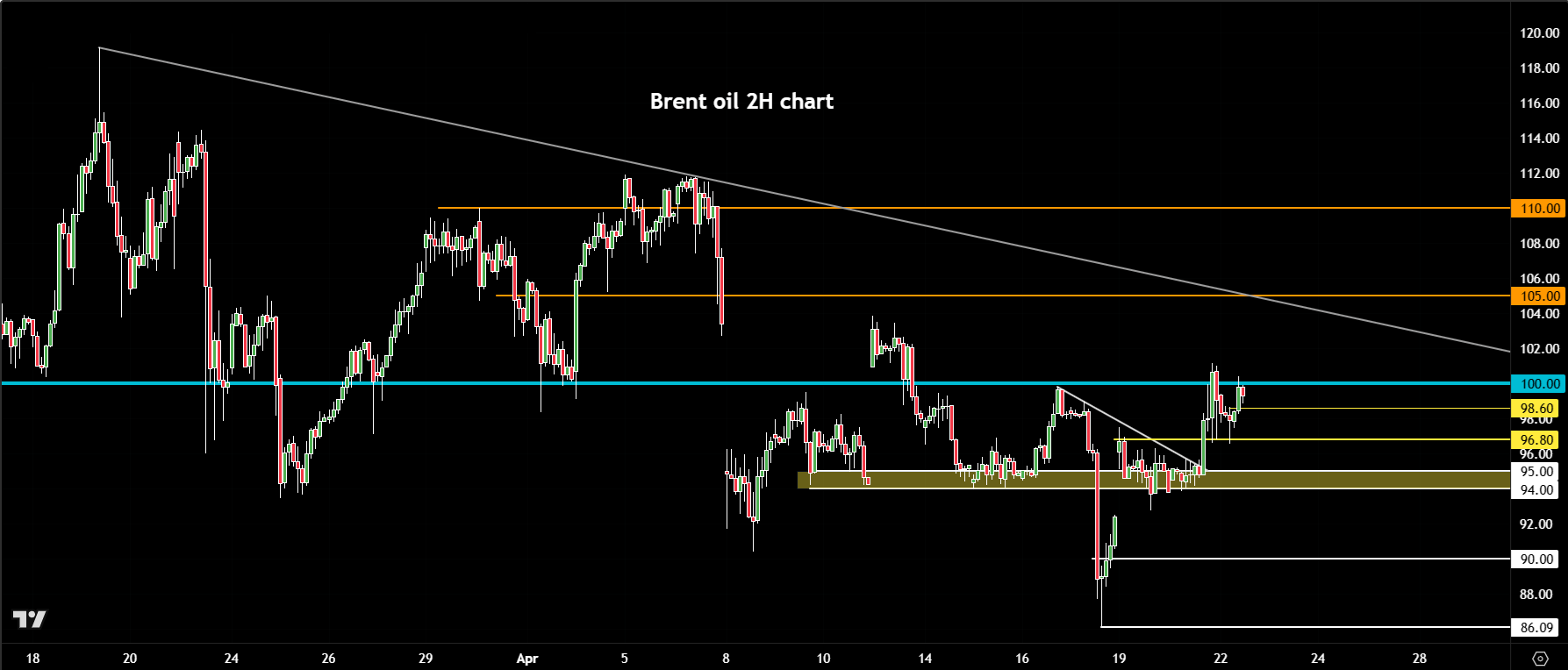
Since then, crude oil prices have rebounded and retested the $100 level, though they were pulling back again at the time of writing. In this crude oil analysis, it’s clear that $100 remains a key psychological and technical resistance. A sustained break and hold above this level could open the door to a potentially much stronger recovery than what we’ve seen in recent sessions.
If that upside momentum builds, the next resistance levels to watch come in around $103, followed by $105, and then $110—particularly if there’s a meaningful escalation in the conflict.
On the flip side, without further escalation, oil prices may continue to trade in a range, moving from level to level as markets wait for clearer direction from ongoing talks between the two sides.
In terms of support, the first level to watch sits around $98.50. Below that, $96.60 comes into focus, followed by the $94–$95 zone. This area marks range where prices were trading for several days before the latest breakout higher.
A move back below $94 would start to shift the outlook more negatively and suggest that the recent bullish momentum is beginning to fade.

-- Written by Fawad Razaqzada, Market Analyst
Follow Fawad on Twitter @Trader_F_R