
- Nvidia’s historic rally revives Japan’s AI trade
- Japanese AI stocks show heightened Nvidia sensitivity
- Intraday correlations warn against chasing opening strength
- Nikkei bulls face overhead resistance zone above 58,500
Nvidia’s largest percentage gain in more than 23 years following the reinstatement of Jensen Huang as CEO has breathed new life into the AI and US economic exceptionalism trades, delivering the largest single-session increase in market capitalisation in stock market history.
It also resuscitates the picks and shovels trade among upstream suppliers of AI infrastructure, including those in Japan, where many of the names caught up in the recent AI rout could see substantial gains as trading resumes following Monday’s public holiday.
However, whether Monday’s rapid rebound marks the start of a more durable recovery for the sector remains unanswered. Concerns surrounding the sustainability of AI capex, the ability to generate sufficient returns on investment and the availability and cost of financing amid renewed expectations for Fed tightening have not gone away. Nor have the political risks surrounding the pace of AI infrastructure investment in the US, with calls from some Democrats to slow the buildout.
Given how oversold many AI names were heading into the shock intervention from the Trump administration, you’d be hard-pressed to describe the price action as anything other than a short squeeze of biblical proportions at this stage. While our Japan 225 contract has rebounded sharply from its recent lows, from a technical perspective, the all-clear is nowhere near being given.
Opening strength, intraday doubts
Even with Friday’s rout, Nvidia shares have gained 13.1% since Japanese cash equities last traded, pointing to the potential for a sizeable squeeze in some of Japan’s best-known AI-linked names.
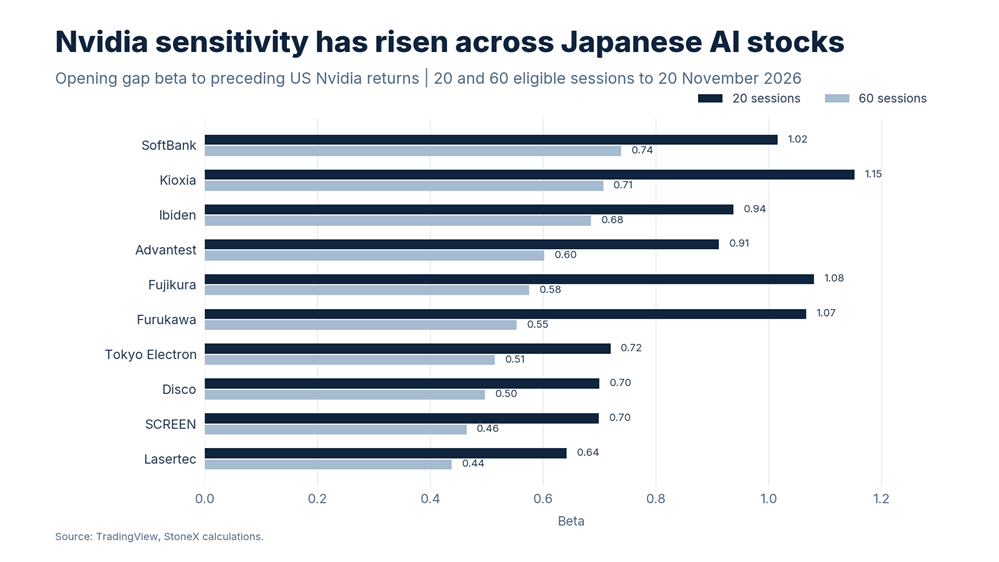
As seen in the graphic below, the sensitivity of opening price gaps to movements in Nvidia shares during US trade has increased across all 10 Japanese AI names assessed over the past month. Kioxia, Fujikura, Furukawa Electric and SoftBank have all recorded opening gap betas above one over the past 20 sessions, meaning their initial reaction to movements in Nvidia has tended to be amplified.
Source: TradingView
While caution is warranted given the unexpected nature of Huang’s reinstatement and the sheer scale of Nvidia’s rally, the figures give a sense of which names may see the most pronounced reaction.
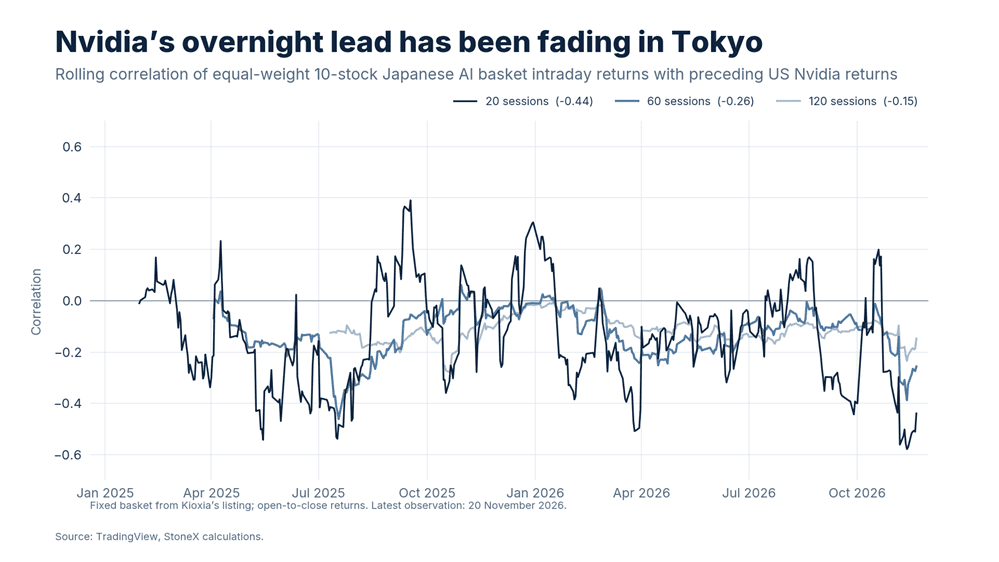
However, it’s what happens afterwards that may be of more interest to intraday traders. As shown below, the relationship between Nvidia’s overnight performance and how Japanese AI stocks trade from the Tokyo open to close has turned unusually negative recently.
Source: TradingView
In simple terms, strength in Nvidia has recently been associated with Japanese AI stocks giving back ground after the open, and vice versa when Nvidia has declined. While historical studies always need to be treated with caution, it provides a reason to be wary of chasing opening strength today.
An outsized AI influence
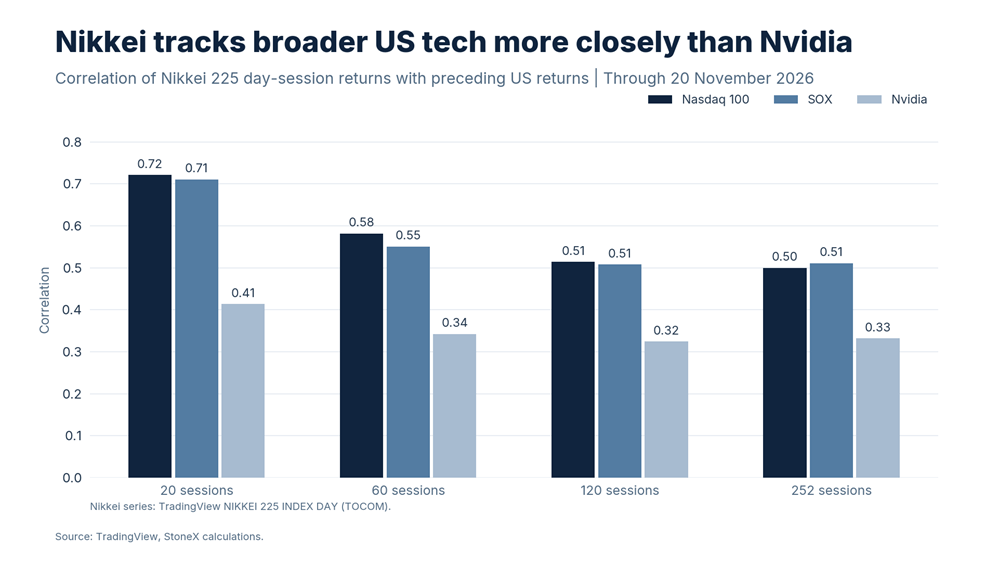
While Nvidia is an important piece of the jigsaw puzzle for Japan’s AI names given its role in both supplying and financing the AI infrastructure buildout, the broader Nikkei index has shown a far stronger relationship with the wider US technology sector.
That relationship has strengthened over shorter timeframes, with correlations between daily Nikkei returns and preceding US-session returns for the Nasdaq 100 and Philadelphia Semiconductor Index (SOX) sitting at +0.69 and +0.64 respectively over the past 10 sessions, compared with around +0.50 over the past year. Interestingly, the correlation with Nvidia has been virtually non-existent over the past 10 sessions at +0.07.
Source: TradingView
What I find interesting is just how volatile the Nikkei has been relative to the Nasdaq 100 recently, despite its exposure to a far broader range of cyclical sectors. Over the past 20 sessions, the standard deviation of daily returns for the Nikkei has been 2.25%, only marginally below the 2.47% recorded by the Nasdaq 100. Over the past year, the Nikkei has actually been more than 36% more volatile than its US counterpart, underlining just how influential a handful of AI names have become in driving the performance of Japan’s price-weighted benchmark index.
Japan 225: Squeeze meets resistance
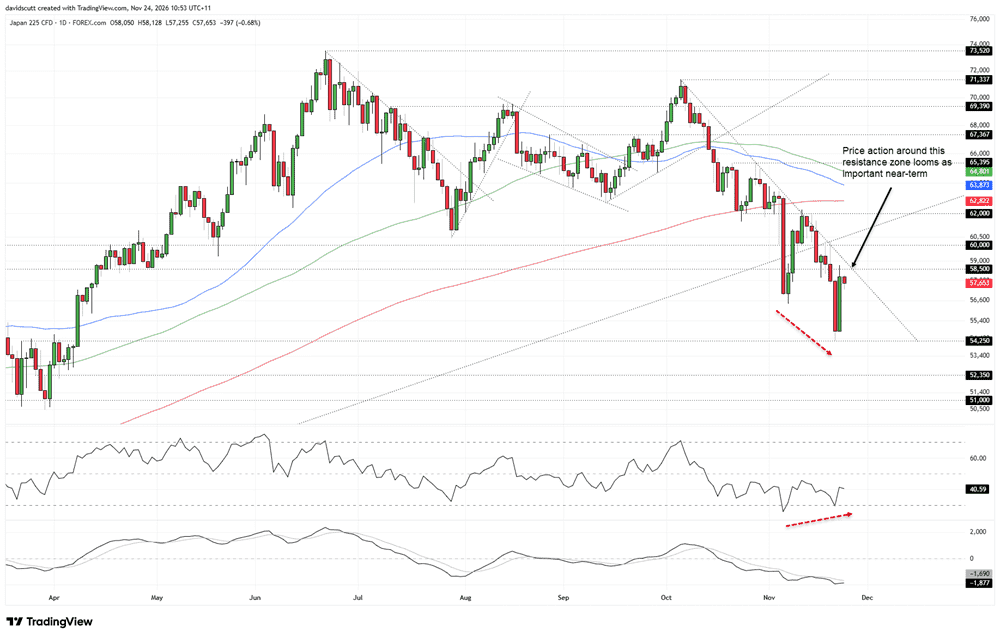
After tagging support at 54,250 late last week, the rebound in our Japan 225 contract has taken the price back to 58,500, a level that previously acted as both support and resistance. The price briefly traded through it prior to today’s cash market open but couldn’t sustain the move. With downtrend resistance dating back to the October high located in close proximity, this is the zone to watch today.
A sustained break above both would suggest the index may be embarking on a new trend, be it sideways or higher, putting 60,000, 62,000 and the 200-day moving average on the radar. However, failure to reclaim 58,500 may see a retracement take place, potentially back towards 54,250. While the strength on Wall Street suggests that’s unlikely in the near term, plenty of questions remain unanswered well beyond Huang’s reinstatement.
Source: TradingView
Adding to the cautious tone, the price remains beneath its major moving averages, with both the 50 and 100-day moving averages sloping lower. It would likely take a close above 62,000 to start talking seriously about the resumption of an uptrend and a potential retest of the record highs.
As for momentum, RSI (14) remains beneath the neutral 50 level, although the emergence of bullish divergence is a warning for the bears. MACD continues to sit beneath its signal line in negative territory, yet to confirm the shift in momentum signalled by RSI (14), although a bullish crossover may not be far away.
Regardless of your directional bias, given the extraordinary levels of volatility we’re witnessing, appropriate position sizing and assessment of risk-reward are paramount.