




DAX: EUR/USD parity has big implications for European indices
The recent price action in EUR/USD should serve as a reminder of the importance of the FX market, even if you’re not trading it directly.
Share this:

As my colleague Fawad Razaqzada noted this morning, the world’s most widely-traded currency pair falling to the critical psychological level of parity (1.00) for the first time in nearly 20 years is a momentous event in the forex market, but the implications of widespread US dollar strength reach far beyond the currency market itself.
One of the clearest cross-market impacts of FX market fluctuations is on stock market indices. Generally speaking, a strengthening currency can boost total returns of assets in that currency, whereas investments denominated in a depreciating currency face a headwind from the so-called “foreign currency effect.” From the perspective of a European trader, if the dollar strengthens relative to the euro, it boosts the return of the Dow Jones Industrial Average (Wall Street) relative to euro-denominated indices like the DAX (Germany 40).
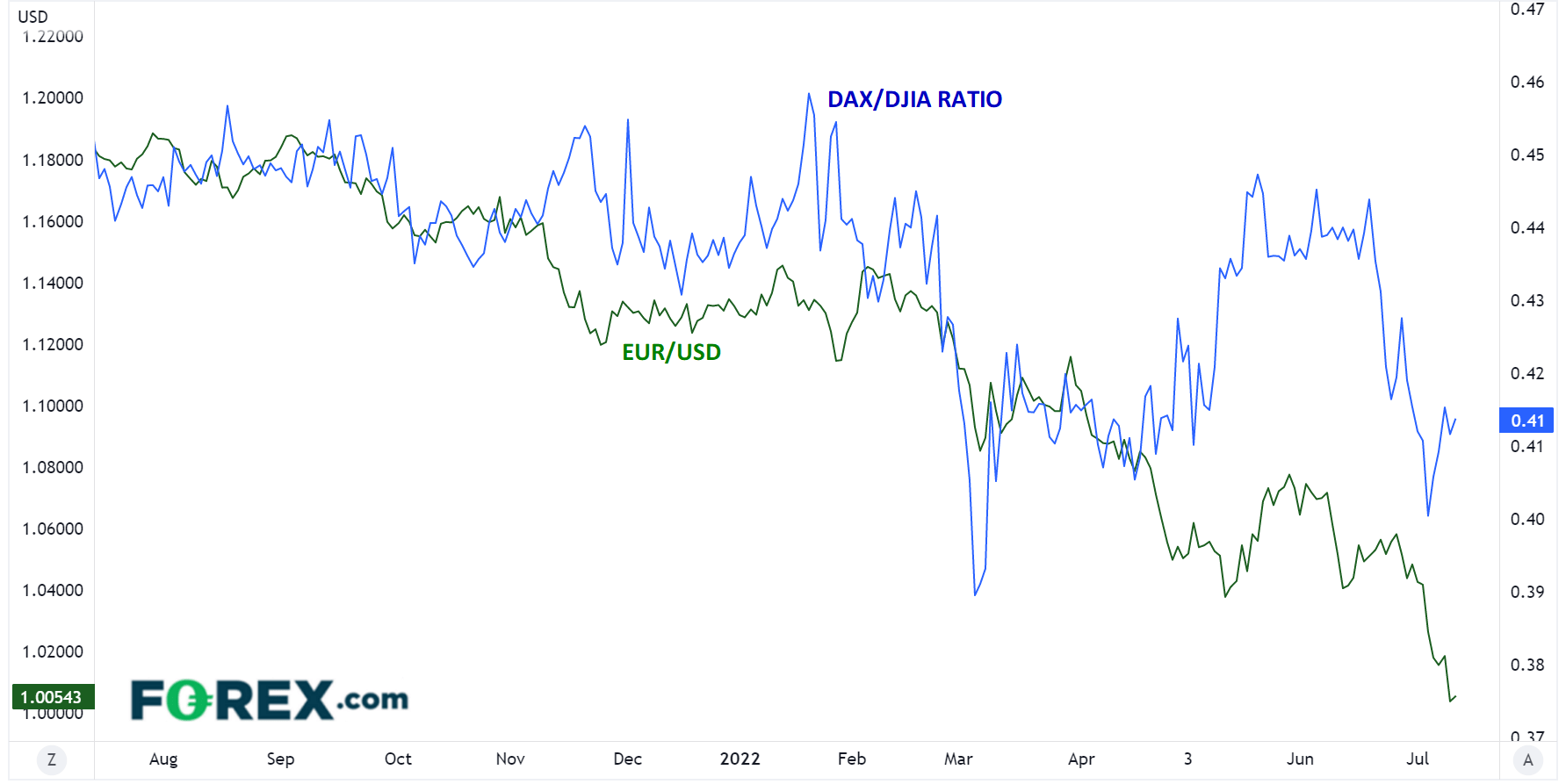
The chart below shows that effect in action:
Source: StoneX, TradingView
Over the last year, the EUR/USD exchange rate (green line, left axis) has fallen from roughly 1.18 last July to the aforementioned parity level today; at the same time, a ratio chart of Germany’s DAX index relative to the Dow Jones Industrial Average (blue line, right axis) has dropped from 0.45 to 0.41. While the move doesn’t sound particularly dramatic, it can have an underappreciated impact on medium- and long-term positions, especially when there are high-volatility moves in the FX market as we’re seeing of late.
The upshot for traders is clear: If you expect the US dollar to continue to strengthen relative to the euro, it makes sense to favor long positions in US indices and short positions in European-based (or other non-US-based) indices, all else equal.
Of course, all else is never exactly equal when it comes to trading, but at a minimum, the recent price action in EUR/USD should serve as a reminder of the importance of the FX market, even if you’re not trading it directly.
How to trade with FOREX.com
Follow these easy steps to start trading with FOREX.com today:
- Open a Forex.com account, or log-in if you’re already a customer.
- Search for the pair you want to trade in our award-winning platform.
- Choose your position and size, and your stop and limit levels.
- Place the trade.
As my colleague Fawad Razaqzada noted this morning, the world’s most widely-traded currency pair falling to the critical psychological level of parity (1.00) for the first time in nearly 20 years is a momentous event in the forex market, but the implications of widespread US dollar strength reach far beyond the currency market itself.
One of the clearest cross-market impacts of FX market fluctuations is on stock market indices. Generally speaking, a strengthening currency can boost total returns of assets in that currency, whereas investments denominated in a depreciating currency face a headwind from the so-called “foreign currency effect.” From the perspective of a European trader, if the dollar strengthens relative to the euro, it boosts the return of the Dow Jones Industrial Average (Wall Street) relative to euro-denominated indices like the DAX (Germany 40).
The chart below shows that effect in action:
Source: StoneX, TradingView
Over the last year, the EUR/USD exchange rate (green line, left axis) has fallen from roughly 1.18 last July to the aforementioned parity level today; at the same time, a ratio chart of Germany’s DAX index relative to the Dow Jones Industrial Average (blue line, right axis) has dropped from 0.45 to 0.41. While the move doesn’t sound particularly dramatic, it can have an underappreciated impact on medium- and long-term positions, especially when there are high-volatility moves in the FX market as we’re seeing of late.
The upshot for traders is clear: If you expect the US dollar to continue to strengthen relative to the euro, it makes sense to favor long positions in US indices and short positions in European-based (or other non-US-based) indices, all else equal.
Of course, all else is never exactly equal when it comes to trading, but at a minimum, the recent price action in EUR/USD should serve as a reminder of the importance of the FX market, even if you’re not trading it directly.
How to trade with City Index
You can trade with City Index by following these four easy steps:
- Open an account, or log in if you’re already a customer
• Open an account in the UK
• Open an account in Australia
• Open an account in Singapore
- Search for the market you want to trade in our award-winning platform
- Choose your position and size, and your stop and limit levels
- Place the trade
Related tags:



The complete CFD trading experience
Award-winning platforms, competitive spreads, low commissions and dedicated support.
We live and breathe the markets and are dedicated to helping traders realise their ambitions as we continue to set the industry bar.
Economic calendar
Web Trader platform
Our sophisticated web-based platform is packed with features.
Related articles

S&P 500 forecast: Stocks extend drop as correction risks grow
US and global equity markets have extended Wednesday’s sell-off, with Wall Street opening lower after a weak handover from Asia and Europe. The deterioration in risk appetite has been spreading across global markets. The dollar was firmer, Treasury yields were holding onto yesterday’s gains, while gold, silver and bitcoin were all under pressure alongside equities and major currencies.

GBP/USD, DJIA Outlook: Support Levels Meet Oversold Risks
GBP/USD and the Dow test key support levels as rising Treasury yields, Fed rate-hike expectations and oversold momentum increase reversal risks.


EUR/USD, Nasdaq Price Outlook: Reversal Risks Build
EUR/USD and Nasdaq Price Outlook: Overbought/oversold momentum on hourly and daily time frames is raising reversal risks across the U.S. dollar, EUR/USD and Nasdaq after a strong weekly advance.
StoneX Europe Ltd may make third party material available on this website which may contain information included but not limited to the conditions of financial markets. The material is for information purposes only and does not contain, and should not be construed as containing, investment advice and/or investment recommendation and/or an investment research and/or an offer of or solicitation for any transactions in financial instruments; any decision to enter into a specific transaction shall be made by the client following an assessment by him/her of their situation.
StoneX Europe Ltd makes no representation or warranty and assumes no liability as to the accuracy or completeness of the information provided, nor any loss arising from any investment based on a recommendation, forecast or other information supplied. You should always seek independent advice as to your suitability to speculate in any related markets and your ability to assume the associated risks, if you are at all unsure. We are not under any obligation to update any such material. Any opinion made may be personal to the author and may not reflect the opinion of StoneX Europe Ltd.