


Gold forecast undermined by oil, yields and dollar strength
Strong oil prices and continued hawkish rhetoric from central banks are keeping the metal under pressure. The resulting rise in bond yields and expectations of tighter monetary policy have dampened appetite from dip-buyers at these relatively elevated levels, leaving the near-term bias leaning slightly to the downside.
Share this:

Gold was up 0.7% earlier, but it has been trending lower in recent times. Strong oil prices and continued hawkish rhetoric from central banks are keeping the metal under pressure. The resulting rise in bond yields and expectations of tighter monetary policy have dampened appetite from dip-buyers at these relatively elevated levels, leaving the near-term bias leaning slightly to the downside. At the same time, there is a bit of counterbalance. Safe-haven demand remains present amid ongoing tensions in the Middle East, even if its influence has faded somewhat as gold is increasingly treated as a risk-sensitive asset. Nonetheless, the need to hedge against inflation, alongside persistent central bank buying, has helped limit deeper downside moves so far. Against these conflicting forces, the near-term gold forecast remains tilted to the downside.
From my perspective, the ongoing uncertainty surrounding the Strait of Hormuz continues to act as a floor beneath oil prices. As long as that risk remains in play, it’s difficult to see crude pulling back meaningfully. If oil continues to grind higher, the dollar should stay supported, particularly against currencies from energy-importing regions such as the eurozone. In that environment, gold is likely to remain under pressure.
Key US data to impact gold forecast this week
Last week’s hawkish tone from the Fed (and other central banks), combined with stubbornly high energy prices, has clearly shifted the narrative. Markets are now toying with the idea of some additional tightening this year from the Fed. In other words, we’ve moved beyond simply delaying rate cuts: there’s now a genuine question as to whether policymakers may lean back towards tightening in response to renewed inflation pressures. For the Fed, the key issue is whether policymakers feel greater pressure from inflation or from any signs of softening in the labour market. That’s where this week’s data becomes crucial.
On the employment side, we have JOLTS today, ADP tomorrow, and non-farm payrolls on Friday. On the inflation front, the prices paid component of the ISM services PMI will also be closely watched today. If that begins to tick higher, alongside rising market-based inflation expectations, the Fed may be pushed more decisively towards prioritising price stability again.
The broader inflation outlook remains closely tied to the oil shock and whether second-round effects begin to emerge. That dynamic is already influencing global policy, with the Reserve Bank of Australia opting to deliver another rate hike in its current tightening cycle.
Unless we see meaningful progress towards stability in the Gulf, elevated oil prices are likely to keep short-end US yields, and by extension, the dollar underpinned. That combination is not good for the near-term gold forecast.
Gold technical analysis
The technical picture for gold remains mixed, though with a modest bearish tilt in the near term. Price action has produced a sequence of lower highs, while the market continues to trade below the 21-day moving average, which is itself trending lower. That keeps the short-term direction pointed down.
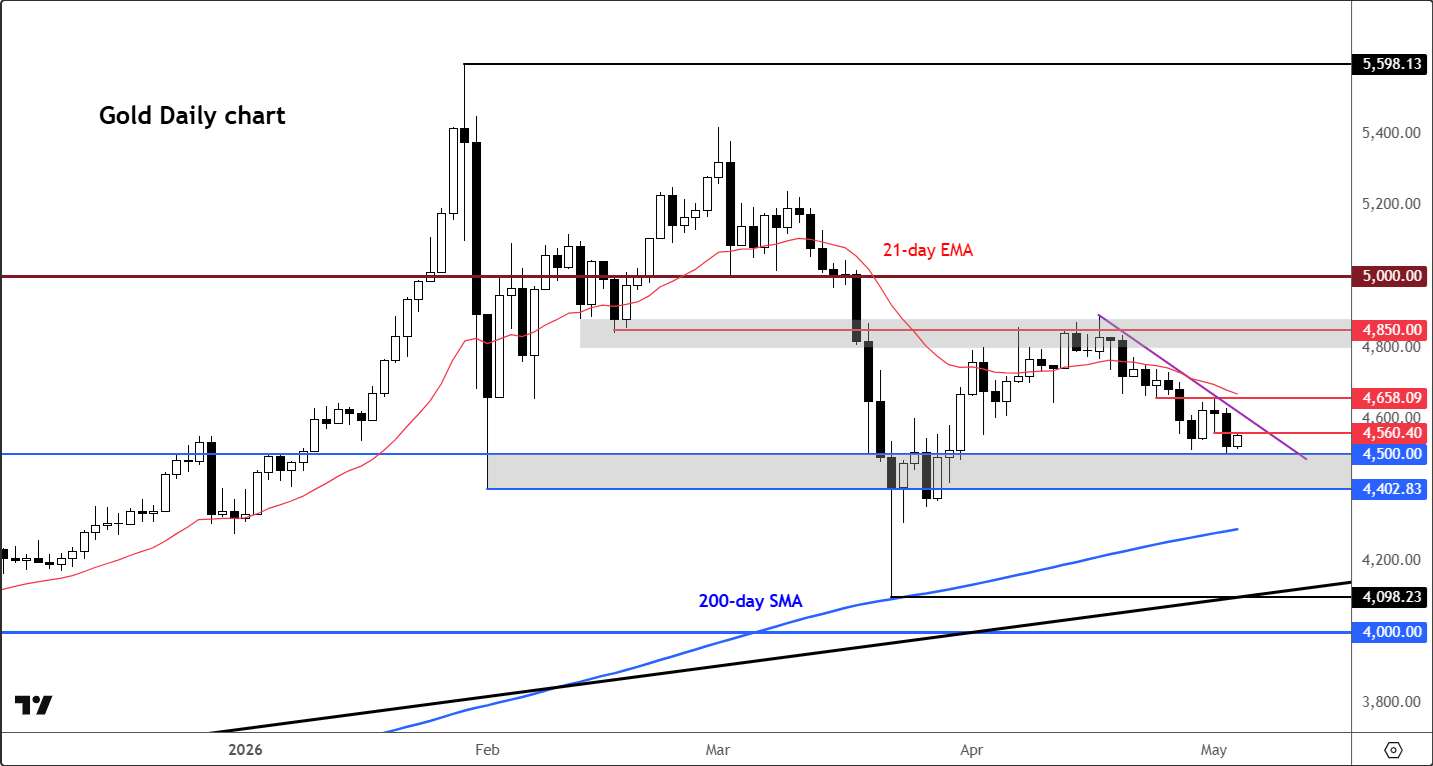
However, the longer-term structure remains intact on XAUUSD. The 200-day moving average is still rising, suggesting the longer term trend is positive — at least for now.
The metal was testing the $4,550–$4,560 region at the time of writing. This area had previously acted as support before breaking during the latest sell-off yesterday. Let’s see what gold does here.
Should gold break above that region, the $4,645–$4,660 zone stands out as the next key short-term resistance area. As long as that caps upside attempts, the near-term bias remains skewed lower.
For now, though, this still looks like a market more suited to range trading rather than chasing momentum. The geopolitical backdrop, particularly surrounding Iran, should continue to keep price action relatively contained.
On the downside, $4,500 is the first level to watch, followed by $4,400 should selling pressure begin to build.

-- Written by Fawad Razaqzada, Market Analyst
Follow Fawad on Twitter @Trader_F_R
Latest market news




The complete CFD trading experience
Award-winning platforms, competitive spreads, low commissions and dedicated support.
We live and breathe the markets and are dedicated to helping traders realise their ambitions as we continue to set the industry bar.
Economic calendar
Web Trader platform
Our sophisticated web-based platform is packed with features.
Related articles
Gold Q4 2026 outlook: Resilience in the face of rallying dollar and yields
As we headed towards the latter stages of Q3 and into Q4, the Fed had just hiked rates in a hawkish FOMC meeting, while the likes of the ECB and BoJ had also tightened their respective policies. Oil prices remained elevated amid the prolonged US-Iran conflict. Meanwhile, bond yields were breaking out, and the dollar was higher across the board. Yet, remarkably, gold was still holding in the positive territory for the third quarter, even if it had weakened somewhat in September.

Oil Quietly Hands the Fed a Reason to Stay Hawkish
Oil prices and the U.S. dollar are both on the front foot as elevated energy costs feed Fed warnings that inflation may prove sticky.

S&P 500 forecast: Stocks extend drop as correction risks grow
US and global equity markets have extended Wednesday’s sell-off, with Wall Street opening lower after a weak handover from Asia and Europe. The deterioration in risk appetite has been spreading across global markets. The dollar was firmer, Treasury yields were holding onto yesterday’s gains, while gold, silver and bitcoin were all under pressure alongside equities and major currencies.
StoneX Europe Ltd may make third party material available on this website which may contain information included but not limited to the conditions of financial markets. The material is for information purposes only and does not contain, and should not be construed as containing, investment advice and/or investment recommendation and/or an investment research and/or an offer of or solicitation for any transactions in financial instruments; any decision to enter into a specific transaction shall be made by the client following an assessment by him/her of their situation.
StoneX Europe Ltd makes no representation or warranty and assumes no liability as to the accuracy or completeness of the information provided, nor any loss arising from any investment based on a recommendation, forecast or other information supplied. You should always seek independent advice as to your suitability to speculate in any related markets and your ability to assume the associated risks, if you are at all unsure. We are not under any obligation to update any such material. Any opinion made may be personal to the author and may not reflect the opinion of StoneX Europe Ltd.