


Australian Dollar Outlook: Bullock, GDP and NFP Raise the Stakes for AUD/USD
AUD/USD faces a pivotal week as Governor Bullock, Australian GDP, China PMIs, US ISM surveys and nonfarm payrolls shape the outlook.
Share this:

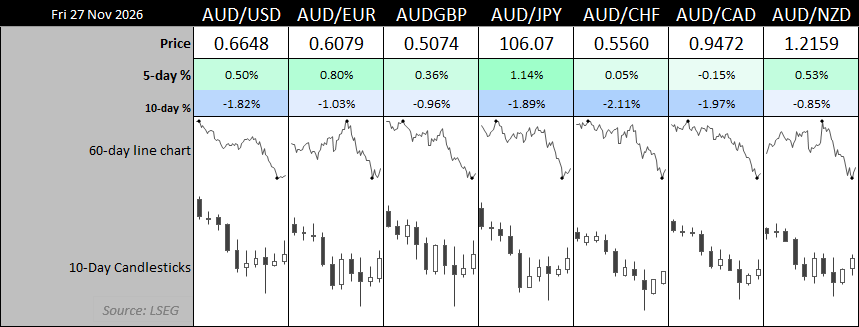
AUD/USD found support after falling to an 11-month low, but its recovery now faces one of the busiest economic calendars in several weeks. Governor Bullock and Australian GDP dominate the domestic schedule, while China’s PMIs will test the regional growth backdrop.
Attention then turns to the US ISM surveys and nonfarm payrolls, which could reshape expectations for further Fed tightening. With short-dated implied volatility rising and the AU–US yield spread still under pressure, the week offers several potential catalysts for the Australian dollar.
AUD/USD Faces Australian GDP and US Payrolls Test
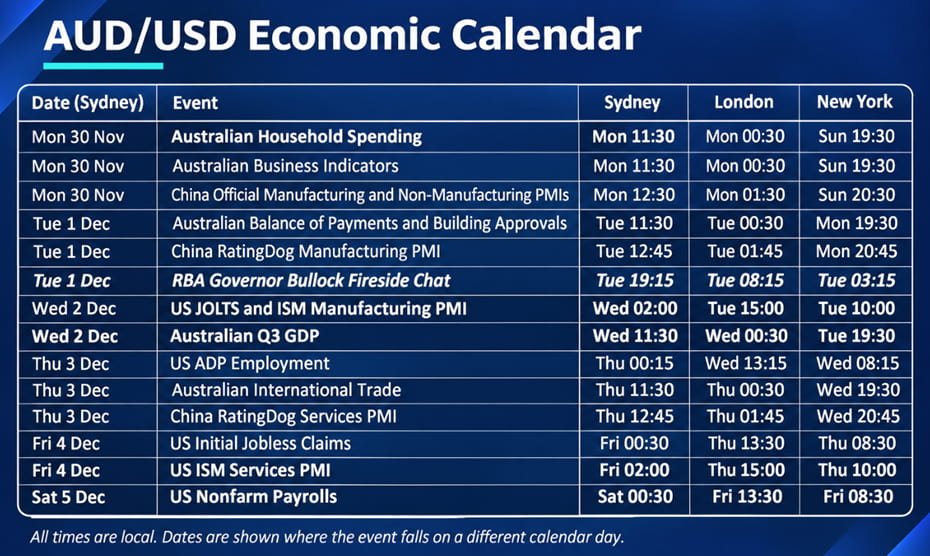
Australian Economic Events: GDP and Bullock Take Centre Stage
Australian events dominate the first half of the week. Household spending and business indicators will help refine expectations for Wednesday’s GDP report, while Tuesday’s balance-of-payments data will reveal how much net exports added to or subtracted from growth. These releases are more useful as pieces of the GDP puzzle than as standalone drivers of the Australian dollar.
Governor Bullock’s Tuesday evening appearance could be more immediately important. Traders will be looking for how the RBA balances stronger inflation against a weakening labour market ahead of next week’s policy decision.
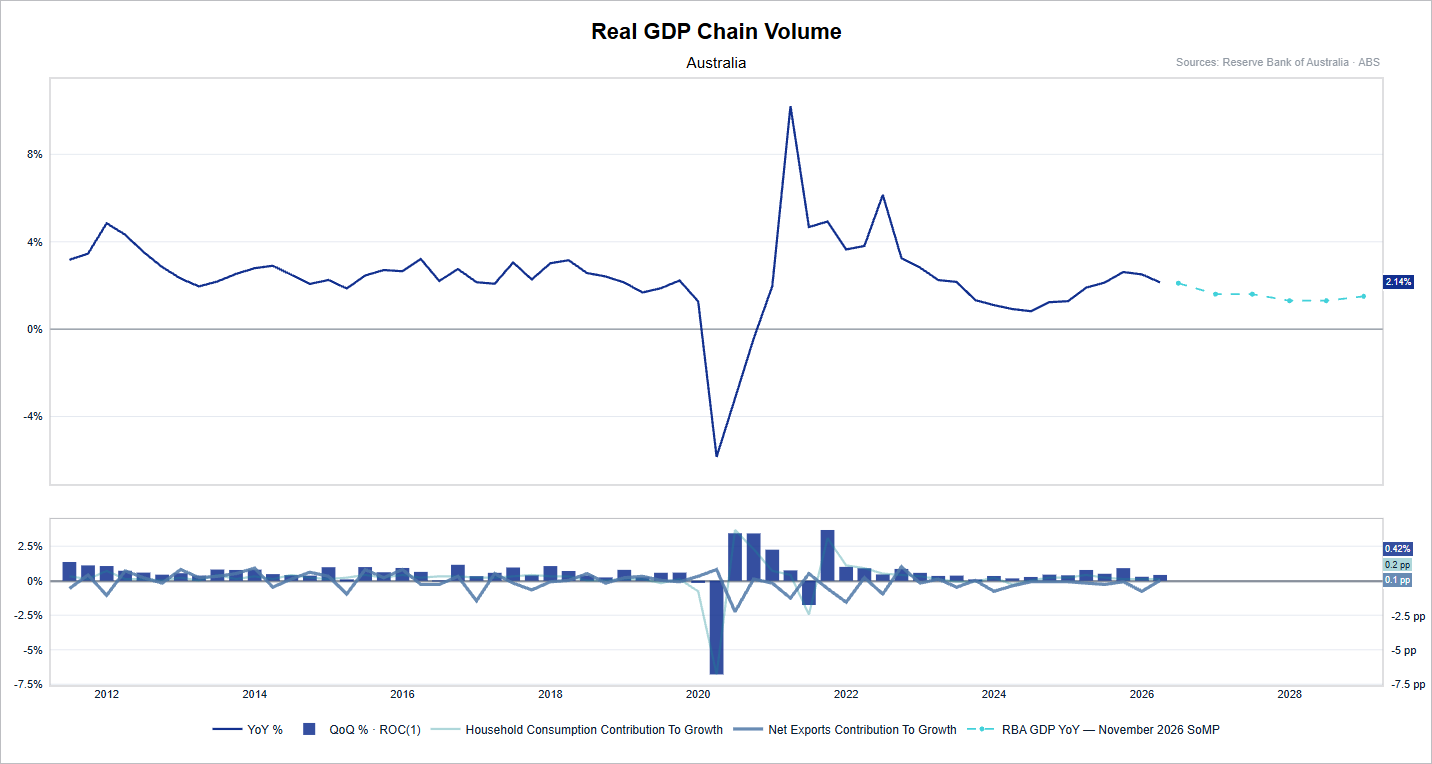
After household consumption and net exports contributed only modestly last quarter, Q3 GDP is expected to rise by around 0.5%, supported by booming data-centre investment. However, much of that equipment was imported, so household consumption, GDP per capita and productivity will provide a better indication of underlying economic strength. A strong headline driven narrowly by investment may not be as AUD-positive as broad-based growth.
US Economic Events: ISM Surveys and Payrolls Test Fed Pricing
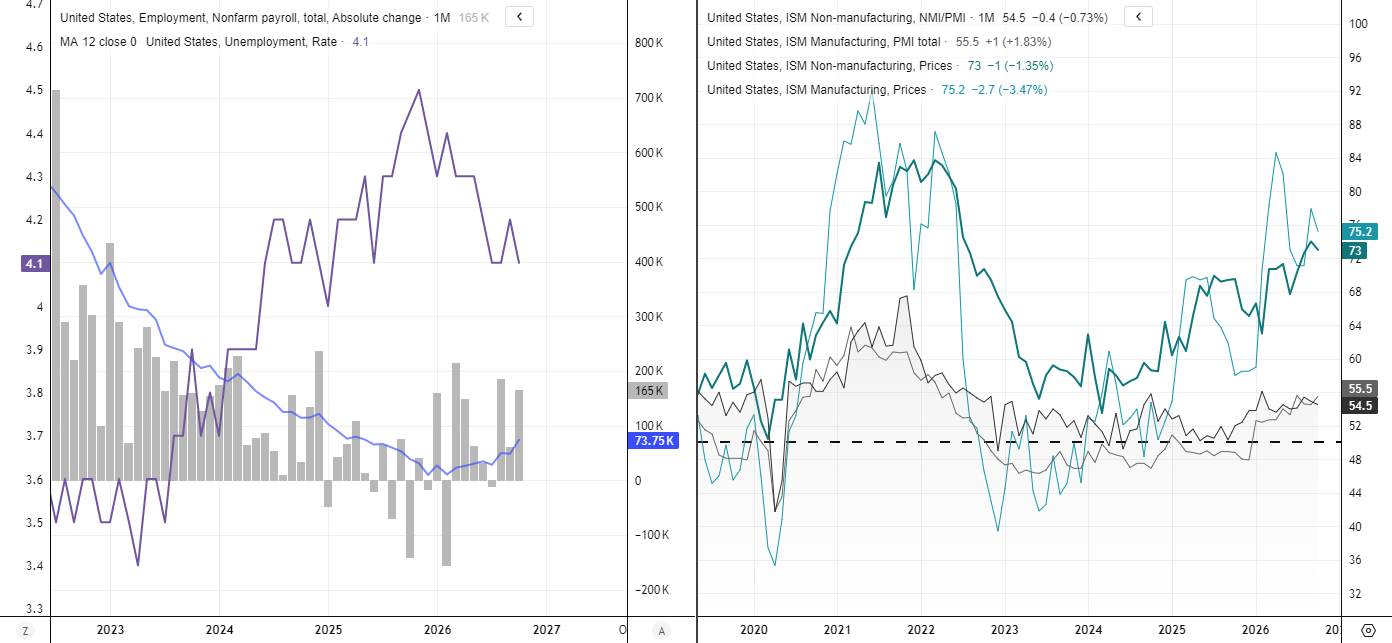
The focus then shifts to the US ISM surveys and Friday’s employment report—released early Saturday morning in Sydney. Manufacturing and services remain comfortably above the 50 expansion threshold, while both prices-paid indexes are above 70. Firm activity combined with persistent cost pressures would strengthen the case for further Fed tightening and present a headwind for AUD/USD.
Nonfarm payrolls are expected to slow to around 90,000 after October’s unusually strong 165,000 increase. However, the 12-month average has fallen to roughly 74,000, highlighting the broader slowdown and recent volatility in job creation. Unemployment and average hourly earnings may therefore carry more weight than the headline. Another strong report—particularly alongside firmer wages—would reinforce Fed hike expectations, while a meaningful downside surprise could provide AUD/USD with some relief.
China PMIs Could Shape Australian Dollar Sentiment
China’s official PMIs are expected to show manufacturing and services remaining just below the 50 expansion threshold. Continued weakness would reinforce concerns about domestic Chinese demand and could weigh on the Australian dollar and commodity prices. A surprise return to expansion would provide a more supportive backdrop, although the private RatingDog surveys later in the week may again present a firmer picture than the official data.

AUD/USD Technical Analysis: Australian Dollar vs US Dollar
AUD/USD December Seasonality
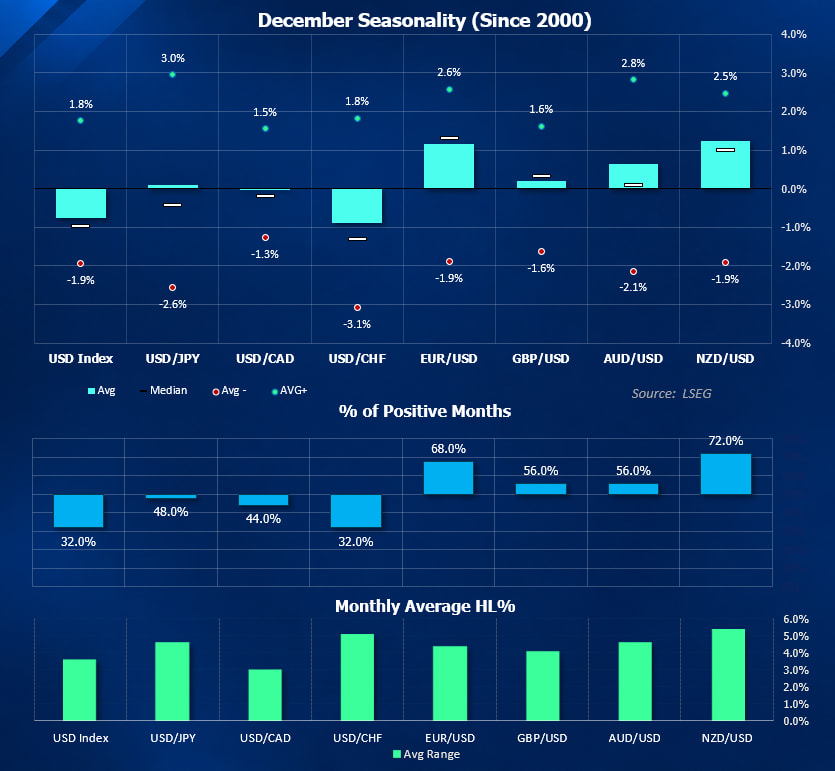
A reminder that December tends to be bearish for the US dollar, helping AUD/USD deliver an average return of 0.6%. However, its median return is just 0.1%, showing that the average is not as robust as the headline suggests.
The intramonth analysis in Friday’s article on December seasonality for FX majors showed that AUD/USD gains tend to arrive very late in the month—particularly during the final two trading days. Still, AUD/USD has posted a 56% win rate since 2000. Its average return during bullish Decembers has been 2.8%, compared with an average loss of 2.1% during bearish months.
AUD/USD Correlations
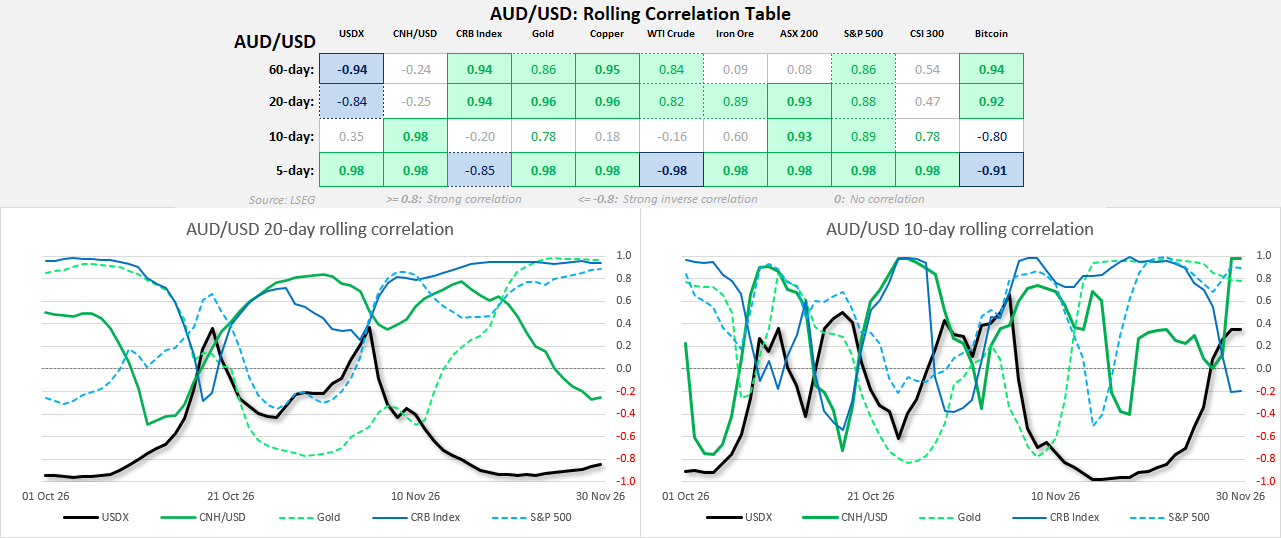
- The US dollar remains the dominant medium-term driver: AUD/USD holds a strong inverse relationship with DXY across the 20- and 60-day windows.
- The yuan is the best short-term confirmation: CNH/USD correlation has surged to 0.98 over 10 days, making yuan direction particularly relevant this week.
- Risk appetite matters: AUD/USD remains closely aligned with the ASX 200 and S&P 500, so equity weakness would likely limit any Aussie rebound.
- Treat the five-day readings cautiously: Almost every relationship has jumped towards ±1, signalling a short-lived market regime rather than reliable longer-term correlations.
This content was created by an affiliate of FOREX.com and represents the views and opinions of the author/speakers, not the views and opinions of FOREX.com, StoneX Group Inc., or its subsidiaries. The content has not been independently reviewed by FOREX.com.
AUD/USD Options and Yields Point to Two-Way Volatility
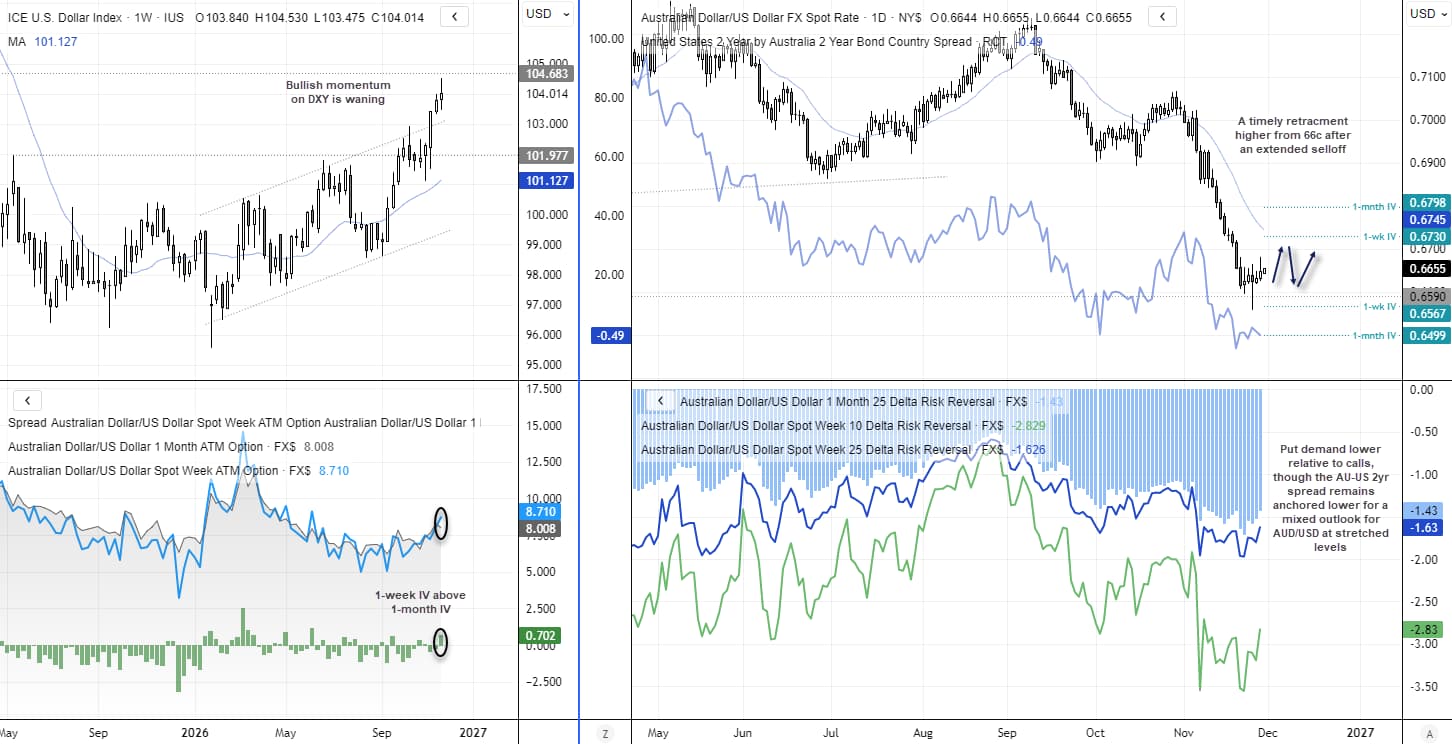
The trend is clearly pointing lower, though a shallow countertrend move is currently underway for AUD/USD. Upside volatility is also waning on the US dollar index, which formed a doji below resistance last week to hint at a pause in trend, or minor pullback.
Wednesday’s bullish pinbar marked a false break of 66c for AUD/USD, and the prior leg lower was already becoming arguably stretched. Note that risk reversals are also lifting higher from their own recent lows to suggest a reduction of put demand relative to calls, but with the AU-US 2yr yield remaining anchored lower than it points towards natural retracement, not a trend reversal, at this stage. That said, the 1-week implied volatility is back above the 1-month to warn of incoming volatility amid a busy economic calendar. And with ISM and NFP likely to remain firm, perhaps bears will be seeking to fade into rallies towards 67c. But given clues overall, I am also not convinced AUD/USD will simply roll over below 66c immediately. We could be in for a week of two-way volatility.
Source: ICE, TradingView
View related analysis:



Open an account today
Experience award-winning platforms with fast and secure execution.
Economic calendar
Web Trader platform
Our sophisticated web-based platform is packed with features.
Related articles
Australian Dollar Outlook: Bullock, GDP and NFP Raise the Stakes for AUD/USD
AUD/USD faces a pivotal week as Governor Bullock, Australian GDP, China PMIs, US ISM surveys and nonfarm payrolls shape the outlook.

Gold weekly outlook: XAU/USD finally finds support but overhead resistance looms
The gold outlook remains uncertain following year-long selling. While the recent rebound is a welcome sign, this could just turn out to be an oversold bounce.

Nasdaq 100 forecast: Stocks rebound, but have markets found a floor?
US equities have recovered sharply after last week’s bruising sell-off, as confidence in Nvidia draws investors back into technology stocks. But a busy economic calendar, led by the November jobs report, will test whether the rebound has legs.
From time to time, StoneX Financial Pty Ltd (“we”, “our”) website may contain links to other sites and/or resources provided by third parties. These links and/or resources are provided for your information only and we have no control over the contents of those materials, and in no way endorse their content. Any analysis, opinion, commentary or research-based material on our website is for information and educational purposes only and is not, in any circumstances, intended to be an offer, recommendation or solicitation to buy or sell. You should always seek independent advice as to your suitability to speculate in any related markets and your ability to assume the associated risks, if you are at all unsure. No representation or warranty is made, express or implied, that the materials on our website are complete or accurate. We are not under any obligation to update any such material.
As such, we (and/or our associated companies) will not be responsible or liable for any loss or damage incurred by you or any third party arising out of, or in connection with, any use of the information on our website (other than with regards to any duty or liability that we are unable to limit or exclude by law or under the applicable regulatory system) and any such liability is hereby expressly disclaimed.