



Crude Oil, USD/JPY Outlook: Dollar and Oil Rebound as Hormuz Risks Persist
Crude Oil, USD/JPY Outlook: Crude oil and USD/JPY remain supported as Hormuz tensions keep geopolitical risk premiums elevated. Key technical levels to watch for WTI and USD/JPY.
Share this:

Persistent shifts in sentiment surrounding a potential US-Iran agreement continue to reinforce, rather than eliminate, geopolitical risks. As a result, both crude oil and the US Dollar Index (DXY) have regained ground, with the DXY holding above its 2026 uptrend support near 99.30 and WTI crude remaining firmly above the $70 mark.
The unresolved security framework surrounding the Strait of Hormuz—including future navigation and transit arrangements—remains one of the key obstacles preventing the conflict from transitioning into a durable ceasefire and the full resumption of shipping flows through the strait. Alongside the broader nuclear negotiations that remain central to any lasting resolution, these issues require a long-term political framework before markets can confidently price a sustained geopolitical de-escalation.

As discussed in my previous article, Crude Oil Outlook: What the 1973 Oil Embargo Tells Us About the 2026 Hormuz Crisis, the current environment may resemble historical episodes such as the 1973 oil embargo, when geopolitical uncertainty kept energy risk premiums elevated until durable security and political frameworks were established, supporting decades of stability in global energy markets. Similar conditions have yet to emerge in the 2026 Strait of Hormuz conflict.
The recent market reaction continues to reinforce this intermarket framework:
- The Dow Jones was the first major index to rally to fresh record highs before broader equity markets followed, while simultaneously testing a major higher-timeframe resistance zone. Dow Jones Outlook
- The US Dollar Index (DXY) corrected only to its 2026 uptrend support near 99.30, maintaining its broader bullish structure. DXY Outlook
- WTI and Brent crude oil continue to hold above their respective geopolitical risk premium zones near $66 and $70, suggesting markets have yet to fully price a lasting de-escalation.
Markets reward trends far more consistently than geopolitical headlines. Headlines may trigger volatility, but sustained trends require confirmation through price action. Current intermarket relationships continue to favor caution. Equity indices are testing major long-term resistance, Bitcoin remains unable to confirm the broader risk-on move, the US dollar continues to respect its 2026 bullish structure, and USD/JPY remains resilient despite persistent intervention risks. Together, these signals suggest that markets continue to price geopolitical uncertainty, elevated Treasury yields, and expectations for a more hawkish Federal Reserve as the dominant macro narrative.
Crude Oil Price Outlook: Weekly Time Frame – Log Scale
Source: TradingView
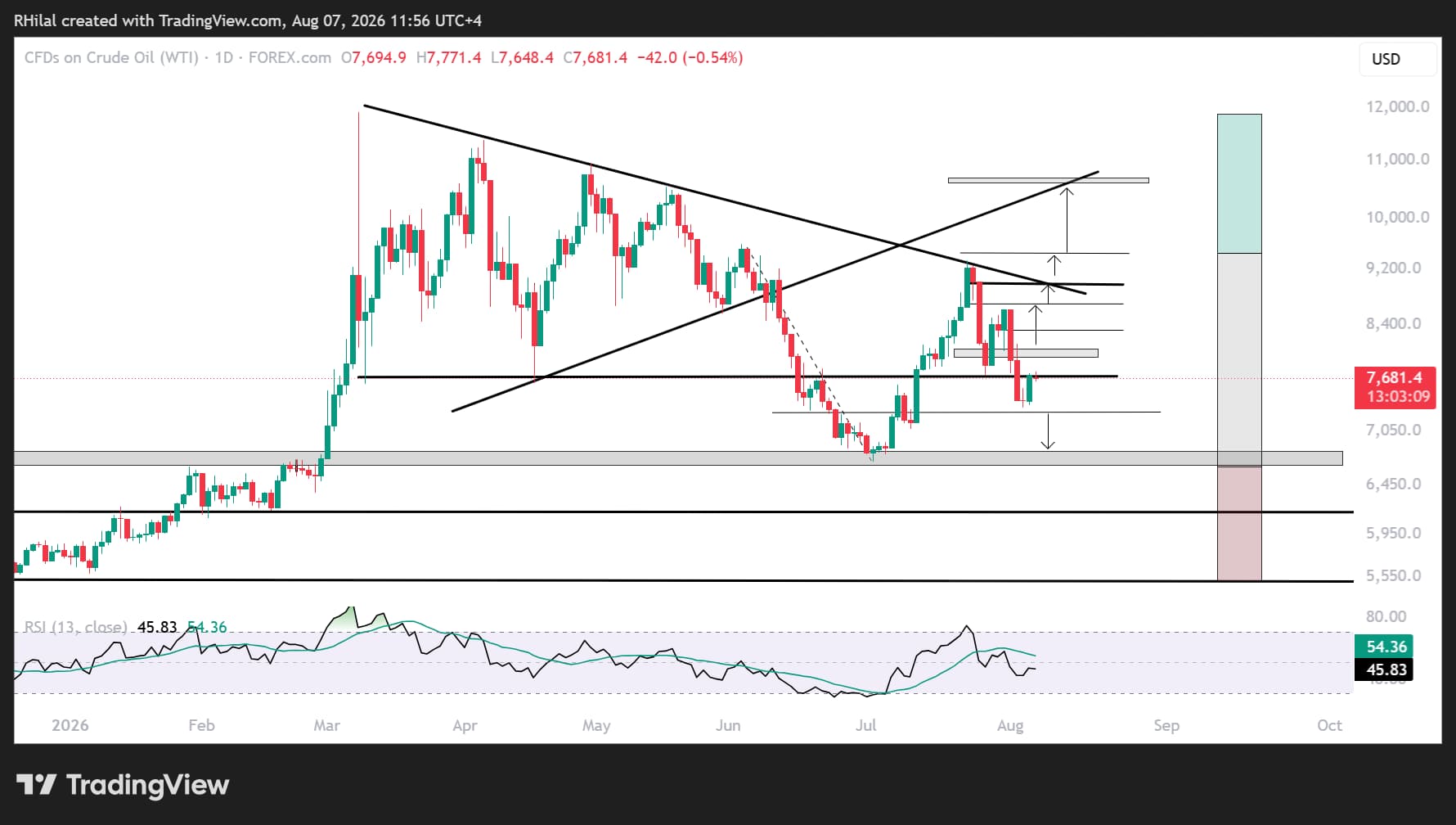
WTI crude oil's latest pullback found support near $72, corresponding with the 78.6% Fibonacci retracement of July's advance. Persistent US-Iran tensions helped stabilize prices above that level, reinforcing the broader bullish structure.
Price action continues to hold above the $70–72 support zone, maintaining the geopolitical risk premium embedded in oil prices. A sustained move above $77—the multi-month support level from March 2026 that has since turned into resistance—would expose the next Fibonacci extension levels derived from July's advance:
- $80.40 – 27.2% Fibonacci extension
- $83.30 – 38.2% Fibonacci extension
- $86.50 – 50% Fibonacci extension
- $89.60 – 61.8% Fibonacci extension, representing a major area where pullback risks may emerge as it aligns with the long-term trendline extending from the lower boundary of the March-June consolidation that preceded July's decline from $93 to $77.
Such a move would likely coincide with persistent tensions surrounding the Strait of Hormuz and continued disruptions to crude oil refining and supply chains. A sustained move into the $86.50–89.60 region would suggest markets are pricing another phase of geopolitical escalation, increasing broader market drawdown risks.
Bearish Scenario
Should WTI crude oil fall back below $72, attention would immediately shift to the $68–66.50 support zone.
This area continues to define the broader escalation versus de-escalation narrative for 2026, having repeatedly acted as both support and resistance since 2019. A weekly close below $66.50 would expose the 2026 lows near $55, signalling that markets are beginning to price a longer-term geopolitical de-escalation scenario. Such a development would likely improve global risk sentiment while easing inflationary pressures.
USD/JPY Outlook: Weekly Time Frame – Log Scale
Source: TradingView
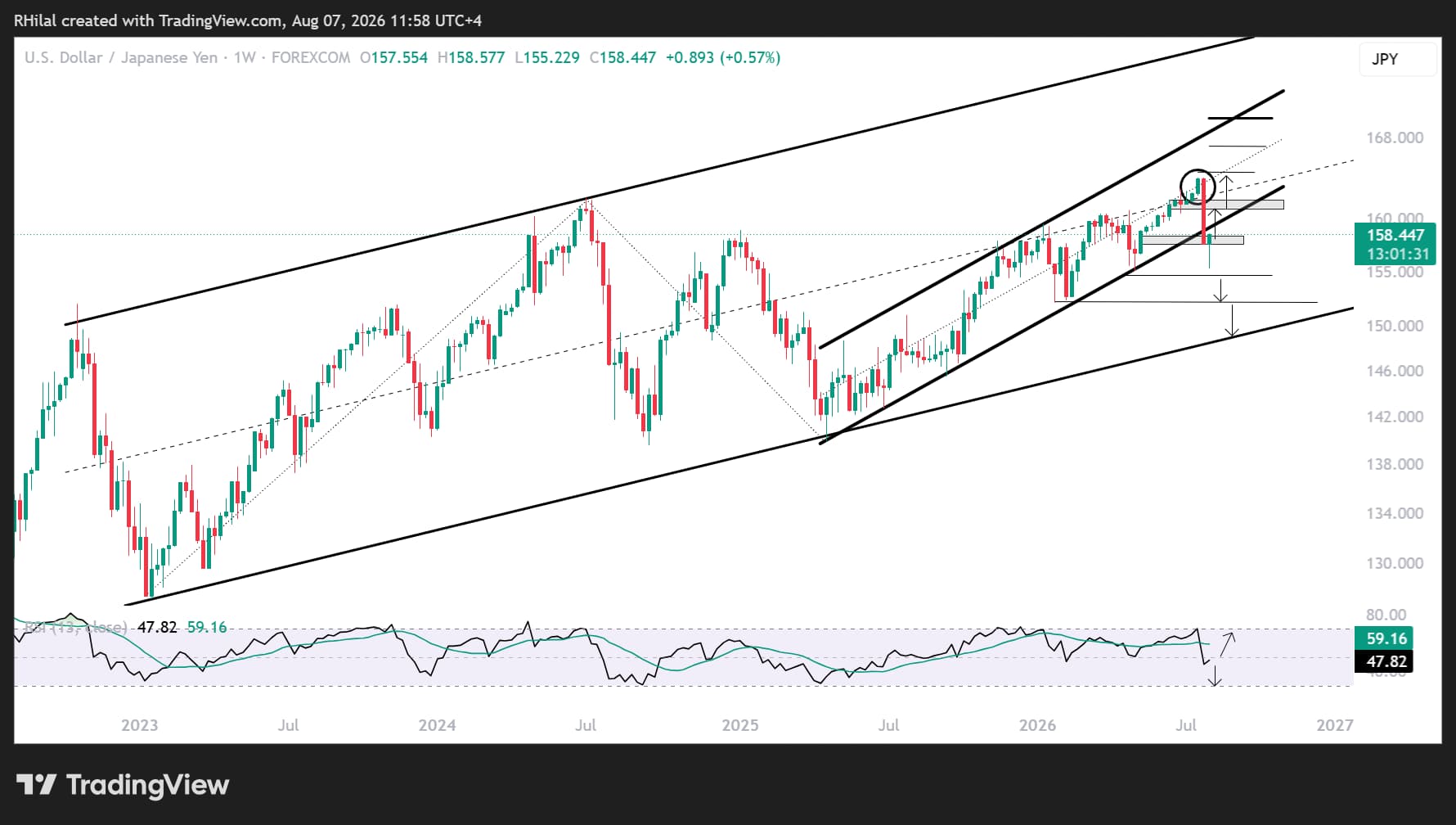
The USD/JPY pullback from the 164.00 confluence zone—a resistance area aligning with both the midpoint of the April 2025–July 2026 channel and the broader 2022–2026 channel—found support near 155.00.
Current support aligns with:
- The 38.2% Fibonacci retracement of the April 2025–July 2026 advance.
- Oversold daily momentum, last seen in 2024.
- A breakdown below the 2025–2026 ascending channel.
Should the current rebound stabilize above 159.50, bullish momentum could return, allowing the pair to retest 161.00, 161.80, and eventually 164.00.
These former support levels may now act as resistance during another test of price levels not seen since the 1980s. A sustained break above 164.00 would expose the upper boundary of the broader channel near 170, following a significant rebuilding of upside momentum.
Conversely, a close below 155.00 would expose the next key support levels at 152.00 and 149.00. This remains a critical region, aligning with the lower boundary of the 2022–2026 channel and defining the longer-term bullish versus bearish outlook for the US dollar—not only against the Japanese yen but across broader financial markets.
The broader outlook continues to favour a bullish bias unless a durable framework governing Middle East shipping routes is established, US Treasury yields begin to decline, and expectations for further Federal Reserve tightening continue to fade.
Written by Razan Hilal, CMT
Follow on X: @Rh_waves



Open an account today
Experience award-winning platforms with fast and secure execution.
Economic calendar
Web Trader platform
Our sophisticated web-based platform is packed with features.
Related articles
Silver Outlook: Improving risk appetite puts squeeze in play
Silver continues to amplify moves in gold, with unusually strong correlations with tech stocks offering another reason to monitor the recovery in risk appetite.

USD/JPY Weekly Outlook: Fed Hikes, AI Volatility and a Sleeping Yen
USD/JPY is tracking the direction of US rates without responding with its usual magnitude. Can Jensen Huang and the payrolls lottery wake the pair from its slumber?

USD/JPY Forecast: Is Market Uncertainty Limiting Direction?
One of the developments that has become increasingly evident in recent weeks is the growing neutrality surrounding the Japanese yen. This can be clearly seen in USD/JPY price action, which has moved by barely 0.5% over the last four trading sessions, highlighting that neither the dollar nor the yen has managed to build enough momentum to establish a clear direction for the pair.

From time to time, StoneX Financial Pty Ltd (“we”, “our”) website may contain links to other sites and/or resources provided by third parties. These links and/or resources are provided for your information only and we have no control over the contents of those materials, and in no way endorse their content. Any analysis, opinion, commentary or research-based material on our website is for information and educational purposes only and is not, in any circumstances, intended to be an offer, recommendation or solicitation to buy or sell. You should always seek independent advice as to your suitability to speculate in any related markets and your ability to assume the associated risks, if you are at all unsure. No representation or warranty is made, express or implied, that the materials on our website are complete or accurate. We are not under any obligation to update any such material.
As such, we (and/or our associated companies) will not be responsible or liable for any loss or damage incurred by you or any third party arising out of, or in connection with, any use of the information on our website (other than with regards to any duty or liability that we are unable to limit or exclude by law or under the applicable regulatory system) and any such liability is hereby expressly disclaimed.