


USD/JPY Forecast: Is Market Uncertainty Limiting Direction?
One of the developments that has become increasingly evident in recent weeks is the growing neutrality surrounding the Japanese yen. This can be clearly seen in USD/JPY price action, which has moved by barely 0.5% over the last four trading sessions, highlighting that neither the dollar nor the yen has managed to build enough momentum to establish a clear direction for the pair.
Share this:

One of the developments that has become increasingly evident in recent weeks is the growing neutrality surrounding the Japanese yen. This can be clearly seen in USD/JPY price action, which has moved by barely 0.5% over the last four trading sessions, highlighting that neither the dollar nor the yen has managed to build enough momentum to establish a clear direction for the pair.
This lack of direction remains evident despite the strength the dollar has shown in recent weeks. However, concerns surrounding a potential intervention in the yen have limited the greenback's ability to establish a more consistent trend. At the same time, the Japanese currency has also been unable to generate meaningful momentum on its own, a situation that has increasingly highlighted a phase of indecision in recent USD/JPY price action and could continue to remain relevant.

Is Indecision Becoming More Relevant?
One of the most important factors behind the yen's performance against the dollar this year has been the interest rate differential between the United States and Japan. While Japan's benchmark rate remains around 1.25%, U.S. interest rates continue to hold near 4.00%, leaving a spread of approximately 2.75% between the two economies. This dynamic has supported the relative attractiveness of dollar-denominated investments over yen-denominated assets for much of the year and has been one of the key factors behind the weakness displayed by the Japanese currency throughout much of 2026.
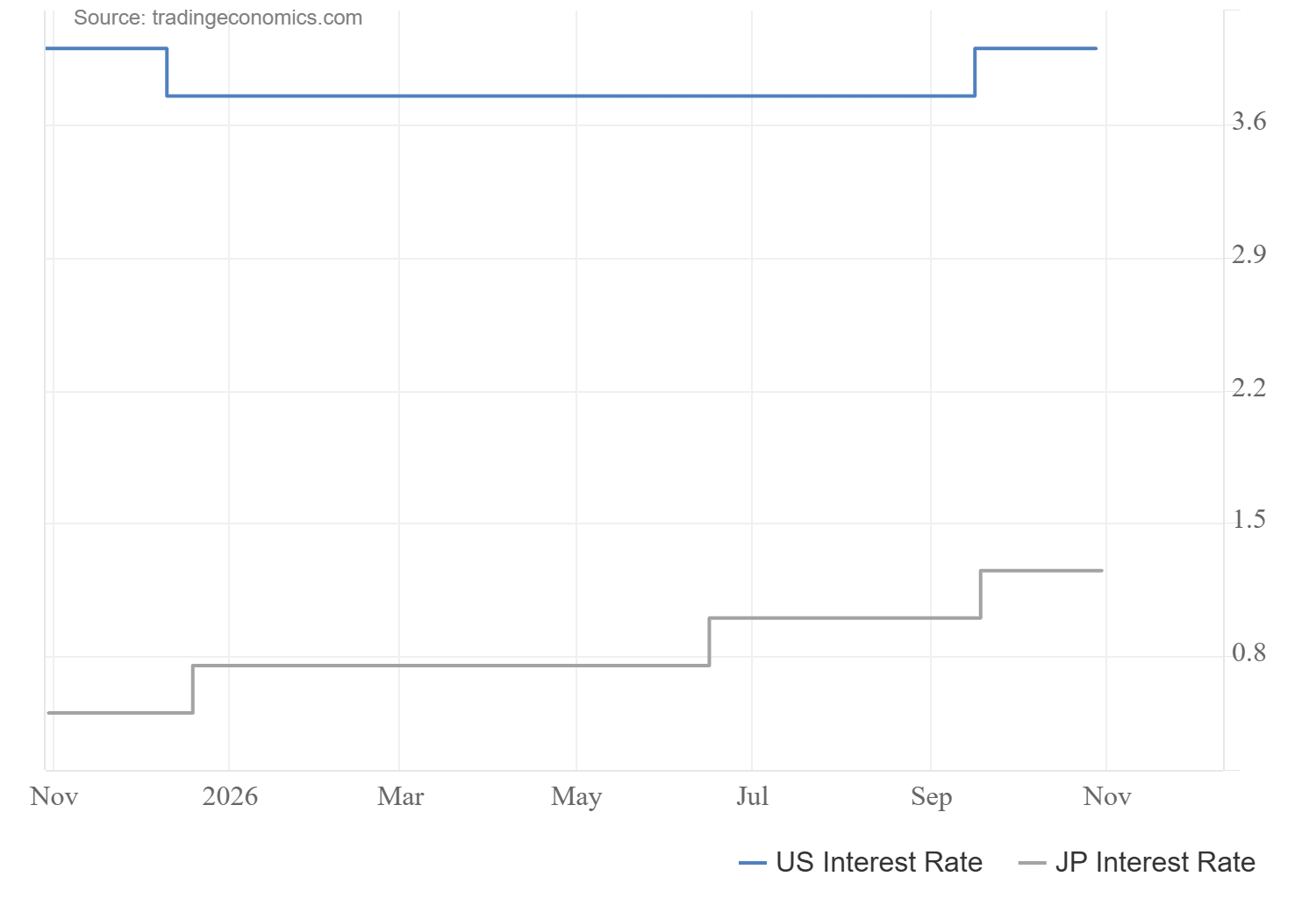
Source: TradingEconomics
That said, this dynamic appears to be losing some momentum in the short term. Although there is more than a 97% probability that the United States will raise rates toward 4.25% at the December meeting, the Bank of Japan is not expected to remain completely unchanged. Markets currently assign more than a 50% probability that Japanese interest rates could rise toward 1.50% during the December 17 meeting.
Under this scenario, the interest rate differential would remain relatively stable, reducing the likelihood that the dollar finds an additional catalyst to gain further traction against the yen into year-end. In other words, markets appear to have already priced in much of this scenario and there are currently few surprises surrounding interest rate expectations. However, the outlook is not clearly favorable for the yen either, as Japanese rates remain considerably lower than those in the United States, maintaining a cautious environment around the pair.
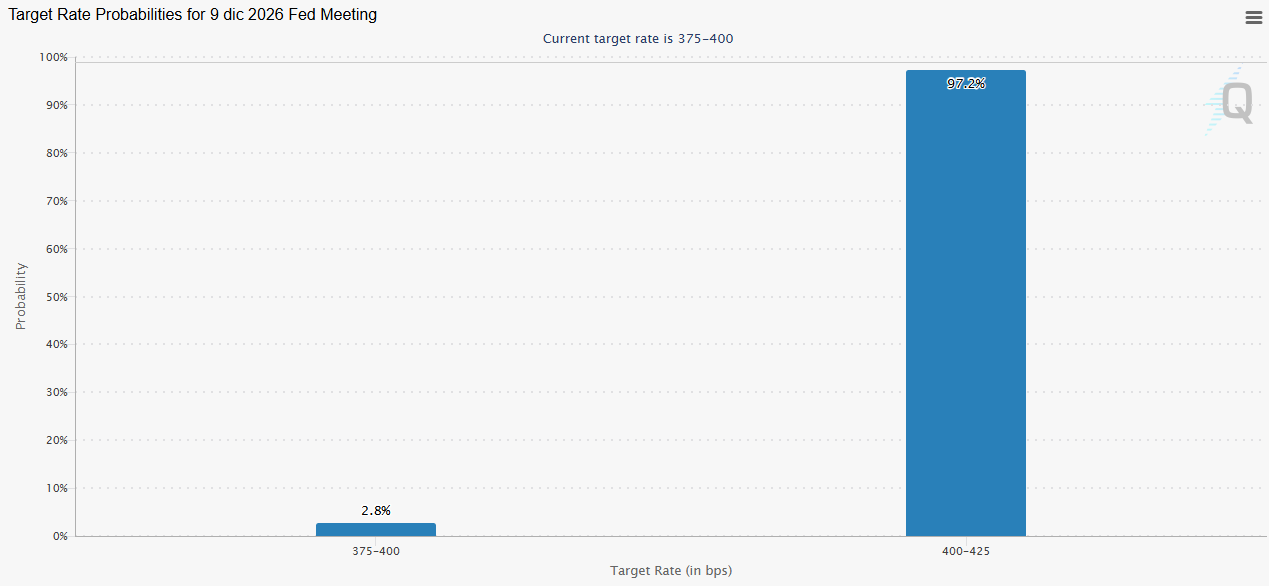
Source: CME
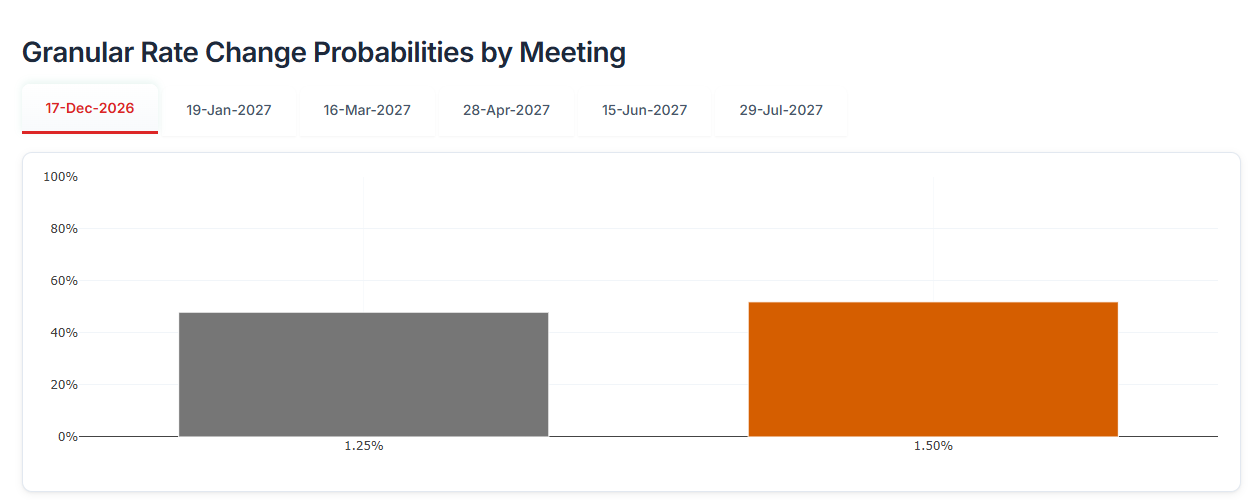
Source: Centralbankwatch
The story does not end there because another factor continuing to limit the dollar's advance is the possibility of intervention by Japanese authorities. Throughout 2026, several intervention episodes have taken place in response to excessive yen depreciation, as a weaker currency can increase domestic inflationary pressures and significantly reduce consumers' purchasing power.
For this reason, part of the market appears to be pricing in that risk once again, particularly because interventions tend to gain relevance when USD/JPY approaches the 160 yen per dollar area, a level that remains highly sensitive for both market participants and Japanese authorities.
Given that recent dollar strength had pushed the pair back toward this reference, part of the current caution may be linked to the risk of potential intervention, a situation that has also limited the dollar's ability to continue extending gains against the yen in the short term.
The situation becomes even more evident when comparing recent USD/JPY movements with those of the DXY Index, which measures dollar strength against its major peers. While the DXY has continued advancing over recent weeks, even reaching new 2026 highs above the 104-point area, USD/JPY has displayed a much more moderate performance.
This loss of alignment suggests that, although the dollar continues strengthening against most major currencies, that strength has not been enough to generate meaningful additional gains against the yen. The situation appears to reflect a combination of two factors: intervention concerns and expectations that there will be no major surprises from central banks regarding the interest rate differential in the short term.
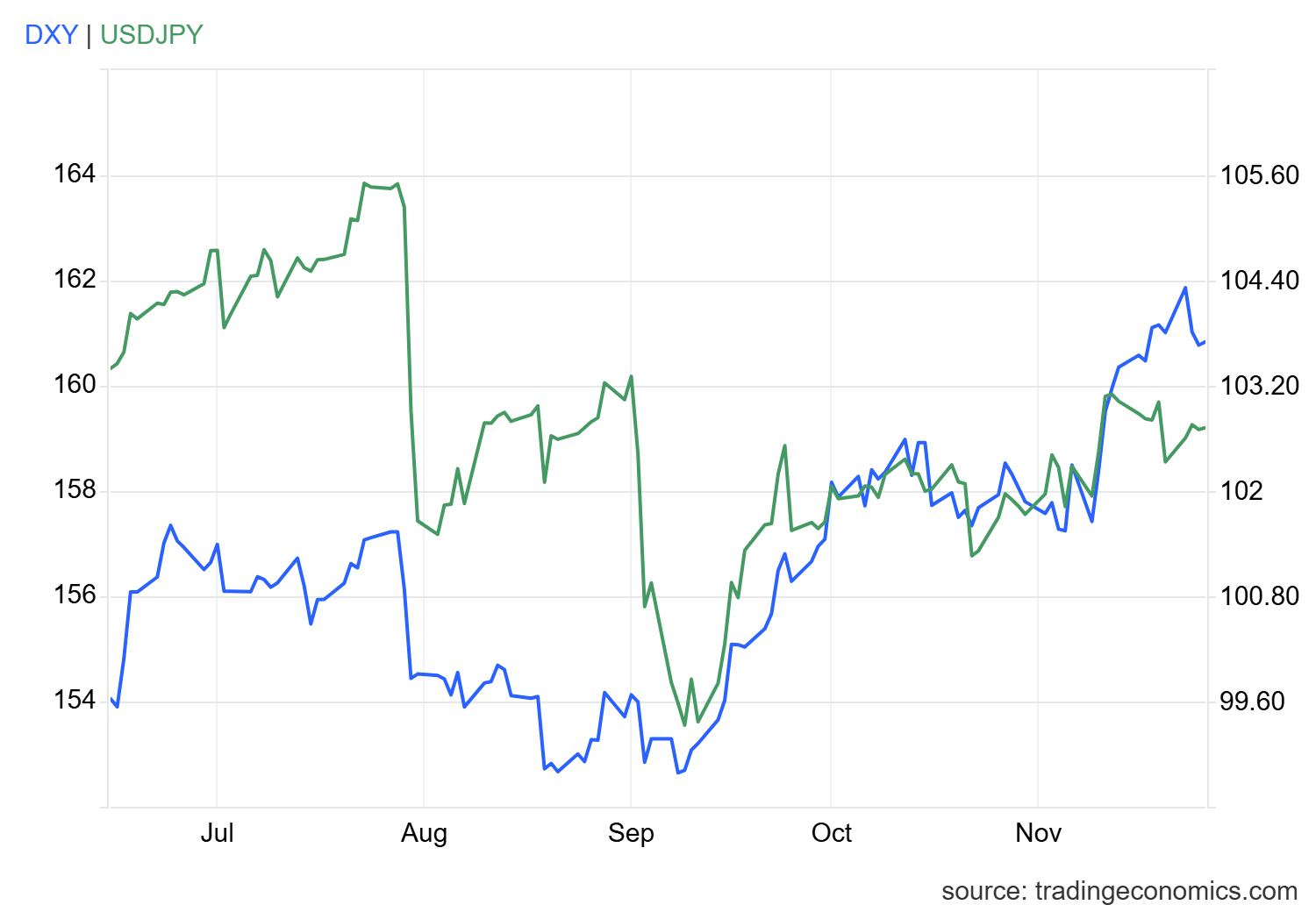
Source: TradingEconomics
With all of this in mind, the yen currently faces a complicated environment when it comes to establishing a clear direction. On one side, the interest rate gap continues to limit the currency's ability to attract sustained demand. On the other, intervention risks remain present and could once again provide support for the yen, as has already happened several times throughout the year.
As long as expectations for higher rates in the United States continue to collide with intervention risks in Japan, the current phase of indecision around USD/JPY could remain relevant in the short term, at least until new signals emerge from central banks or Japanese authorities provide greater clarity regarding potential intervention.
USD/JPY Technical Forecast
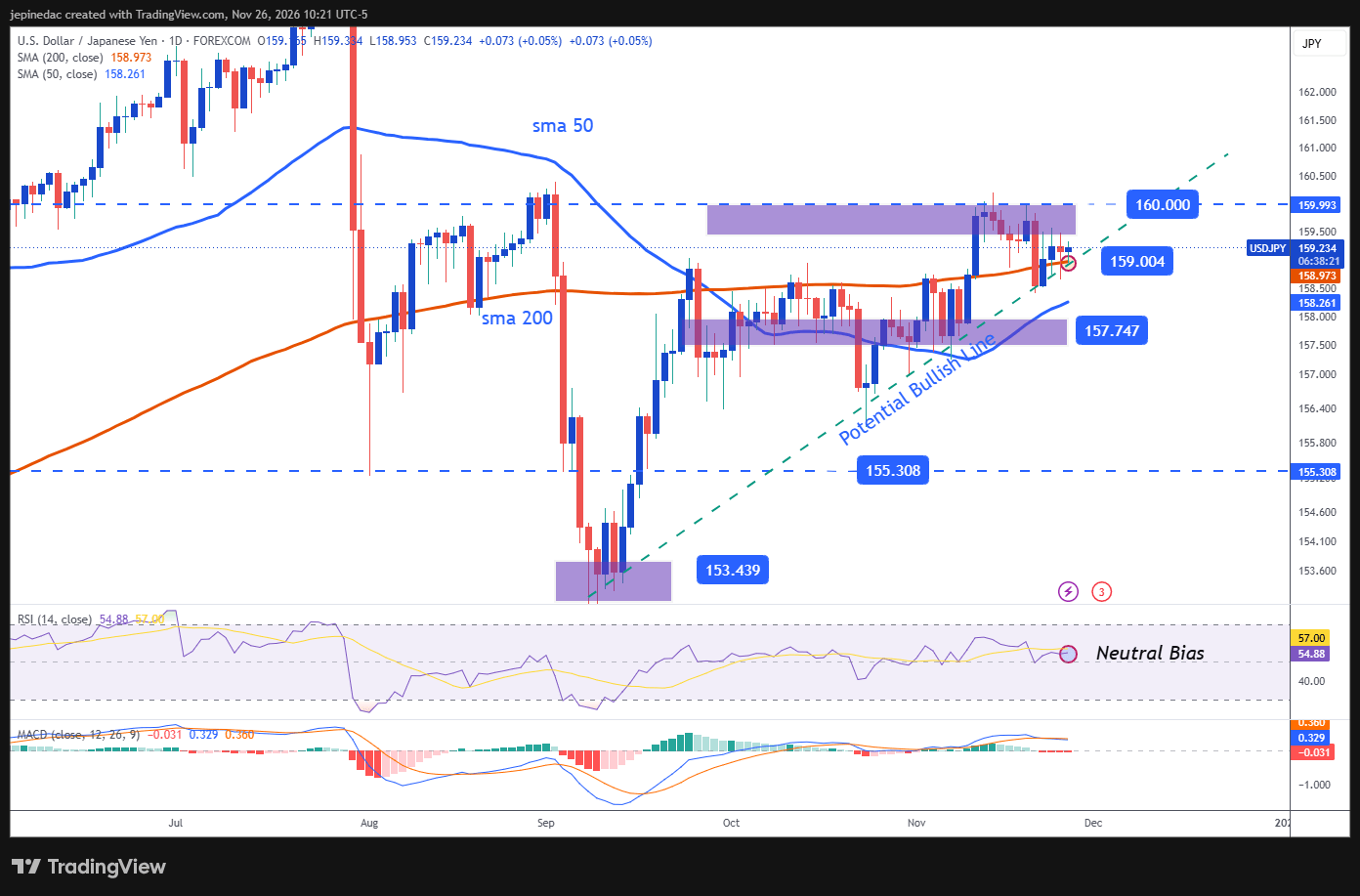
Source: StoneX, Tradingview
- Potential bullish trendline enters a risk zone: Although USD/JPY had been developing a pattern of progressively higher highs during recent weeks, gradually forming a potential bullish trendline, growing caution has become increasingly evident in recent sessions. This dynamic is beginning to test that structure and, unless the buying momentum seen in previous weeks recovers consistently, the current phase of neutrality could begin reducing the importance of the bullish trend and open the door for a broader range-bound structure to become the dominant technical pattern in the weeks ahead.
- MACD: The MACD histogram continues to develop near the neutral 0 line, a reading that reflects relatively balanced short-term moving average momentum. This situation suggests that a relatively consistent phase of neutrality has begun gaining relevance in recent daily price action.
- RSI: A similar picture can be observed in the RSI, which continues fluctuating around the neutral 50 level. This reflects a relatively balanced relationship between buying and selling pressure and continues to support the idea that indecision is becoming an increasingly important feature of the current market environment.
Key Levels:
- 160.00 – Key Resistance: This level not only corresponds to recent highs but also represents an important psychological threshold for the market. Price action managing to establish itself above this barrier could restore momentum to the bullish bias and create room for an extension of the potential bullish trendline as the dominant technical structure over the coming weeks.
- 159.00 – Nearby Barrier: An important equilibrium level that also coincides with the 200-period moving average. As long as price continues trading around this reference without moving decisively away from it, indecision could continue gaining relevance and even lead to the formation of a more structured trading range.
- 157.74 – Primary Support: A previous swing low that remains one of the most important downside barriers on the chart and sits below the key moving averages. Price action returning toward this area could bring renewed attention to the bearish bias and create room for more consistent downside pressure during the weeks ahead.
Written by Julian Pineda, CFA, CMT – Market Analyst
Follow him on: @julianpineda25



Open an account today
Experience award-winning platforms with fast and secure execution.
Economic calendar
Web Trader platform
Our sophisticated web-based platform is packed with features.
Related articles
USD/JPY Forecast: Is Market Uncertainty Limiting Direction?
One of the developments that has become increasingly evident in recent weeks is the growing neutrality surrounding the Japanese yen. This can be clearly seen in USD/JPY price action, which has moved by barely 0.5% over the last four trading sessions, highlighting that neither the dollar nor the yen has managed to build enough momentum to establish a clear direction for the pair.

EURUSD, Nasdaq Outlook: Multi-Year Trends Provide Support for EURUSD and Nasdaq
EURUSD, Nasdaq Outlook: Steep market sell-offs driven by interest-rate concerns and AI valuation risks are pushing the EURUSD and Nasdaq toward key multi-year support levels near 1.0880 and 24,800. These levels could determine whether the longer-term uptrends continue or a broader market unwind unfolds.


USD/CHF Outlook: Swiss Franc Surges as AI Trade Capitulates and SNB Bets Shift
USD/CHF weakens as the Swiss franc surges amid AI trade capitulation and shifting SNB rate bets, with further downside possible as December approaches.

From time to time, StoneX Financial Pty Ltd (“we”, “our”) website may contain links to other sites and/or resources provided by third parties. These links and/or resources are provided for your information only and we have no control over the contents of those materials, and in no way endorse their content. Any analysis, opinion, commentary or research-based material on our website is for information and educational purposes only and is not, in any circumstances, intended to be an offer, recommendation or solicitation to buy or sell. You should always seek independent advice as to your suitability to speculate in any related markets and your ability to assume the associated risks, if you are at all unsure. No representation or warranty is made, express or implied, that the materials on our website are complete or accurate. We are not under any obligation to update any such material.
As such, we (and/or our associated companies) will not be responsible or liable for any loss or damage incurred by you or any third party arising out of, or in connection with, any use of the information on our website (other than with regards to any duty or liability that we are unable to limit or exclude by law or under the applicable regulatory system) and any such liability is hereby expressly disclaimed.