As the first week of March comes to an end, a clear lack of consistent activity has become evident in the cryptocurrency market, resulting in a generalized neutral bias and a loss of relative appeal compared to more aggressive moves observed in traditional markets.
The week was marked by escalating tensions in the Middle East and the release of US employment data. However, both events proved insufficient to reignite meaningful volatility in the crypto market. Instead, substitute and safe-haven markets absorbed most of the capital flows, limiting the possibility of a consistent short-term recovery in cryptocurrencies.
If this lack of activity persists, even amid relevant economic and geopolitical developments, a phase of structural indecision could consolidate across the crypto market in the coming sessions.

Geopolitical Tensions and Employment Data
The week was defined by escalating geopolitical tensions in the Middle East, with ongoing attacks and counterattacks between Iran, the United States, and Israel, which created disruptions around the Strait of Hormuz — a critical passage for more than 20% of global oil supply. Toward the end of the week, President Trump reiterated that he would accept nothing short of Iran’s surrender, keeping risk perception elevated and supporting demand for safe-haven assets in the short term.
On March 6, the US Non-Farm Payrolls (NFP) report was also released, surprising markets with a loss of 92,000 jobs in February, compared to expectations of +58,000 jobs added.
Although the result was significantly below expectations, the slowdown in employment was not enough to meaningfully alter expectations regarding Federal Reserve rate cuts. Markets continue to price in probabilities above 90% and 77% that interest rates will remain unchanged in the March and April meetings, respectively.
Both developments share a common effect: geopolitical tensions have supported higher yields in safe-haven markets such as US Treasuries, amid concerns about inflationary pressures. Meanwhile, the employment data did not significantly shift expectations for a high-rate environment, allowing elevated yields to persist in the bond market.
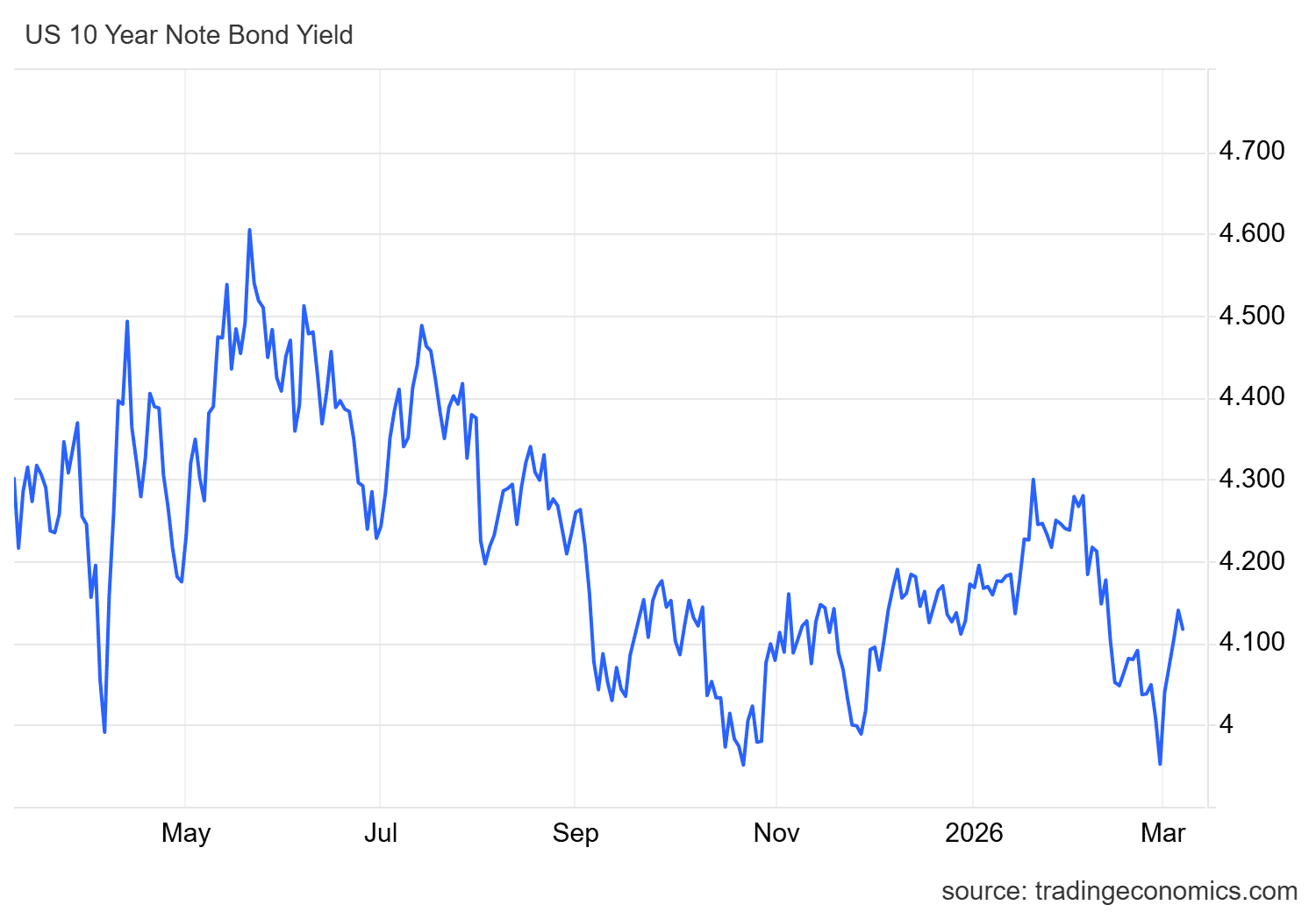
Indeed, the US 10-year Treasury yield has climbed above 4.1% since the conflict intensified. Despite the negative employment surprise, yields have not meaningfully declined, preserving the relative attractiveness of fixed-income markets compared to higher-risk assets such as cryptocurrencies.
Source: TradingEconomics
In this context, while traditional markets considered more stable regain attractiveness amid uncertainty, activity within the cryptocurrency market has remained subdued.
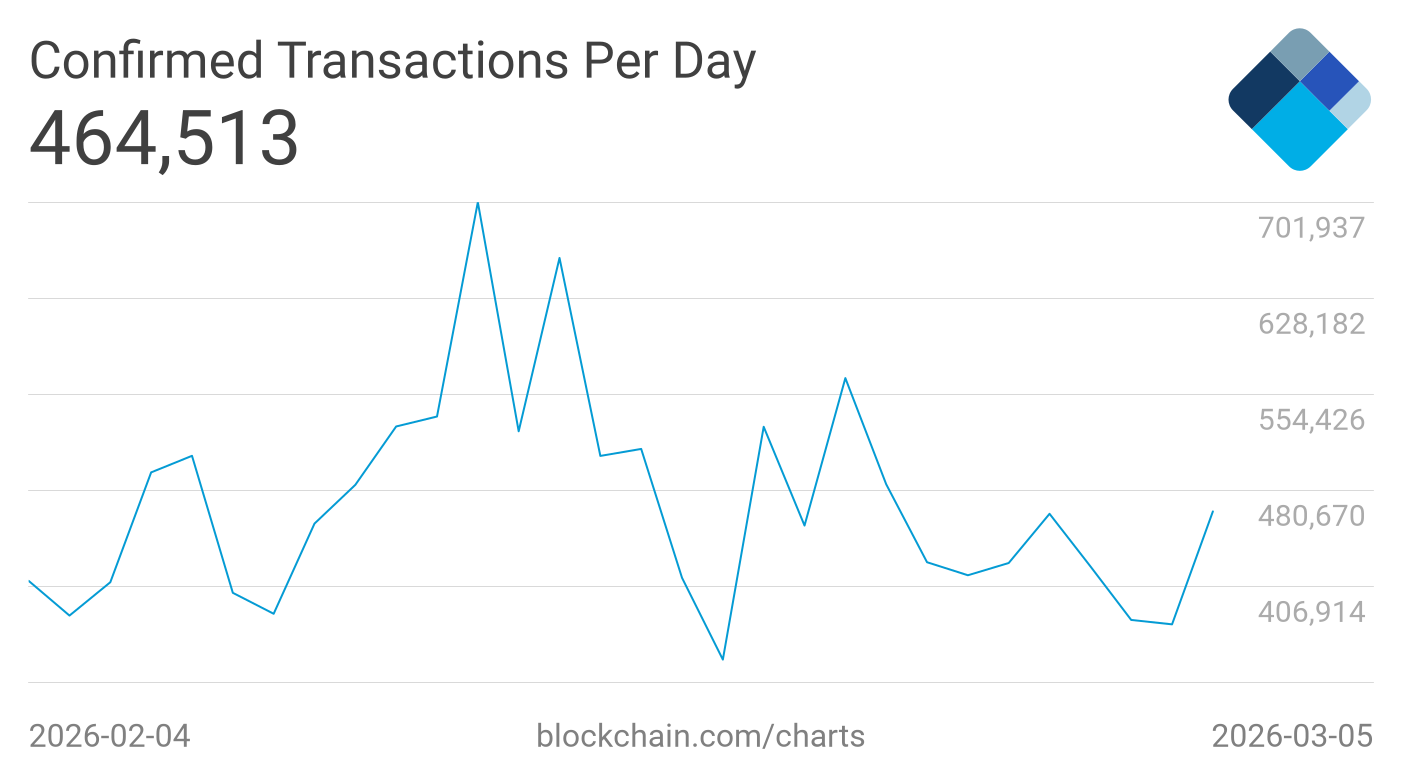
Looking at confirmed transactions on the Bitcoin network, weekly activity closed at approximately 464,000 confirmed transactions, well below the more than 700,000 transactions recorded in mid-February. This reflects a progressive decline in network activity and a lack of consistent short-term demand.
Source: Blockchain
In summary, despite geopolitical tensions and relevant economic data, investor focus appears concentrated on more stable safe-haven assets such as bonds. For now, the cryptocurrency market has not been perceived as a meaningful refuge, reinforcing a phase of neutrality and indecision that could persist in the coming sessions.
Bitcoin Versus Other Markets
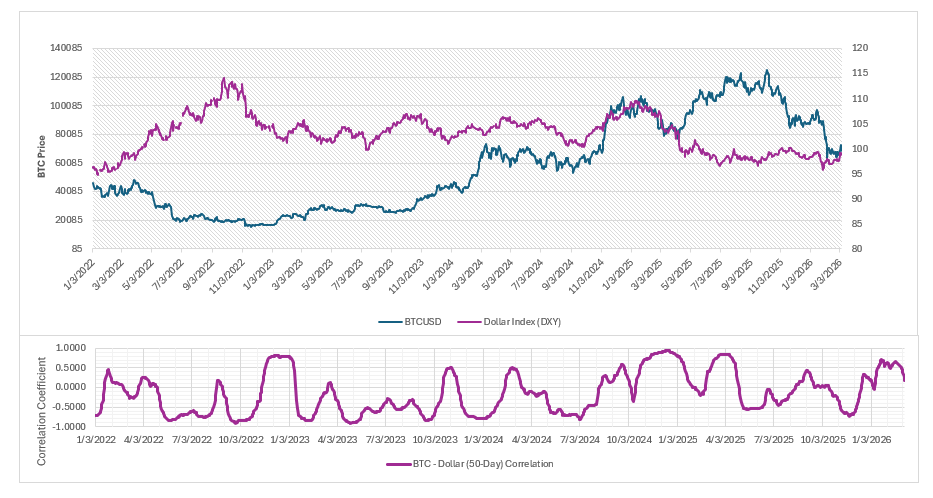
Bitcoin’s lack of correlation with traditional markets has become increasingly evident. The correlation coefficient with the DXY index remains near 0, indicating little alignment between the two markets in the short term.
While the US dollar has shown consistent recovery, Bitcoin has maintained a neutral bias, failing to mirror the strengthening observed in the currency market. It is important to remember that correlation coefficients can change over time.
Source: Data – TVC, StoneX, Tradingview
This dynamic suggests that market focus has shifted toward traditional stable assets such as the US dollar, partly supported by rising Treasury yields. In contrast, alternative markets like Bitcoin have lagged behind, showing neither aggressive weakness nor renewed demand momentum. This highlights the current lack of prominence of the crypto market.
Overall, the combination of geopolitical uncertainty, weak correlation with safe-haven markets, and reduced risk appetite creates a challenging environment for cryptocurrencies. As long as these factors persist, neutrality is likely to dominate the sector’s behavior and may even give way to episodes of further weakness.
Confidence Attempts to Recover, But It Is Not Enough
The Crypto Fear and Greed Index continues to fluctuate around the 20-point level. Although it has shown some recovery compared to previous weeks, it remains near the boundary between “fear” and “extreme fear,” indicating that caution still dominates market sentiment.
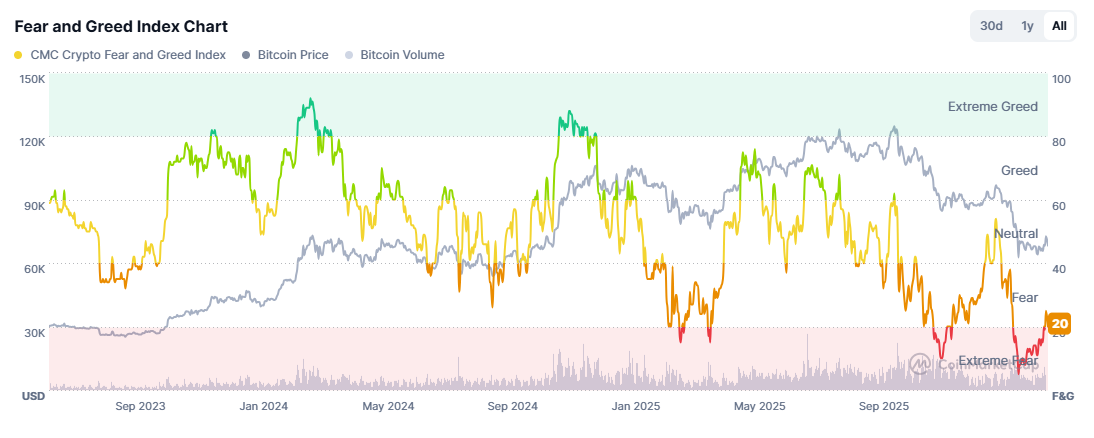
Source: Coinmarketcap
In this environment, weak confidence makes it difficult to establish sustained demand. Unless sentiment indicators show clear improvement, indecision and weakness are likely to continue defining short-term crypto price movements.
Written by Julian Pineda, CFA, CMT – Market Analyst
Follow him on: @julianpineda25