
The week has started with risk assets remaining largely on the front foot, after the big tech-driven rally on Wall Street ahead of key earnings reports this week. Weekend chatter points to a fresh proposal from Iran to extend the ceasefire, which at least keeps the door ajar for a negotiated resolution to the Middle East tensions. That said, the Strait of Hormuz remains shut and this is what matters the most for oil prices, and by extensions, for EUR/USD forecast. At the time of writing, the euro and European indices were trading near session highs as prices were coming off earlier highs.
With a real risk that even if a peace deal is eventually struck, things won’t snap back quickly in terms of oil production, this suggests inflation risks are real and could see both the ECB and FOMC echo that sentiment at their policy meetings this week - something that could potentially weigh on the euro. The upside in risk sentiment could also be tempered for the same reason in a busy week of central bank meetings. With policymakers likely need to strike a firm tone, to keep inflation expectations anchored, I am not convinced there’s much scope for the dollar to weaken materially from here.
Can we see renewed dollar buying?
Despite easing off their earlier highs, crude oil prices remained well supported for now with the US and Iran drifting further apart from striking a deal and re-opening the Strait of Hormuz. Strength in oil is usually supportive of the dollar.
Meanwhile, the central message from central banks this week could be that interest rates will need stay elevated to prevent inflation from spiralling. The main focus will be the US, where the FOMC meets on Wednesday. This week, we will also get a raft of tech earnings and data including first-quarter US GDP and inflation prints from several major economies.
With energy prices rising, inflation still sticky, and both consumption and employment holding up reasonably well, the Fed is likely to reinforce the message that rates will need to stay at current levels for longer. That could offer at least modest support to the dollar.
Away from the Fed decision, the US calendar also brings consumer confidence data, the core PCE deflator—still the Fed’s preferred inflation gauge—and the first estimate of Q1 GDP. Growth is expected to rebound to around 2.2% annualised, following a subdued 0.5% in the previous quarter, but the focus will most likely be on the inflation data.
For now, the dollar did has come under some pressure on those Iran headlines, but with oil holding firm and central banks yet to fully respond, the downside for the greenback look limited from here.
EUR/USD forecast undermined by oil shock
In the eurozone, Thursday’s ECB meeting takes centre stage. The impact of higher oil prices is already filtering through the data. For example, the closely watched Ifo index, Germany’s most prominent leading indicator, falling to its lowest level since the pandemic.
For the eurozone, the key question is how the ECB will respond to what is increasingly looking like a stagflationary shock. While a hike this week seems highly unlikely, the ECB will need to keep a tightening bias firmly in place to keep inflation expectations anchored.
The prolonged closure of the Strait of Hormuz means this is also turning into a broader supply chain shock, which is bad news for the German economy sensitive to global disruptions. And with stagflation risks rising, tightening policy in this environment is usually good news for the currency. If it was rising rate hike expectations because of solid growth, then it would have been a different story. So, a hawkish repricing in this case may not necessarily support the currency too much.
But if the ECB provides any strong hint that it is willing to look through the current price pressures, then this could paradoxically support the euro and EU stocks. That might sound like a bizarre thing to suggest, but hiking into stagflation might prove more damaging to the economy than keeping rates lower, especially as many analysts agree that the strait of Hormuz will soon have to re-open one way or another because the economic costs of keeping it closed for longer is not in the interest of the Iranian or global economies.
Key technical levels to watch
Among other levels to watch 1.1750 is near-term resistance, followed by 1.1800. Support is initially seen at 1.1720ish area, followed by 200-day average at 1.1675, then there is nothing important until 1.1600.
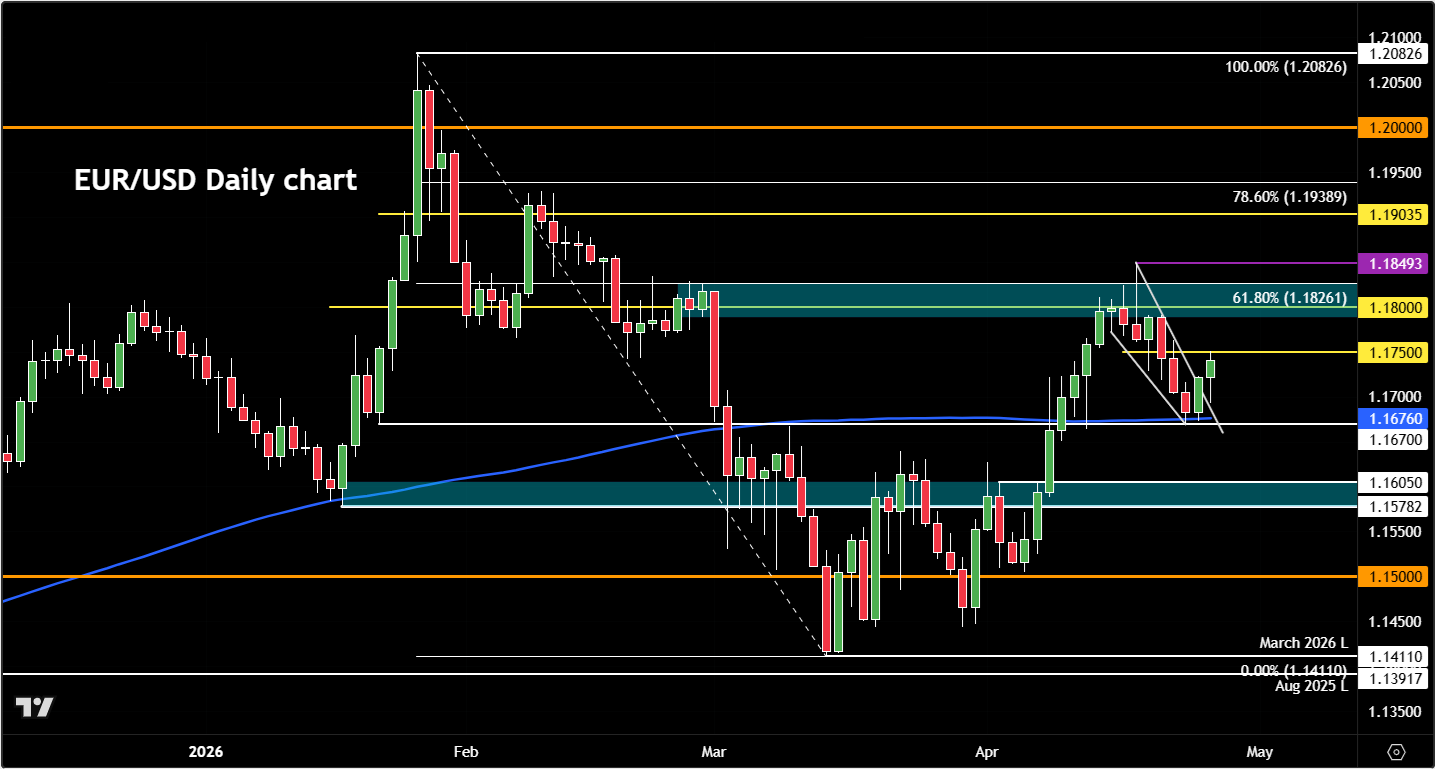
All told, the downside risks remain higher for the EUR/USD forecast, and I don’t necessarily expect a rally if the ECB signals that a June hike might be on the table.

-- Written by Fawad Razaqzada, Market Analyst
Follow Fawad on Twitter @Trader_F_R