
The EUR/USD has climbed back above 1.1000 and turned positive on the day, after a five-day slide took it slightly below that handle earlier. The dollar's inflation-fuelled rally has not reversed, but it is running into a major long-term support area on this pair. With sellers failing to build on the break, the risks to the near-term EUR/USD outlook are starting to tilt to the upside, although it is still early days.
- EUR/USD has reclaimed 1.1000 after dipping below it earlier
- Hot US inflation and a near-certain December Fed hike still favour the dollar, but much of that repricing may already be in the price
- A sustained recovery could bring the 1.1100–1.1150 area back into view, where the 21-day exponential meets the short-term bearish trend line
Watch the Full Video
Stubborn US inflation keeps the dollar in demand
The US dollar's broad-based advance has been the main force behind the recent weakness in EUR/USD and other major currency pairs. The Dollar Index climbed to a 19-month high before easing modestly, extending a rally fuelled by signs that US inflationary pressures are proving stubborn.
October's CPI report, released on 10 November, was the main driver. Markets are now pricing in roughly a 95% probability of a 25-basis-point Fed rate increase in December, and another hike could follow in January.
That has underpinned US yields and demand for the greenback, particularly as investors reassess the prospect of interest rates staying higher for longer. From a macro point of view, it is therefore far too early to suggest that the dollar is about to stage a meaningful correction.
How much of the Fed is already in the price?
The more pertinent question, however, is how much of this hawkishness is already priced in. With a December hike all but fully discounted, the bar for fresh hawkish surprises is considerably higher, and it is quite possible that the bulk of the repricing is now behind us.
Put another way, the risks are no longer quite as symmetrical. Strong US data would largely confirm what markets already expect, whereas any sign that the Fed's hawkishness has been overstated would leave the dollar exposed. If the greenback were to slip now, perhaps on the back of fresh AI concerns hurting US technology stocks, then major pairs sitting on long-term support, such as EUR/USD, could be well placed to rebound.
The euro faces a different problem
There is still scope for the euro to draw support from the European Central Bank's relatively hawkish policy outlook, with markets anticipating further rate increases. However, the timing of additional ECB tightening remains less aggressive than the repricing taking place along the US interest-rate curve, which leaves the dollar with the upper hand for now.
Oil prices could tip that balance. Europe remains particularly exposed to energy costs, so a renewed decline in crude would ease some of the inflationary pressure on the eurozone, improve the region's growth outlook and reduce the risk of another adverse energy shock. That would be a much more favourable backdrop for the single currency.
Technical EUR/USD forecast and key levels to watch
From a technical analysis point of view, the EUR/USD forecast could improve if we now see some bullish price action. That may have started today now that buyers have evidently returned to a long-term support zone. Below 1.1000, we have the 61.8% Fibonacci retracement of the upswing from early 2025 to early 2026 coming in near the 1.0900 handle.
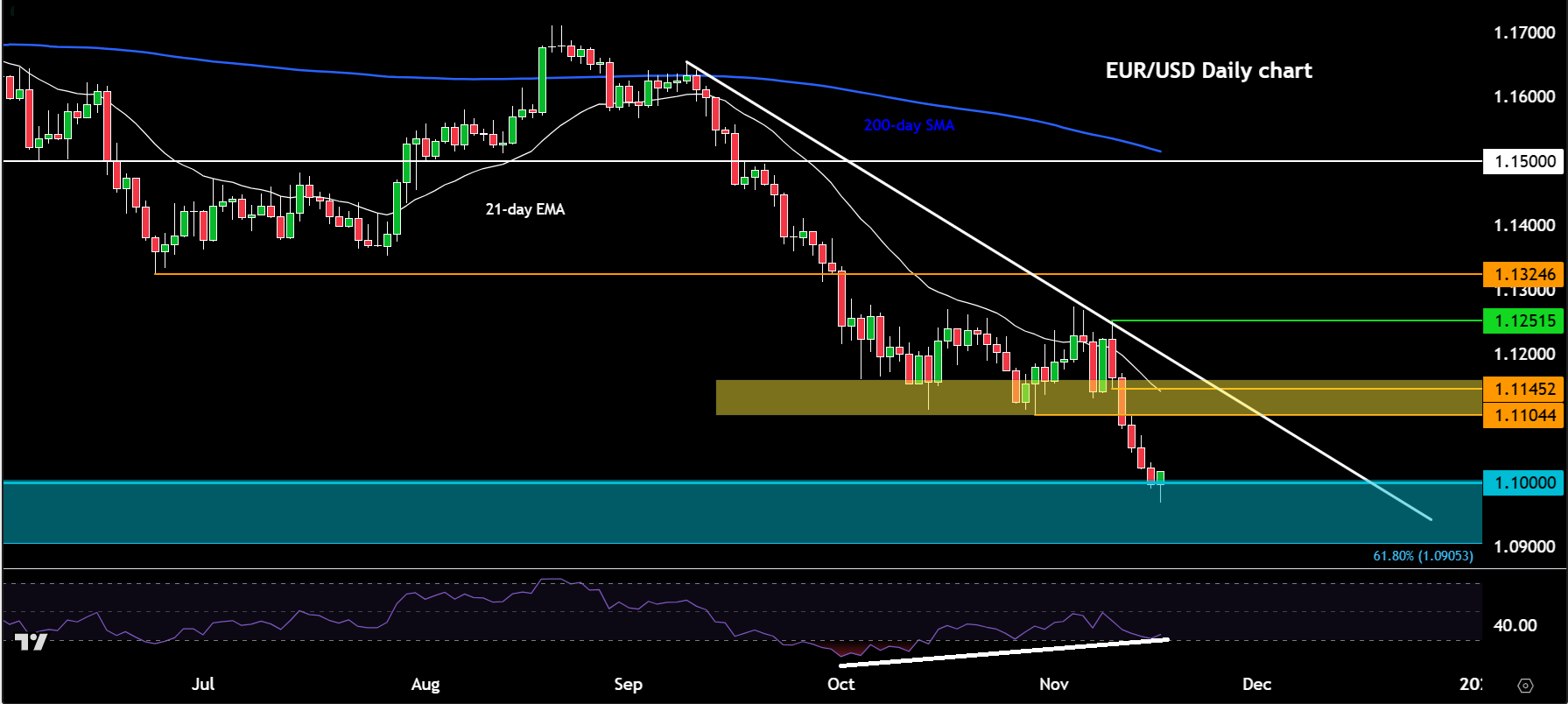
The RSI has meanwhile formed a higher low while price made a lower low, a bullish divergence which suggests selling pressure is weakening at oversold levels. If the recovery proves sustainable, the next stop could be prior support around 1.1100–1.1150, where the 21-day exponential converges with the short-term bearish trend line. Break above that trend line and things would start to look decidedly more bullish.
A sustained break back below the 1.0900–1.1000 area, by contrast, would reinforce the bearish picture on the EUR/USD. But for now, the failure to extend this week's initial decline suggests sellers may need a fresh catalyst to push EUR/USD materially lower.
Frequently asked questions
Why did EUR/USD fall below 1.1000?
Hotter-than-expected US CPI data reinforced expectations of further Fed tightening, lifting the dollar and pushing EUR/USD lower for five consecutive days. The break below 1.1000 failed to attract follow-through selling, however, and the pair has since recovered. At least for now.
Where is the key support for EUR/USD?
Key support comes in around 1.0900 to 1.1000, where the psychological handle meets the 61.8% Fibonacci retracement of the early-2025 to early-2026 upswing and a prior double-top high.
What could drive a EUR/USD recovery?
A pullback in the dollar, if markets conclude the Fed's hawkish repricing has run its course, together with lower oil prices would help. Technically, a move above the short-term bearish trend line near 1.1100–1.1150 would strengthen the bullish case.
-- Written by Fawad Razaqzada, Market Analyst | Follow Fawad on Twitter @Trader_F_R