




FOMC meeting preview Will inflation spook the Fed
The most important data point to watch will be the central bank’s expectations for interest rates in 2022 and 2023...
Share this:

Traders are still digesting the surprising outcome of Thursday’s ECB meeting, wherein the central bank announced that it would start purchasing bonds at a “significantly higher pace” over the next quarter in an attempt to get ahead of rising yields and (potential) increasing price pressures in the coming months.
Beyond its immediate implications for European assets, this decision underscores different approaches to THE biggest question vexing global central bankers this year: Is the coordinated rise in bond yields across the globe signaling excessive inflation in the coming quarters?
While the ECB appears to think the answer to that question may be “yes,” recent comments from Federal Reserve policymakers suggest that they’re still skeptical of a sustained uptick in inflation. With the US central bank scheduled for their semi-quarterly monetary policy meeting on Wednesday March 17, traders will be eager to see if the Fed’s resolve remains steadfast. To that end, a couple of solid to outright strong long-term Treasury bond auctions this week could convince the central bank to hold off on any additional stimulus at this month’s meeting.
Fed meeting: Key things to watch
This month’s meeting will be accompanied by the quarterly update to the central bank’s economic projections, and given the recent shifts in yields and market-based measures of inflation expectations, the most important data point to watch will be the central bank’s expectations for interest rates in 2022 and 2023 (the infamous “dot plot”).
In their December projections, only one Fed policymaker expected interest rates to rise off the current, essentially 0% interest rate level by 2022. If several more policymakers indicate an expected rate hike as soon as next year, or if the median member starts to expect a hike in 2023, it would show that US central bankers may not be as united and sanguine on price pressures as they’ve appeared to date.
In addition to interest rate expectations, the market will also scrutinize the central banks economic projections. Given the just-passed fiscal stimulus bill and rapid progress of vaccinations in the country, the Fed’s December forecasts for 4.2% economic growth and a 5.0% unemployment rate at the end of the year look overly pessimistic; they are likely to be revised higher, though it will be interesting to see if those revisions also “pull forward” previously-expected economic improvements from 2022 and 2023.
Finally, any changes to the official monetary policy statement, as well as the general tone of Fed Governor Jerome Powell’s press conference, could provide insight on the Fed’s plans moving forward. Expect media members to grill Powell on the definition of “substantial progress” toward the central bank’s employment and price stability goals in an attempt to glean insight into when bond purchases could cease and interest rates could rise.
Given its previous premature attempts to tighten policy, the central bank may be most likely to remain in “lower for longer” / “wait and see” for this meeting, with any evidence of rising inflation characterized as transitory for now.
Fed meeting: USD impact
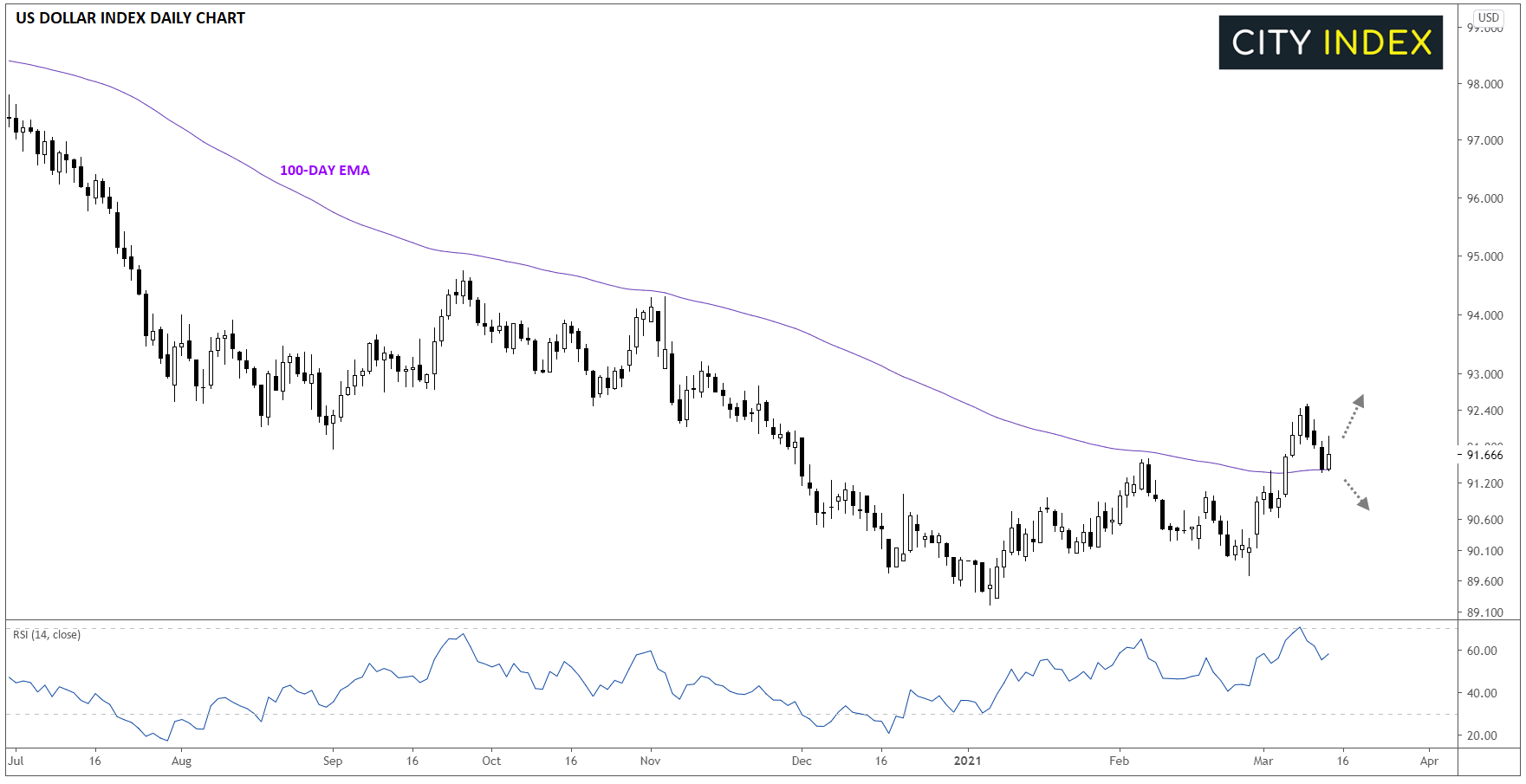
As for the world’s reserve currency, the US dollar has caught a bid so far this month, albeit off a relatively low level. If the Fed makes no changes to policy and expresses no immediate concerns about inflation, it would serve as a proverbial “green light” for traders to push bond yields, and by extension the US dollar, higher. Meanwhile, any explicit concerns about inflation or hints at stepping up bond purchases like we saw from the ECB could hit the greenback and drive the dollar index lower.
Source: StoneX
Learn more about forex trading opportunities.



Open an account today
Experience award-winning platforms with fast and secure execution.
Economic calendar
Web Trader platform
Our sophisticated web-based platform is packed with features.
Related articles

USD/MXN Forecast: Mexican Peso Weakness Persists as Year-End Approaches
These continue to be challenging sessions for the Mexican peso. The currency has remained under pressure in recent weeks, a trend clearly reflected in USD/MXN, which has now posted seven consecutive bullish sessions, gaining more than 7.0% over that period.


USD/JPY Forecast: Is Market Uncertainty Limiting Direction?
One of the developments that has become increasingly evident in recent weeks is the growing neutrality surrounding the Japanese yen. This can be clearly seen in USD/JPY price action, which has moved by barely 0.5% over the last four trading sessions, highlighting that neither the dollar nor the yen has managed to build enough momentum to establish a clear direction for the pair.

EURUSD, Nasdaq Outlook: Multi-Year Trends Provide Support for EURUSD and Nasdaq
EURUSD, Nasdaq Outlook: Steep market sell-offs driven by interest-rate concerns and AI valuation risks are pushing the EURUSD and Nasdaq toward key multi-year support levels near 1.0880 and 24,800. These levels could determine whether the longer-term uptrends continue or a broader market unwind unfolds.

From time to time, StoneX Financial Pty Ltd (“we”, “our”) website may contain links to other sites and/or resources provided by third parties. These links and/or resources are provided for your information only and we have no control over the contents of those materials, and in no way endorse their content. Any analysis, opinion, commentary or research-based material on our website is for information and educational purposes only and is not, in any circumstances, intended to be an offer, recommendation or solicitation to buy or sell. You should always seek independent advice as to your suitability to speculate in any related markets and your ability to assume the associated risks, if you are at all unsure. No representation or warranty is made, express or implied, that the materials on our website are complete or accurate. We are not under any obligation to update any such material.
As such, we (and/or our associated companies) will not be responsible or liable for any loss or damage incurred by you or any third party arising out of, or in connection with, any use of the information on our website (other than with regards to any duty or liability that we are unable to limit or exclude by law or under the applicable regulatory system) and any such liability is hereby expressly disclaimed.