

Cryptocurrencies attempted to regain confidence this week, driven mainly by the Federal Reserve’s decision to cut interest rates. However, toward the end of the week, a renewed sense of indecision emerged, reflected in declining activity across key network metrics for assets such as BTC. This could lead to a period of more persistent neutrality in the sessions ahead and suggests that, for now, the central bank’s decision has not been sufficient to sustain a strong bullish bias in the crypto market.

Neutrality Remains Consistent
This week featured a key event for global financial markets: the Federal Reserve’s rate decision, in which the central bank cited labor-market weakness to justify cutting its policy rate from 4.00% to 3.75%. Chair Powell’s comments indicated that the Fed is not planning to maintain high rates into 2026; rather, policymakers anticipate a mix of neutral and low rates, as long as inflation remains moderate.
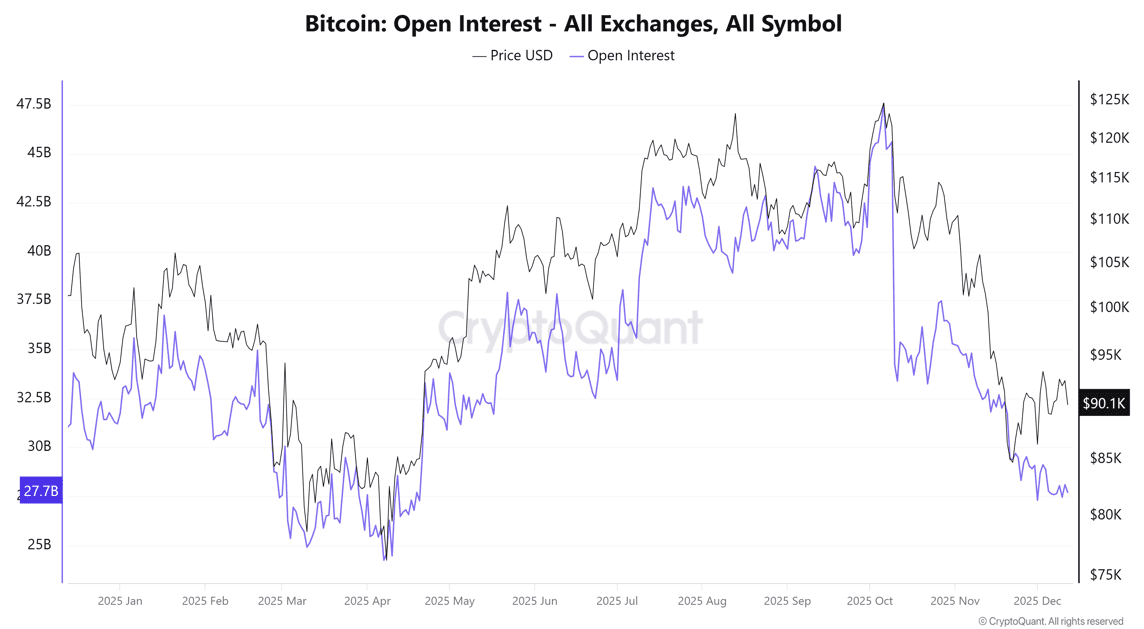
Despite the importance of this announcement, the initial optimism was not enough to sustain demand in the cryptocurrency market. Part of the move had already been priced in, or the market simply preferred to direct its risk appetite toward other assets, such as equities. This lack of enthusiasm has begun to show in key indicators. Bitcoin’s Open Interest—which measures the total number of open futures positions—fell back toward 27 billion, accompanied by increased indecision in price action. This suggests outflows from long positions during the week and confirms a lack of consistent institutional demand, a pattern that likely extends to other cryptocurrencies, since BTC acts as the market’s benchmark asset.
Source: Cryptoquant
In this environment, expectations of lower U.S. rates may not have been enough to support a stronger rebound in major cryptocurrencies. This is partly because additional cuts could arrive gradually, meeting by meeting, while the Fed is expected to maintain a neutral stance for now. The confidence sparked by the recent rate cut has not translated into stronger crypto demand, suggesting that market participants may be shifting toward alternative assets. If this continues, a more pronounced neutral tone could emerge across crypto price movements in the sessions ahead.
Bitcoin Compared to Other Markets
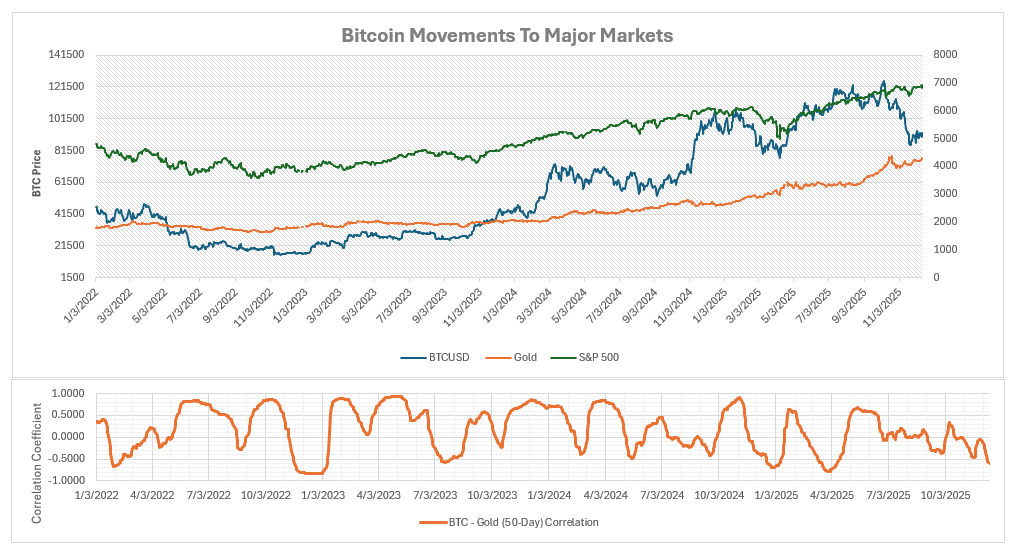
Recent Bitcoin movements show a moderate negative correlation with gold, with a coefficient below –0.5, which indicates that BTC is behaving in the opposite direction of one of the most important safe-haven assets in the short term. While gold has attempted to reach new highs, Bitcoin has not followed that trajectory, instead showing indecisive price action and failing to attract meaningful interest from investors seeking to preserve capital in the final weeks of the year.
It is important to remember that this coefficient can vary over time, meaning the observed correlation is temporary and tied to current market sentiment.
Source: Data – TVC, StoneX, Tradingview
With this in mind, one of the immediate effects of the Fed’s decision was an increase in uncertainty heading into 2026, which boosted demand for safe-haven assets. In this context, neither Bitcoin nor the crypto market in general is being viewed as a temporary or stable refuge—unlike gold—which could open the door to a prolonged period of indecision as this sentiment persists.
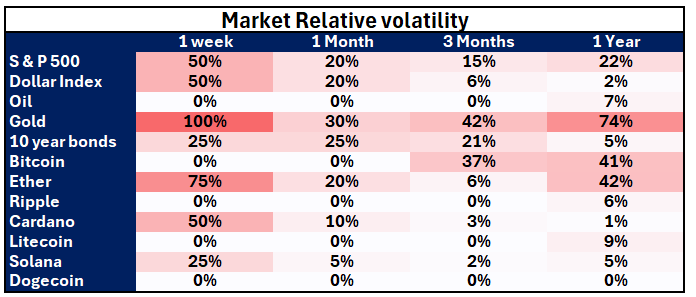
Additionally, the lack of direction and the decline in volatility are already reflected in the crypto market’s relative volatility chart. Only Ether and Cardano show oscillations slightly above the weekly average, while assets such as BTC exhibit very limited movement, even below their monthly averages. This does not signal stability but rather persistent indecision, which could continue affecting the recovery in confidence the market attempted to build in previous weeks.
Source: Data – TVC, StoneX, Tradingview
Confidence Moves into Indecision
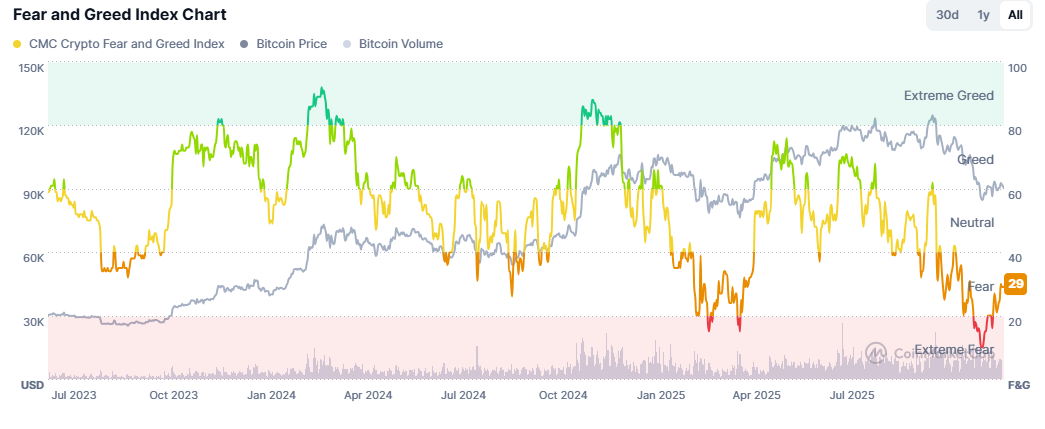
The Crypto Fear & Greed Index has shown gradual recovery from “extreme fear”, rising toward 29 points, although it remains within the broader “fear” zone. Recent oscillations have shown little progression, reinforcing a persistent short-term indecision within the crypto market.
Source: Coinmarketcap
As long as the index does not surpass the “neutral” zone, it will be difficult for a sustained bullish bias to form and drive solid demand for cryptocurrencies such as Bitcoin. In this scenario, ongoing neutrality could even lead to a new period of weakness for major cryptoassets, given the absence of sufficient confidence to generate stronger buying flows in the coming sessions.
Written by Julian Pineda, CFA, CMT – Market Analyst
Follow him at: @julianpineda25