





EUR/USD Analysis: Euro Fails to Rebound Ahead of Weekly Close
Over the past three trading sessions, EUR/USD has remained in a state of neutral consolidation, with price movement limited to just 0.3%, reducing the bullish momentum that had begun to build earlier in the week.
Share this:

Over the past three trading sessions, EUR/USD has remained in a state of neutral consolidation, with price movement limited to just 0.3%, reducing the bullish momentum that had begun to build earlier in the week. For now, uncertainty prevails, driven by new comments from the European Central Bank (ECB) and the release of key U.S. economic data. As long as major catalysts remain unconfirmed, this neutral bias may persist in the short term.
What’s Next for Central Banks?
On the European side, several ECB members have suggested that the bank may be nearing the end of its rate-cutting cycle, as inflation continues to converge toward the 2% target, and the recent easing of trade tensions no longer justifies further monetary loosening in the near term.
These statements could become important catalysts for the euro, as the ECB’s accommodative policy over the past year has reduced the appeal of euro-denominated assets and limited sustained demand for the currency.
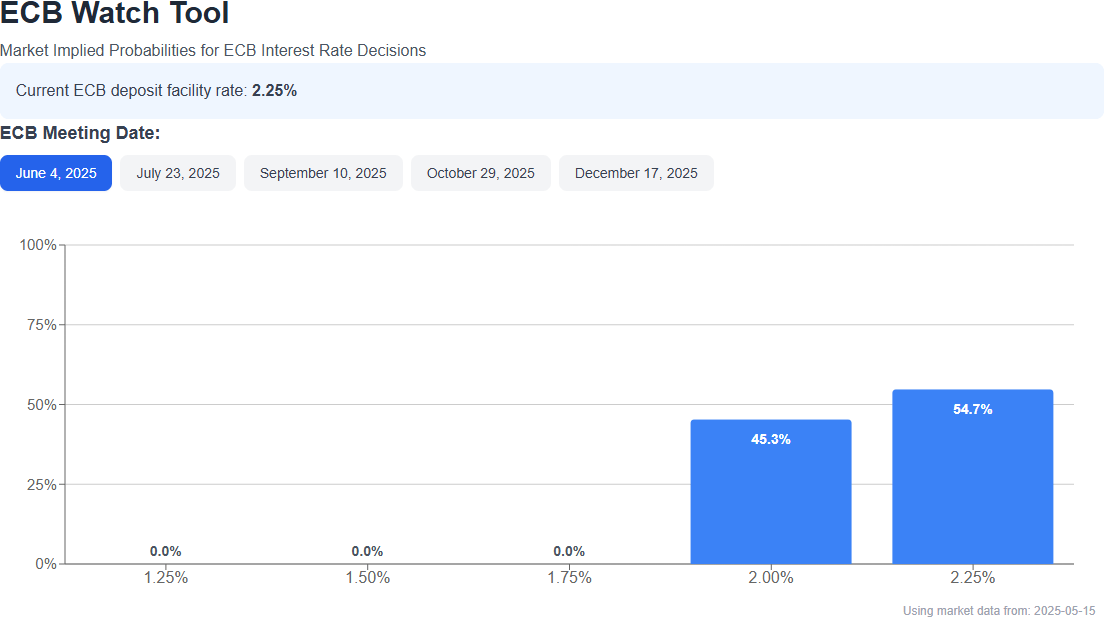
This shift in outlook is already reflected in the ECB Watch Tool, which now shows a 54.7% probability that the ECB will keep the deposit rate unchanged at 2.25% at its June 4 meeting.
Source: ECB Watch
Meanwhile, this week’s release of the U.S. annual CPI showed inflation at 2.3%, slightly below the expected 2.4%. Initially, this led some to believe that the Federal Reserve could soon consider a new rate-cut cycle, especially as inflation nears the central bank’s 2% goal.
However, that has not been the case so far. According to CME Group's FedWatch Tool, there is still a 94.8% probability that the Fed will leave rates unchanged at 4.5% at its June 18 meeting, and a 69.3% probability of the same outcome at the July 30 meeting.
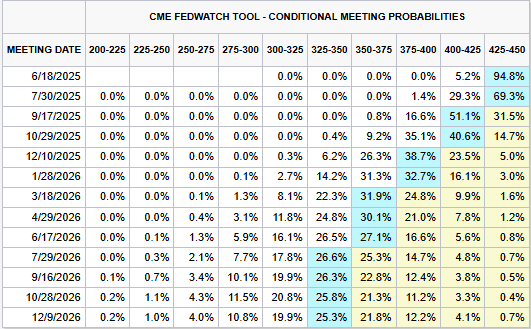
Source: CME Group
This divergence in monetary policy has likely contributed to the lack of clear direction in EUR/USD. On one hand, Europe is hinting at a potential shift away from easing, while the U.S. maintains a firm stance with elevated rates.
This rate differential, 4.5% in the U.S. vs. 2.25% in the Eurozone, continues to favor dollar-denominated assets, which could increase demand for U.S. fixed income instruments, ultimately boosting demand for the U.S. dollar. In this context, downward pressure on EUR/USD could intensify if this divergence remains in place.
EUR/USD Technical Outlook
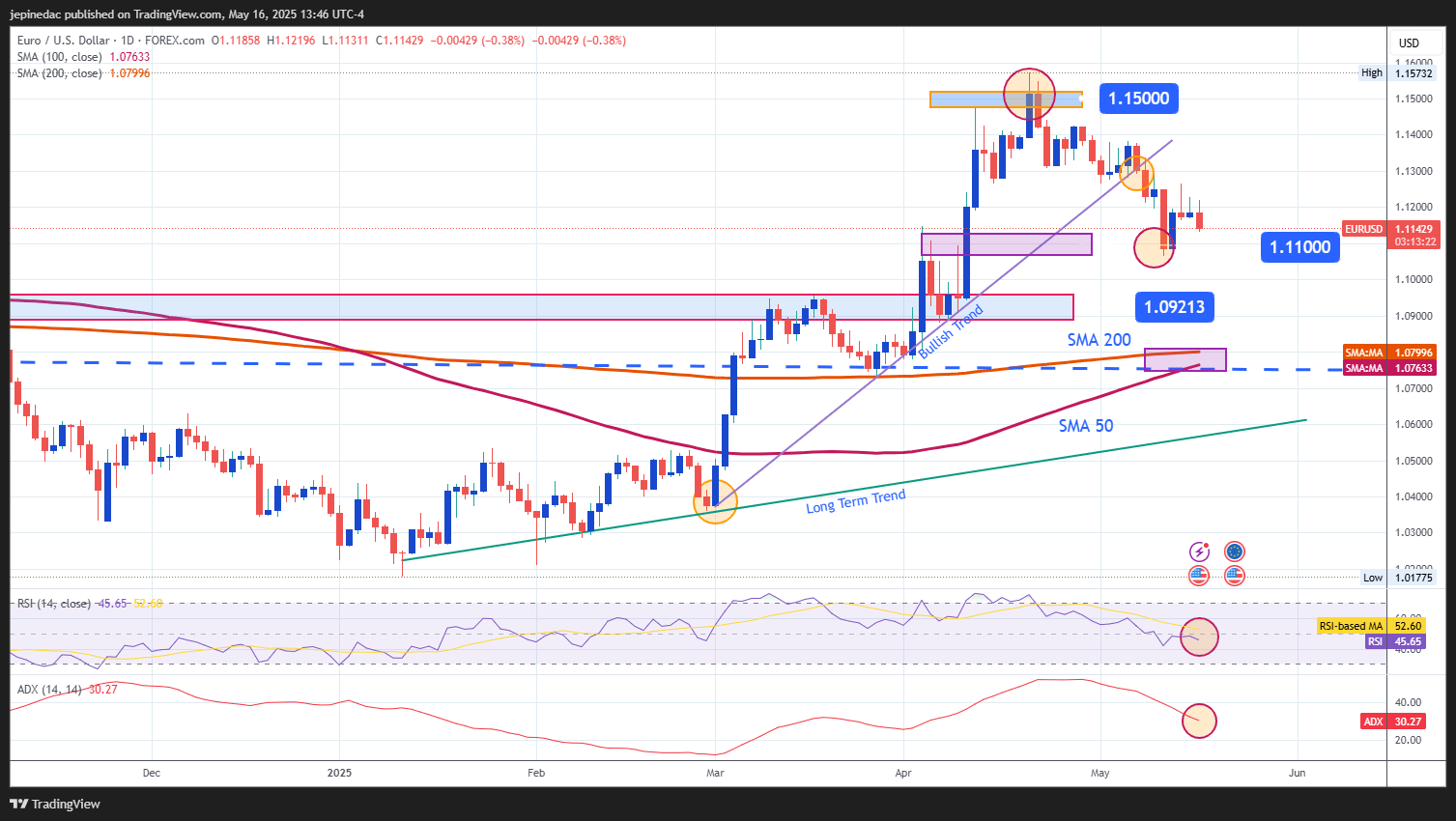
Source: StoneX, Tradingview
- Bullish Trend Break: In recent sessions, selling pressure has been strong enough to break the short-term uptrend that had been in place since early March. While the pullback has not been aggressive enough to confirm a new prolonged downtrend, it has been sufficient to invalidate the bullish bias that had been forming. The pair is now in a zone of indecision near 1.11000, and as long as price continues oscillating around this level, the market may enter a sideways phase in the near term.
- RSI: The RSI line remains close to the 50 level, reflecting a balance between buyers and sellers. If the RSI continues to flatten at this level, the lack of clear direction may persist and weigh on the pair in the short term.
- ADX: Although the ADX line remains above 20, its slope has started to fall below 30, indicating a decline in trend strength. If the ADX continues to drop, it could suggest further indecision in euro price movements.
Key Levels:
- 1.11000 – Crucial Support: A psychological level aligned with recent zones of indecision. A breakdown below this area could trigger a broader bearish bias.
- 1.09213 – Distant Support: A support zone near the 100- and 200-period simple moving averages. A sustained move toward this level could initiate a new downtrend on the chart.
- 1.15000 – Key Resistance: A psychological level and the recent multi-month high. If price returns to this area, it could reactivate the bullish bias and lead to a resumption of the upward trend.
Written by Julian Pineda, CFA – Market Analyst
Follow him at: @julianpineda25
Related tags:


Open an account in minutes
Experience award-winning platforms with fast and secure execution.
Economic calendar
Web Trader platform
Our sophisticated web-based platform is packed with features.
Related articles

What UK GDP Means for GBP/AUD After a Key Resistance Break
The GBP/AUD breakout follows a Reserve Bank of Australia rate hike paired with a signal of a prolonged pause, draining support from the Aussie.


EUR/USD, EUR/JPY: Hawkish Fed Weighs on Euro as Yen Bulls Struggle
Hawkish Fed bets weigh on EUR/USD as ECB caution grows, while EUR/JPY's bullish wedge breakout keeps 181.50 in focus despite broader downside risks.


Gold under the pump as dollar sensitivity surges
Gold's sensitivity to the US dollar is approaching historical extremes, while its reaction to the latest Treasury yield shock ranks among the most severe in decades.

The information on this web site is not targeted at the general public of any particular country. It is not intended for distribution to residents in any country where such distribution or use would contravene any local law or regulatory requirement. The information and opinions in this report are for general information use only and are not intended as an offer or solicitation with respect to the purchase or sale of any currency or CFD contract. All opinions and information contained in this report are subject to change without notice. This report has been prepared without regard to the specific investment objectives, financial situation and needs of any particular recipient. Any references to historical price movements or levels is informational based on our analysis and we do not represent or warranty that any such movements or levels are likely to reoccur in the future. While the information contained herein was obtained from sources believed to be reliable, author does not guarantee its accuracy or completeness, nor does author assume any liability for any direct, indirect or consequential loss that may result from the reliance by any person upon any such information or opinions.
Futures, Options on Futures, Foreign Exchange and other leveraged products involves significant risk of loss and is not suitable for all investors. Losses can exceed your deposits. Increasing leverage increases risk. Spot Gold and Silver contracts are not subject to regulation under the U.S. Commodity Exchange Act. Contracts for Difference (CFDs) are not available for US residents. Before deciding to trade forex, commodity futures, or digital assets, you should carefully consider your financial objectives, level of experience and risk appetite. Any opinions, news, research, analyses, prices or other information contained herein is intended as general information about the subject matter covered and is provided with the understanding that we do not provide any investment, legal, or tax advice. You should consult with appropriate counsel or other advisors on all investment, legal, or tax matters. References to FOREX.com or GAIN Capital refer to StoneX Group Inc. and its subsidiaries. Please read Characteristics and Risks of Standardized Options.