



NZD/USD: Kiwi hit hard by risk aversion despite Q1 GDP pop
New Zealand’s economy outperformed in Q1, but you wouldn’t know it from the Kiwi’s reaction. NZD/USD broke sharply lower Thursday as geopolitical nerves saw risk appetite crater, triggering a bearish technical break that may have further to run.
Share this:

NZD/USD Summary
The New Zealand economy may have started 2025 with a bang, but that wasn’t enough to support the Kiwi dollar on Thursday with the pair sinking to multi-week lows as risk aversion returned. Having taken out some key downside levels, there’s scope for the move to extend further—especially if risk appetite were to sour.
Strong Growth is Yesterday’s News
New Zealand’s economy grew 0.8% in Q1, comfortably ahead of the RBNZ’s 0.4% forecast, with strength concentrated in goods production. Despite the quarterly pop, annual GDP was still down 1.1%, a reminder that broader conditions remain fragile.
Manufacturing rebounded 2.4%, helped by transport equipment and machinery, while business services also rose 2.4% thanks to a lift in IT-related activity. Healthcare chipped in with another solid quarter, up 1.4%. The bounce in goods-producing industries—up 1.3% after a sharp fall in Q4—was a key driver behind the upside surprise. The services side—the largest sector accounting for 73.6% of GDP—was softer, rising 0.4% overall.
Despite topping market and RBNZ expectations, the data was rightly treated by traders as something akin to a historic document with little relevance to today.
NZD/USD Breaks Down
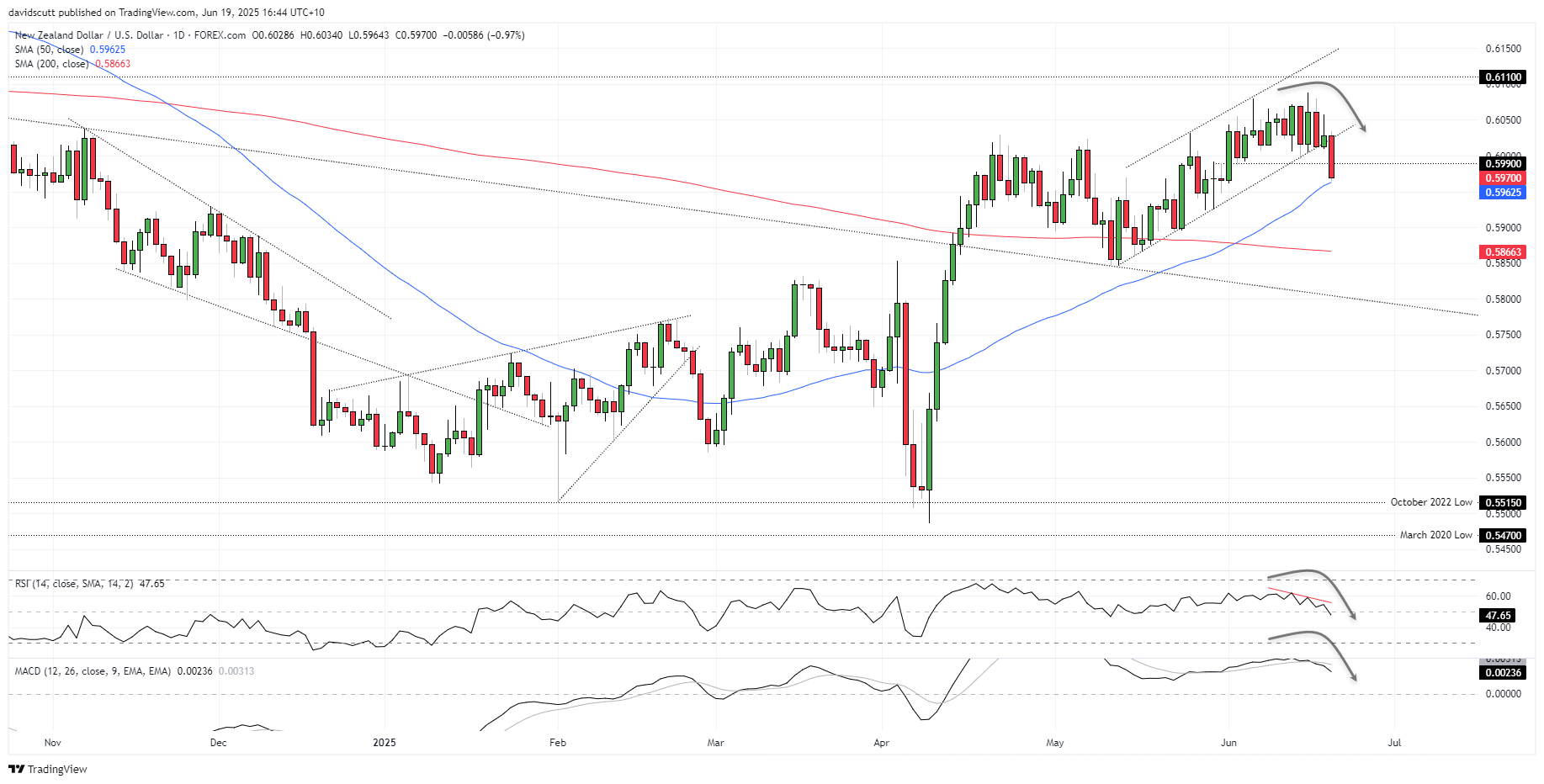
Source: TradingView
Downside risks for NZD/USD flagged earlier in the week have materialised, with the price tumbling to levels not seen since early June. Rather than being Kiwi-specific, the move was sparked by a Bloomberg headline stating the U.S. was readying for a possible attack on Iran in the “coming days.” It was enough to see NZD/USD break channel support it had been testing for several days beforehand, overwhelming buyers who had been lurking beneath .6000.
RSI (14) is trending lower and below 50. MACD remains above zero but has already crossed the signal line and is keeling over, adding to the sense that while not yet outright bearish, the momentum picture is shifting in that direction.
Downside levels to watch include the 50-day moving average, .5925—where the Kiwi bounced from in late May—along with .5900 and the important 200-day moving average. Having previously acted as support, .5990 may now revert to resistance if the bearish break were to reverse.
-- Written by David Scutt
Follow David on Twitter @scutty
How to trade with City Index
You can trade with City Index by following these four easy steps:
- Open an account, or log in if you’re already a customer
• Open an account in the UK
• Open an account in Australia
• Open an account in Singapore
- Search for the market you want to trade in our award-winning platform
- Choose your position and size, and your stop and limit levels
- Place the trade
Related tags:

Open an account in minutes
Experience award-winning platforms with fast and secure execution.
Economic calendar
Web Trader platform
Our sophisticated web-based platform is packed with features.
Related articles
Nasdaq 100 forecast: Nvidia troubles put AI recovery into question
The recovery for major indices this week has helped repair much of the technical damage inflicted by last week’s sell-off, but the latest developments with Nvidia suggest investors are not quite ready to put the underlying risks behind them. The Nasdaq 100 led other US index futures lower overnight, with falls of around 0.8%.

Bitcoin Selloff Deepens as Midterm Sweep Stalls Crypto Bill
The Bitcoin selloff is being driven by hot U.S. inflation data, a Democratic midterm sweep that stalls the CLARITY Act and heavy ETF outflows.

What UK GDP Means for GBP/AUD After a Key Resistance Break
The GBP/AUD breakout follows a Reserve Bank of Australia rate hike paired with a signal of a prolonged pause, draining support from the Aussie.
The information on this web site is not targeted at the general public of any particular country. It is not intended for distribution to residents in any country where such distribution or use would contravene any local law or regulatory requirement. The information and opinions in this report are for general information use only and are not intended as an offer or solicitation with respect to the purchase or sale of any currency or CFD contract. All opinions and information contained in this report are subject to change without notice. This report has been prepared without regard to the specific investment objectives, financial situation and needs of any particular recipient. Any references to historical price movements or levels is informational based on our analysis and we do not represent or warranty that any such movements or levels are likely to reoccur in the future. While the information contained herein was obtained from sources believed to be reliable, author does not guarantee its accuracy or completeness, nor does author assume any liability for any direct, indirect or consequential loss that may result from the reliance by any person upon any such information or opinions.
Futures, Options on Futures, Foreign Exchange and other leveraged products involves significant risk of loss and is not suitable for all investors. Losses can exceed your deposits. Increasing leverage increases risk. Spot Gold and Silver contracts are not subject to regulation under the U.S. Commodity Exchange Act. Contracts for Difference (CFDs) are not available for US residents. Before deciding to trade forex, commodity futures, or digital assets, you should carefully consider your financial objectives, level of experience and risk appetite. Any opinions, news, research, analyses, prices or other information contained herein is intended as general information about the subject matter covered and is provided with the understanding that we do not provide any investment, legal, or tax advice. You should consult with appropriate counsel or other advisors on all investment, legal, or tax matters. References to FOREX.com or GAIN Capital refer to StoneX Group Inc. and its subsidiaries. Please read Characteristics and Risks of Standardized Options.