








AUD monthly outlook: February 2024
AUD/USD suffered its worst month in 11 in January, after traders scaled back bets of several Fed cuts this year which helped the US dollar rally and force AUD/USD -3.5% lower for the month. The focus now shifts to next week's RBA meeting.
Share this:

AUD monthly outlook: January performance and highlights
- AUD/USD suffered its worst month in 11 in January, and was the second weakest FX major behind the yen
- Traders scaled back bets of several Fed cuts this year which helped the US dollar rally from its December low and force AUD/USD -3.5% lower for the month
- Even further promise of stimulus from China failed to revive sentiment towards the Australian dollar
- The rate of Australian CPI softened faster than expected in Q4, which brought forward bets that the RBA could cut rates as early as May
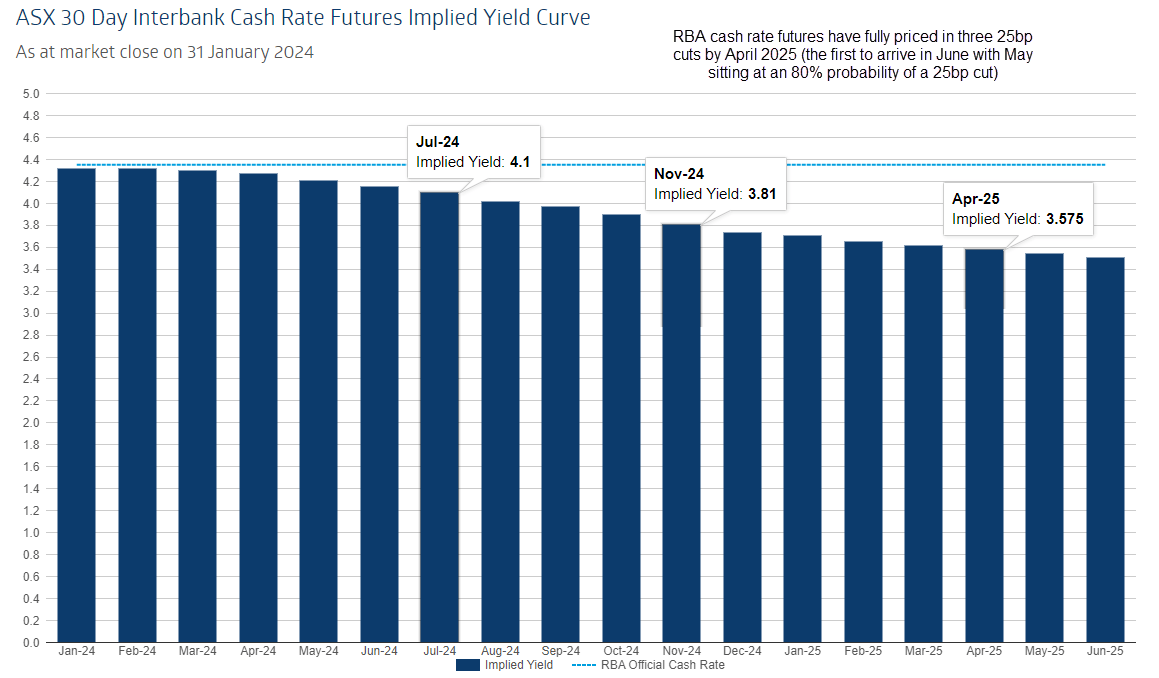
- The odds of a cut by May rose to 80% and a July cut is now full priced in, according to the RBA’s cash rate futures curve
- January reports showed that the economy was cooling in December, with retail sales down -2.6% m/m and over 100k full-time jobs were shed
What to look out for in February 2024
| Event | AEDT (GMT 11) |
| Producer price indices | 11:30, 2nd Feb |
| US Nonfarm payrolls report | 00:30, 4th Feb |
| International goods in trade | 11:30, 5th Feb |
| RBA cash rate decision | 14:30, 6th Feb |
| Houeshold spending | 11:30, 9th Feb |
| Labour force report | 11:30, 15th Feb |
| Wage price index | 11:30, 21st Feb |
| Monthly CPI report | 11:30, 28th Feb |
| Retail trade, capex report | 11:30, 29th Feb |
RBA cash rate decision – 14:30 AEDT, February 6th
“Whether further tightening of monetary policy is required to ensure that inflation returns to target in a reasonable timeframe will depend upon the data and the evolving assessment of risks”.
RBA statement, December 2023
It seems highly unlikely that the RBA would cut their interest rate next week, even if that is what many want to see. Sure, retail sales, inflation and full-time employment were lower, yet unemployment remains low by historical standards. It is also too soon to tell whether soft retail sales are trending lower, or if it was that shoppers scaled back purchases after big spending over the Black Friday sales. Furthermore, the Fed (who the RBA tend to mimic) have a higher interest rate of 5.25 – 5.5% and continue to push back on imminent rate cuts.
However, the soft inflation report for Q4 could get a mention in the RBA’s statement, and that could spark a bout of AUD selling if traders suspect the RBA are nearing a dovish ‘pivot’.
Labour force report – 11:30 AEDT, February 15th
If the RBA meeting reveals no clues for policy, we’d next look to the employment report. The -106.6k full-time jobs lost in December was its fastest pace since the pandemic. Or to put it another way, a very large drop considering there was no global shutdown. We likely don’t need to see another -100k print on full-time jobs to spark panic of a slowdown and renewed bets of an RBA cut in H1. However, if full-time jobs were to rebound then it underscores the strength of the relatively low 3.9% unemployment rate. And that could push back bets of an RBA cut.
Monthly inflation report - 11:30 AEDT, February 28th
The RBA have just been gifted a notably softer set of quarterly inflation prints. And whilst the quarterly report is considered to be more robust (and therefore favoured by the RBA), the monthly report can sway expectations of the Q1 CPI report to be released in April.
Ultimately, the faster headline CPI numbers fall towards and ideally within the RBA’s 2-3% CPI target band, the stronger the case is for cut/s to begin sooner than later. The ideal scenario for a lower cash rate is for retail sales, household spending, employment and inflation to weaken. And that could even spark bets of a March cut and would surely weigh on the Australian dollar to send it closer towards towards 60c.
AUD/USD seasonality:
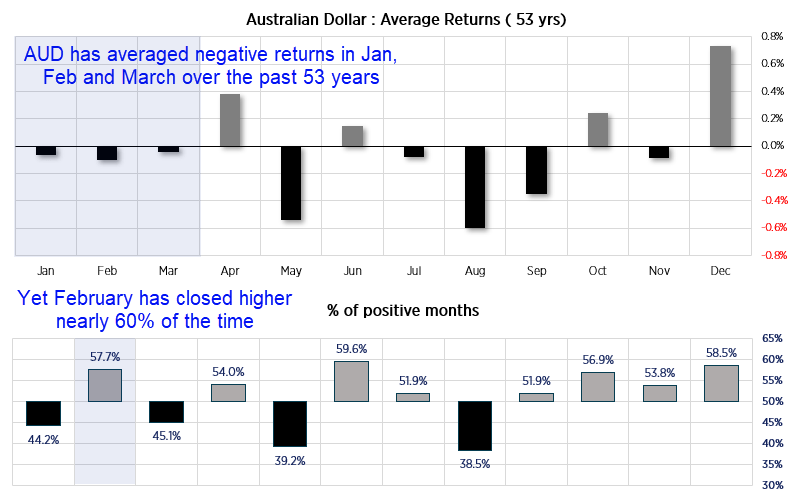
The Australian dollar has been tracking its seasonal pattern well, having posted strong gains in December (thanks Santa’s rally) before switching lower in January. Over the past 53 years, AUD/USD has delivered negative average returns in January, February and March, and has closed lower ~58% of the time in January and March.
However, whilst February has averaged negative returns, it has actually closed higher nearly 58% of the time to show the bearish months outweighed the positive.
- The average up month in February is 1.9%
- The average down month in February is -2.8%.
AUD/USD futures: Market positioning from the COT report
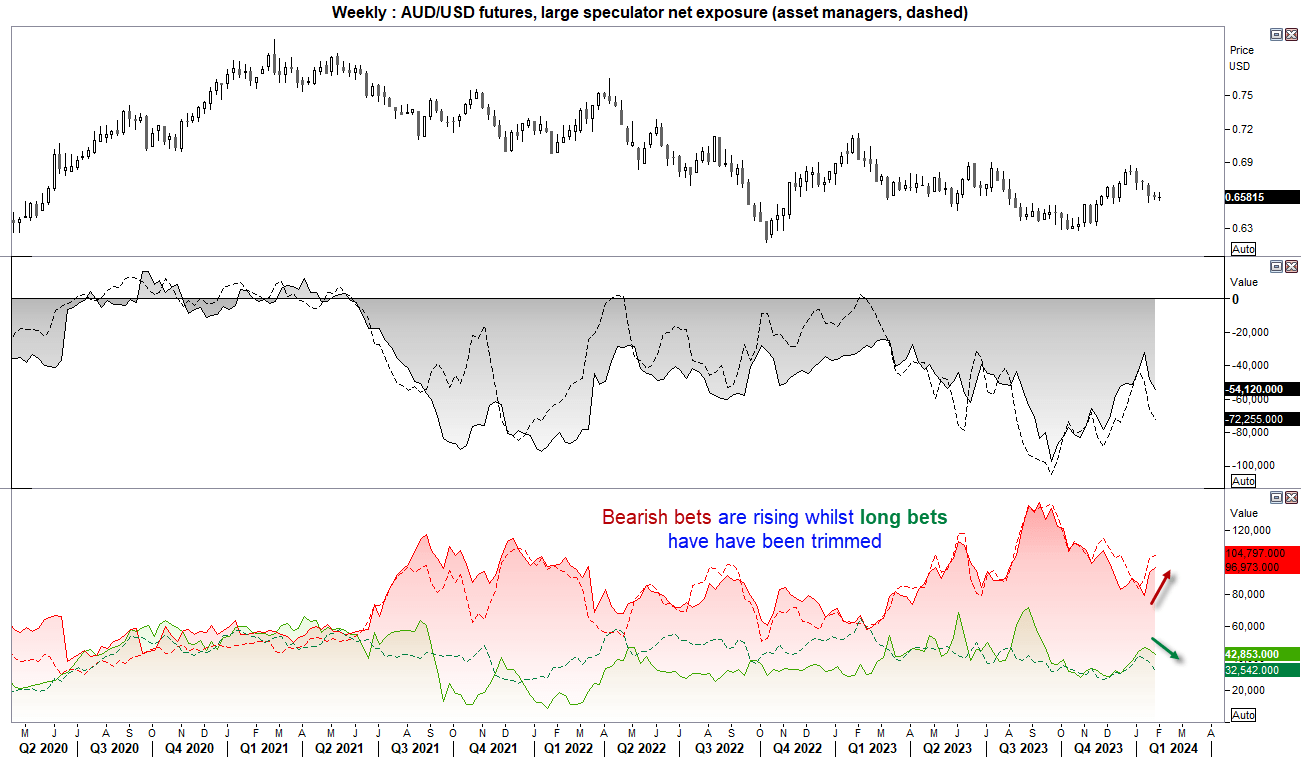
Shorting AUD/USD is not a new idea, with large speculators being net-short Aussie futures since June 2021. Yet the closure of short bets in recent months looks set to reverse, with bears stepping back in and long exposure being reduced. Given net-short exposure does not seem to be around a sentiment extreme, it suggests further downside potential for AUD/USD over the coming weeks.
AUD/USD weekly/monthly chart:
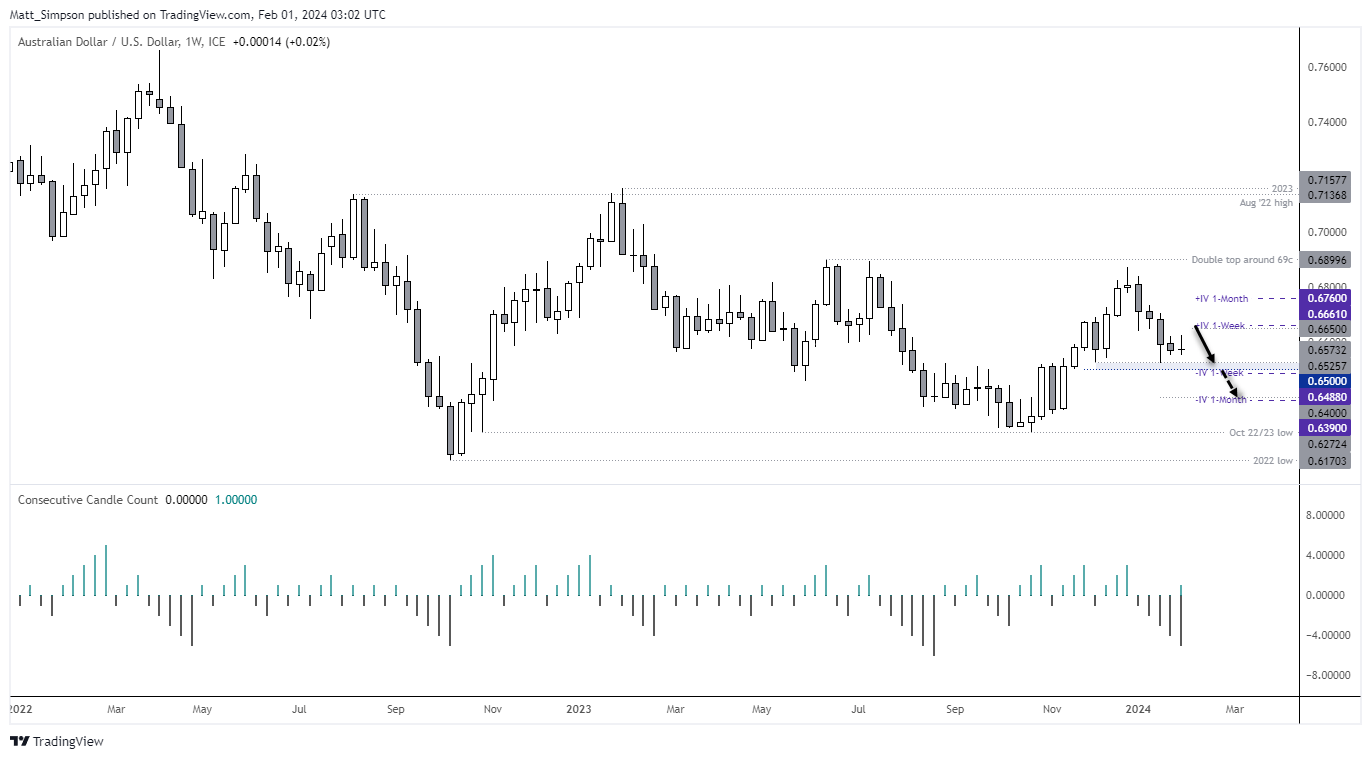
AUD/USD has traded lower for four consecutive weeks and is considering trading lower for a fifth. Statistically, this could raises the risk of a minor bounce, given that bearish sequences tend to peter out around the fourth of fifth week. Also note the bearish inside week which formed last week, and AUD/USD has held above cycle lows despite the less-dovish0than-hoped FOMC meeting.
The bias is to sell into minor rallies given the relative hawkishness of the Fed compare with the RBA. Another soft employment and inflation report could help send AUD/USD below 65c. Take note that the 1-month implied volatility band suggests ~68% chance of prices landing between 0.6390 – 0.6760 at the end of Feb.
-- Written by Matt Simpson
Follow Matt on Twitter @cLeverEdge
How to trade with City Index
You can trade with City Index by following these four easy steps:
- Open an account, or log in if you’re already a customer
• Open an account in the UK
• Open an account in Australia
• Open an account in Singapore
- Search for the market you want to trade in our award-winning platform
- Choose your position and size, and your stop and limit levels
- Place the trade
Related tags:
Latest market news



Open an account in minutes
Experience award-winning platforms with fast and secure execution, and enjoy tight spreads from 0.5 pts on FX and 0.3 pts on indices.
Economic calendar
Web Trader platform
Our sophisticated web-based platform is packed with features.
Related articles
EUR/USD weekly outlook: Oil, inflation and NFP in focus
After coming under significant pressure in recent weeks, the EUR/USD came off its lows to finish the week on a positive note on Friday, albeit with only a mild rebound. That was not enough to prevent the exchange rate falling for the third consecutive week, as the US dollar and bond yields rallied across the board.

Gold Q4 2026 outlook: Resilience in the face of rallying dollar and yields
As we headed towards the latter stages of Q3 and into Q4, the Fed had just hiked rates in a hawkish FOMC meeting, while the likes of the ECB and BoJ had also tightened their respective policies. Oil prices remained elevated amid the prolonged US-Iran conflict. Meanwhile, bond yields were breaking out, and the dollar was higher across the board. Yet, remarkably, gold was still holding in the positive territory for the third quarter, even if it had weakened somewhat in September.

EUR/USD Q4 2026 Outlook: Euro at a Crossroads as Fed, ECB Tighten 9 25 2026
EUR/USD enters Q4 at a pivotal inflection point as competing Fed-ECB policy paths and persistent inflation risks collide with major technical support.
This report is intended for general circulation only. It should not be construed as a recommendation, or an offer (or solicitation of an offer) to buy or sell any financial products. The information provided does not take into account your specific investment objectives, financial situation or particular needs. Before you act on any recommendation that may be contained in this report, independent advice ought to be sought from a financial adviser regarding the suitability of the investment product, taking into account your specific investment objectives, financial situation or particular needs.
StoneX Financial Pte. Ltd., may distribute reports produced by its respective foreign entities or affiliates within the StoneX group of companies or third parties pursuant to an arrangement under Regulation 32C of the Financial Advisers Regulations. Where the report is distributed to a person in Singapore who is not an accredited investor, expert investor or an institutional investor (as defined in the Securities Futures Act), StoneX Financial Pte. Ltd. accepts legal responsibility to such persons for the contents of the report only to the extent required by law. Singapore recipients should contact StoneX Financial Pte. Ltd. at 6826 9988 for matters arising from, or in connection with the report.
In the case of all other recipients of this report, to the extent permitted by applicable laws and regulations neither StoneX Financial Pte. Ltd. nor its associated companies will be responsible or liable for any loss or damage incurred arising out of, or in connection with, any use of the information contained in this report and all such liability is hereby expressly disclaimed. No representation or warranty is made, express or implied, that the content of this report is complete or accurate.
StoneX Financial Pte. Ltd. is not under any obligation to update this report.
Trading CFDs carries a high level of risk that may not be suitable for some investors. Consider your investment objectives, level of experience, financial resources, risk appetite and other relevant circumstances carefully. The possibility exists that you could lose some or all of your investments, including your initial deposits. If in doubt, please seek independent expert advice. Visit www.forex.com/en-sg/terms-and-policies for the complete Risk Disclosure Statement.