



Crude Oil 2026 Outlook: Supply Risks in the Headlines
Crude oil prices are eyeing 2026 from a bearish bias lens, pressured by supply-glut risks and the dominance of a 2-year downtrend extending from the highs of September 2023. Exporter breakeven prices are also at risk, and demand potential and key levels are in sight to confirm levels potentially defining the 2026 outlook.
Share this:

Key Events
• OPEC is set to hold production output in Q1 2026, projecting a balanced outlook between supply and demand, while the IEA projects a surplus near 4 million barrels per day.
• World economic growth projections are forecasted by the IMF near 3.1%, reflecting moderate resilience and an oil-demand outlook across major economies following the tariff waves.
• Crude prices are pressured below the 60-barrier and benchmarks for key crude-exporting countries, raising outlooks for buy-the-dip opportunities at key levels ahead.
• Geopolitics remains a consistently uncertain element between sanction escalations, tariffs, and peace-deal supply risks.
• Energy transitions continue to evolve and contribute to a lag in crude demand.
The fundamental outlook for crude remains a fragile mix: markets are wrestling with oversupply worries from rising OPEC and non-OPEC production, fragile demand expectations in line with a cautious FOMC and labor market tone, uneven Chinese growth, alongside accelerating energy transition trends and the possibility of ceasefire or de-escalation deals in key geopolitical hotspots.
However, if demand picks up, especially from China in terms of industrial production, in line with improving global growth, this could reverse the current bias. Crude has been trending in a dominant downside channel since September 2023 and would require a strong catalyst, accompanied by a decisive breakout above the upper bound of this channel (70 mark), to shift the medium-term narrative from “rallies to sell” to “dips to buy, in line with crude’s 160-year uptrend.
FOMC Meeting Raises Caution for 2026
With only one projected rate cut in 2026 so far, followed by a suggested pause, caution is rising for the 2026 growth outlook amid labor-market balancing and Fed chair election risks. The upcoming non-farm payroll report remains a key risk factor for market trends following the year-end Santa-rally period heading into 2026 — unless caution intensifies near the extended and extreme highs of 2025, which already faced strong headwinds from exhausted policy tools under a new presidency.
Supply & Demand Outlook: IEA vs OPEC
The IEA has lowered its 2026 oil surplus forecast to 3.84 million barrels per day, reflecting the combined impact of ongoing sanctions on Russian and Venezuelan supply and a modest improvement in global demand expectations. The agency now anticipates +0.86 mb/d of additional demand in 2026, bringing total global consumption to roughly 105.9 mb/d, against an estimated global supply of around 107 mb/d. This imbalance reinforces the risk of continued oversupply, and any ceasefire agreements or relaxation of sanctions could steepen the supply overhang further, potentially pressuring crude prices toward the mid-50s under a bearish scenario.
OPEC, however, maintains a far tighter view of the 2026 balance. The group has announced a halt to its production unwinding in Q1 2026, projecting a near-balanced market with expected demand of ~106.5 mb/d versus supply estimates of 106.8–107 mb/d. The discrepancy between the IEA’s surplus outlook and OPEC’s balanced view underscores the role of demand uncertainties—particularly global macro sentiment, China’s fuel consumption trajectory, U.S. dollar strength, and geopolitical outcomes including sanctions and ceasefire developments.
Whether OPEC resumes its unwinding of voluntary cuts beyond Q1 2026 will likely depend on how the supply/demand/price dynamic evolves in early 2026. The group remains focused on balancing market stability with the strategic interests of key exporting and importing countries, suggesting production policy will stay flexible and data-dependent.
Increasing Supply over demand potential: Bearish outlook
Improving demand expectations: Bullish outlook
Energy Transitions and Supply Drag
Global Oil Demand Growth by Sector
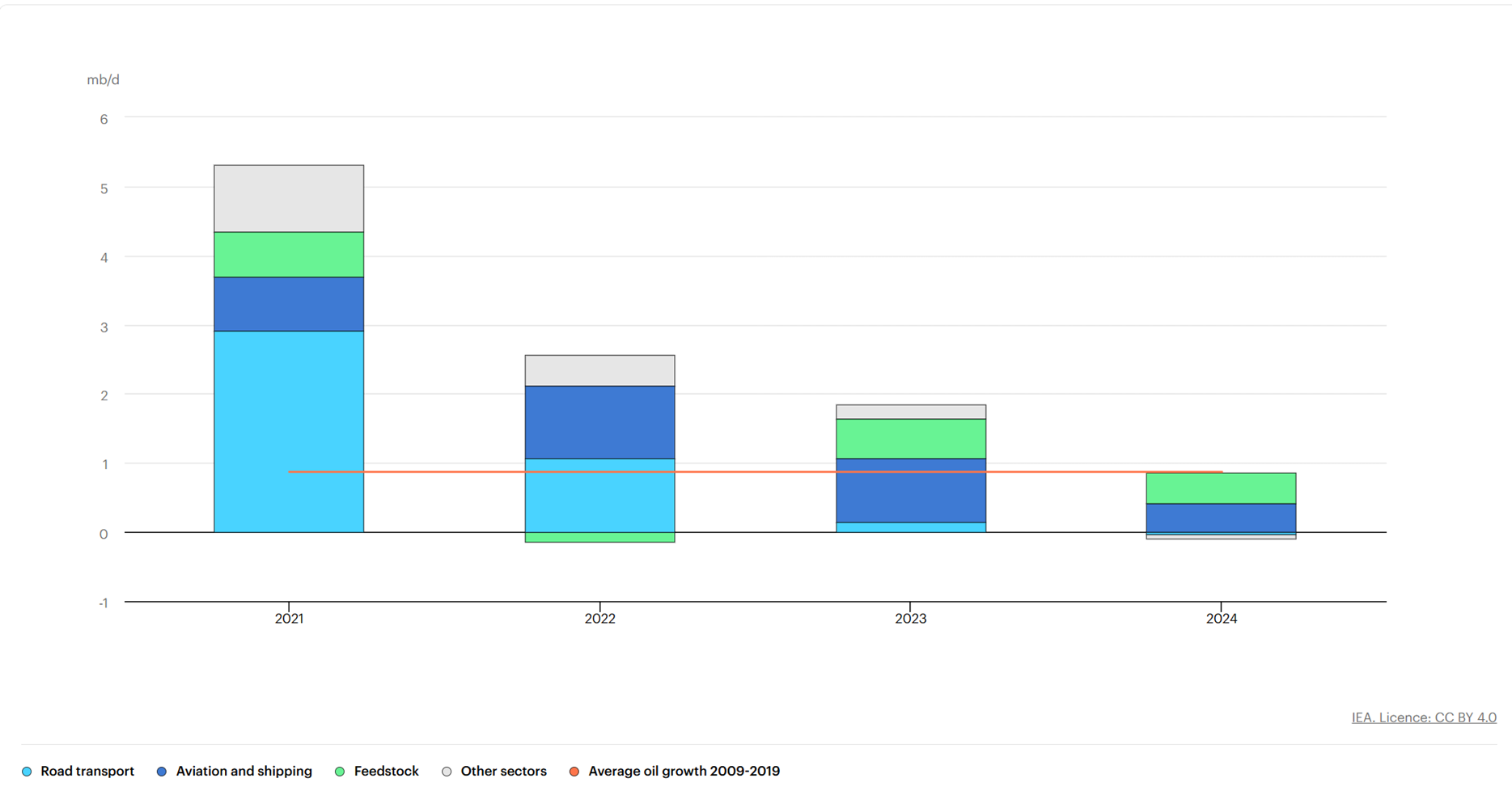
Source: IEA
According to the IEA, global oil demand growth from road transport (shown in light blue) fell sharply from around 2.9 mb/d in 2021 to near-zero growth by 2024, reflecting the impact of rising EV adoption, improved fuel efficiency, and remote working. While the energy transition is slowing transport-related demand, the IEA notes that petrochemicals remain one of the strongest long-term drivers of oil consumption. Plastics, chemicals, solvents, and synthetic fibers rely on crude-derived feedstocks, and petrochemicals are expected to account for around one-third of global oil-demand growth through 2030, adding roughly 3–4 mb/d.
This matters for crude’s long-term trajectory because petrochemical and industrial uses are far harder to replace than gasoline or diesel. Even as EV penetration rises, crude remains essential in manufacturing, packaging, construction materials, fertilizers, and consumer goods, with demand still expanding in Asia. As a result, the IEA expects global oil demand to flatten rather than collapse, with petrochemical growth offsetting stagnation in road-fuel demand.
Geopolitics
The most uncertain element in every crude oil outlook remains geopolitics. U.S. sanctions on Russia, Venezuela, and Iran continue to drive black-market shipments, allowing major importers such as India and China to purchase crude at discounted prices. This dynamic creates geopolitical competition, tariff friction, and strains between the world’s largest economies.
Another factor to watch is the potential removal of Russian sanctions should a peace agreement with Ukraine materialize. Such a development would raise oversupply risks, amplifying concerns around an already fragile demand outlook.
Rising sanction risks: bullish for crude
Peace deals: bearish for crude
With the mentioned risks, crude oil prices are eyeing 2026 from a bearish bias lens, pressured by supply-glut risks and the dominance of a 2-year downtrend extending from the highs of September 2023. Exporter breakeven prices are also at risk, and demand potential and key levels are in sight to confirm levels potentially defining the 2026 outlook.
From a technical perspective, crude oil’s price action has been dominated by a series of down-trending channels since the peaks of 2022. A more prominent and structurally defined descending channel, extending from the highs of September 2023, continues to pressure prices below the 60 level in line with mounting global supply dynamics.
The 160-year trendline, which has supported crude’s higher lows since the 1860s, is now a key area of focus. It may help quantify the potential depth of any further drawdown and identify long-term support levels should the 55 level be decisively breached heading into 2026.
Crude Oil Weekly Outlook: Weekly Time Frame – Log Scale

Source: Trading view
From a weekly-timeframe perspective, crude has been trending within a downward-sloping parallel channel since June 2025, which itself lies within an even broader downtrend dating back to September 2023.
This multi-layered structure reinforces a broader bearish bias and establishes the key levels crude must be clear to transition from short-term fluctuations toward a more constructive long-term outlook.
Upside Structure (Seven-Month Channel)
• 60.50 – Key upside breakout level that crude was previously attempting to hold.
• 62.60 – Next major resistance aligned with the upper boundary of the seven-month channel.
• 65 - 66.40 → 68 – A confirmed weekly close above 62.60 could open a path toward the two-year channel boundary at 66.40, then 68, marking early confirmation of a longer-term bullish reversal structure should the trend hold above the channel bounds and 70 psychological level.
Downside Structure
• 55.00 (7 month channel support)→ 49.00 – A confirmed close below 55 would expose the long-term channel boundary at 49, offering another potential long-term buy-the-dip opportunity.
Crude’s broader structure is leaning toward a potential double-bottom reversal, in line with exporter breakeven price risks, either from the 55 low or the deeper 49 low from the lower 2-year channel border. However, as long as price remains within the down trending channel established since 2023, along with declining global oil demand growth, the overarching bearish bias remains intact.
Written by Razan Hilal, CMT
Follow on X: @Rh_waves
Latest market news




Open an account in minutes
Experience award-winning platforms with fast and secure execution, and enjoy tight spreads from 0.5 pts on FX and 0.3 pts on indices.
Economic calendar
Web Trader platform
Our sophisticated web-based platform is packed with features.
Related articles
FOMC Meeting Preview: Is Warsh Even Capable of Delivering a Hawkish Hold?
Fed Funds futures traders are pricing in ~90% odds that the FOMC leaves rates unchanged this week, but the big question is whether FOMC Chairman Warsh can deliver a true hawkish hike.


S&P 500 Forecast: SPX rises ahead of tech earnings and as the Fed meeting begins
U.S. stocks are rising as oil prices ease and investors cautiously look ahead to U.S. megacap earnings as a test of the AI trade. The Federal Reserve has also kicked off its two-day meeting ahead of tomorrow's announcement.


DAX, Oil Forecast: Two trades to watch 271026
DAX struggles as optimism fades ahead of ECB rate decision this week. Oil recovers earlier losses as Middle East supply concerns offset diplomacy hopes.
This report is intended for general circulation only. It should not be construed as a recommendation, or an offer (or solicitation of an offer) to buy or sell any financial products. The information provided does not take into account your specific investment objectives, financial situation or particular needs. Before you act on any recommendation that may be contained in this report, independent advice ought to be sought from a financial adviser regarding the suitability of the investment product, taking into account your specific investment objectives, financial situation or particular needs.
StoneX Financial Pte. Ltd., may distribute reports produced by its respective foreign entities or affiliates within the StoneX group of companies or third parties pursuant to an arrangement under Regulation 32C of the Financial Advisers Regulations. Where the report is distributed to a person in Singapore who is not an accredited investor, expert investor or an institutional investor (as defined in the Securities Futures Act), StoneX Financial Pte. Ltd. accepts legal responsibility to such persons for the contents of the report only to the extent required by law. Singapore recipients should contact StoneX Financial Pte. Ltd. at 6826 9988 for matters arising from, or in connection with the report.
In the case of all other recipients of this report, to the extent permitted by applicable laws and regulations neither StoneX Financial Pte. Ltd. nor its associated companies will be responsible or liable for any loss or damage incurred arising out of, or in connection with, any use of the information contained in this report and all such liability is hereby expressly disclaimed. No representation or warranty is made, express or implied, that the content of this report is complete or accurate.
StoneX Financial Pte. Ltd. is not under any obligation to update this report.
Trading CFDs carries a high level of risk that may not be suitable for some investors. Consider your investment objectives, level of experience, financial resources, risk appetite and other relevant circumstances carefully. The possibility exists that you could lose some or all of your investments, including your initial deposits. If in doubt, please seek independent expert advice. Visit www.forex.com/en-sg/terms-and-policies for the complete Risk Disclosure Statement.