



Currency Pair of the Week AUDUSD
AUD/USD has had a strong run since mid-March, trading from .5701 to .7243.
Share this:

AUD/USD has had a strong run since mid-March, trading from .5701 to .7243. The Reserve Bank of Australia (RBA) stated at their last meeting that given the recent outbreaks of the coronavirus and localized shutdowns, current monetary policy was still necessary (interest rates at 0.25%) and that rates would remain at current levels until inflation is sustainable within the 2% to 3% target. In addition, they would begin buying bonds again (they haven’t done so since May) as they try and target the yield on the 3-year bonds, which had risen as of late.
Australia releases their Employment Change for July on Thursday. Expectations are for 40,000 after adding 210,000 in June. Recall however that -38,100 of those jobs were full time, which means 248,000 were part time jobs! Yet, given the coronavirus situation in the US and its affect of the US Dollar, AUD/USD has remained bid.
As we have been discussing recently, the US Dollar has been in a freefall. The coronavirus in the US has been getting worse rather than better, which is signaling to US Dollar Index (DXY) traders that a slowdown in the economy (after the recent rebound) may be ahead. At the most recent Fed Interest rate meeting, the Fed said that the path of the coronavirus would drive monetary policy. They stated the key interest rate will remain at 0%-0.25% until they achieved its maximum employment and inflation goals.
The US released Nonfarm payrolls last week. The US added 1,763,000 jobs to the economy in July vs 1,600,000 expected. Although the number was better than expected, it is nowhere near the 4,791,000 jobs created in June. US initial jobless claims have been steady near 1,400,000 per week, indicating a further slowdown in new job creation may be ahead.
As the coronavirus continues to dominate the US, it became obvious new fiscal measures were needed when emergency jobless insurance expired on July 31st. After Republicans and Democrats could not reach a solution last week, President Trump signed Executive Orders over the weekend. In summary, there would be a deferral of payroll taxes for people making under $100,000 until the end of the year and emergency jobless benefits would be extended at $300 per week rather than the previous $600 per week. Also, the ban on some evictions and foreclosures would continue.
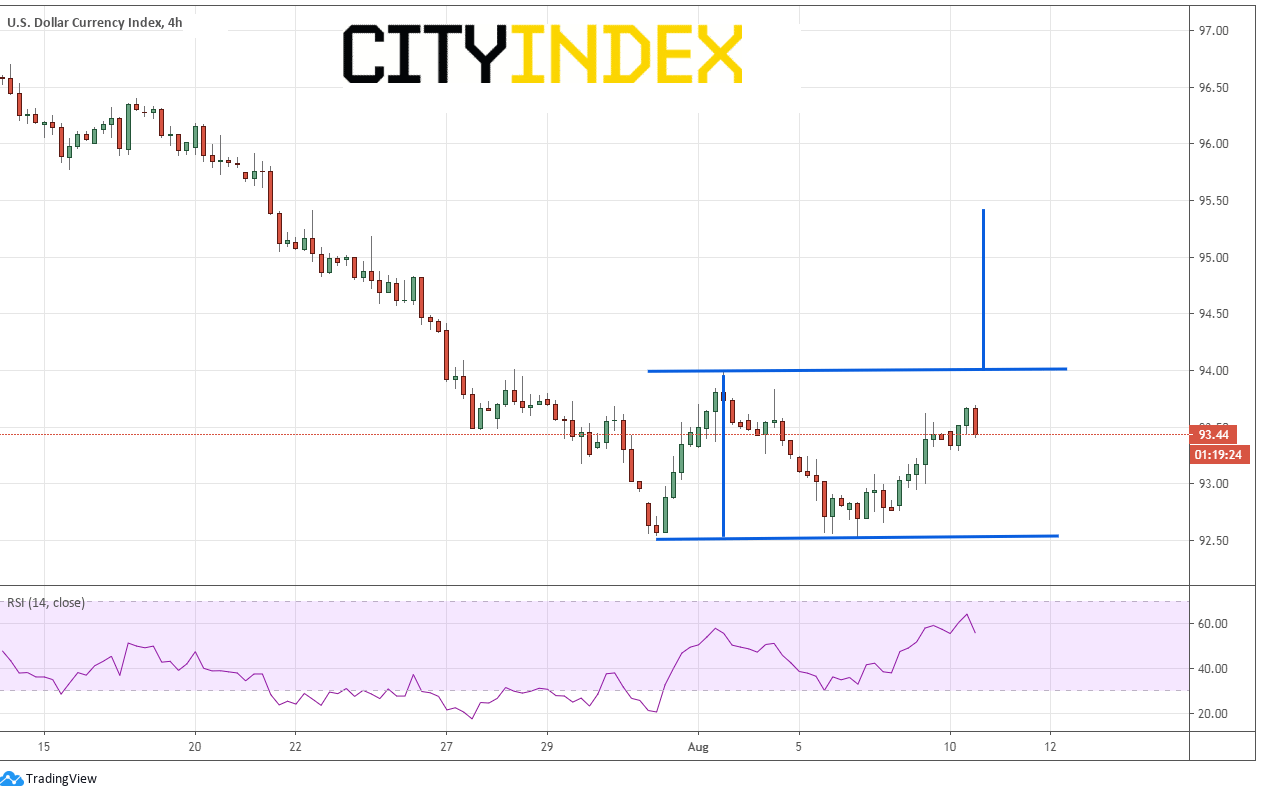
On a 240-minute timeframe, after the DXY formed support and a *potential* double bottom near 92.50, DXY bounced. A break above 94.00 would confirm the double bottom and indicate a target near 95.50.
Source: Tradingview, City Index
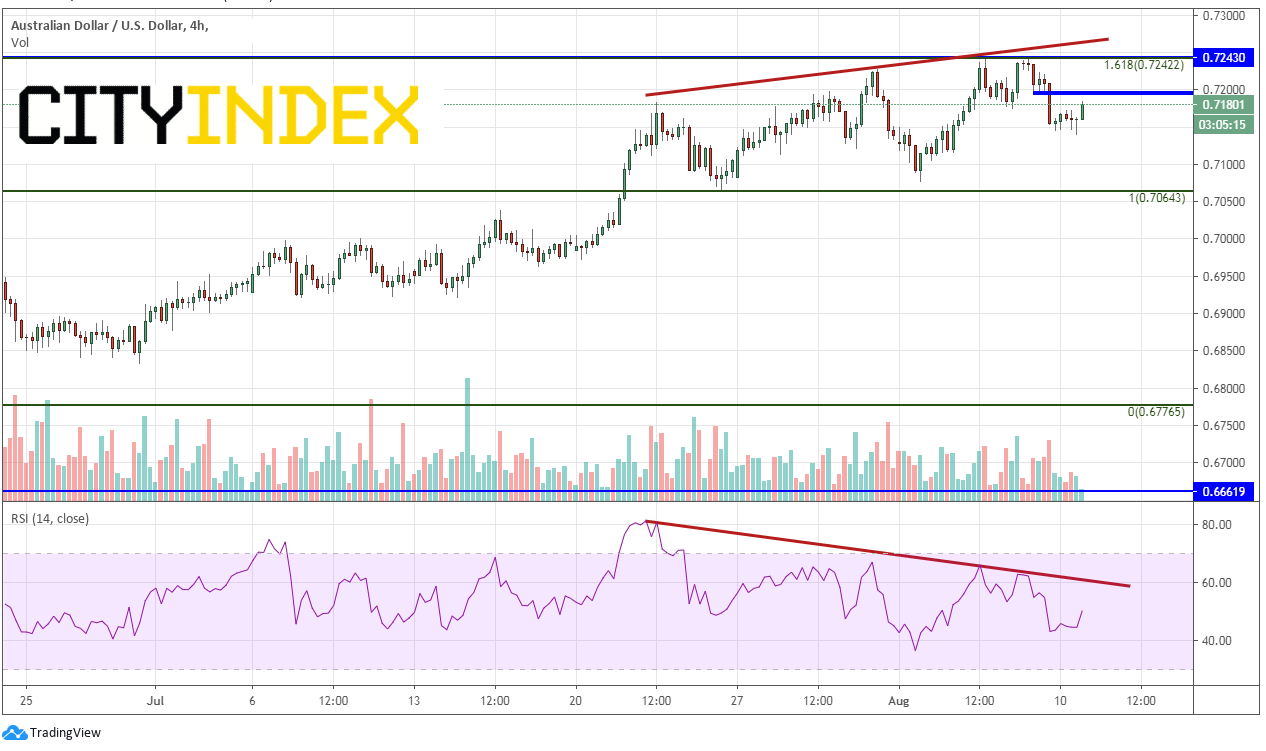
Also, on a 240-minute chart, after the AUD/USD reached the 161% Fibonacci extension from the highs of June 11th to the lows June 15th near .7243, the pair pulled back slightly. This was the highest level since February 2019. It was no surprise to see AUD/USD pull back as the RSI was diverging from price and the DXY was bouncing. Horizontal resistance crosses near .7200, then the previous highs at .7244. Support is at Monday’s (current) lows near .7140, then near prior resistance and previous lows at .7064. There is also the psychological round number support near .7000.
Source: Tradingview, City Index
There are a few specific events that could cause volatility in AUD/USD this week. First is the coronavirus. An increase in cases in Australia or the US could push that country’s currency lower. In addition, if there is continued fallout over the fiscal package in the US, this could move the pair. Finally, in Australia, if the jobs number is better than expected and the recent outbreak of coronavirus cases had little effect on job creation, AUD/USD could move higher.
AUD/USD has had a strong run since mid-March, trading from .5701 to .7243. The Reserve Bank of Australia (RBA) stated at their last meeting that given the recent outbreaks of the coronavirus and localized shutdowns, current monetary policy was still necessary (interest rates at 0.25%) and that rates would remain at current levels until inflation is sustainable within the 2% to 3% target. In addition, they would begin buying bonds again (they haven’t done so since May) as they try and target the yield on the 3-year bonds, which had risen as of late.
Australia releases their Employment Change for July on Thursday. Expectations are for 40,000 after adding 210,000 in June. Recall however that -38,100 of those jobs were full time, which means 248,000 were part time jobs! Yet, given the coronavirus situation in the US and its affect of the US Dollar, AUD/USD has remained bid.
As we have been discussing recently, the US Dollar has been in a freefall. The coronavirus in the US has been getting worse rather than better, which is signaling to US Dollar Index (DXY) traders that a slowdown in the economy (after the recent rebound) may be ahead. At the most recent Fed Interest rate meeting, the Fed said that the path of the coronavirus would drive monetary policy. They stated the key interest rate will remain at 0%-0.25% until they achieved its maximum employment and inflation goals.
The US released Nonfarm payrolls last week. The US added 1,763,000 jobs to the economy in July vs 1,600,000 expected. Although the number was better than expected, it is nowhere near the 4,791,000 jobs created in June. US initial jobless claims have been steady near 1,400,000 per week, indicating a further slowdown in new job creation may be ahead.
As the coronavirus continues to dominate the US, it became obvious new fiscal measures were needed when emergency jobless insurance expired on July 31st. After Republicans and Democrats could not reach a solution last week, President Trump signed Executive Orders over the weekend. In summary, there would be a deferral of payroll taxes for people making under $100,000 until the end of the year and emergency jobless benefits would be extended at $300 per week rather than the previous $600 per week. Also, the ban on some evictions and foreclosures would continue.
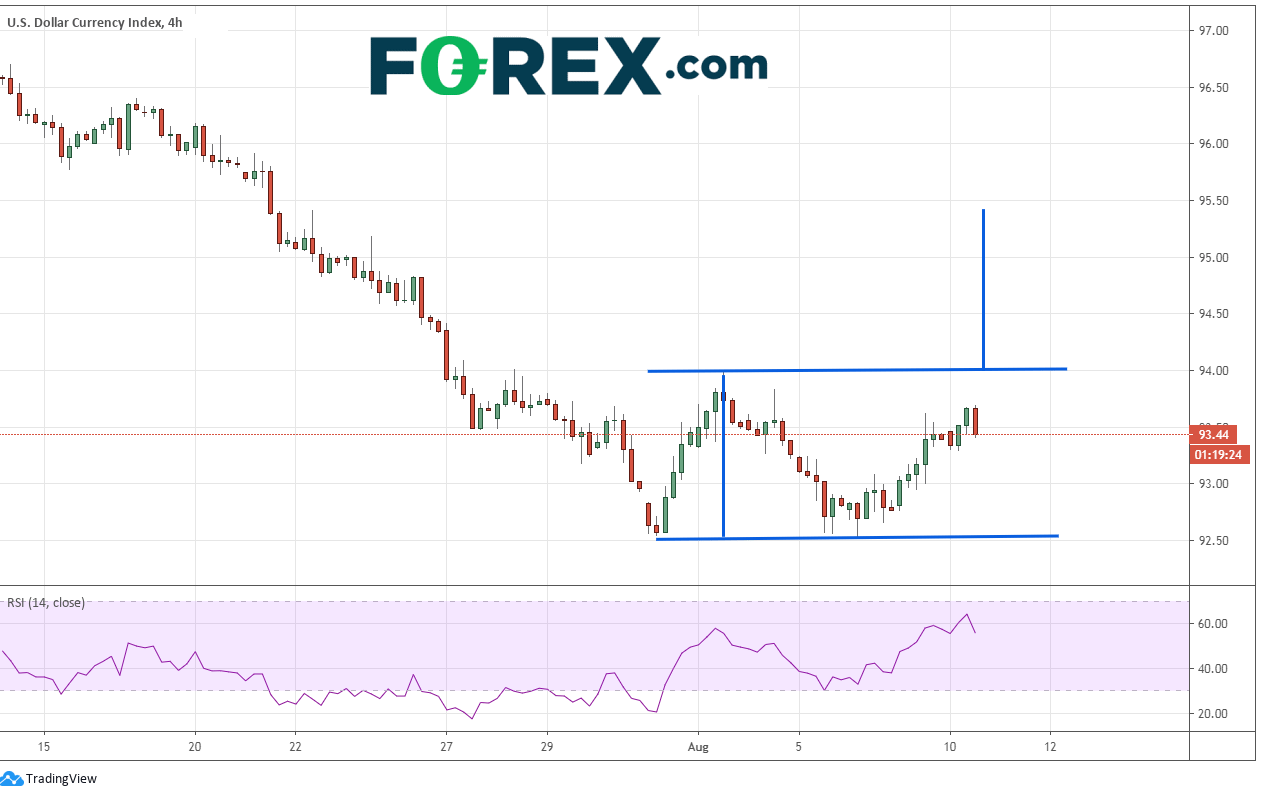
On a 240-minute timeframe, after the DXY formed support and a *potential* double bottom near 92.50, DXY bounced. A break above 94.00 would confirm the double bottom and indicate a target near 95.50.
Source: Tradingview, Forex.com
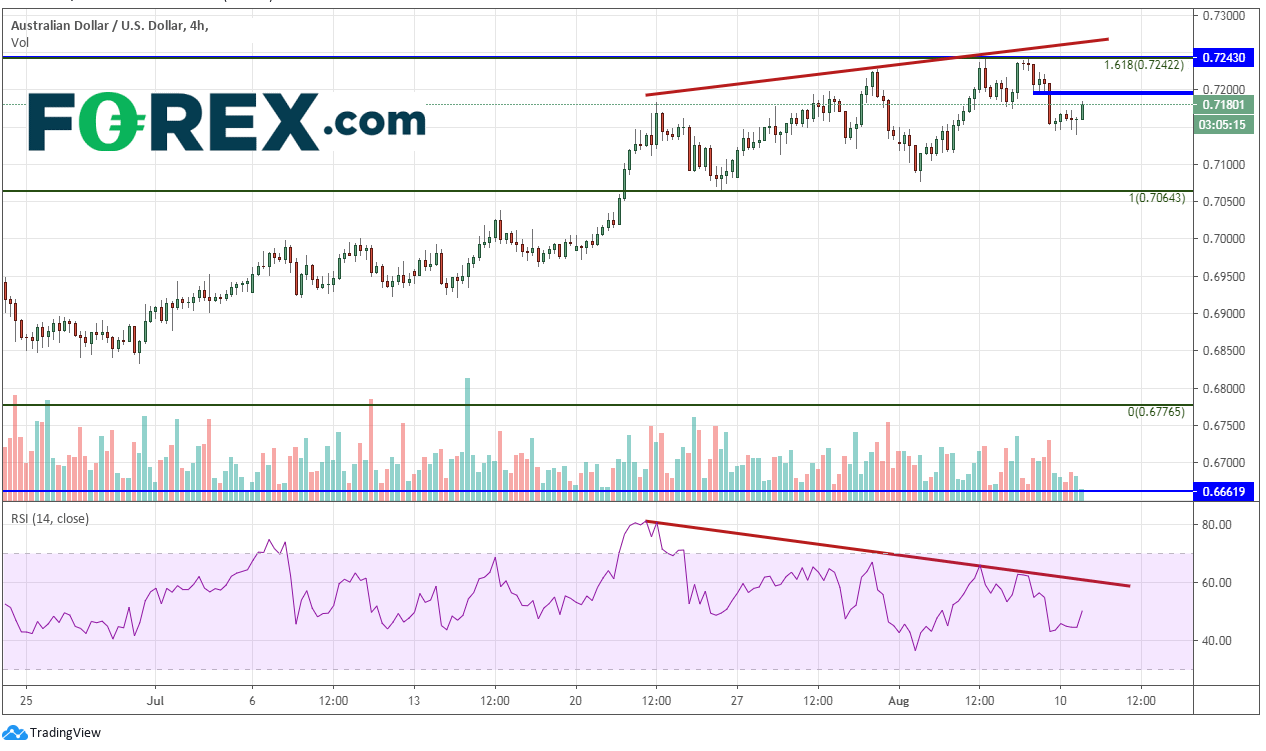
Also, on a 240-minute chart, after the AUD/USD reached the 161% Fibonacci extension from the highs of June 11th to the lows June 15th near .7243, the pair pulled back slightly. This was the highest level since February 2019. It was no surprise to see AUD/USD pull back as the RSI was diverging from price and the DXY was bouncing. Horizontal resistance crosses near .7200, then the previous highs at .7244. Support is at Monday’s (current) lows near .7140, then near prior resistance and previous lows at .7064. There is also the psychological round number support near .7000.
Source: Tradingview, Forex.com
There are a few specific events that could cause volatility in AUD/USD this week. First is the coronavirus. An increase in cases in Australia or the US could push that country’s currency lower. In addition, if there is continued fallout over the fiscal package in the US, this could move the pair. Finally, in Australia, if the jobs number is better than expected and the recent outbreak of coronavirus cases had little effect on job creation, AUD/USD could move higher.
Related tags:
Latest market news



Open an account in minutes
Experience award-winning platforms with fast and secure execution, and enjoy tight spreads from 0.5 pts on FX and 0.3 pts on indices.
Economic calendar
Web Trader platform
Our sophisticated web-based platform is packed with features.
Related articles

USD/JPY outlook: Currency Pair of the Week | September 15, 2026
The USD/JPY managed to extend its recovery to around 155.00 this morning which is a pivotal technical and psychologically-important level. The pair has been recovering from a seven-month low, as US Treasury yields and oil prices have been pushing higher and investors position for a potentially more hawkish Federal Reserve on Wednesday. Meanwhile the potential for a hawkish Bank of Japan surprise has limited the USD/JPY’s upside for now, relative to other dollar FX major pairs.

EUR/USD forecast: Currency Pair of the Week | September 7, 2026
The higher oil goes, the worse it may get for the euro, which, to be fair, has performed well during the more recent rises in oil prices compared to earlier this year. Still, the risks to the near EUR/USD forecast remains tilted lower as the pair tests the 200-day average ahead of a pivotal week.

EUR/AUD, GBP/AUD, AUD/NZD: Aussie dollar charging as hawkish RBA bets build
Australia’s latest inflation report was ugly enough to make mortgage holders feel sick, and traders have responded by rapidly ramping up RBA hike bets. The Aussie is now breaking key levels across the major crosses.

This report is intended for general circulation only. It should not be construed as a recommendation, or an offer (or solicitation of an offer) to buy or sell any financial products. The information provided does not take into account your specific investment objectives, financial situation or particular needs. Before you act on any recommendation that may be contained in this report, independent advice ought to be sought from a financial adviser regarding the suitability of the investment product, taking into account your specific investment objectives, financial situation or particular needs.
StoneX Financial Pte. Ltd., may distribute reports produced by its respective foreign entities or affiliates within the StoneX group of companies or third parties pursuant to an arrangement under Regulation 32C of the Financial Advisers Regulations. Where the report is distributed to a person in Singapore who is not an accredited investor, expert investor or an institutional investor (as defined in the Securities Futures Act), StoneX Financial Pte. Ltd. accepts legal responsibility to such persons for the contents of the report only to the extent required by law. Singapore recipients should contact StoneX Financial Pte. Ltd. at 6826 9988 for matters arising from, or in connection with the report.
In the case of all other recipients of this report, to the extent permitted by applicable laws and regulations neither StoneX Financial Pte. Ltd. nor its associated companies will be responsible or liable for any loss or damage incurred arising out of, or in connection with, any use of the information contained in this report and all such liability is hereby expressly disclaimed. No representation or warranty is made, express or implied, that the content of this report is complete or accurate.
StoneX Financial Pte. Ltd. is not under any obligation to update this report.
Trading CFDs carries a high level of risk that may not be suitable for some investors. Consider your investment objectives, level of experience, financial resources, risk appetite and other relevant circumstances carefully. The possibility exists that you could lose some or all of your investments, including your initial deposits. If in doubt, please seek independent expert advice. Visit www.forex.com/en-sg/terms-and-policies for the complete Risk Disclosure Statement.