



EUR/USD stalls despite tailwinds as intervention fears cap EUR/JPY upside
EUR/USD has tracked yields, equities and crude almost perfectly over the past week, yet the price still can’t convincingly break higher. EUR/JPY faces a similar battle with intervention fears looming overhead.
Share this:

- EUR/USD correlations with yields, equities and crude remain near extreme levels
- WSJ report on Gulf military access sparks sharp reversal in oil prices
- Payrolls consensus looks modest following the strong ADP print
- EUR/USD keeps printing topside rejection wicks above 1.1747
- Suspected Japanese intervention caps EUR/JPY upside at 184.80
Bulls hesitate despite supportive conditions
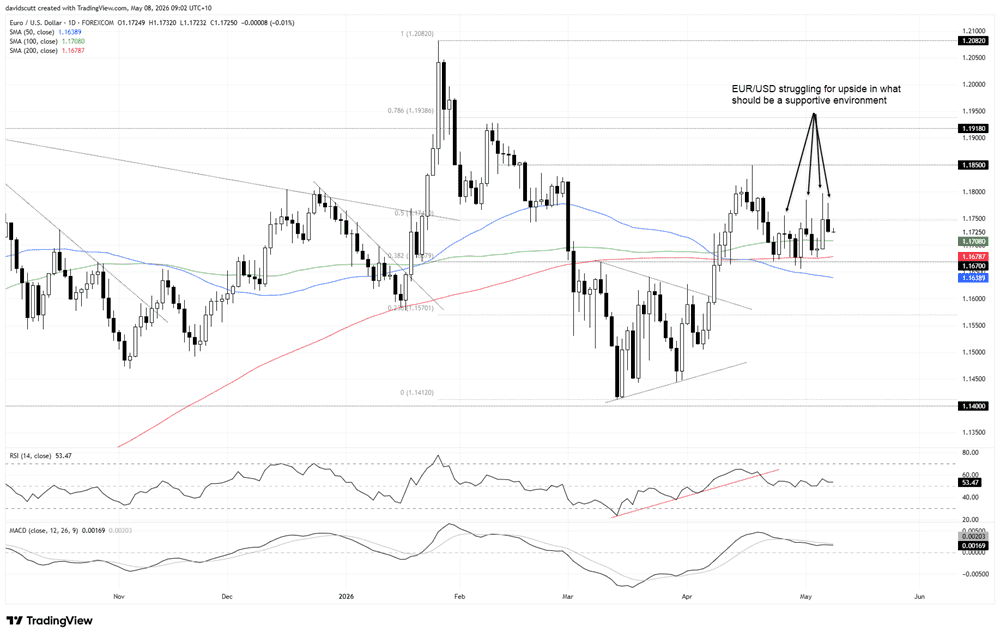
EUR/USD price action has looked increasingly unconvincing over the past week, repeatedly rejected on probes towards 1.1800 despite a macro backdrop that should, in theory, be supportive for gains against the dollar.
Lower crude prices, easing volatility, firmer equities and declining US yields have typically aligned with EUR/USD strength recently, yet the pair has struggled to capitalise.
That hesitation stands out even more when viewed against the incredibly tight grip crude oil continues to hold over broader asset classes. Over the past five days, EUR/USD has posted near perfect inverse correlations with US two-year yields at -0.99 and US 10-year yields at -0.97. The pair has also tracked S&P 500 futures closely at 0.95, global equities at 0.93 and Brent crude futures inversely at -0.87.
That grip was again on display overnight after the Wall Street Journal reported Saudi Arabia and Kuwait had lifted restrictions on the US military’s use of airspace and bases, potentially allowing Washington to restart escort operations through the Strait of Hormuz as early as this week. Crude prices rallied on the report before adding to gains on news of explosions near Bandar Abbas in Iran, reinforcing how sensitive markets remain to developments in the Gulf.
Payrolls risk looms for the dollar
The inability of EUR/USD to build upon the supportive backdrop may reflect caution ahead of US nonfarm payrolls later today where an increase of 62,000 is expected alongside an unchanged unemployment rate of 4.3%.
The payrolls forecast also looks skinny relative to other labour market indicators received this week, including ADP private payrolls which printed at 109,000 in April, the strongest increase since January 2025. ADP has also not had a bad recent track record leading the private payrolls component within the establishment survey, leaving open the possibility markets may be underestimating upside risks in the official release.
As ever, the direction and magnitude of the deviation from consensus is what markets tend to initially react to, with stronger payrolls generally supporting the dollar, and vice versa. If accompanied by complementary movement in the unemployment rate, which is what the Fed cares most about, the reaction in the greenback can often become far more meaningful.
A combination of a sizeable payrolls beat alongside a lower unemployment rate would likely boost the dollar, with the opposite if the results disappoint. While developments in the Gulf continue to dictate broader market direction for now, payrolls still carries the capacity to generate sizeable short-term volatility in this environment and should not be underestimated by traders.
EUR/USD struggles to sustain upside breaks
Source: TradingView
While the overall bias for EUR/USD has been higher over the past week, the price action has been anything but convincing for the bulls. It's been a slog rather than a gallop, with the string of long topside wicks above the 50% retracement of the February-March bear move delivering an increasingly bearish message even though we haven't seen a classical topping pattern emerge as yet.
Above 1.1747 up to 1.1800, bears are lining up to sell, casting doubt on how much longer bulls will be willing to defend the 200DMA given the repeated inability to break higher. That's the immediate range for traders to focus on as we head towards payrolls and the weekend.
Beneath the 200DMA, we also have the 38.2% Fibonacci retracement of the February-March move along with the 50DMA, creating a support zone that may deter bears from becoming overly aggressive without a meaningful catalyst, be it another escalation in the Gulf or a much stronger-than-expected payrolls report.
However, with little significant technical support evident beneath that zone, if it gives way, focus would shift towards a potential retest of the March lows with only the 23.6% retracement level and the 1.1500 handle of note in between.
Above the resistance zone from 1.1747 up to 1.1800, the levels to watch include 1.1850, which has already acted as both support and resistance this year, along with 1.1918, the swing high set in September last year.
While RSI (14) and MACD continue to marginally favour the bulls, both are flatlining near neutral levels, signalling momentum is not with either side right now. That places greater emphasis on the price action when assessing trade setups as they emerge.
EUR/JPY trapped between intervention and momentum
Source: TradingView
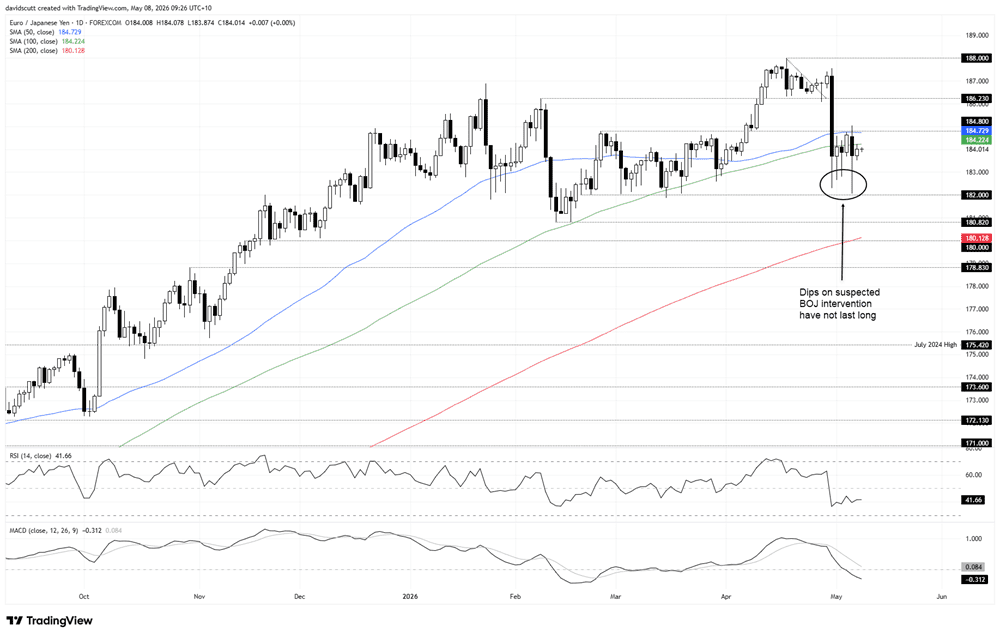
Whereas crude fluctuations resulting from Gulf headlines remain the dominant driver of EUR/USD movements, for EUR/JPY the largest force over the past week has been suspected intervention from the Bank of Japan on behalf of the Japanese government, using thin market conditions in the Asian session with Chinese and Japanese markets offline to sell into strength.
Of which there has been plenty.
One look at the daily chart tells the opposite story to EUR/USD, with a string of long downside wicks from support at 182.00 the obvious feature.
Overhead, the confluence of resistance near 184.80 with the 50DMA has been capping gains, providing traders with a clear range to work with today.
With four suspected rounds of intervention already under the belt, Japanese officials may be reluctant to continue fighting the broader bearish yen trend until macro conditions become more suitable, so don't for one second believe the BOJ will be asked to step in again should the price break and hold above 184.80.
If that does eventuate, 186.23 has acted as both support and resistance recently, making it the next level overhead to watch before the April swing high near 188 comes into view.
Beneath 182.00, 180.82 and the confluence of the 200DMA with 180.00 would be on the radar should we see a more sustained push lower.
Unless backed by fundamentals supportive of yen strength, further dips towards 182.00 that fail to be sustained would make for decent long entries, allowing for stops to be placed beneath the zone while targeting 184.80 initially.

Open an account in minutes
Experience award-winning platforms with fast and secure execution, and enjoy tight spreads from 0.5 pts on FX and 0.3 pts on indices.
Economic calendar
Web Trader platform
Our sophisticated web-based platform is packed with features.
Related articles

Tankan Backs BOJ Tightening, but Yen Rate Expectations Ease
Japan’s Tankan supports further BOJ tightening, although softer rate expectations could limit support for the Japanese yen.


Nikkei breakout accelerates as yen weakness returns
Nikkei has started October with a powerful breakout, helped by renewed yen weakness and strong upside momentum

AUD/USD hammered by US yields and fading RBA hike bets
US yields, dollar strength and fading RBA hike bets have combined to drive AUD/USD to fresh multi-month lows. The macro and technical bias remains bearish, although history suggests parts of the move are now reaching unusually stretched levels.
This report is intended for general circulation only. It should not be construed as a recommendation, or an offer (or solicitation of an offer) to buy or sell any financial products. The information provided does not take into account your specific investment objectives, financial situation or particular needs. Before you act on any recommendation that may be contained in this report, independent advice ought to be sought from a financial adviser regarding the suitability of the investment product, taking into account your specific investment objectives, financial situation or particular needs.
StoneX Financial Pte. Ltd., may distribute reports produced by its respective foreign entities or affiliates within the StoneX group of companies or third parties pursuant to an arrangement under Regulation 32C of the Financial Advisers Regulations. Where the report is distributed to a person in Singapore who is not an accredited investor, expert investor or an institutional investor (as defined in the Securities Futures Act), StoneX Financial Pte. Ltd. accepts legal responsibility to such persons for the contents of the report only to the extent required by law. Singapore recipients should contact StoneX Financial Pte. Ltd. at 6826 9988 for matters arising from, or in connection with the report.
In the case of all other recipients of this report, to the extent permitted by applicable laws and regulations neither StoneX Financial Pte. Ltd. nor its associated companies will be responsible or liable for any loss or damage incurred arising out of, or in connection with, any use of the information contained in this report and all such liability is hereby expressly disclaimed. No representation or warranty is made, express or implied, that the content of this report is complete or accurate.
StoneX Financial Pte. Ltd. is not under any obligation to update this report.
Trading CFDs carries a high level of risk that may not be suitable for some investors. Consider your investment objectives, level of experience, financial resources, risk appetite and other relevant circumstances carefully. The possibility exists that you could lose some or all of your investments, including your initial deposits. If in doubt, please seek independent expert advice. Visit www.forex.com/en-sg/terms-and-policies for the complete Risk Disclosure Statement.