




How much more excitement can sterling take
Sterling is facing its biggest setback for weeks
Share this:

Sterling faces its biggest setback for weeks on Prime Minister Boris Johnson’s plan to suspend Parliament
The Queen’s Speech—the traditional event that opens a new session of Parliament after the summer recess—will take place on 14th October, later than usual. Johnson plans a “very exciting” domestic agenda for the forthcoming session. Before then, Parliament will be suspended for more than a month from 12th September. The impact of the news on sterling has been its deepest one-day drop in almost four weeks, with a fall against the dollar of around 130 pips in the hour after reports emerged and sterling/dollar still 0.8% lower on the day into the afternoon.
Still, there are signs of restraint in the market reaction. The pound quickly erased around a half of its loss in the immediate aftermath of its slump, before slipping again, though it has held around the 50% mark of its slide. Sterling implied volatility across terms spanning one month or more remains elevated relative to July floors. But like shorter-term measures of how much options traders expect the pound to swing, it is not rocketing.
The reaction looks calibrated to the view that whilst the PM may be pushing the envelope, he is not aggressively suppressing Parliamentary sovereignty.
The plan will see PM Johnson utilising normal procedure to delay Parliament’s normal opening date. So there’s no question of him deploying controversial extraordinary powers. Additionally, the move will not be the type of suspension over which there has been broad apprehension across Westminster. In that case, the new session would already be under way.
But there’s less doubt that the plan is a ploy. As such it has stoked fury amongst politicians opposed to Johnson’s push to leave the EU with or without a deal by the EU’s 31st October deadline. Their view is that the tactic will essential limit the ability of the house to prevent the government from taking Britain out of the EU without a deal, by keeping the House shut for longer than expected. That would leave just over two weeks for normal debate before the Brexit deadline on Halloween. Parliament would also be resuming just days before an EU summit.
The Speaker of the House, John Bercow, joined a number of MPs in dubbing the move a “constitutional outrage”. As we’ve seen, that may not be a strictly accurate accusation, but the distinction is probably immaterial. The development may not make a great deal of difference to a Brexit outcome that will be a tortured one either way. But the government’s decision to agitate opponents of a no-deal Brexit could still accelerate Britain’s headlong plunge into a deepening political crisis.
This is chiefly because the planned suspension emboldens MPs who had been seeking a no-confidence vote that could collapse the government. Labour’s plan to pass a bill that would block ‘no-deal’ and force the government to seek an extension – as opposed to going for a no-confidence vote—has been gaining ground in recent days, despite conditions many parties find onerous. Now, MPs, such as the pro-EU Conservative Dominic Grieve are suggesting that choices may be narrowing again. Parliament returns from its recess next week, and a vote of no-confidence could be back on the cards.
If so, the perception that such an event could push Britain faster and harder into a General Election—a prospect the market really doesn’t relish—will increase. In turn, the pound’s ability to limit its reaction to a retreat instead of a rout, will again be in question.
Chart thoughts
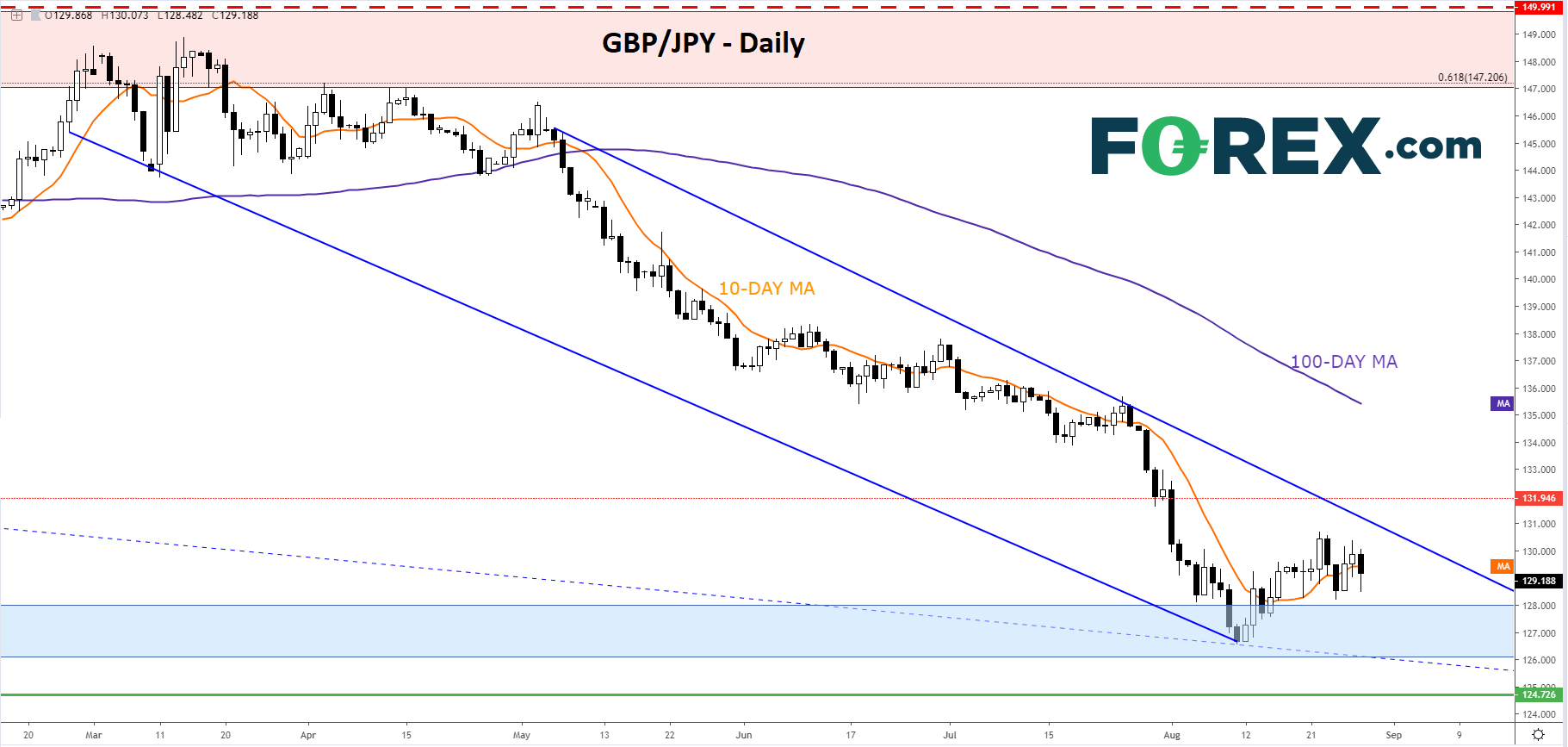
The broader uncertainty of the times has seen traders particularly favouring bearish sterling trades against in-demand ‘safe-haven’ currencies, with the yen preeminent. In recent weeks though, marginal political stability and hardening plans to block no-deal have enabled sterling to recoil from multi-year lows. However, despite sterling/yen’s 3%-odd move higher after grinding to as low as ¥126.53 on 11th August, it did not escape the confines of the downdraft—and declining channel in formation—it entered since its most recent rejection of highs above roughly ¥147-¥150. That band is in confluence with a 61.8% marker of GBP/JPY’s three-year advance to a ¥195.8 cycle peak in 2015. It has stymied the rate’s attempts to break higher since May 2018. The barrier keeps downward pressure on GBP/JPY intense, as affirmed by the falling trend of moving averages right out to the 100-day. On the downside, the region of October 2016’s consolidation coincided with the rate’s bounce at the beginning of the month, which also tagged the downtrend line that kicked off on 11th September 2017. The stage is set for an even deeper dramatic breakdown—but only if the region of support begins to crumble in short order. Destruction of 11th August swing low would hike bearish probabilities. Sellers would then target their next major prize: 11th October 2016’s sharp spike low of ¥124.7.
GBP/JPY – Daily
Source: FOREX.com
Sterling faces its biggest setback for weeks on Prime Minister Boris Johnson’s plan to suspend Parliament
The Queen’s Speech—the traditional event that opens a new session of Parliament after the summer recess—will take place on 14th October, later than usual. Johnson plans a “very exciting” domestic agenda for the forthcoming session. Before then, Parliament will be suspended for more than a month from 12th September. The impact of the news on sterling has been its deepest one-day drop in almost four weeks, with a fall against the dollar of around 130 pips in the hour after reports emerged and sterling/dollar still 0.8% lower on the day into the afternoon.
Still, there are signs of restraint in the market reaction. The pound quickly erased around a half of its loss in the immediate aftermath of its slump, before slipping again, though it has held around the 50% mark of its slide. Sterling implied volatility across terms spanning one month or more remains elevated relative to July floors. But like shorter-term measures of how much options traders expect the pound to swing, it is not rocketing.
The reaction looks calibrated to the view that whilst the PM may be pushing the envelope, he is not aggressively suppressing Parliamentary sovereignty.
The plan will see PM Johnson utilising normal procedure to delay Parliament’s normal opening date. So there’s no question of him deploying controversial extraordinary powers. Additionally, the move will not be the type of suspension over which there has been broad apprehension across Westminster. In that case, the new session would already be under way.
But there’s less doubt that the plan is a ploy. As such it has stoked fury amongst politicians opposed to Johnson’s push to leave the EU with or without a deal by the EU’s 31st October deadline. Their view is that the tactic will essential limit the ability of the house to prevent the government from taking Britain out of the EU without a deal, by keeping the House shut for longer than expected. That would leave just over two weeks for normal debate before the Brexit deadline on Halloween. Parliament would also be resuming just days before an EU summit.
The Speaker of the House, John Bercow, joined a number of MPs in dubbing the move a “constitutional outrage”. As we’ve seen, that may not be a strictly accurate accusation, but the distinction is probably immaterial. The development may not make a great deal of difference to a Brexit outcome that will be a tortured one either way. But the government’s decision to agitate opponents of a no-deal Brexit could still accelerate Britain’s headlong plunge into a deepening political crisis.
This is chiefly because the planned suspension emboldens MPs who had been seeking a no-confidence vote that could collapse the government. Labour’s plan to pass a bill that would block ‘no-deal’ and force the government to seek an extension – as opposed to going for a no-confidence vote—has been gaining ground in recent days, despite conditions many parties find onerous. Now, MPs, such as the pro-EU Conservative Dominic Grieve are suggesting that choices may be narrowing again. Parliament returns from its recess next week, and a vote of no-confidence could be back on the cards.
If so, the perception that such an event could push Britain faster and harder into a General Election—a prospect the market really doesn’t relish—will increase. In turn, the pound’s ability to limit its reaction to a retreat instead of a rout, will again be in question.
Chart thoughts
The broader uncertainty of the times has seen traders particularly favouring bearish sterling trades against in-demand ‘safe-haven’ currencies, with the yen preeminent. In recent weeks though, marginal political stability and hardening plans to block no-deal have enabled sterling to recoil from multi-year lows. However, despite sterling/yen’s 3%-odd move higher after grinding to as low as ¥126.53 on 11th August, it did not escape the confines of the downdraft—and declining channel in formation—it entered since its most recent rejection of highs above roughly ¥147-¥150. That band is in confluence with a 61.8% marker of GBP/JPY’s three-year advance to a ¥195.8 cycle peak in 2015. It has stymied the rate’s attempts to break higher since May 2018. The barrier keeps downward pressure on GBP/JPY intense, as affirmed by the falling trend of moving averages right out to the 100-day. On the downside, the region of October 2016’s consolidation coincided with the rate’s bounce at the beginning of the month, which also tagged the downtrend line that kicked off on 11th September 2017. The stage is set for an even deeper dramatic breakdown—but only if the region of support begins to crumble in short order. Destruction of 11th August swing low would hike bearish probabilities. Sellers would then target their next major prize: 11th October 2016’s sharp spike low of ¥124.7.
GBP/JPY – Daily
Source: City Index

Open an account in minutes
Experience award-winning platforms with fast and secure execution, and enjoy tight spreads from 0.5 pts on FX and 0.3 pts on indices.
Economic calendar
Web Trader platform
Our sophisticated web-based platform is packed with features.
Related articles

USD into a Massive Week as Yields Fly and Gold Breaks
It’s a huge week with PCE and NFP, but it’s what’s happening off of the calendar that demands attention with US yields flying to fresh multi-decade highs.


USDJPY Forecast Intervention Fears Clash with Dollar Strength
Recent trading sessions have produced mixed results for the Japanese yen. By the end of last week, USD/JPY had fallen by more than 1.00%, reflecting a modest recovery in the yen. However, the start of this week has seen the pair move slightly back in favor of the U.S. dollar, posting gains of around 0.04%.


AUD/USD forecast: Currency Pair of the Week | September 28, 2026
The week has started with stocks, gold, silver and bitcoin all falling, as crude oil rebounded and bond yields pushed further higher. Trump refusing to agree to Tehran’s proposal to re-open the Strait of Hormuz has left the markets disappointed. Still, reports that mediators are expected to hold talks with the two sides on an amended version of the 7-day proposal that Iran presented, keeps hopes alive that we may see some progress.
This report is intended for general circulation only. It should not be construed as a recommendation, or an offer (or solicitation of an offer) to buy or sell any financial products. The information provided does not take into account your specific investment objectives, financial situation or particular needs. Before you act on any recommendation that may be contained in this report, independent advice ought to be sought from a financial adviser regarding the suitability of the investment product, taking into account your specific investment objectives, financial situation or particular needs.
StoneX Financial Pte. Ltd., may distribute reports produced by its respective foreign entities or affiliates within the StoneX group of companies or third parties pursuant to an arrangement under Regulation 32C of the Financial Advisers Regulations. Where the report is distributed to a person in Singapore who is not an accredited investor, expert investor or an institutional investor (as defined in the Securities Futures Act), StoneX Financial Pte. Ltd. accepts legal responsibility to such persons for the contents of the report only to the extent required by law. Singapore recipients should contact StoneX Financial Pte. Ltd. at 6826 9988 for matters arising from, or in connection with the report.
In the case of all other recipients of this report, to the extent permitted by applicable laws and regulations neither StoneX Financial Pte. Ltd. nor its associated companies will be responsible or liable for any loss or damage incurred arising out of, or in connection with, any use of the information contained in this report and all such liability is hereby expressly disclaimed. No representation or warranty is made, express or implied, that the content of this report is complete or accurate.
StoneX Financial Pte. Ltd. is not under any obligation to update this report.
Trading CFDs carries a high level of risk that may not be suitable for some investors. Consider your investment objectives, level of experience, financial resources, risk appetite and other relevant circumstances carefully. The possibility exists that you could lose some or all of your investments, including your initial deposits. If in doubt, please seek independent expert advice. Visit www.forex.com/en-sg/terms-and-policies for the complete Risk Disclosure Statement.