


Nasdaq 100: AI enthusiasm meets valuation reality
Technology stocks remained under pressure on Friday, extending a sell-off that has spread from Wall Street into Europe and Asia. The retreat reflects a combination of factors. After a remarkable rally in recent months, investors have become increasingly sensitive to stretched valuations, rising infrastructure costs associated with AI, and a more hawkish outlook for US monetary policy. While some degree of profit-taking was perhaps inevitable, the latest moves also raise broader questions about whether expectations for the sector have simply run too far ahead of commercial reality.
Share this:

Technology stocks remained under pressure on Friday, extending a sell-off that has spread from Wall Street into Europe and Asia. The retreat reflects a combination of factors. After a remarkable rally in recent months, investors have become increasingly sensitive to stretched valuations, rising infrastructure costs associated with AI, and a more hawkish outlook for US monetary policy. While some degree of profit-taking was perhaps inevitable, the latest moves also raise broader questions about whether expectations for the sector have simply run too far ahead of commercial reality. We maintain a cautious outlook on Nasdaq 100 forecast and the tech sector.
Rising costs cast a shadow on Nasdaq 100 forecast
The pressure intensified following Thursday’s session on Wall Street, where Apple led declines after announcing price increases for its MacBook and iPad ranges, citing higher component costs, including semiconductors. The stock fell 6%, overshadowing stronger-than-expected earnings from Micron.
The market reaction suggests investors are becoming increasingly concerned that higher semiconductor costs could begin to erode margins across the technology sector. Companies have been willing to absorb rising expenditure in pursuit of AI leadership, but there are growing signs that those costs are becoming more difficult to ignore.
That theme continued into Friday’s trading. Several US chipmakers fell sharply in pre-market trading, while European semiconductor stocks also opened lower. In Asia, SoftBank Group tumbled by double digits, leading a broader decline across the region’s technology sector as investors questioned whether current levels of AI investment remain sustainable.
Momentum reverses in tech
The latest weakness has significantly altered the picture for US technology stocks. The Nasdaq has fallen more than 4% this week, wiping out the previous week’s gains and pushing the index into negative territory for June, following two exceptionally strong months in April and May.
While the scale of the decline is notable, it also reflects how concentrated market gains had become around a relatively small group of AI-linked companies. As valuations expanded, the margin for disappointment inevitably narrowed.
The AI investment question
At the heart of the debate is the sheer scale of capital being committed to artificial intelligence. The sector has attracted trillions of dollars of investment, yet profits have yet to emerge on anything like the same scale.
Critics argue that the industry now faces mounting pressure to justify those spending levels within a relatively short timeframe. Unlike earlier technological revolutions, today’s investment cycle is exceptionally capital-intensive, requiring vast expenditure on chips, data centres and electricity before meaningful returns can be generated.
The concern is not whether AI will ultimately transform the economy, but whether businesses and consumers will generate sufficient demand quickly enough to support current valuations. If monetisation takes decades rather than years, today’s level of spending may prove difficult to sustain.
Higher rates add another headwind
The reassessment of AI comes as investors also contend with a shifting interest rate outlook. Expectations for further policy tightening have increased after Federal Reserve Chair Kevin Warsh reiterated the central bank’s commitment to bringing inflation under control.
Higher interest rates would increase borrowing costs across the economy, posing an additional challenge for companies undertaking large-scale AI investment programmes. For a sector whose future depends on sustained capital expenditure, tighter financial conditions could make investors less willing to overlook the absence of near-term earnings.
Taken together, rising costs, elevated valuations and a less accommodating monetary backdrop have prompted investors to reassess one of this year’s strongest market narratives. Whether the current pullback proves to be a healthy correction or the beginning of a more prolonged repricing will depend less on AI’s long-term promise than on its ability to deliver tangible profits in the near future.
Technical Nasdaq 100 forecast and levels to watch
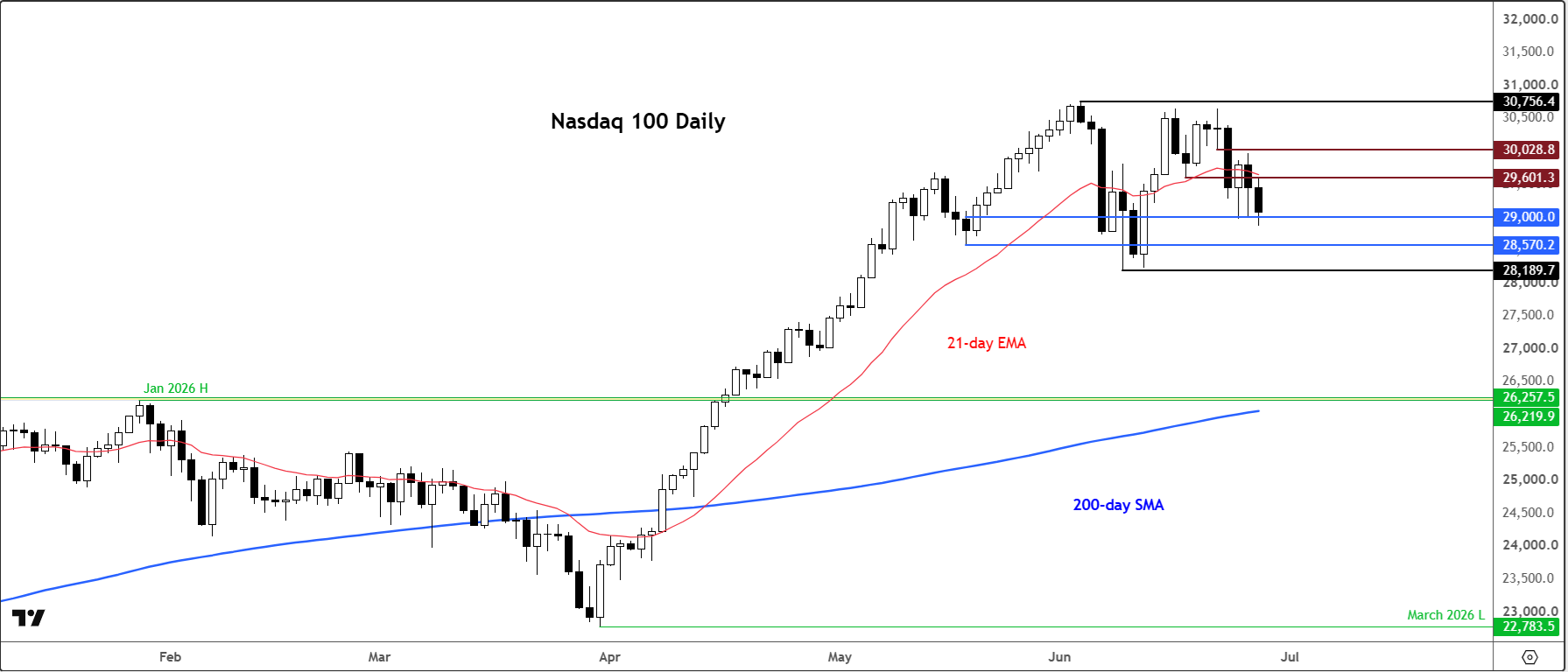
From a technical point of view, the chart for the US Tech 100, which is derived from the underlying Nasdaq 100 futures, is starting to look a little more bearish. The index has now fallen back below the 21-day exponential moving average and has formed a couple of lower highs and a couple of interim lower lows.
That said, I wouldn’t say we’re in corrective territory just yet, as none of the major support levels have broken down. However, that could change if we don’t see the return of the dip-buying mentality over the coming days.
For now, consolidation remains the name of the game, although the directional bias has turned slightly bearish.
In terms of key levels to watch, resistance on the upside comes in around 29,600, which previously acted as support last week before giving way during this week’s sell-off. Above that, 30,028 is the next level of potential resistance. This was a support level on Monday before it was broken during Tuesday’s sell-off. As is often the case, former support can turn into resistance when approached from below.
Beyond that, 30,500 marks the next area of potential resistance, followed by the all-time high at 30,756.
On the downside, 29,000 is the first support level to watch, and it was being tested at the time of this writing. Below that, 28,570 is another important support area. The most recent swing low from earlier this month sits around 28,190, and that is now the line in the sand. A break below that level would be viewed as a bearish technical development and could pave the way for further selling pressure.
So, let’s see whether that level holds. If it doesn’t, we’ll reassess the Nasdaq 100 forecast from there. Things could become a little more bearish should that happen.


-- Written by Fawad Razaqzada, Market Analyst
Follow Fawad on Twitter @Trader_F_R
How to trade with City Index
You can trade with City Index by following these four easy steps:
- Open an account, or log in if you’re already a customer
• Open an account in the UK
• Open an account in Australia
• Open an account in Singapore
- Search for the company you want to trade in our award-winning platform
- Choose your position and size, and your stop and limit levels
- Place the trade
Related tags:
Latest market news



Open an account in minutes
Experience award-winning platforms with fast and secure execution, and enjoy tight spreads from 0.5 pts on FX and 0.3 pts on indices.
Economic calendar
Web Trader platform
Our sophisticated web-based platform is packed with features.
Related articles
S&P 500 forecast: Stocks extend drop as correction risks grow
US and global equity markets have extended Wednesday’s sell-off, with Wall Street opening lower after a weak handover from Asia and Europe. The deterioration in risk appetite has been spreading across global markets. The dollar was firmer, Treasury yields were holding onto yesterday’s gains, while gold, silver and bitcoin were all under pressure alongside equities and major currencies.
Gold forecast: XAU/USD could take a larger dive after the big rise in yields
Gold prices have been falling in the last few days after last week’s post-FOMC pop faded amid rising interest rate expectations, higher oil prices and a strengthening US dollar. As before, I wasn’t convinced gold would thrive in the current macro backdrop.

Gold, silver slammed as hawkish Fed repricing reignites dollar upside
Gold and silver had held up surprisingly well against surging US yields. Wednesday’s DXY breakout may have changed that equation.

This report is intended for general circulation only. It should not be construed as a recommendation, or an offer (or solicitation of an offer) to buy or sell any financial products. The information provided does not take into account your specific investment objectives, financial situation or particular needs. Before you act on any recommendation that may be contained in this report, independent advice ought to be sought from a financial adviser regarding the suitability of the investment product, taking into account your specific investment objectives, financial situation or particular needs.
StoneX Financial Pte. Ltd., may distribute reports produced by its respective foreign entities or affiliates within the StoneX group of companies or third parties pursuant to an arrangement under Regulation 32C of the Financial Advisers Regulations. Where the report is distributed to a person in Singapore who is not an accredited investor, expert investor or an institutional investor (as defined in the Securities Futures Act), StoneX Financial Pte. Ltd. accepts legal responsibility to such persons for the contents of the report only to the extent required by law. Singapore recipients should contact StoneX Financial Pte. Ltd. at 6826 9988 for matters arising from, or in connection with the report.
In the case of all other recipients of this report, to the extent permitted by applicable laws and regulations neither StoneX Financial Pte. Ltd. nor its associated companies will be responsible or liable for any loss or damage incurred arising out of, or in connection with, any use of the information contained in this report and all such liability is hereby expressly disclaimed. No representation or warranty is made, express or implied, that the content of this report is complete or accurate.
StoneX Financial Pte. Ltd. is not under any obligation to update this report.
Trading CFDs carries a high level of risk that may not be suitable for some investors. Consider your investment objectives, level of experience, financial resources, risk appetite and other relevant circumstances carefully. The possibility exists that you could lose some or all of your investments, including your initial deposits. If in doubt, please seek independent expert advice. Visit www.forex.com/en-sg/terms-and-policies for the complete Risk Disclosure Statement.