



Nasdaq 100 Forecast: “Magnificent Seven” Q3 2025 Earnings Preview
Key themes for the Magnificent 7 Earnings season include the AI CapEx boom, digital ad spending, the divergence between enterprise and consumer spending and the regulatory backdrop.
Share this:

Nasdaq 100 Key Points
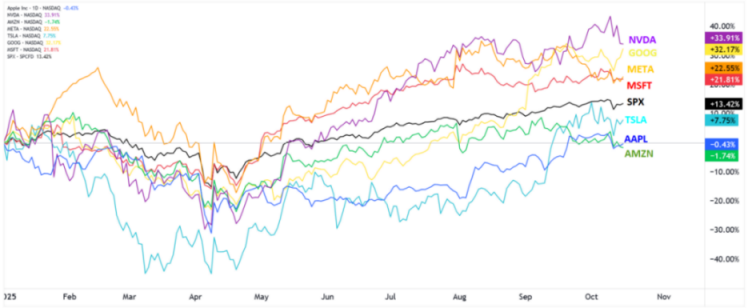
- Within the Magnificent Seven, laggards like Apple and Amazon have fallen so far this year despite generally bullish conditions and standouts like Nvidia and Alphabet have gained more than 30% year-to-date
- Key themes include the AI CapEx boom, digital ad spending, the divergence between enterprise and consumer spending and the regulatory backdrop.
- The bias for the Nasdaq 100 remains tilted toward the topside as long as this season’s earnings results at least meet analyst expectations.
Magnificent Seven Earnings Preview – MSFT, AAPL, GOOG, AMZN, NVDA, META, TSLA
Throughout most of the last few years, the “Magnificent Seven” big technology stocks (Microsoft, Apple, Nvidia, Alphabet/Google, Meta/Facebook, and Tesla) broadly moved as a monolithic unit, rising and falling in unison with the (mostly) ups and (fewer) downs of the broader market, albeit to differing extents.
Since flipping the calendar to 2025, the individual differences between these massive entities have become more stark, with laggards like Apple and Amazon falling despite generally bullish conditions and standouts like Nvidia and Alphabet gaining more than 30% year-to-date:
Source: StoneX, TradingView
Each of the Magnificent Seven stocks faces its own set of opportunities and challenges, but with Q3 earnings season just around the corner, it’s worthwhile to identify some common themes that are relevant to all the Magnificent Seven (and many other of the largest technology stocks as well).
Magnificent 7 Earnings “Cheat Sheet”
|
COMPANY |
Report date / time |
CONSENSUS EPS ESTIMATE* |
|
Tesla (TSLA) |
22 October |
$0.41 |
|
Alphabet (GOOGL) |
29 October |
$2.29 |
|
Microsoft (MSFT) |
29 October |
$3.65 |
|
Meta (META) |
29 October |
$6.58 |
|
Apple (AAPL) |
Thu 31 Jul |
$1.74 |
|
Amazon (AMZN) |
30 October* |
$1.58 |
|
NVIDIA (NVDA) |
19 November* |
$1.17 |
*estimated earnings date
Key Magnificent Seven Themes to Watch This Earnings Season
- AI CapEx: Spending Big, Demanding More
The hyperscaler capex arms race continues to define this earnings season, but the tone is shifting from scale to scrutiny. After investing an estimated $345 billion in AI and datacenter infrastructure in 2024, hyperscalers are projected to lift that figure to $414 billion in 2025, and upwards of $430 billion in 2026, according to BofA and McKinsey estimates. AWS, Microsoft Azure, Google Cloud, and Meta lead the charge, with all four pushing aggressive build-outs to support inference, training, and monetization of their AI models and platforms.
But some analysts are wondering whether the days of “capex at any cost” may be behind us. Morgan Stanley cautioned in a recent note that AI investments now carry heightened risk: rising power and real estate costs, rack overbuild risk, and a maturing monetization curve are forcing CFOs to justify infrastructure ROI more rigorously. In earnings calls, the Street will be listening closely for any cracks in the supply-demand balance - particularly from Nvidia, which remains sold out of its high-demand Blackwell chips - and whether hyperscaler executives are willing to blink on spend levels heading into 2026.
- Digital Advertising: Growth Still Intact, But Watch the Margins
Digital ad revenue continues to grow, but not without friction. According to GroupM and Dentsu, global ad spending is expected to grow ~5–8% in 2025, with digital commanding nearly 75% of the pie—roughly $678 billion in spend. That would mark another record, but also a slowdown in growth from the pandemic-era boom.
Crucially, the companies within the Magnificent Seven are dependent on digital ad spending to differing extents. Google and Meta are grappling with flattening search and feed ad pricing, while Shorts and Reels inventory continue to scale with relatively lower CPMs. Amazon, by contrast, is still gaining share via its high-margin retail media network and could again surprise to the upside. Forward guidance will be absolutely critical for GOOG, META, and AMZN in particular, where a pullback in Q4 holiday bookings could overshadow any solid Q3 results.
- The Two-Speed Economy: Enterprise Strength, Consumer Strain
This quarter may further entrench the bifurcation between consumer and enterprise demand. Apple and Tesla, two of the more consumer-sensitive names in the Mag 7, continue to show signs of strain as the chart above shows. iPhone volumes in China slipped nearly 9% YoY in Q1 2025, while Tesla’s auto gross margin declined from 16% in 2024 to 13.6% in Q2, with potential for more downside moving forward as Model 3 and Y price cuts bite.
Enterprise tech, meanwhile, remains healthy. Microsoft’s cloud business is expected to post 13–15% YoY growth, with Azure retaining its AI attach-rate tailwind. Amazon Web Services remains on track for 20%+ YoY gains, and Alphabet’s cloud unit is slowly expanding margins while gaining share in enterprise AI. This divergence explains much of the year-to-date performance and will remain a key theme through this reporting cycle as investors reward infrastructure-centric firms with strong cloud positioning, while discounting those exposed to discretionary consumer tech.
- Policy & Geopolitics: The Unrelenting Overhang
Regulatory and trade overhangs are again in the spotlight. The U.S. Department of Justice has moved into the remedies phase of its antitrust victory against Google, with analysts now debating whether the government will push for meaningful business separation or behavioral shifts. Apple, meanwhile, remains entangled in EU Digital Markets Act compliance and is appealing a €500 million fine tied to alleged anti-steering practices.
On the geopolitical front, Nvidia’s workaround GPUs including the much-discussed H20 are helping it maintain China sales despite tightening U.S. export controls. But the situation remains fluid with the US government increasingly getting involved both as a policymaker and outright investor in rival firms.

Nasdaq 100 Technical Analysis – NDX Daily Chart

Source: TradingView, StoneX
As the chart above shows, the Nasdaq 100 remains within a 5-month bullish channel for now, showing relative resilience against its major US index rivals.
Against that technical backdrop, the bias remains tilted toward the topside as long as this season’s earnings results at least meet analyst expectations. To the topside, the next level of resistance to watch is the round 25,000 handle, followed by the 161.8% Fibonacci extension of the “Liberation Day” swoon near 25,900 after that.
However, if weak earnings reports start to accumulate and the index breaks down from its channel to fall below the 50-day EMA, a deeper retracement toward the 200-day MA near previous resistance at 22,150 could be in the cards.
-- Written by Matt Weller, Global Head of Research
Follow Matt on Twitter: @MWellerFX
Related tags:




Open an account in minutes
Experience award-winning platforms with fast and secure execution, and enjoy tight spreads from 0.5 pts on FX and 0.3 pts on indices.
Economic calendar
Web Trader platform
Our sophisticated web-based platform is packed with features.
Related articles

Nikkei threatens breakout as tech rebound broadens
Breakouts across the SOX and Nasdaq are being matched by rebounds across Asia, with the Nikkei now threatening to join the move.


S&P 500, Nasdaq 100 Forecast for the Week Ahead
A hawkish Fed and 10-Year Notes on the verge of a push above 5%, yet stocks have so far shrugged off that fear. But can it continue?


Hang Seng Tech rout nears make-or-break zone
The technical damage is clear, but with Hang Seng Tech now deeply stretched and approaching major support, the risk-reward is becoming more two-sided.
This report is intended for general circulation only. It should not be construed as a recommendation, or an offer (or solicitation of an offer) to buy or sell any financial products. The information provided does not take into account your specific investment objectives, financial situation or particular needs. Before you act on any recommendation that may be contained in this report, independent advice ought to be sought from a financial adviser regarding the suitability of the investment product, taking into account your specific investment objectives, financial situation or particular needs.
StoneX Financial Pte. Ltd., may distribute reports produced by its respective foreign entities or affiliates within the StoneX group of companies or third parties pursuant to an arrangement under Regulation 32C of the Financial Advisers Regulations. Where the report is distributed to a person in Singapore who is not an accredited investor, expert investor or an institutional investor (as defined in the Securities Futures Act), StoneX Financial Pte. Ltd. accepts legal responsibility to such persons for the contents of the report only to the extent required by law. Singapore recipients should contact StoneX Financial Pte. Ltd. at 6826 9988 for matters arising from, or in connection with the report.
In the case of all other recipients of this report, to the extent permitted by applicable laws and regulations neither StoneX Financial Pte. Ltd. nor its associated companies will be responsible or liable for any loss or damage incurred arising out of, or in connection with, any use of the information contained in this report and all such liability is hereby expressly disclaimed. No representation or warranty is made, express or implied, that the content of this report is complete or accurate.
StoneX Financial Pte. Ltd. is not under any obligation to update this report.
Trading CFDs carries a high level of risk that may not be suitable for some investors. Consider your investment objectives, level of experience, financial resources, risk appetite and other relevant circumstances carefully. The possibility exists that you could lose some or all of your investments, including your initial deposits. If in doubt, please seek independent expert advice. Visit www.forex.com/en-sg/terms-and-policies for the complete Risk Disclosure Statement.