










NZD/USD: Split decision at RBNZ clouds path for further easing
Markets got their cut, but not the dovish consensus they were expecting. A firmer inflation tone and a lone dissenting vote hint the RBNZ may not be fully aligned on what comes next.
Share this:

- RBNZ cut OCR by 25bp to 3.25%, as expected
- One member voted to hold, adding hawkish tone
- Rising inflation expectations noted
- More rate cuts likely, downside risks seen abroad
- NZD reversed lower before rebounding on split vote
Summary
The Reserve Bank of New Zealand (RBNZ) cut interest rates and signalled a need for additional policy easing compared to three months ago. However, the decision was not unanimous, and its language on inflation was noticeably firmer, putting a hawkish tinge on the move.
Cash Rate Cut, Not Unanimous
The RBNZ delivered a 25bp cut in the cash rate to 3.25%, as was fully priced by markets. The surprise came from the meeting discussion, with the final decision coming down to a choice between holding the cash rate steady or cutting by 25bp—ruling out a supersized 50bp move.
“The case for lowering the OCR [cash rate] to 3.25% highlighted that CPI inflation is in the target range and there is significant spare capacity in the economy,” the minutes said.
“In considering the merits of holding the OCR unchanged at 3.50%... some members noted that this would allow the Committee to better assess whether increased economic policy uncertainty was having a noticeable impact on household and firm behaviour.
“An unchanged OCR could also further consolidate inflation expectations around the target mid-point, and guard against the risk of higher-than-expected inflation from the supply-side effects of increased tariffs.”
Adding a hawkish twist to the decision, only five members voted to cut, with one opting to keep the cash rate unchanged at 3.5%.
The unexpected split vote saw the New Zealand dollar and short-dated interest rates reverse initial kneejerk declines, overriding what was otherwise a more aggressive rate cut profile than three months earlier.
RBNZ Rate Track Forecast Lowered
Source: RBNZ
The RBNZ lowered its rate track forecast, indicating further cuts are likely beyond the move in May. The cash rate is now seen bottoming at an average of 2.85% in Q1 2026—some 25bp lower than projected in February. It implies policy may need to move into mildly stimulatory territory this cycle.
Hinting that U.S. trade policy will be a key swing factor for the cash rate, the Committee discussed two scenarios for the domestic economy, labelled “negative” and “more negative”. Despite the framing, the “negative” scenario suggested a higher cash rate would be needed from December to return inflation to the 2% mid-point. Under the “more negative” scenario, the opposite applies—a lower rate would be necessary.
Source: RBNZ
Inflation Tone Firmer
Reflecting uncertainty stemming from shifting U.S. trade policy, the RBNZ struck a more dovish tone on the global outlook, although it was firmer on inflation and the domestic economy.
While it acknowledged core inflation is falling and spare capacity remains, it noted inflation expectations among firms and households have “risen”. On the local economy, it said it is “recovering after a period of contraction”, with “high commodity prices and lower interest rates” supporting overall activity.
Markets Trim Rate Cut Bets
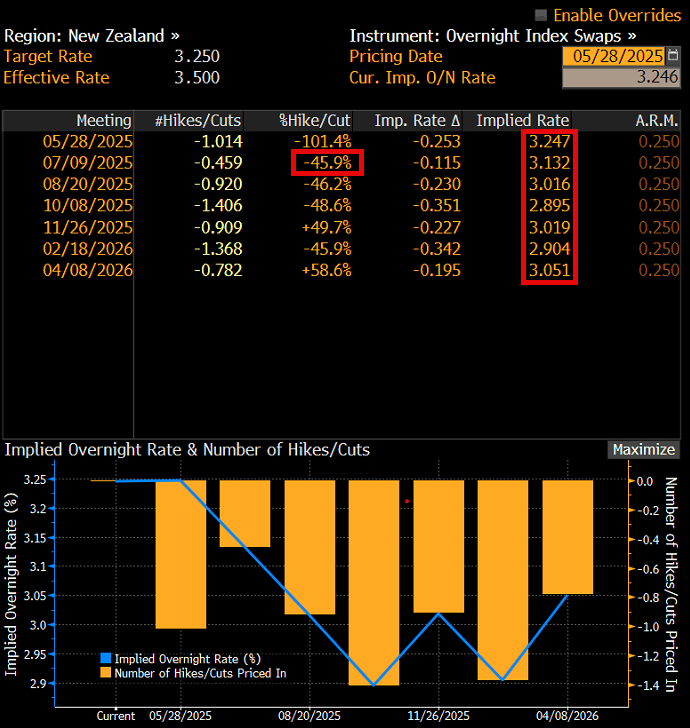
Following the statement and updated forecasts, swaps markets trimmed the odds of the cash rate falling below 3%, with rates now expected to remain on hold at the RBNZ’s July meeting—though pricing suggests it will be a close call. While the risk of a move to 2.75% is still partially priced following quarterly inflation prints, markets have tilted towards 3% being the likely floor this cycle.
Source: Bloomberg
Still, with so much excess slack in the labour market, it’s debatable whether conditions are conducive for domestic price pressures to rebuild, leaving the door open for the cash rate to move closer to 2.5% to spur private sector activity. We retain that view, and that’s before factoring in risks from offshore.
NZD/USD: Buying Dips Favoured
Source: TradingView
NZD/USD reversed course and pushed higher following the rate decision before running into resistance at .5968. Sitting above the 50 and 200-day moving averages, and with both price and momentum indicators trending higher, buying dips remains the preferred near-term strategy. Below trend support from mid-May, buyers may emerge around the 50DMA, 200DMA, and .5850. Above .5968, .6030 stands as key resistance.
-- Written by David Scutt
Follow David on Twitter @scutty
How to trade with City Index
You can trade with City Index by following these four easy steps:
- Open an account, or log in if you’re already a customer
• Open an account in the UK
• Open an account in Australia
• Open an account in Singapore
- Search for the market you want to trade in our award-winning platform
- Choose your position and size, and your stop and limit levels
- Place the trade
Related tags:
Latest market news




Open an account in minutes
Experience award-winning platforms with fast and secure execution, and enjoy tight spreads from 0.5 pts on FX and 0.3 pts on indices.
Economic calendar
Web Trader platform
Our sophisticated web-based platform is packed with features.
Related articles
Gold Q4 2026 outlook: Resilience in the face of rallying dollar and yields
As we headed towards the latter stages of Q3 and into Q4, the Fed had just hiked rates in a hawkish FOMC meeting, while the likes of the ECB and BoJ had also tightened their respective policies. Oil prices remained elevated amid the prolonged US-Iran conflict. Meanwhile, bond yields were breaking out, and the dollar was higher across the board. Yet, remarkably, gold was still holding in the positive territory for the third quarter, even if it had weakened somewhat in September.
EUR/USD Q4 2026 Outlook: Euro at a Crossroads as Fed, ECB Tighten 9 25 2026
EUR/USD enters Q4 at a pivotal inflection point as competing Fed-ECB policy paths and persistent inflation risks collide with major technical support.

AUD/USD Q4 Outlook: RBA and Fed Hikes Set the Tone
AUD/USD enters Q4 with RBA and Fed hikes in focus as sticky inflation, rising unemployment and US dollar strength shape the Australian dollar.

This report is intended for general circulation only. It should not be construed as a recommendation, or an offer (or solicitation of an offer) to buy or sell any financial products. The information provided does not take into account your specific investment objectives, financial situation or particular needs. Before you act on any recommendation that may be contained in this report, independent advice ought to be sought from a financial adviser regarding the suitability of the investment product, taking into account your specific investment objectives, financial situation or particular needs.
StoneX Financial Pte. Ltd., may distribute reports produced by its respective foreign entities or affiliates within the StoneX group of companies or third parties pursuant to an arrangement under Regulation 32C of the Financial Advisers Regulations. Where the report is distributed to a person in Singapore who is not an accredited investor, expert investor or an institutional investor (as defined in the Securities Futures Act), StoneX Financial Pte. Ltd. accepts legal responsibility to such persons for the contents of the report only to the extent required by law. Singapore recipients should contact StoneX Financial Pte. Ltd. at 6826 9988 for matters arising from, or in connection with the report.
In the case of all other recipients of this report, to the extent permitted by applicable laws and regulations neither StoneX Financial Pte. Ltd. nor its associated companies will be responsible or liable for any loss or damage incurred arising out of, or in connection with, any use of the information contained in this report and all such liability is hereby expressly disclaimed. No representation or warranty is made, express or implied, that the content of this report is complete or accurate.
StoneX Financial Pte. Ltd. is not under any obligation to update this report.
Trading CFDs carries a high level of risk that may not be suitable for some investors. Consider your investment objectives, level of experience, financial resources, risk appetite and other relevant circumstances carefully. The possibility exists that you could lose some or all of your investments, including your initial deposits. If in doubt, please seek independent expert advice. Visit www.forex.com/en-sg/terms-and-policies for the complete Risk Disclosure Statement.