






Problems with the Magnificent Seven Stocks
Vincent Deluard, StoneX global macro strategist, asks: are we at an inflexion point, when higher bond yields and a steeper yield curve could hit the rating of expensive growth stocks? The Magnificent Seven (Mag7) stocks have become synonymous with this bull market: Amazon, Alphabet, Apple, Nvidia, Meta, Microsoft and Tesla. These stocks make up a quarter of the S&P 500 market value.
Share this:
Vincent Deluard, StoneX global macro strategist, asks: are we at an inflexion point, when higher bond yields and a steeper yield curve could hit the rating of expensive growth stocks? The Magnificent Seven (Mag7) stocks have become synonymous with this bull market: Amazon, Alphabet, Apple, Nvidia, Meta, Microsoft and Tesla. These stocks make up a quarter of the S&P 500 market value.
The Mag7 portfolio
Last year was challenging. Investors were confronted the worst inflation shock in 40 years, a complete about-turn in monetary policy, and underperformance of the traditional 60/40 equity/bond portfolio. In comparison, 2023 was boring. What mattered for investors was how much exposure they had to the Mag7 stocks. Yet except for Nvidia and Tesla, the Mag7 have struggled to see revenues keep up with nominal economic growth. Their valuation premium is now larger than it was during the COVID lockdowns, when they first rallied. There are signs that Mag7 grip on market leadership is slipping, falling on average 11% from summertime peaks.
Growth stock risks
Deluard argues that we now potentially face years of underperformance by these megacap growth stocks. He offers four arguments for this view:
- Megacaps have a higher premium higher today than it was during COVID, when these stocks benefitted most from the extraordinary boost to online spending caused by lockdowns and stimulus checks.
- Growth stocks derive most of their capitalization size from their expected long-term earnings, and these long duration stocks should suffer the most if bond yields rise.
- Five of the big tech companies’ revenues’ are struggling to keep pace with economic growth (Nvidia and, to a lesser extent, Tesla still post extraordinary growth).
- Given their weight in the major indices, who will be left to buy the Mag7 in 2024?
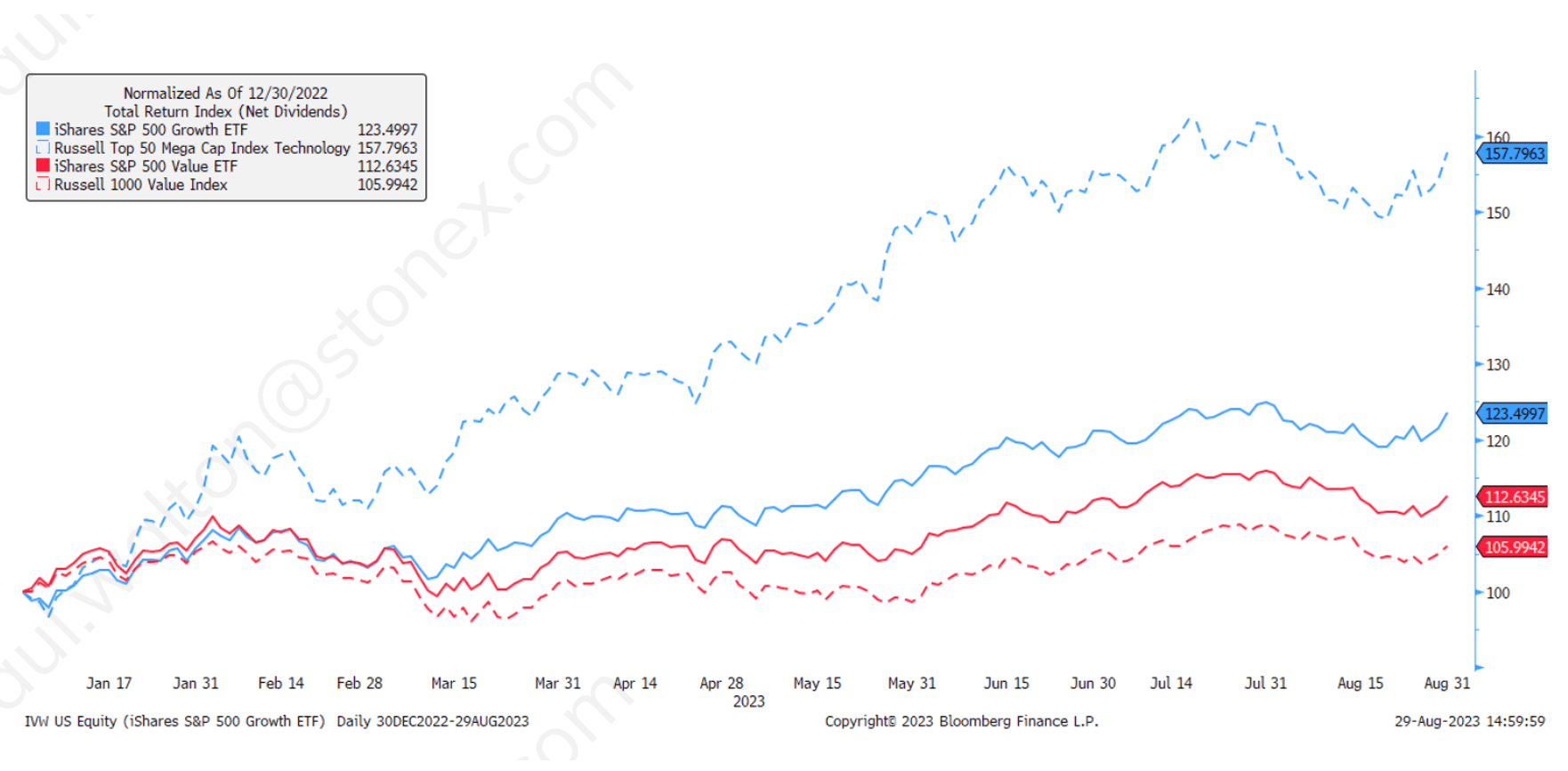
Performance of Growth and Value Indices
Source: Bloomberg, toneX.
Valuations historically high
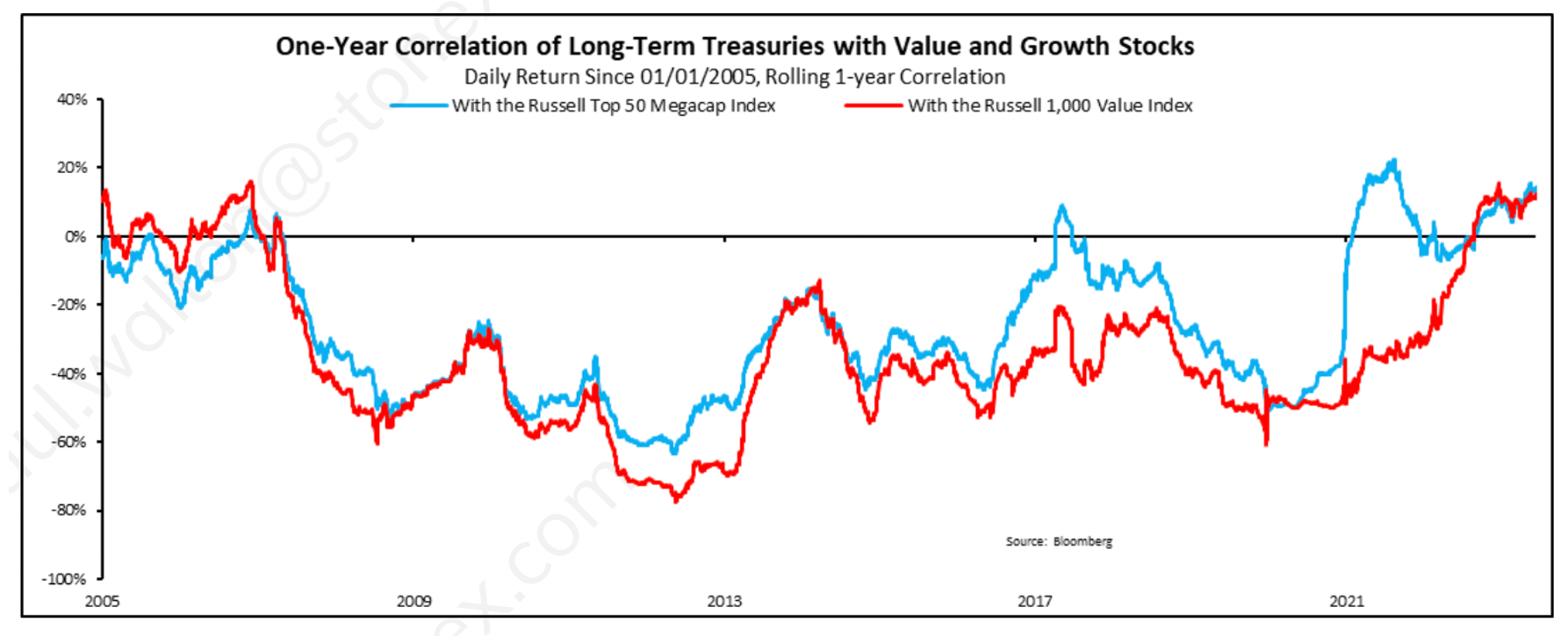
Deluard argues that a highly-valued non-dividend-paying growth stock should have the duration of a very long-term bond. Conversely, value stocks’ generous dividends and high book value are the equivalent of a short-term, high-coupon bond. Historically, growth stocks have indeed been more correlated with long-term Treasuries than value stocks. Value stocks should outperform growth stocks when long term bond yields rise. This year we have seen the benchmark 10-year US bond yield rise to 4.5%, close to a two-decade high, up from 3.25% over the summer, with no sign that they have peaked.
Growth / Value Relative Strength versus 10-Year Yield
Source: Bloomberg, StoneX.
Correlation of Growth/ Value Relative Strength versus 10-Year Yield
Source: Bloomberg, StoneX.
Historically expensive
However, Deluard adds, the Mag7 stocks are about twice as expensive as the rest of the index on a price-to-sales basis. At this point, the S&P 500 index is made of two indices of almost equal size: the highly-priced mag seven, and the remaining 493 companies. The premium is especially large if we compare the P/E of the Russell Top 50 Megacap Index with that of the S&P 500 equal-weighted index.
Tech megacaps command a 78% premium, which is even larger than the peak logged during the COVID lockdowns. The premium could be justified in terms of growth back then because US consumption was boosted by stimulus checks, and skewed towards online purchases and instead of services, travel, and transportation.
Why should big tech’s premium be higher now that their sales and earnings growth has normalized and that consumers are engaging in “revenge spending” on real-world experiences, such as $4,000 tickets to attend Taylor Swift’s Era’s Tour?
Valuation of Tech Megacaps versus the S&P 500 Equal-Weighted Index
Source: Bloomberg, StoneX.
Revenues and profits slowing
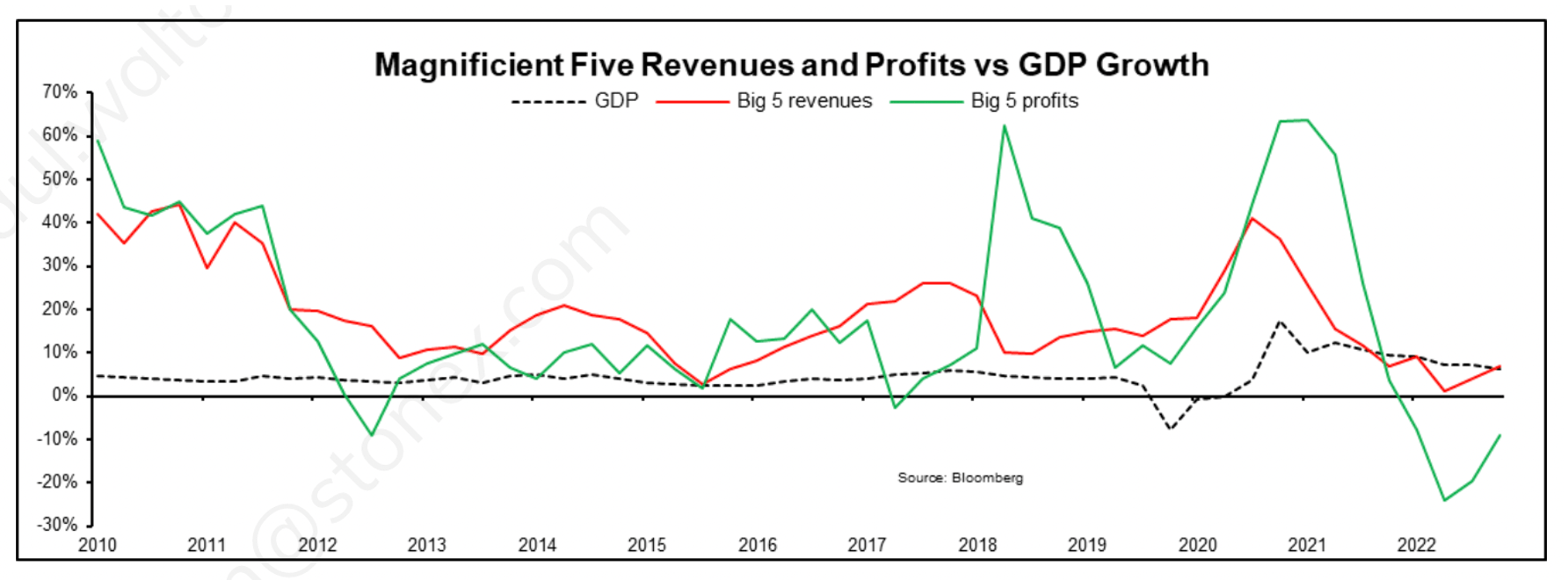
Revenues and profits are slowing for at least some of the Mag7. Nvidia and, to a lesser extent, Tesla are still growing at an extraordinary pace, but the big five platforms (Apple, Amazon, Microsoft, and Alphabet) have become mature companies whose massive revenues barely keep up with nominal GDP growth. Their collective net income fell to $263 billion in the past four quarters, down 9% from $289 billion the year before.
Added to revenue concerns are some worrying stock specific headlines. “Justice Department Sues Google (Alphabet) for Monopolizing Digital Advertising Technologies”. “China’s Apple iPhone Ban Appears to Be Retaliation.” “Tesla’s Cybertruck has a serious problem that only a complete redesign can fix.” “Meta faces a future of more legal woes and falling revenues.”
Magnificent Seven Revenue and Profit Growth
Source: Bloomberg, StoneX.
Rate-sensitive valuations
The money market fund-like balance sheets of the magnificent seven may help to explain the paradox which has so greatly hurt my personal account and sense of logic this year: they have large cash balances and debt issued during the low-rate era, providing the Mag7 with $709 million in net interest income in 2022, against a net expense of $668 million at the end of 2021.
What should an investor do?
Deluard cautions investors to look abroad: there are attractively priced good growth stocks outside of the US, and he argues that they should fare better in what he believes will be a coming correction. The foreign growth category is a diverse bag of European pharmaceuticals, French luxury groups, under owned Chinese tech platforms, and emerging markets banks. The natural diversification of international growth stocks should be an asset compared to US growth funds, which invest overwhelmingly in the same five large platforms with considerable overlap in the fields of cloud computing, consumer electronics, online entertainment, and social media.
Further, he argues that US-focused investors may want to focus on stocks which belong to the second decile in terms of growth of valuation (the next ten percent of stocks outside of the top ten per cent.) True value stocks have decent fundamentals, so they usually have high-but-not-extreme dividend yields.
The 2023 rally was all about extremes so far: the biggest stocks did best. So did the most speculative ones, and those stocks with the most eye-popping growth forecasts. Investors should find comfort in steady, boring, reasonably-priced large companies in the coming correction.
Analysis by Vincent Deluard, CFA, Director, Global Macro Strategy. [email protected]
Edited by Paul Walton, Financial Writer: [email protected]
Latest market news




Open an account in minutes
Experience award-winning platforms with fast and secure execution, and enjoy tight spreads from 0.5 pts on FX and 0.3 pts on indices.
Economic calendar
Web Trader platform
Our sophisticated web-based platform is packed with features.
Related articles

S&P 500 Forecast: SPX rises as oil prices fall, but treasuries remain at multi-decade highs
U.S. stocks are rising on Friday after a volatile week that saw a surge in Treasury yields ripple through financial markets.


USD/JPY Q4 2026 Outlook: Hawkish Fed Pricing Clashes With Intervention Risk
The year-end tug-of-war is clear: hawkish Fed pricing supports USD/JPY, while intervention risk limits the upside.


S&P 500 forecast: Stocks extend drop as correction risks grow
US and global equity markets have extended Wednesday’s sell-off, with Wall Street opening lower after a weak handover from Asia and Europe. The deterioration in risk appetite has been spreading across global markets. The dollar was firmer, Treasury yields were holding onto yesterday’s gains, while gold, silver and bitcoin were all under pressure alongside equities and major currencies.

This report is intended for general circulation only. It should not be construed as a recommendation, or an offer (or solicitation of an offer) to buy or sell any financial products. The information provided does not take into account your specific investment objectives, financial situation or particular needs. Before you act on any recommendation that may be contained in this report, independent advice ought to be sought from a financial adviser regarding the suitability of the investment product, taking into account your specific investment objectives, financial situation or particular needs.
StoneX Financial Pte. Ltd., may distribute reports produced by its respective foreign entities or affiliates within the StoneX group of companies or third parties pursuant to an arrangement under Regulation 32C of the Financial Advisers Regulations. Where the report is distributed to a person in Singapore who is not an accredited investor, expert investor or an institutional investor (as defined in the Securities Futures Act), StoneX Financial Pte. Ltd. accepts legal responsibility to such persons for the contents of the report only to the extent required by law. Singapore recipients should contact StoneX Financial Pte. Ltd. at 6826 9988 for matters arising from, or in connection with the report.
In the case of all other recipients of this report, to the extent permitted by applicable laws and regulations neither StoneX Financial Pte. Ltd. nor its associated companies will be responsible or liable for any loss or damage incurred arising out of, or in connection with, any use of the information contained in this report and all such liability is hereby expressly disclaimed. No representation or warranty is made, express or implied, that the content of this report is complete or accurate.
StoneX Financial Pte. Ltd. is not under any obligation to update this report.
Trading CFDs carries a high level of risk that may not be suitable for some investors. Consider your investment objectives, level of experience, financial resources, risk appetite and other relevant circumstances carefully. The possibility exists that you could lose some or all of your investments, including your initial deposits. If in doubt, please seek independent expert advice. Visit www.forex.com/en-sg/terms-and-policies for the complete Risk Disclosure Statement.