








RBA Cuts, Warns on Slower Growth Ahead
The RBA cut rates again as expected, but softer forecasts and rising uncertainty pushed markets to price in a more dovish path ahead. AUD slipped, yields fell, and the RBA’s inflation risk now looks more balanced.
Share this:

- RBA cuts cash rate 25bp to 3.85% as expected
- Growth and inflation projections both revised lower
- Board judged inflation risks more balanced
- AUD/USD dipped as short-end yields led bull steepening
The RBA sees slower economic growth, higher unemployment, and underlying inflation continuing to move back towards the midpoint of its 2–3% target, making it an easy decision to deliver its second cut of the easing cycle in May, taking the cash rate to 3.85%.
With the 25bp reduction entirely priced in, and guidance on the rates outlook absent—as is usually the case when the cash rate is moved—it was always going to come down to the commentary and updated forecasts to dictate market direction.
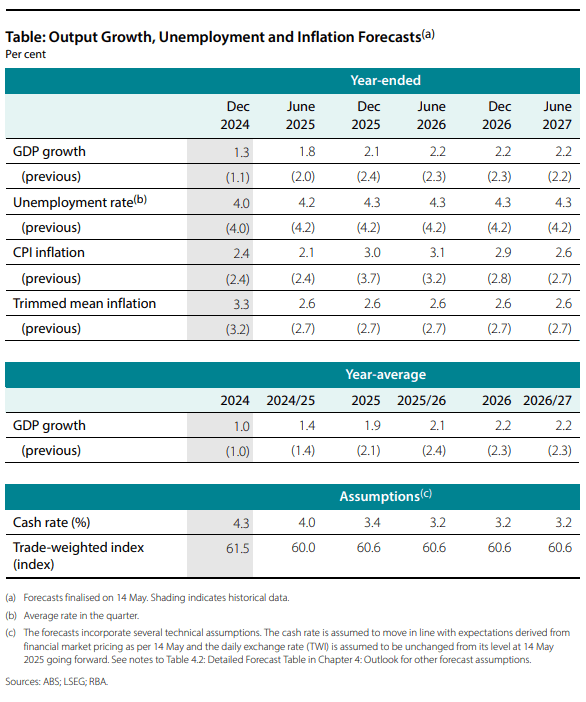
RBA Forecasts Slower Growth, Higher Unemployment, Lower Inflation
On balance, they were marginally more dovish than three months ago, with elevated uncertainty resulting in slower economic growth, slightly higher unemployment, and softer inflation.
Source: RBA
While the revisions make perfect sense given the tricky macroeconomic climate, the question was always going to be how the forecasts would shift based on another interest rate cut being added to the 2025 profile relative to three months ago. Back then, the RBA argued three cuts this year would be too stimulatory to push trimmed mean inflation back to the 2.5% midpoint of its target band. On this occasion, it judged heightened uncertainty more than offset the risk that an additional cut could spark another unwelcome pickup in inflationary pressures.
“The Board judged that the risks to inflation have become more balanced,” the bank said in its statement. “Inflation is in the target band and upside risks appear to have diminished as international developments are expected to weigh on the economy.”
Adding context, it noted that “while the central projection is for growth in household consumption to continue to increase…recent data suggest that the pick-up will be a little slower than was expected three months ago.”
“There is a risk that any pick-up in consumption is even slower than this, resulting in continued subdued growth in aggregate demand and a sharper deterioration in the labour market than currently expected,” it said.
It was telling the board also considered a “severe downside scenario” to its forecasts, providing additional fuel to the broader dovish assessment. In her press conference following the decision, Governor Michele Bullock acknowledged both a 25 and 50 basis point cut were discussed at the meeting, along with keeping policy stable.
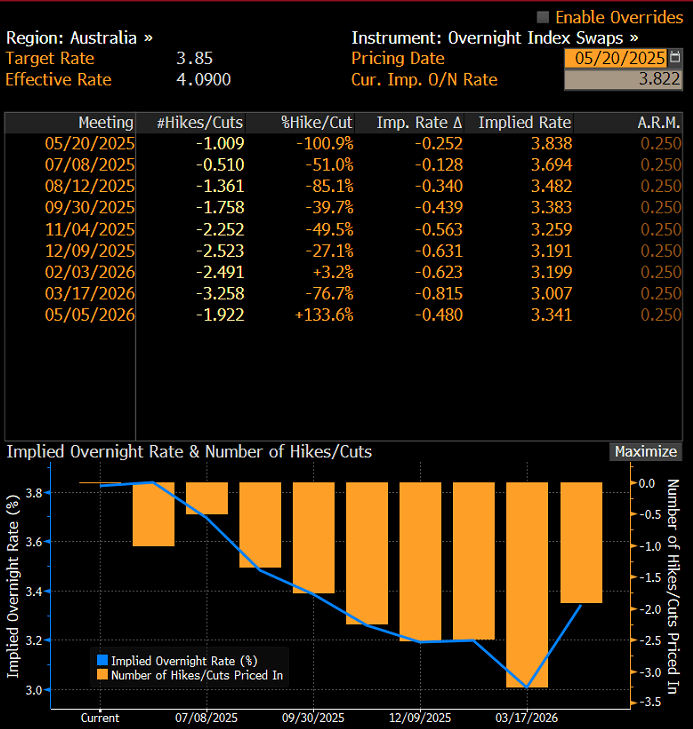
A 25bp cut at the RBA’s next meeting in July is deemed a coin flip, with a move in August fully priced. A second cut seen by November.
Source: Bloomberg
Dovish Market Reaction
Source: TradingView
The Australian 3s10s curve bull steepened following the statement, led by a larger decline in shorter-dated yields. That acted to drag AUD/USD lower, with the pair adding to losses during Bullock’s press conference. AUD/USD attracted bids below .6400 in each of the past three sessions, putting that on the radar for traders following the RBA-led reversal. Uptrend support at .6370 and .6356 are levels of note found below. The 200DMA remains the key topside level near-term.
Source: TradingView
Bond Bulls Back in Control
Source: TradingView
Australian three-year bond futures hit one-week highs as markets shifted forward the expected timing of rate cuts, seeing the price testing the 50DMA and minor horizontal resistance at 96.48. A break above this level would bring the downtrend dating back to the April highs into play. If the price remains around these levels into the close, it would also deliver a key bullish reversal candle, pointing to the risk of lower three-year yields ahead. Momentum indicators are also showing signs of turning higher, although the overall signal remains neutral for the moment.
On the downside, a support zone between 96.30 and the 50DMA remains the one to watch.
-- Written by David Scutt
Follow David on Twitter @scutty
How to trade with City Index
You can trade with City Index by following these four easy steps:
- Open an account, or log in if you’re already a customer
• Open an account in the UK
• Open an account in Australia
• Open an account in Singapore
- Search for the market you want to trade in our award-winning platform
- Choose your position and size, and your stop and limit levels
- Place the trade
Related tags:
Latest market news




Open an account in minutes
Experience award-winning platforms with fast and secure execution, and enjoy tight spreads from 0.5 pts on FX and 0.3 pts on indices.
Economic calendar
Web Trader platform
Our sophisticated web-based platform is packed with features.
Related articles
AUD/USD Q4 Outlook: RBA and Fed Hikes Set the Tone
AUD/USD enters Q4 with RBA and Fed hikes in focus as sticky inflation, rising unemployment and US dollar strength shape the Australian dollar.
USD/JPY Q4 2026 Outlook: Hawkish Fed Pricing Clashes With Intervention Risk
The year-end tug-of-war is clear: hawkish Fed pricing supports USD/JPY, while intervention risk limits the upside.
Japanese Yen Forecast: USD/JPY 4% Rally Challenges Post-Intervention Downtrend 9 24 2026
USD/JPY momentum has shifted sharply higher, putting a major resistance confluence in focus as U.S. and Japanese event risk builds.

This report is intended for general circulation only. It should not be construed as a recommendation, or an offer (or solicitation of an offer) to buy or sell any financial products. The information provided does not take into account your specific investment objectives, financial situation or particular needs. Before you act on any recommendation that may be contained in this report, independent advice ought to be sought from a financial adviser regarding the suitability of the investment product, taking into account your specific investment objectives, financial situation or particular needs.
StoneX Financial Pte. Ltd., may distribute reports produced by its respective foreign entities or affiliates within the StoneX group of companies or third parties pursuant to an arrangement under Regulation 32C of the Financial Advisers Regulations. Where the report is distributed to a person in Singapore who is not an accredited investor, expert investor or an institutional investor (as defined in the Securities Futures Act), StoneX Financial Pte. Ltd. accepts legal responsibility to such persons for the contents of the report only to the extent required by law. Singapore recipients should contact StoneX Financial Pte. Ltd. at 6826 9988 for matters arising from, or in connection with the report.
In the case of all other recipients of this report, to the extent permitted by applicable laws and regulations neither StoneX Financial Pte. Ltd. nor its associated companies will be responsible or liable for any loss or damage incurred arising out of, or in connection with, any use of the information contained in this report and all such liability is hereby expressly disclaimed. No representation or warranty is made, express or implied, that the content of this report is complete or accurate.
StoneX Financial Pte. Ltd. is not under any obligation to update this report.
Trading CFDs carries a high level of risk that may not be suitable for some investors. Consider your investment objectives, level of experience, financial resources, risk appetite and other relevant circumstances carefully. The possibility exists that you could lose some or all of your investments, including your initial deposits. If in doubt, please seek independent expert advice. Visit www.forex.com/en-sg/terms-and-policies for the complete Risk Disclosure Statement.