



USD/JPY H2 2025 Forecast: Correlation Breakdown, Political Risks and Central Bank Wildcards
Tariffs bite, budget cracks widen, Fed cut bets surge—pressure’s building and the technicals aren't offering much relief.
Share this:

- USD/JPY correlations with key macro drivers remain weak entering Q3
- Political risks and tariff policy are weighing on the U.S. dollar
- Markets now favour three Fed cuts in 2025 as data softens
- BoJ hike risk alive if trade tensions ease; markets split on timing
- USD/JPY downside favoured, with 138.00 key if 140.25 gives way
USD/JPY Outlook Summary
With USD/JPY weakening through Q2 and falling correlations with traditional macro drivers, markets are clearly responding to a different set of influences. Once a pair heavily dictated by U.S.–Japan rate differentials and risk sentiment, that relationship has broken down, raising the prospect that political developments—especially those linked to U.S. trade and fiscal policy—may now be playing a greater role in driving price action.
This piece explores the fundamental backdrop heading into H2 2025, including the apparent correlation breakdown, the growing political overhang weighing on the greenback, and what’s currently priced for both the Fed and BoJ in the second half of the year.
Correlations: Drivers Go Missing
Source: TradingView
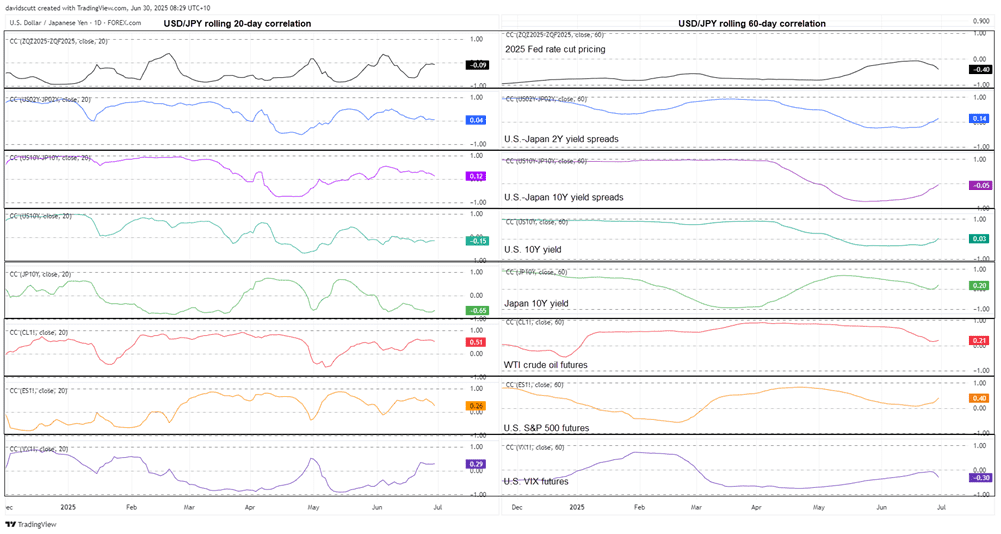
What stands out from the recent data is the clear deterioration in correlation strength between USD/JPY and its traditional macro inputs. Looking across one-month and one-quarter rolling periods, there’s been little to no sustained relationship between the pair and major variables including U.S. Treasury yields, yield differentials, and broader risk appetite proxies like the S&P 500 and VIX futures.
This divergence suggests markets are no longer trading the pair in a textbook fashion. Despite notable moves in both U.S. and Japanese 10-year yields over Q2, the pair has largely ignored these developments. Even front-end spread changes, typically a reliable driver of JPY flows, have failed to generate a lasting directional pull. Oil, often used as a barometer for inflation and demand dynamics, has also shown negligible influence.
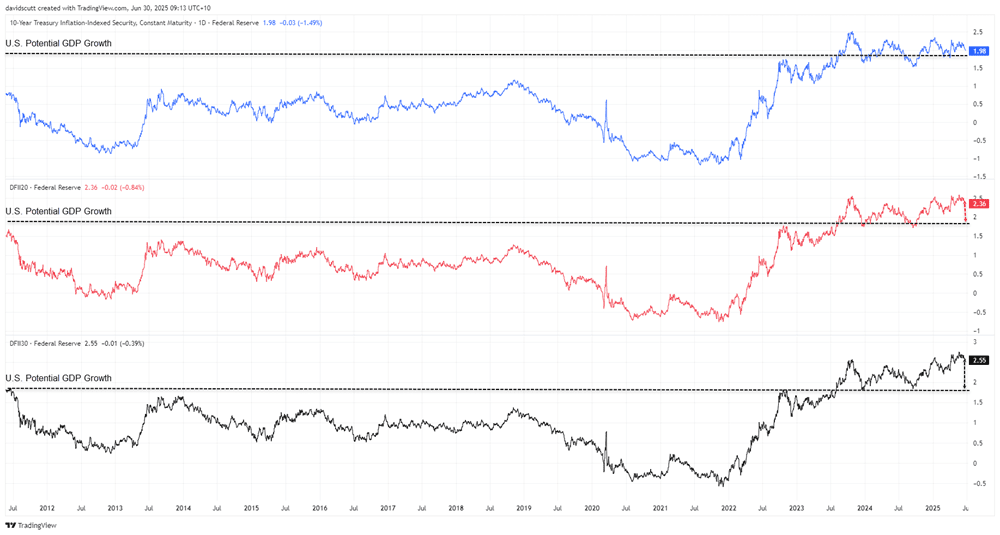
Instead, what seems to be playing a larger role is a rotation out of the U.S. dollar triggered by growing political unease. The turning point appears to have been the announcement of reciprocal tariffs on U.S. goods during U.S. ‘Liberation Day’ in early April. Since then, longer-dated U.S. Treasury yields have risen relative to short-dated yields, pointing to an increase in term premium—a concept that refers to the additional yield investors demand to hold longer-term bonds given uncertainty around inflation, growth, and fiscal stability.
Source: TradingView
Importantly, this lift in term premium hasn’t supported the dollar. If anything, it’s coincided with growing distrust from offshore buyers and rising concerns around the sustainability of the U.S. fiscal trajectory. Charts of real (inflation-adjusted) yields on 10 (blue line0, 20 (red line) and 30-year Treasuries (black line) show the shift clearly. With 20 and 30-year TIPS now well above levels seen for most of the past decade, it suggests investors are demanding greater compensation for long-term risk.
Given U.S. potential growth is broadly seen at around 1.8%, current real yields imply markets are not only reacting to fiscal slippage but also pricing in more structural uncertainty—likely tied to concerns about governance and trade under the Trump administration.
Fed: Policy Path Hazy Amid Political Overhang
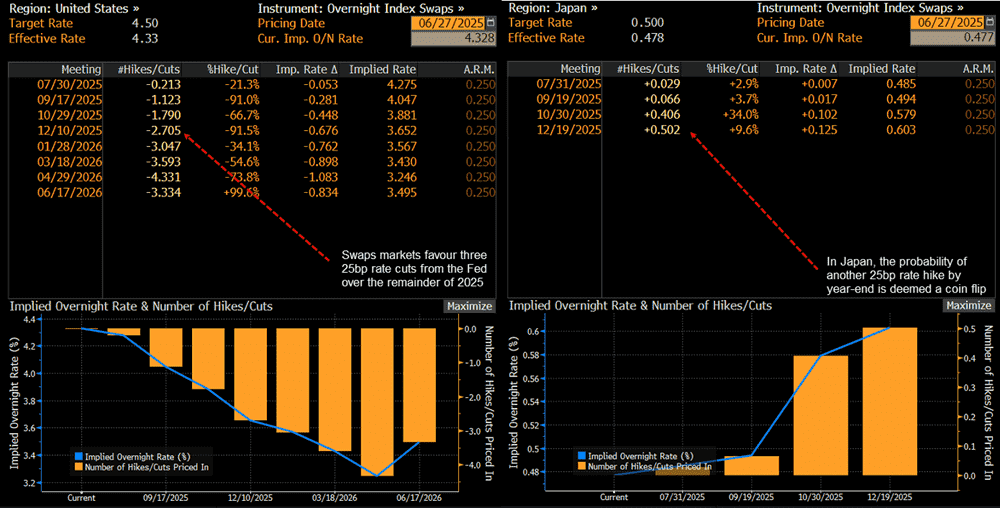
While real yields at the long end of the curve remain elevated, the front end has moved in the opposite direction. Softer inflation prints and patchy consumer data through Q2 have led to a modest dovish repricing for the Fed, with markets now assigning a decent chance to three rate cuts before the end of the year.
The bigger risk factor, though, stems from politics. Reports suggest President Trump may name a shadow Federal Reserve chair well in advance of Jerome Powell’s term expiring in May 2026. The move could effectively undermine the independence of monetary policy in the near term, especially if the nominee signals a preference for materially lower interest rates. While Powell remains in place for now, markets are increasingly sensitive to any commentary suggesting a new policy direction is already taking shape behind the scenes.
In short, artificially low interest rates are no longer a hypothetical—they’re a growing market concern. For now, CPI, PPI, payrolls and PCE remain key for the Fed outlook, but the political backdrop could start to exert more weight on rate expectations as H2 progresses.
Source: Bloomberg
BoJ: Tariff Shadow Lingers Over Policy Normalisation
The BoJ remains in a difficult position. Had it not been for growing trade-related uncertainty, there’s a strong case it would already have hiked beyond the 25bp move delivered in January. Inflation pressures remain firm, with annual core readings still sitting well above target. Domestic wage growth has also remained robust, supported by another round of sizeable increases struck earlier this year.
Despite that, markets remain hesitant to price in a meaningful tightening cycle, reflecting the cloud hanging over Japanese export prospects. With the reciprocal tariff extension set to expire on July 9, the key variable may be whether Japan can extract a deal from the U.S. that limits the damage to its auto sector. At this stage, 25% tariffs on Japanese car imports remain in place, and without movement there, the BoJ may be reluctant to hike again. A global slowdown triggered by retaliatory trade actions would quickly reverse progress made on domestic inflation.
Still, markets remain split, with current pricing assigning roughly a 50/50 chance of a second rate hike before year-end. Should the trade overhang lift—or a deal be struck that shields Japan’s key export sectors—the BoJ may feel more confident acting again. That could reintroduce rate differentials as a driver of USD/JPY, but we’re not there yet.
U.S. Dollar Index (DXY) Doldrums
Source: TradingView
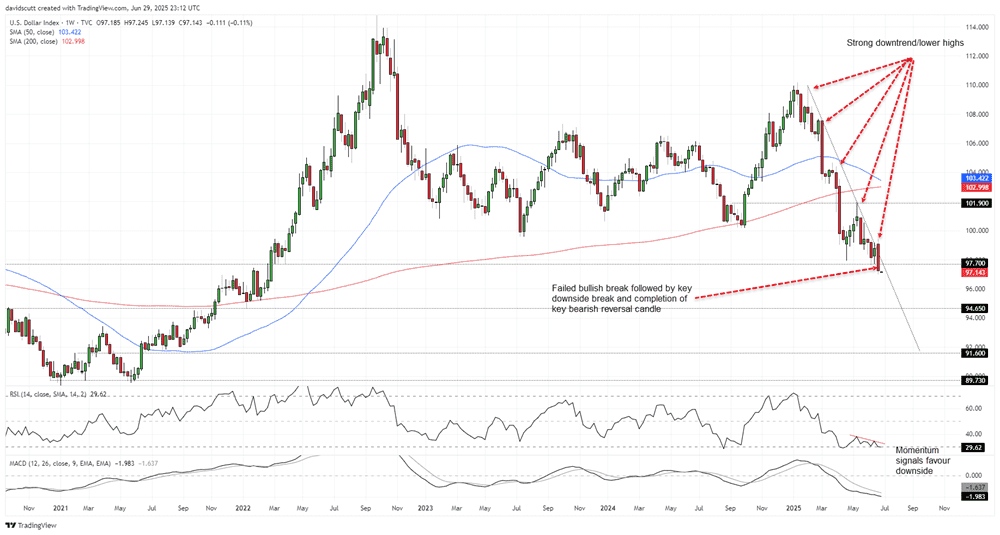
The U.S. dollar index (DXY) has been under sustained pressure since reciprocal tariff rates were announced on U.S. Liberation Day, printing a string of lower highs and lower lows within a broader downtrend on the weekly timeframe. With a bearish key reversal candle printing in the last full week of Q2—sending the DXY tumbling through support at 97.70—it signals the dollar could lose even more ground in the early stages of H2.
Momentum indicators bolster this view with RSI (14) trending lower while sitting in deeply negative territory. MACD is doing the same, confirming the overwhelming bearish signal that favours downside over upside.
With the DXY trading below 97.70, the next downside levels to watch include 94.65 and 91.60. 97.70 may now revert to acting as resistance, with 100 and 101.90 other topside levels of note.
USD/JPY Technical Outlook

Source: TradingView
While USD/JPY trades lower than when the Q2 outlook was completed, the story over recent months has been one of modest upside with support running from the April lows continuing to repel bearish moves in May and June. On the topside, sellers have been parked above 148, resulting in violent downside moves, including in late June. That price action may be informative as to what direction USD/JPY is likely to break from the ascending triangle it trades in.
Even though momentum indicators like RSI (14) and MACD are signalling that selling pressure is ebbing—not increasing—downside risks remain tilted lower entering H2, keeping the risk of a potential retest of support starting from 140.25 on the table.
Should we see a weekly close beneath 140.25, it would increase the risk of a move towards major support at 138.00. Below, 134.00, 129.65 and 127.00 are the levels to watch. Should sellers parked between 148.00–70 be eventually overrun, resistance levels of note include 151.00 and 153.38.
The colour-coding signifies the potential ranges where USD/JPY may finish 2025, along with an assigned probability of each occurring as marked. The green zone between 148.00 on the topside and 138.00 on the downside is favoured at 70%, underpinned by the belief that while broader USD pressure is likely to persist, in the absence of a major U.S. market meltdown that sparks major carry trade unwind or significant economic downturn (both of which screen as unlikely over the medium term), a venture into the blue zone is deemed low probability at just 20%.
The implied probability of a push above 148 is even lower at just 10%, likely requiring a combination of policy inertia from the Fed, a positive resolution to trade and geopolitical risks, along with booming financial markets. Such a backdrop comes across as more akin to wishful thinking rather than plausible.
Latest market news




Open an account in minutes
Experience award-winning platforms with fast and secure execution, and enjoy tight spreads from 0.5 pts on FX and 0.3 pts on indices.
Economic calendar
Web Trader platform
Our sophisticated web-based platform is packed with features.
Related articles
AUD/USD Q4 Outlook: RBA and Fed Hikes Set the Tone
AUD/USD enters Q4 with RBA and Fed hikes in focus as sticky inflation, rising unemployment and US dollar strength shape the Australian dollar.
USD/JPY Q4 2026 Outlook: Hawkish Fed Pricing Clashes With Intervention Risk
The year-end tug-of-war is clear: hawkish Fed pricing supports USD/JPY, while intervention risk limits the upside.
Japanese Yen Forecast: USD/JPY 4% Rally Challenges Post-Intervention Downtrend 9 24 2026
USD/JPY momentum has shifted sharply higher, putting a major resistance confluence in focus as U.S. and Japanese event risk builds.

This report is intended for general circulation only. It should not be construed as a recommendation, or an offer (or solicitation of an offer) to buy or sell any financial products. The information provided does not take into account your specific investment objectives, financial situation or particular needs. Before you act on any recommendation that may be contained in this report, independent advice ought to be sought from a financial adviser regarding the suitability of the investment product, taking into account your specific investment objectives, financial situation or particular needs.
StoneX Financial Pte. Ltd., may distribute reports produced by its respective foreign entities or affiliates within the StoneX group of companies or third parties pursuant to an arrangement under Regulation 32C of the Financial Advisers Regulations. Where the report is distributed to a person in Singapore who is not an accredited investor, expert investor or an institutional investor (as defined in the Securities Futures Act), StoneX Financial Pte. Ltd. accepts legal responsibility to such persons for the contents of the report only to the extent required by law. Singapore recipients should contact StoneX Financial Pte. Ltd. at 6826 9988 for matters arising from, or in connection with the report.
In the case of all other recipients of this report, to the extent permitted by applicable laws and regulations neither StoneX Financial Pte. Ltd. nor its associated companies will be responsible or liable for any loss or damage incurred arising out of, or in connection with, any use of the information contained in this report and all such liability is hereby expressly disclaimed. No representation or warranty is made, express or implied, that the content of this report is complete or accurate.
StoneX Financial Pte. Ltd. is not under any obligation to update this report.
Trading CFDs carries a high level of risk that may not be suitable for some investors. Consider your investment objectives, level of experience, financial resources, risk appetite and other relevant circumstances carefully. The possibility exists that you could lose some or all of your investments, including your initial deposits. If in doubt, please seek independent expert advice. Visit www.forex.com/en-sg/terms-and-policies for the complete Risk Disclosure Statement.