



USD/JPY Weekly Outlook: BOJ Intervention Threat Battles Hawkish Fed
The threat of BOJ intervention hangs over USD/JPY once again. But unless the US rates outlook changes materially, the fundamental and technical backdrop continues to favour further upside.
Share this:

- USD/JPY remains supported by widening US-Japan yield differentials
- Fed speakers and PCE data headline a light US calendar
- BOJ's preferred inflation gauge released Tuesday at 2pm JST
- Intervention risk remains elevated with USD/JPY above 160
- Fundamental and technical signals continue to favour upside
USD/JPY enters the new week trading in a known intervention zone above 160, leaving traders to balance the risk of BOJ action against a Federal Reserve that has turned noticeably more hawkish. With the relationship between USD/JPY and US-Japan two-year yield spreads strengthening rapidly following the June FOMC meeting, the focus falls squarely on US data and Fed speakers capable of altering the rates outlook. For the time being at least, the stars remain aligned for further upside in USD/JPY.
Through the fog, yield spreads emerge

Source: Tradingview
The ongoing threat of BOJ intervention and headline-driven environment created by peace negotiations in the Middle East have clouded the picture as to what's driving USD/JPY right now. That's evident across the correlation matrix above where relationships vary considerably across both markets and timeframes.
However, one thing that stands out, at least over the shorter term, is the rapid strengthening in the relationship between USD/JPY and US-Japan two-year yield spreads.
Source: Tradingview
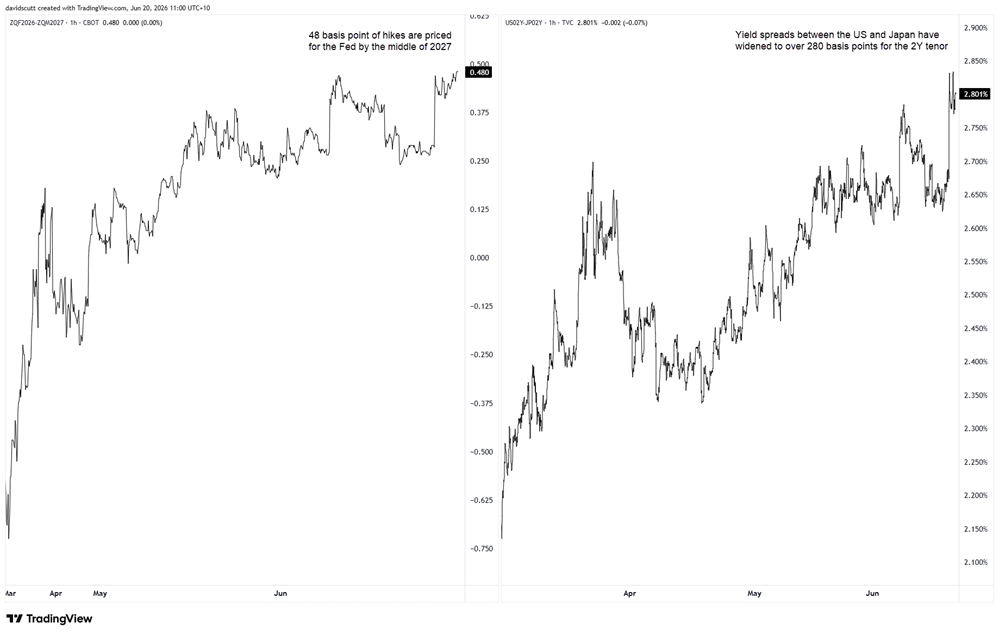
That coincides with a significant repricing in Federal Reserve expectations following the June FOMC meeting. Fed funds futures now imply 48 basis points of tightening by the middle of next year, while US-Japan two-year yield spreads have widened to more than 280 basis points in favour of the dollar, the largest differential since the conflict between US and Iran began.
The real test of Warsh's message
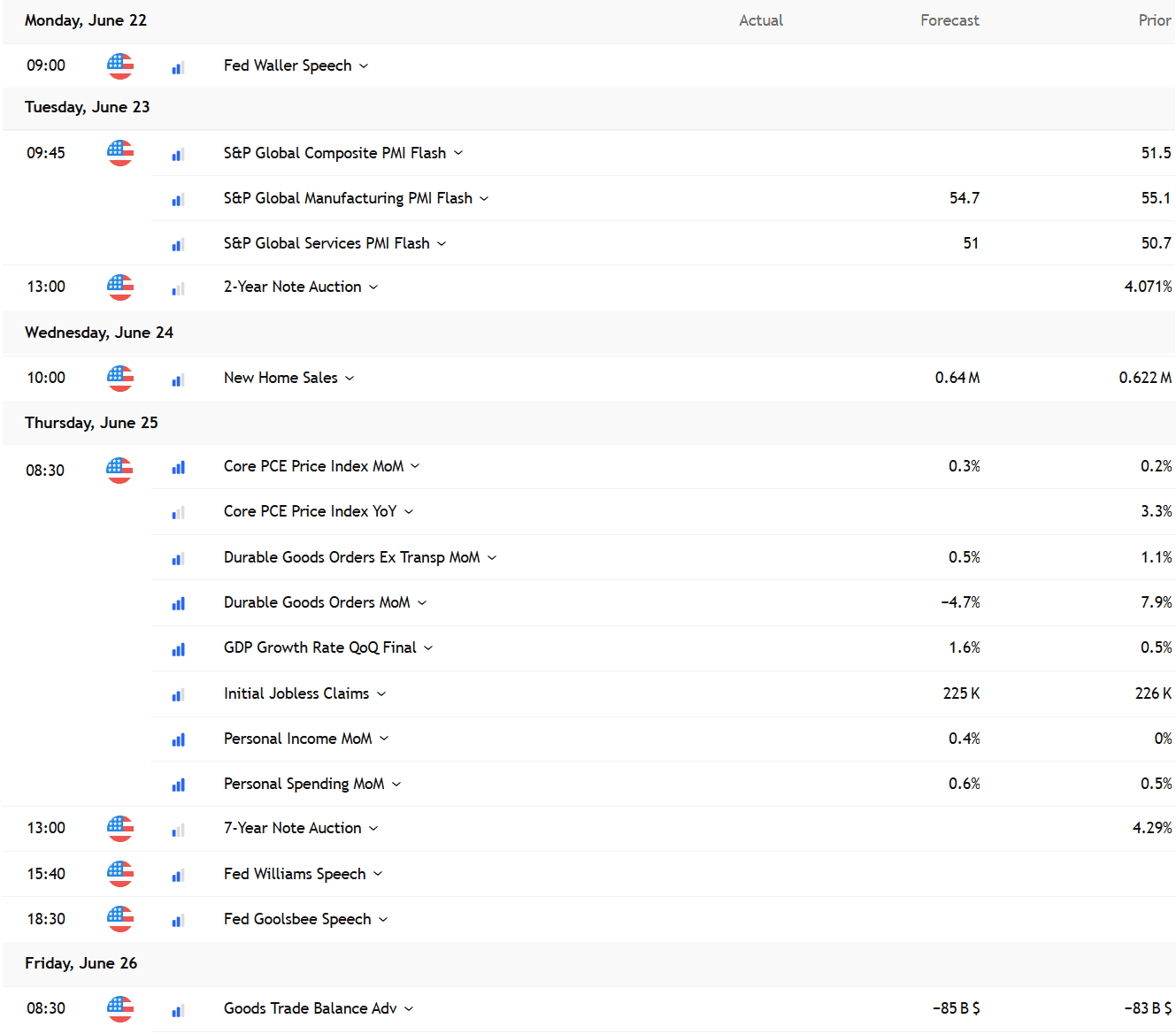
The US calendar is relatively light this week with the May PCE report and a handful of Fed speakers the main events of note.
Source: Tradingview
While the core PCE deflator remains the Fed's preferred inflation measure, there is generally little surprise associated with the release these days given the success private sector economists have had in mapping what's likely to emerge based on CPI and PPI data released earlier in the month. While consensus sits at a 0.3% monthly increase, the forecasts I've seen point closer to 0.4%, which would see the annual rate accelerate to 3.4%, miles above the Fed's 2% inflation target.
Assuming there is no major deviation from those expectations, attention is likely to fall on the personal income and spending figures released alongside it. As the fuel powering the largest part of the US economy, any signs of a slowdown in either measure would raise questions over whether consumer resilience can continue and, in turn, whether the Fed is really likely to deliver the additional rate hikes signalled by so many FOMC members last week.
Realistically, Fed speakers stand out as the main event risk. Following Kevin Warsh's comments after the June FOMC meeting about becoming more data-driven and placing a greater focus on inflation, markets will be looking for confirmation from other influential committee members. Christopher Waller on Monday and New York Fed President John Williams on Thursday stand out in particular. The key question is whether they confirm or contradict the shift outlined by Warsh when it comes to the Fed's reaction function.
Relative to the United States, Japanese data and events remain a distant secondary consideration when it comes to the fundamental drivers of USD/JPY movements.
The inflation print hiding in plain sight
Source: Tradingview (US EDT shown)
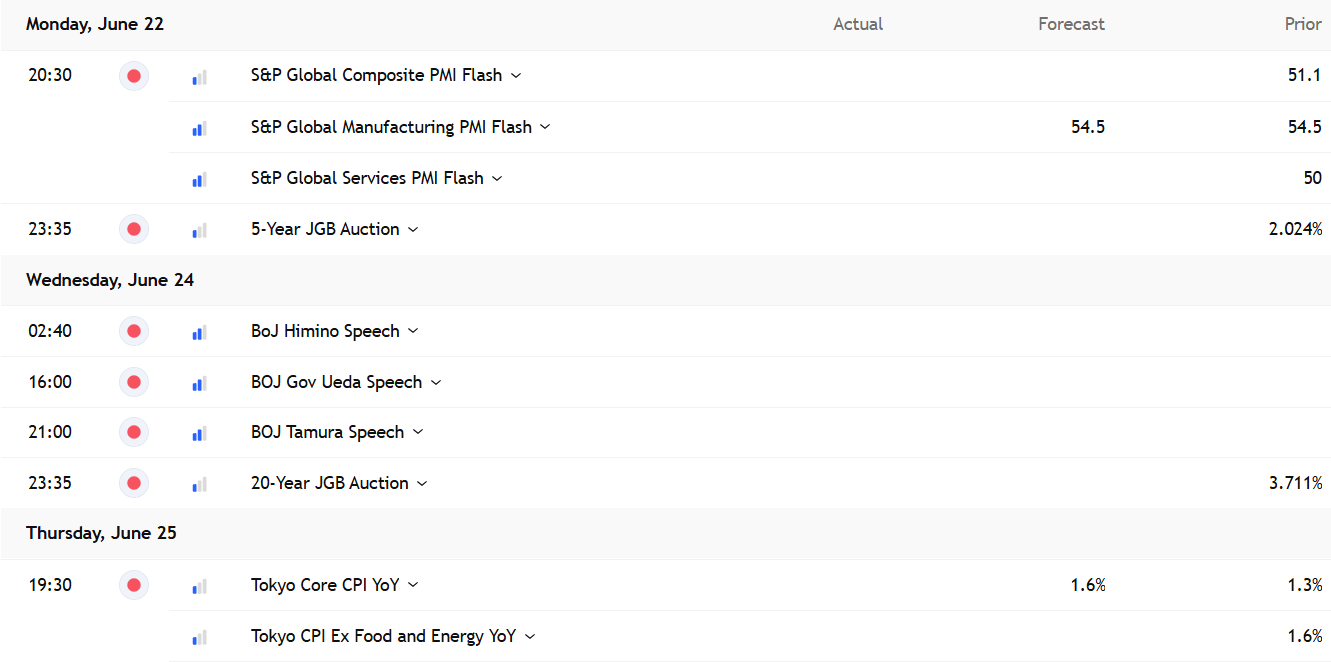
Looking at the Japanese calendar, the most important release is arguably not actually on the calendar. The BOJ's new underlying inflation gauge, officially known as the Underlying CPI Inflation Rate Excluding Government Measures, will be released at 2pm Japan Standard Time on Tuesday. Designed to strip out the distorting impact of government subsidies and administrative measures, it provides a far cleaner read on underlying inflation pressures than either the Tokyo or national CPI reports. Having printed at 2.8% in April, the focus will be on whether underlying inflationary pressures remained elevated in May.
It's also notable that the release will be followed by a raft of BOJ speakers, including Governor Ueda and noted hawk Tamura on Thursday. After Deputy Governor Himeno delivered a hawkish assessment of the policy outlook last week, markets will be watching closely to see whether they strike a similar tone. That's especially important given overnight index swaps continue to price around a 90% probability of another 25 basis point BOJ rate increase by December.
What Friday's inaction may be telling us
Beyond the fundamental side of the equation, one thing markets cannot escape right now is the ongoing threat of intervention from the BOJ on behalf of Japan's Ministry of Finance. That's because USD/JPY is trading in a known intervention zone above 160 where the BOJ has been instructed to act on numerous occasions in the past, including earlier this year.
Finance Minister Katayama reiterated last week following the G7 meeting that authorities stand ready to act if required.
Yet, if authorities were looking for an opportunity to intervene, last Friday was close to ideal. With US markets closed for the Juneteenth holiday, liquidity was exceptionally thin, meaning a relatively modest deployment of Japan's sizeable foreign exchange reserves could have delivered a powerful signal to the market. While USD/JPY experienced plenty of volatile price action during the session, none of it carried the hallmarks normally associated with intervention, suggesting authorities were content to stay on the sidelines.
The challenge is that intervening in this environment goes completely against fundamentals. Even with markets pricing close to another full BOJ rate increase by year-end and policymakers continuing to signal a willingness to normalise policy should forecasts be realised, it has done little to alleviate pressure on the yen.
That's why, even if the Ministry of Finance tells the BOJ to pull the trigger, the impact may be limited to slowing the pace of depreciation rather than stopping it outright. We saw that in late April and early May where intervention generated a sharp reversal, only for buyers to quickly re-emerge, providing better levels for bulls to buy back in.
Until the US side of the equation starts to falter and markets begin questioning whether the next move from the Federal Reserve is more likely to be a cut than a hike, it's difficult to see intervention having a lasting impact. It may slow the pace of yen weakness, not stop it outright.
Bullish signals keep stacking up
Source: Tradingview
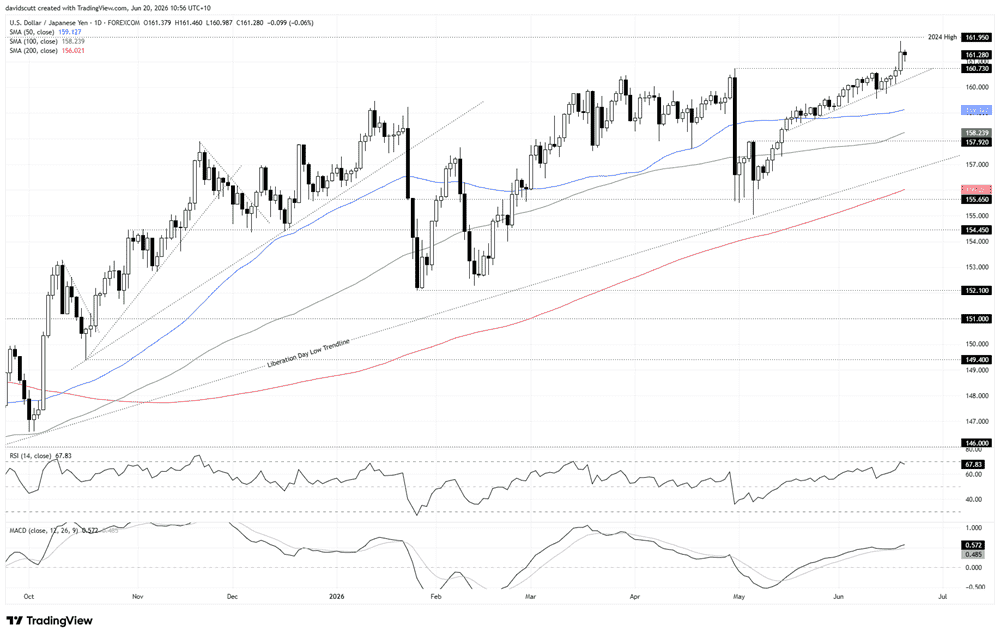
The thing that stands out with USD/JPY is the bullish breakout we saw following last week's Fed meeting, seeing the previous year-to-date high of 160.73 taken out. We came within a whisker of testing the 161.95 high set in June 2024 before reversing on Friday, which may or may not have reflected potential rate checks from the MOF.
The playbook for traders right now is really simple. Having previously acted as resistance, 160.73 may flip to offering support. Underneath, the uptrend running from the middle of May, along with the 50-day moving average, are other levels of note.
161.95 is the immediate focus overhead. Should the pair break above that level, it would push USD/JPY to multi-decade highs. Looking at the longer-term price action, levels of note on a bullish breakout include 164.00, 168.00 and even 180.00, all established back in 1986.
With the pair sitting in a strong uptrend above its key medium and longer-term moving averages, it continues to favour longs over shorts.
The oscillators are providing a complementary signal. RSI (14) continues to push higher and is not yet in overbought territory, while MACD crossed above the signal line back in the middle of May and continues to accelerate away from it while remaining in positive territory.
So it's not only the fundamental side of the equation that does not bode well for intervention, but also the technical side. The stars continue to align for further upside in USD/JPY.
Latest market news




Open an account in minutes
Experience award-winning platforms with fast and secure execution, and enjoy tight spreads from 0.5 pts on FX and 0.3 pts on indices.
Economic calendar
Web Trader platform
Our sophisticated web-based platform is packed with features.
Related articles
AUD/USD Q4 Outlook: RBA and Fed Hikes Set the Tone
AUD/USD enters Q4 with RBA and Fed hikes in focus as sticky inflation, rising unemployment and US dollar strength shape the Australian dollar.
USD/JPY Q4 2026 Outlook: Hawkish Fed Pricing Clashes With Intervention Risk
The year-end tug-of-war is clear: hawkish Fed pricing supports USD/JPY, while intervention risk limits the upside.
Japanese Yen Forecast: USD/JPY 4% Rally Challenges Post-Intervention Downtrend 9 24 2026
USD/JPY momentum has shifted sharply higher, putting a major resistance confluence in focus as U.S. and Japanese event risk builds.

This report is intended for general circulation only. It should not be construed as a recommendation, or an offer (or solicitation of an offer) to buy or sell any financial products. The information provided does not take into account your specific investment objectives, financial situation or particular needs. Before you act on any recommendation that may be contained in this report, independent advice ought to be sought from a financial adviser regarding the suitability of the investment product, taking into account your specific investment objectives, financial situation or particular needs.
StoneX Financial Pte. Ltd., may distribute reports produced by its respective foreign entities or affiliates within the StoneX group of companies or third parties pursuant to an arrangement under Regulation 32C of the Financial Advisers Regulations. Where the report is distributed to a person in Singapore who is not an accredited investor, expert investor or an institutional investor (as defined in the Securities Futures Act), StoneX Financial Pte. Ltd. accepts legal responsibility to such persons for the contents of the report only to the extent required by law. Singapore recipients should contact StoneX Financial Pte. Ltd. at 6826 9988 for matters arising from, or in connection with the report.
In the case of all other recipients of this report, to the extent permitted by applicable laws and regulations neither StoneX Financial Pte. Ltd. nor its associated companies will be responsible or liable for any loss or damage incurred arising out of, or in connection with, any use of the information contained in this report and all such liability is hereby expressly disclaimed. No representation or warranty is made, express or implied, that the content of this report is complete or accurate.
StoneX Financial Pte. Ltd. is not under any obligation to update this report.
Trading CFDs carries a high level of risk that may not be suitable for some investors. Consider your investment objectives, level of experience, financial resources, risk appetite and other relevant circumstances carefully. The possibility exists that you could lose some or all of your investments, including your initial deposits. If in doubt, please seek independent expert advice. Visit www.forex.com/en-sg/terms-and-policies for the complete Risk Disclosure Statement.