



USD/JPY Weekly Outlook: Coiling beneath multi-decade highs
The yen remains on the back foot despite softer US inflation, while USD/JPY continues to compress beneath key resistance. Here's what matters this week and the levels that could determine the next major move.
Share this:

- Yen ignores what should have been bullish news
- Tech earnings could matter more than economic data
- Traditional USD/JPY drivers losing influence
- Momentum, technicals still favour upside
Broader narrative remains intact
USD/JPY starts the week sitting just beneath the highest levels seen in decades. While the pair has struggled to break higher, the price action continues to tighten, raising the risk that the next meaningful move may be a breakout to fresh multi-decade highs.
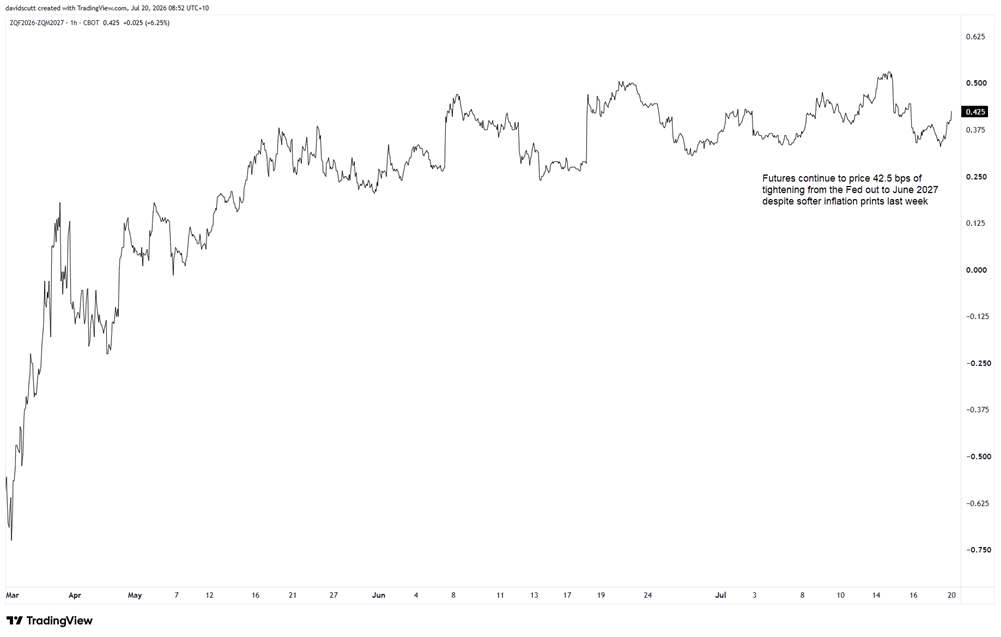
Last week did little to change the broader narrative of persistent yen weakness. Softer US inflation would normally have weighed on the dollar, but that was offset by another lift in energy prices as tensions in the Gulf escalated.
Higher crude prices have been a recurring headwind for the yen this year. As the world's largest energy producer and a net energy exporter, the US is far better placed to absorb higher energy costs than Japan, which remains heavily reliant on imported fuel. That not only exposes Japan's vulnerability from a terms of trade and energy security perspective, but also keeps alive the risk that higher energy costs add to US inflation pressures and force the Fed to keep policy tighter for longer.
Source: TradingView
That may explain Friday's muted reaction to what would normally be bullish yen headlines out of Japan. Reuters reported that the government will reaffirm the BOJ's independence in setting monetary policy, a development that, at face value, should have been supportive for the yen. Separate reports also suggested policymakers continue to explore ways to encourage the GPIF to allocate more capital to domestic assets.
Despite both stories, neither generated much of a market reaction. The lack of interest in the recycled GPIF headlines was particularly notable given similar reports sparked a sharp rally in the yen only a week earlier. The market has already moved on.
A quiet calendar, but not a quiet week
Source: TradingView
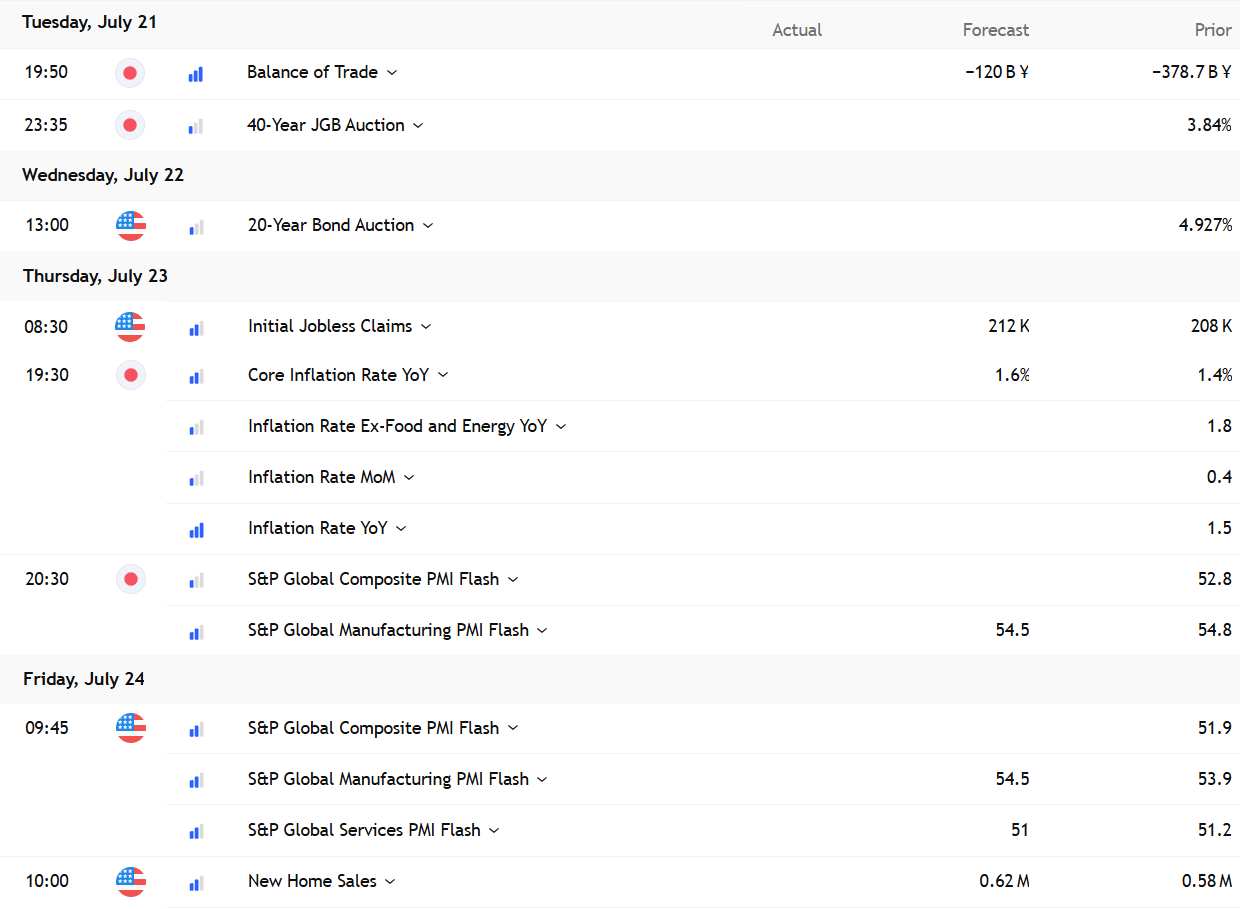
There's nothing on this week's calendar that stands out as being likely to move USD/JPY. The Fed is in its pre-meeting blackout period ahead of next week's FOMC decision, while Japan's nationwide CPI report rarely generates much of a market reaction. Markets have tended to place far greater weight on Tokyo CPI and, more recently, the BOJ's preferred measure of underlying inflation, which won't be released until next week.
Japan is also observing the Marine Day public holiday on Monday, likely keeping liquidity lighter than usual.
That leaves developments in the Gulf and another heavy week of tech earnings as the main event risks. Results from Alphabet, Tesla, Intel and memory chipmaker SK Hynix will be watched closely after selling pressure in AI-related stocks intensified late last week. If that weakness extends, it could trigger an unwind in carry trades, creating downside risk for USD/JPY.
Whether that becomes a meaningful driver of USD/JPY is another question.
A market without a clear compass
Source: TradingView
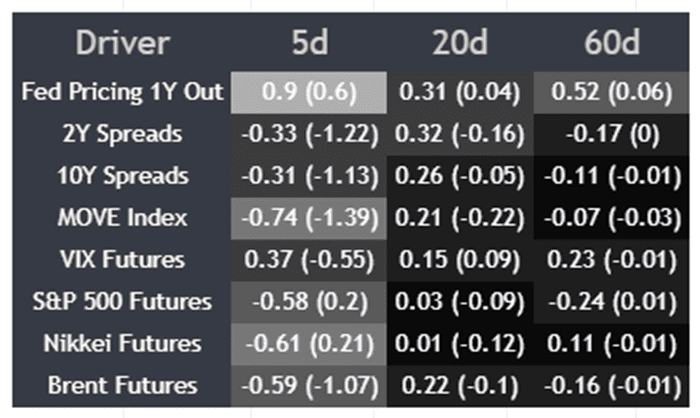
The correlation matrix above provides little evidence that any single factor has consistently driven the pair over the past month or quarter. Relationships with US-Japan two-year and 10-year yield spreads have both been weak, while correlations with broader measures of risk sentiment have also been limited.
Fed pricing over the next year showed the strongest relationship with USD/JPY over the past week. That's worth monitoring, but the absence of similar signals from Treasury yields suggests it's too early to conclude it has become the dominant driver.
USD/JPY Coiling beneath resistance
Source: TradingView
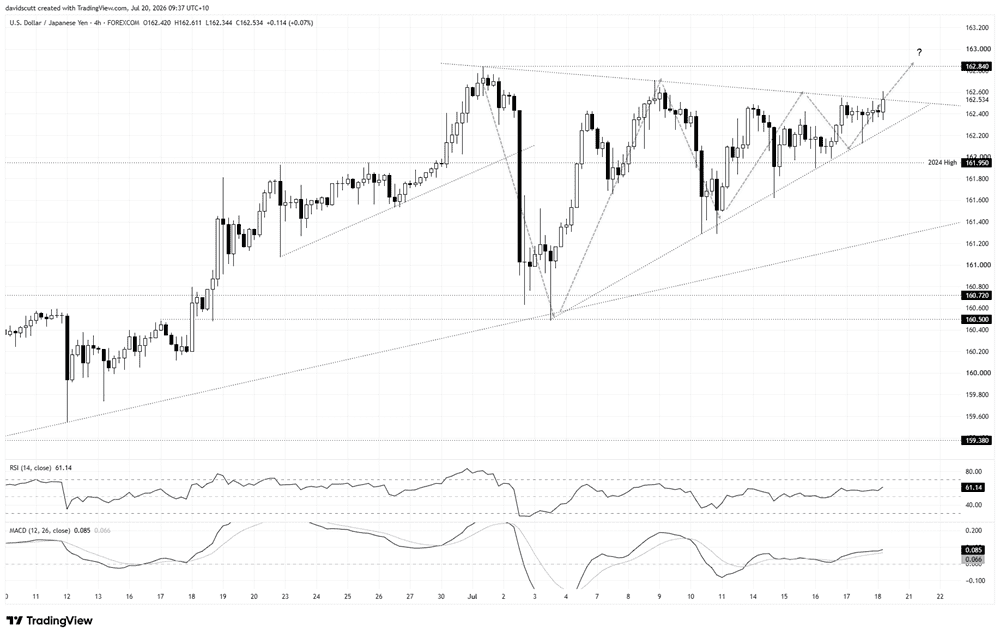
From a technical perspective, USD/JPY continues to coil beneath the multi-decade highs set earlier this month. On the four-hour chart, the pair is trading within a narrowing trading range, bounded by a descending trendline from the July 1 high and a rising trendline from the July 3 low. Multiple tests of both trendlines suggest a decisive move may not be far away.
While the pair briefly traded above downtrend resistance in early Monday trade, the move has yet to attract meaningful follow-through. Even so, the broader technical picture continues to favour the topside. RSI (14) has climbed back above the neutral 50 level to 61, while MACD has completed a bullish crossover and continues to diverge from its signal line.
A convincing break above trendline resistance would bring the July 1 high at 162.84 back into focus. Given the size of the consolidation, a successful breakout could also produce a multi-big-figure move, placing 164 and potentially 165 on the radar for bulls.
On the downside, the rising trendline remains the first level of support. Below that, 161.50 and the former multi-decade high at 160.73 are the key levels to watch.

Open an account in minutes
Experience award-winning platforms with fast and secure execution, and enjoy tight spreads from 0.5 pts on FX and 0.3 pts on indices.
Economic calendar
Web Trader platform
Our sophisticated web-based platform is packed with features.
Related articles

AUD/USD forecast: Currency Pair of the Week | September 28, 2026
The week has started with stocks, gold, silver and bitcoin all falling, as crude oil rebounded and bond yields pushed further higher. Trump refusing to agree to Tehran’s proposal to re-open the Strait of Hormuz has left the markets disappointed. Still, reports that mediators are expected to hold talks with the two sides on an amended version of the 7-day proposal that Iran presented, keeps hopes alive that we may see some progress.


Gold Dips Below Three-Month Uptrend, Bitcoin Pulls Back from Nine-Month High
Gold has dipped below its three-month uptrend, while Bitcoin has pulled back from a nine-month high as U.S. bond yields test levels last seen in 2004 and 2007. Risks build as Fed rate-hike expectations remain above 70%, while the Dollar Index holds near yearly highs.


Crude Oil Q4 2026 Outlook: Will a New Energy-Security Regime Emerge?
Crude Oil Q4 2026 Outlook: The U.S.-Iran conflict has done more than disrupt oil flows. It has challenged many of the assumptions underpinning the global energy security system established after the 1973 oil embargo.
This report is intended for general circulation only. It should not be construed as a recommendation, or an offer (or solicitation of an offer) to buy or sell any financial products. The information provided does not take into account your specific investment objectives, financial situation or particular needs. Before you act on any recommendation that may be contained in this report, independent advice ought to be sought from a financial adviser regarding the suitability of the investment product, taking into account your specific investment objectives, financial situation or particular needs.
StoneX Financial Pte. Ltd., may distribute reports produced by its respective foreign entities or affiliates within the StoneX group of companies or third parties pursuant to an arrangement under Regulation 32C of the Financial Advisers Regulations. Where the report is distributed to a person in Singapore who is not an accredited investor, expert investor or an institutional investor (as defined in the Securities Futures Act), StoneX Financial Pte. Ltd. accepts legal responsibility to such persons for the contents of the report only to the extent required by law. Singapore recipients should contact StoneX Financial Pte. Ltd. at 6826 9988 for matters arising from, or in connection with the report.
In the case of all other recipients of this report, to the extent permitted by applicable laws and regulations neither StoneX Financial Pte. Ltd. nor its associated companies will be responsible or liable for any loss or damage incurred arising out of, or in connection with, any use of the information contained in this report and all such liability is hereby expressly disclaimed. No representation or warranty is made, express or implied, that the content of this report is complete or accurate.
StoneX Financial Pte. Ltd. is not under any obligation to update this report.
Trading CFDs carries a high level of risk that may not be suitable for some investors. Consider your investment objectives, level of experience, financial resources, risk appetite and other relevant circumstances carefully. The possibility exists that you could lose some or all of your investments, including your initial deposits. If in doubt, please seek independent expert advice. Visit www.forex.com/en-sg/terms-and-policies for the complete Risk Disclosure Statement.