




USD/JPY Fundamental 2025 Outlook Preview
USD/JPY enters 2025 at a crossroads. Rising US yields, hawkish Fed pivot, and expansionary fiscal policies could fuel more dollar strength, but BoJ moves and carry trade vulnerabilities may keep yen downside in check. The year ahead promises to be an eventful one.
Share this:

This is an excerpt from our full 2025 USD/JPY Outlook report, one of nine detailed reports about what to expect in the coming year.
- US Treasury yields and Fed policy will be key drivers for USD/JPY in 2025
- Diverging economic performance between the US and Japan creates backdrop for ongoing volatility.
- Trump’s fiscal policies, including potential tax cuts and tariffs, could influence inflation expectations and the dollar.
- BoJ’s moves, including potential rate hikes and intervention, carry sizeable reversal risks
- Carry trades flows vulnerable to expensive asset valuations, narrowing yield differentials
Summary
2024 was a wild year for USD/JPY, with shifting interest rate dynamics and Donald Trump’s re-election as US President driving significant market moves.
This report explores the critical factors behind the price action, including relative economic performance, policy responses from the Fed and BoJ, along with the importance of continued buoyancy in asset valuations.
Key insights include:
- How correlation between USD/JPY and US Treasury yields shaped market moves, with longer-dated yields taking the lead
- The role of carry trade flows and Japanese monetary policy in influencing short-term yen fluctuations
- A technical and fundamental outlook on US Treasury yields and their implications for USD/JPY in 2025
The analysis offers a comprehensive view of USD/JPY’s drivers and scenarios for potential outcomes, providing traders and investors with actionable insights for the year ahead.
US exceptionalism on full display
2024 was the year when the US economy simply wouldn’t quit, roaring back to life just as it seemed activity was rolling over, maintaining its streak of exceptional performance relative to other developed nations, including Japan.
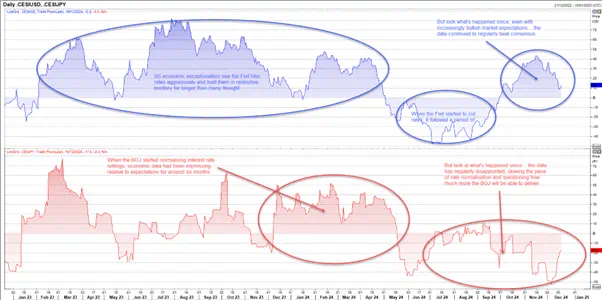
You can see the divergence in the first chart, which shows Citi’s economic surprise indices, a measurement of how economic data performs relative to expectations. A reading above 0 indicates more data than not has topped consensus, with the distance from 0 reflecting the aggregate proportion of surprises.
Source: Refinitiv
Japanese data, shown in red, undershot consensus for large periods in the second half of 2024, coinciding with the BoJ’s move to normalise monetary policy by abandoning yield curve control and lifting overnight rates out of negative territory. In contrast, US economic data, shown in blue, delivered persistent upside surprises over the past two years, apart from a brief dip in mid-2024.
This relative economic divergence, and the subsequent reaction functions from the Fed and BoJ, explains much of the price action seen in USD/JPY in 2024, as the following section outlines.
Comeback’s spark major rates reversal
With US economic data roaring back to life last quarter, it sparked a major recalibration of expectations on how much the Federal Reserve will need to cut interest rates in 2025. Futures shifted from pricing nearly six cuts to fewer than two, contributing to US two-year Treasury yields reversing sharply higher toward levels seen immediately after the US Presidential election.
That event is worth noting as President-elect Donald Trump’s policy mix has been a significant factor behind the sharp rise in longer-dated US Treasury yields, boosting growth expectations and bringing future fiscal deficits into focus. Combined with proposed mass deportations of undocumented workers and one-off impacts from planned import tariffs, perceived inflation risks are skewing higher, including from rising wages
Source: TradingView
The point cannot be reinforced enough: while it will be easy for the Trump Administration to introduce tax cuts and tariffs, delivering offsetting measures to counteract the inflationary impact – such as boosting productive capacity and achieving public sector synergies – will be far more challenging, especially without the threat of industrial action. Such measures could take years to implement.
Key US data to watch
The byproduct of government policy will shape future economic outcomes. For USD/JPY, the key data points to monitor are nonfarm payrolls and core consumer price inflation. While the core PCE deflator is the Fed’s preferred inflation measure, CPI often moves markets more as it includes many components that feed into the PCE measure.
While they don’t carry the same potential to spark volatility, GDP, jobless claims, consumer spending and incomes, along with wage measures such as the Employment Cost Index, are other reports traders should watch. Treasury auctions, given their implications for yields, may also become increasingly influential next year.
The policy mix and trajectory for US economic data will be highly influential on the US interest rate curve in 2025. As the next section explains, it’s also critical for USD/JPY.
Long bonds provide strong leads
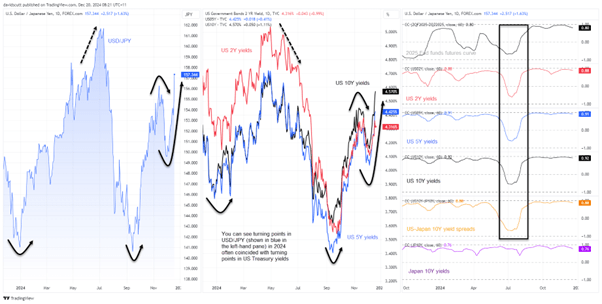
The following chart is divided into three panes: USD/JPY on the left, US two, five, and 10-year Treasury yields in the centre, and the rolling daily correlation between the currency pair and various interest rate variables over the past quarter on the right.
Source: TradingView
Where US Treasury yields moved last year, USD/JPY almost always followed. This is visually evident and confirmed by the correlation coefficient analysis, showing especially tight relationships with US five and 10-year Treasury yields.
Correlation coefficient scores measure the strength and direction of a relationship between two variables, ranging from -1 to +1. A score near +1 signals a strong positive link, where one rises as the other moves up. A reading closer to -1 shows a strong inverse relationship, while zero indicates no correlation.
While correlation does not imply causation, in this instance, US yields in the belly and back end of the Treasury curve drove USD/JPY moves for much of the year.
US short-end rates and interest rate spreads between the US and Japan were also correlated with USD/JPY, albeit less so than longer-term yields.
There was a weak positive relationship with Japanese 10-year yields, but that likely reflects the impact of US Treasury yield fluctuations on global borrowing costs. All else being equal, one would expect an inverse correlation if there were a meaningful fundamental relationship.
Japanese events an important short-term driver
That’s not to say Japanese data and interest rates don’t matter for USD/JPY. They do, but typically only for short periods when they threaten to disrupt carry trade flows. These flows rely on borrowing yen cheaply and swapping it into higher-yielding currencies. Higher Japanese interest rates can discourage carry trades both on a relative return and FX basis, resulting in capital being repatriated into the yen. When that occurs, it has the potential to deliver powerful USD/JPY downside.
Even though US longer-term rates were highly influential for much of 2024, that doesn’t mean they will always be influential. Market drivers can and do change, as indicated by the black box and dotted black arrows in the chart above.
This is an excerpt from our full 2025 USD/JPY Outlook report, one of nine detailed reports about what to expect in the coming year.


Open an account in minutes
Experience award-winning platforms with fast and secure execution, and enjoy tight spreads from 0.5 pts on FX and 0.3 pts on indices.
Economic calendar
Web Trader platform
Our sophisticated web-based platform is packed with features.
Related articles

Japanese Yen Forecast: USD/JPY 4% Rally Challenges Post-Intervention Downtrend 9 24 2026
USD/JPY momentum has shifted sharply higher, putting a major resistance confluence in focus as U.S. and Japanese event risk builds.


Oil Quietly Hands the Fed a Reason to Stay Hawkish
Oil prices and the U.S. dollar are both on the front foot as elevated energy costs feed Fed warnings that inflation may prove sticky.


Oil, USD/JPY Forecast: Two trades to watch
Oil recovers above $90 amid a lack of progress in US-Iran diplomacy. USD/JPY rises to 158 on widening Fed-BoJ policy outlook.

This report is intended for general circulation only. It should not be construed as a recommendation, or an offer (or solicitation of an offer) to buy or sell any financial products. The information provided does not take into account your specific investment objectives, financial situation or particular needs. Before you act on any recommendation that may be contained in this report, independent advice ought to be sought from a financial adviser regarding the suitability of the investment product, taking into account your specific investment objectives, financial situation or particular needs.
StoneX Financial Pte. Ltd., may distribute reports produced by its respective foreign entities or affiliates within the StoneX group of companies or third parties pursuant to an arrangement under Regulation 32C of the Financial Advisers Regulations. Where the report is distributed to a person in Singapore who is not an accredited investor, expert investor or an institutional investor (as defined in the Securities Futures Act), StoneX Financial Pte. Ltd. accepts legal responsibility to such persons for the contents of the report only to the extent required by law. Singapore recipients should contact StoneX Financial Pte. Ltd. at 6826 9988 for matters arising from, or in connection with the report.
In the case of all other recipients of this report, to the extent permitted by applicable laws and regulations neither StoneX Financial Pte. Ltd. nor its associated companies will be responsible or liable for any loss or damage incurred arising out of, or in connection with, any use of the information contained in this report and all such liability is hereby expressly disclaimed. No representation or warranty is made, express or implied, that the content of this report is complete or accurate.
StoneX Financial Pte. Ltd. is not under any obligation to update this report.
Trading CFDs carries a high level of risk that may not be suitable for some investors. Consider your investment objectives, level of experience, financial resources, risk appetite and other relevant circumstances carefully. The possibility exists that you could lose some or all of your investments, including your initial deposits. If in doubt, please seek independent expert advice. Visit www.forex.com/en-sg/terms-and-policies for the complete Risk Disclosure Statement.