
While the stage was set for AUD/USD to breakout of a long-term head-and-shoulders top, bears are yet to have their pound of flesh. A weaker US dollar, hawkish RBA commentary and surging November rate hike expectations have helped the Australian dollar emerge as one of the strongest FX majors this week. And while the threat of a bearish reversal hasn't entirely disappeared, the odds of a textbook head-and-shoulders breakdown appear to be fading fast.
View related analysis:
- AUD/USD: Are Record Short Bets a Breakout Signal or Sentiment Extreme?
- Crude Oil Rally Faces Resistance as WTI and Brent Lose Momentum
- Canadian Dollar Defies CPI Miss as Inflation Expectations Rise: USD/CAD, AUD/CAD
- FX Futures Positioning: US Dollar Bulls Face Crowded FX Shorts
Inflation Concerns Deepen as Major Banks Turn Hawkish
Market-implied odds of an RBA hike in November have roughly doubled from 25% to 50% over the past 24 hours, following hawkish comments from the Reserve Ban of Australia (RBA). Deputy Governor Andrew Hauser warned that the inflation outlook was materially worse than previously forecast, citing elevated crude oil prices and echoing Governor Bullock's concerns that inflation expectations could become entrenched. While acknowledging weaker employment, Hauser stressed the difficult trade-off between controlling inflation and protecting the labour market.
Goldman Sachs revised its RBA forecast from a hold to a 25bp hike in November following Hauser's hawkish comments on Wednesday, bringing it into line with ANZ and UBS. The RBA next meet on November 3 and December 8 before taking a break ahead of their Feb 9 meeting.
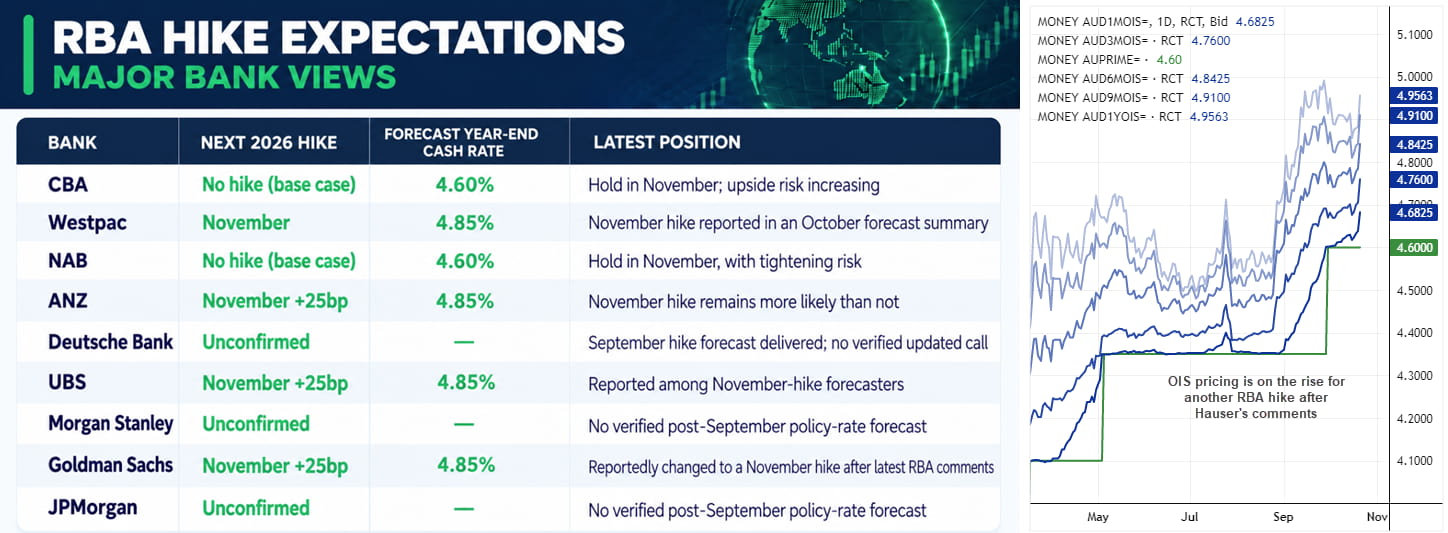
RBA Hike Expectations Could Be Higher
Unemployment held at a near five-year high of 4.7% in September, while employment fell by 39,300. Business and consumer sentiment also remain under pressure from higher borrowing costs and the prospect of further tightening. But as the RBA signalled when conflict in the Middle East first erupted, policymakers are prepared to tolerate some economic weakness if necessary to prevent inflation and inflation expectations from becoming entrenched.
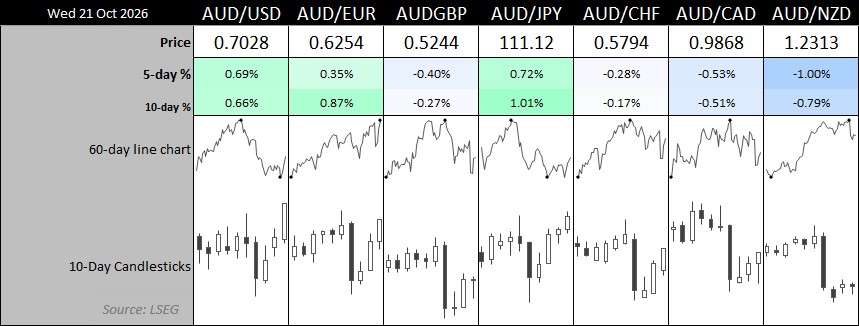
- AUD and NZD lead FX majors: Both currencies benefited from hawkish central bank expectations, although the Kiwi outperformed as markets increased bets on an October RBNZ hike. The narrowing yield differential between Australia and New Zealand also helped drive AUD/NZD 1% lower over five days.
- AUD/USD: The Australian dollar gained 0.69% against the US dollar over five days, trading at 0.7028. Its 10-day gain stands at 0.66%.
- AUD/JPY: The yen remains the Aussie's weakest counterpart, with AUD/JPY rising 0.72% over five days and 1.01% over ten days.
- AUD/EUR: The Aussie has also strengthened against the euro, gaining 0.35% over five days and 0.87% over ten days.
- AUD/NZD: The Kiwi remains the strongest performer against the Aussie, with AUD/NZD falling 1% over five days. The Aussie also lost ground against CAD (-0.53%), GBP (-0.40%) and CHF (-0.28%).
This content was created by an affiliate of FOREX.com and represents the views and opinions of the author/speakers, not the views and opinions of FOREX.com, StoneX Group Inc., or its subsidiaries. The content has not been independently reviewed by FOREX.com.
AUD/USD Technical Analysis: Australian Dollar vs US Dollar
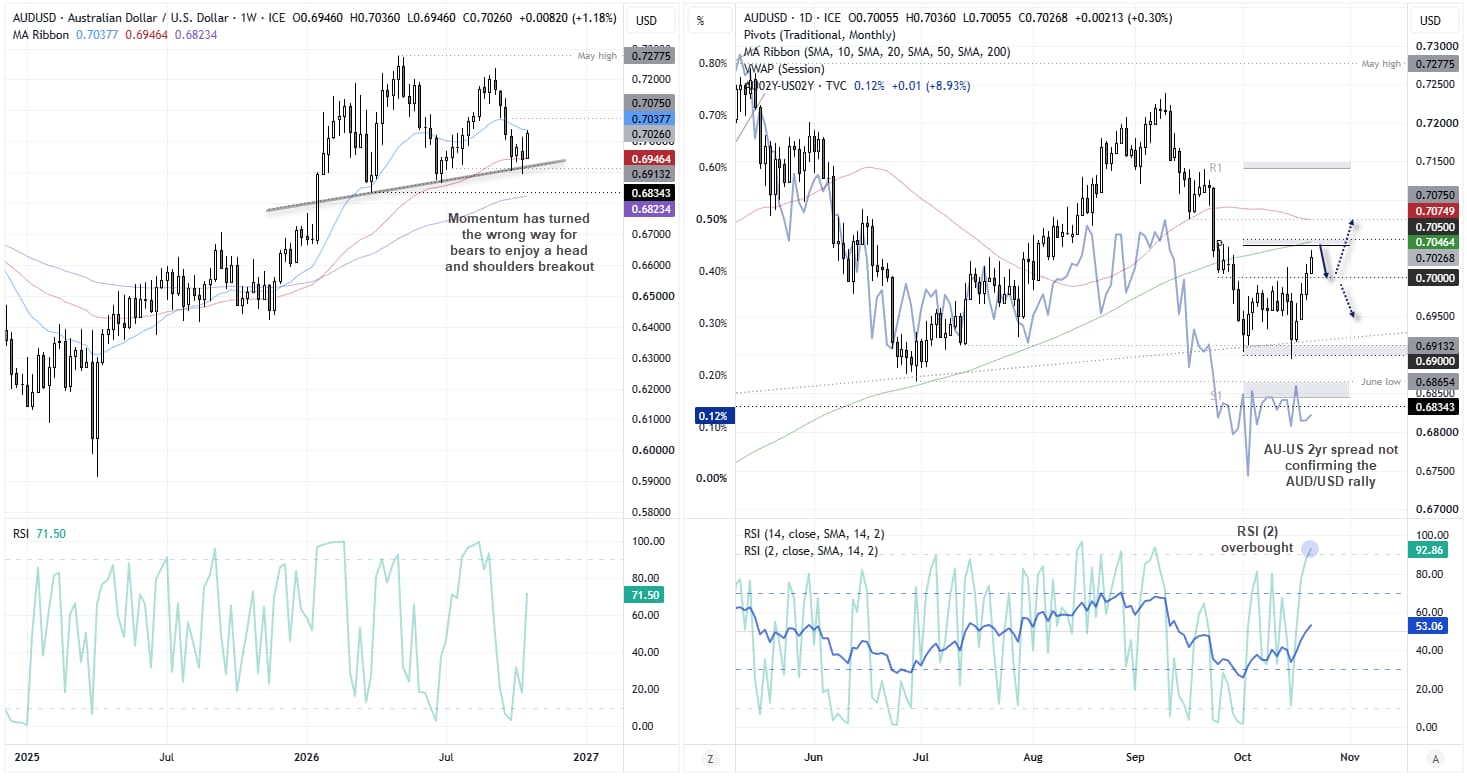
At the beginning of the week, I questioned whether AUD/USD was on the cusp of a bearish breakout to confirm a long-term bearish reversal (head-and-shoulders top) – or whether support would hold and spark a rally due to a potential sentiment extreme in the futures market.
So far, it seems to be the latter, having notched up four consecutive bullish days, including Friday. The fact that AUD/USD has moved back above last week’s doji low also weakens the case for this head-and-shoulders top – at least in its classical form – playing out.

AUD/USD Rally Faces Resistance as Yield Spreads Lag
As firm as the rally appears, resistance looms – so perhaps this is not a move for bulls to chase immediately, unless the US dollar extends its own pullback. Note that the monthly pivot point and 200-day SMA sit nearby, just beneath 0.7050, while the 50-day SMA sits around the 0.7075 level. Whether these turn out to be areas for bears to fade the rally or bulls to book profits remains to be seen. But if US PMIs come in slightly soft, it could help AUD/USD extend its move higher.
The AU-US two-year yield spread has yet to confirm the rally, adding another reason for AUD/USD bulls to be cautious around current levels, despite the hawkish RBA tailwind.
Source: ICE, TradingView
AUD/NZD Technical Analysis: Australian Dollar vs New Zealand Dollar
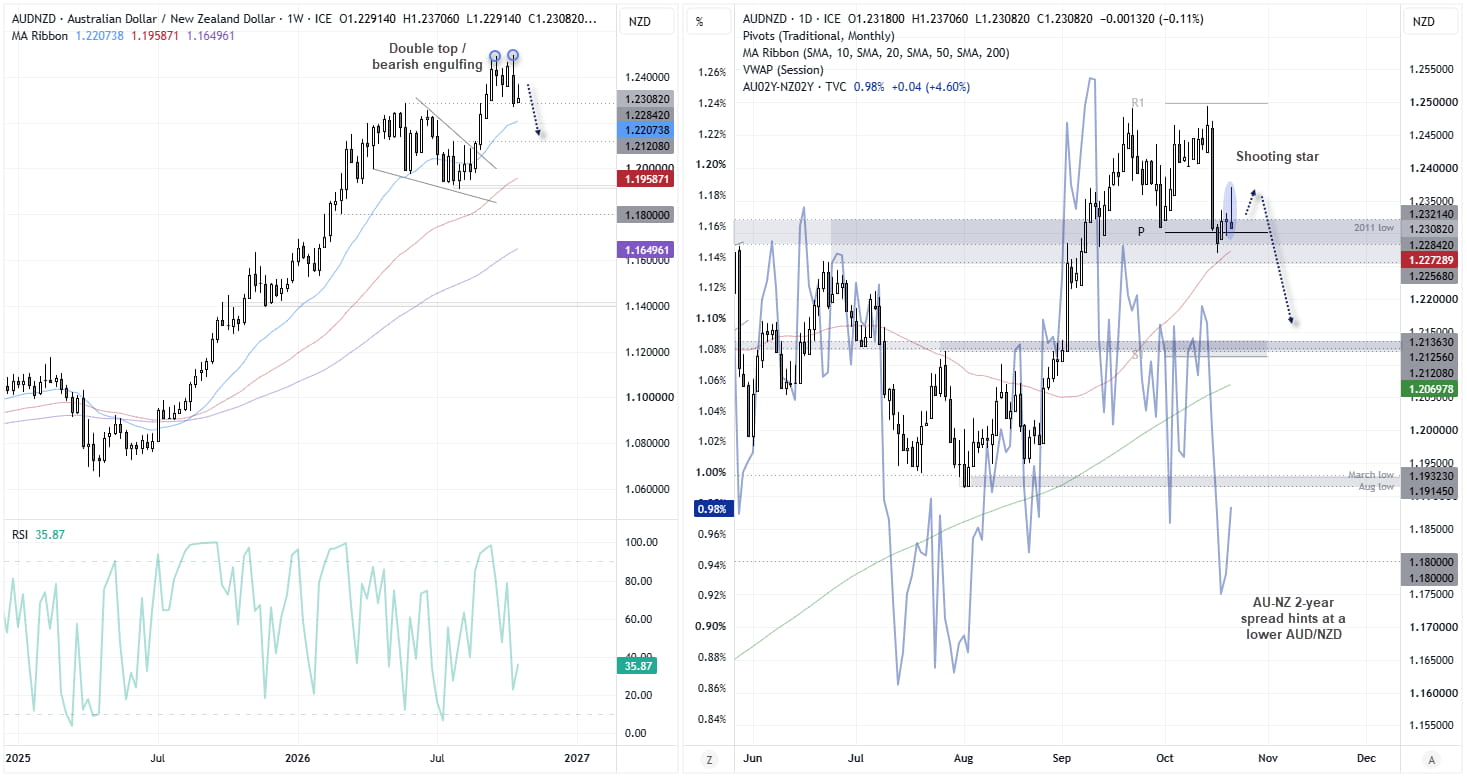
While NZD/USD and AUD/USD are both taking advantage of a weaker US dollar for now, the New Zealand dollar has the slight edge over the Australian dollar. This has seen AUD/NZD fall 1.8% from last week’s high and threatens to deepen its retracement in the coming weeks.
While the weekly chart shows a dominant bullish trend overall, it was arguably overextended and due a pullback. Note that last week’s bearish engulfing candle marked a double top just below 1.25, and potentially the first phase of an ABC correction against an otherwise strong uptrend.
The daily chart shows a mild attempt by AUD/NZD to recoup some of last week’s losses, though bears may be seeking to fade retracements within last Thursday’s sell-off range in anticipation of the next leg lower.
Source: ICE, TradingView