

Oil weighs up Russia developments against Middle Eastern tensions
Oil prices are modestly lower at the start of the week as investors digest two stories which don't quite cancel each other out.
On the one hand, the Russia-Ukraine energy ceasefire and the prospect of additional Russian diesel supplies are giving sellers reason to be optimistic. However, increased attacks around the Strait of Hormuz and strikes on Saudi Arabia are keeping oil prices supported.
On Friday, Trump announced that his administration had reached an agreement with Russia to supply large amounts of diesel to the U.S. and global markets.
Russia will immediately supply over 300,000 metric tonnes of diesel, with more to come later. Gasoline futures dropped 3% on the news. Global diesel consumption runs near 29 million barrels a day, so the announced volumes could help ease some of the tightness. The IEA is also pressing members to assess whether additional diesel releases are needed.
Trump also unexpectedly announced on Sunday that Ukraine and Russia had agreed to an energy ceasefire, although Ukrainian leader Zelensky said he was still waiting to see the details, while Russia has so far not commented.
The prospect of more diesel supplies is encouraging, but normalised conditions in the Middle East are needed for refined product prices to return to normal.
Any losses in oil are being limited by ongoing tensions in the Middle East after Iran said a recent U.S. proposal to reopen the Strait of Hormuz was insufficient.
Iran has also ramped up attacks on shipping through Hormuz since late September, disrupting supplies and driving up prices.
Meanwhile, hostilities involving Saudi Arabia and the Houthis are continuing, with further attacks on Riyadh over the weekend, including on a major airport. Trump said the U.S. was considering joining Saudi strikes against the Houthis.
The developments between Russia and Ukraine do little to address these risks, with Gulf shipping lanes still under threat.
Separately, supply disruptions along the U.S. Gulf Coast remain in focus after Hurricane Eceas made landfall last week. Over 60% of oil production in the region was reported to have gone offline in preparation for the storm.
For now, the outlook depends on whether additional Russian supplies can ease pressure on refined products, while continued disruption to Gulf shipping keeps crude supply risks elevated.
Oil Forecast – Technical Analysis
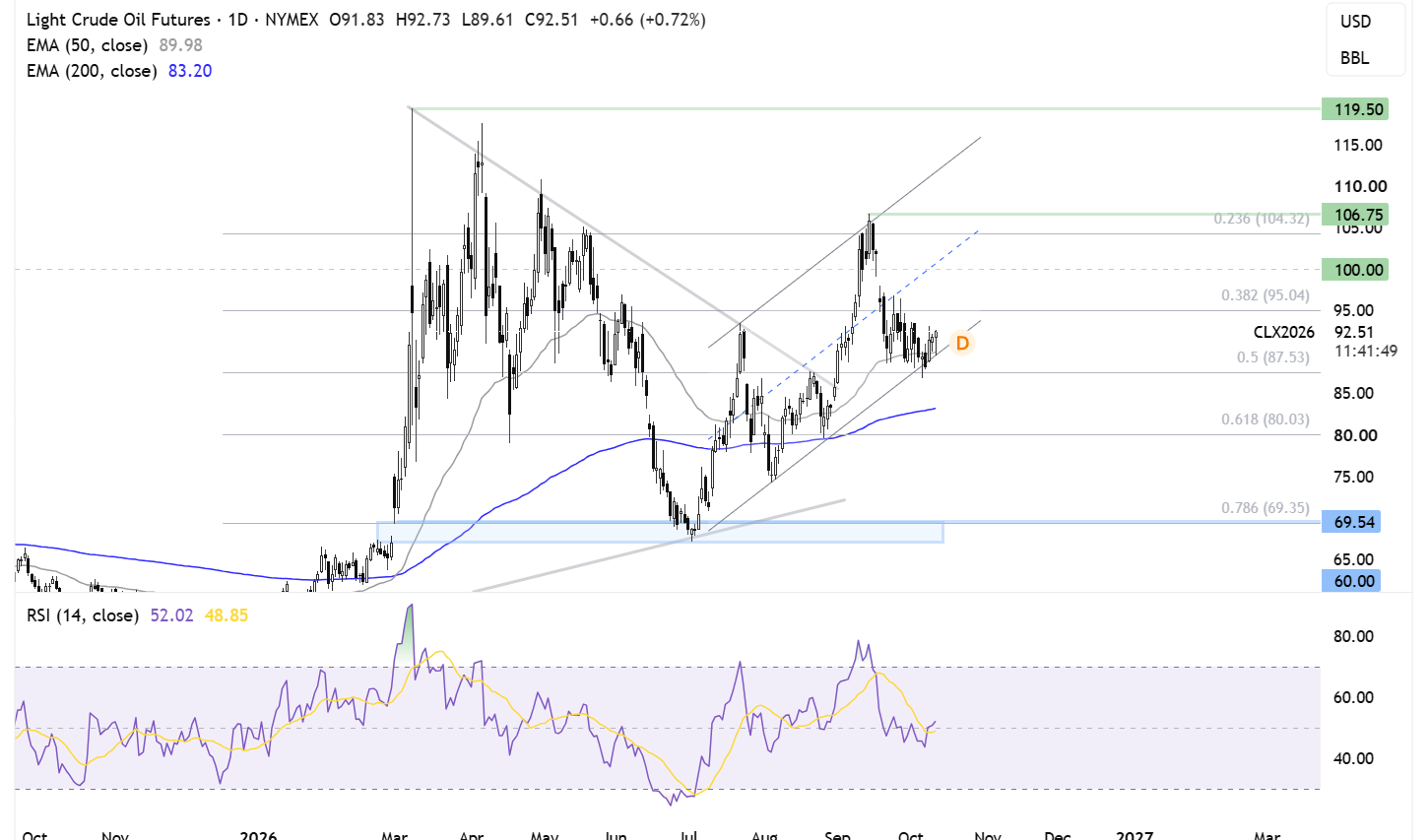
WTI crude oil continues to trade within an ascending channel dating back to early July. After running into resistance at the upper boundary of the channel around $106.75, the price turned lower and is now testing the lower channel boundary and the 50 EMA around $90 a barrel. The RSI is neutral, offering few clues on the next directional move.
Should the 50 EMA support hold, the constructive outlook remains intact. Buyers could look to reclaim $95, the 38.2% Fibonacci retracement of the move from $55 to $120. A break above here would bring $100, the psychological level, into focus, followed by $105 and $106.75, the September high.
Should sellers break below the 50 EMA support, attention would turn towards $88, the 50% Fibonacci retracement and October low. A sustained move below this level would expose the 200 EMA around $83, followed by $80, the psychological level, and the 61.8% Fibonacci retracement.
EUR/USD struggles around 1.12 with US and EZ inflation data this week
EUR/USD is consolidating around the 1.1200 level, close to a 17-month low against the U.S. dollar, and appears vulnerable to extending the downtrend seen over the past month.
The euro has underperformed amid rising concerns over France's spiralling debt crisis and the risk that it could spill over into other heavily indebted nations.
With eurozone bond yields elevated but the euro falling, markets are scaling back expectations for further ECB rate hikes, with another increase now not fully priced in until February.
Inflation data this week will keep ECB expectations in focus, alongside U.S. CPI data.
The U.S. dollar remains strong, trading around an 18-month high, supported by elevated Treasury yields and the Fed's relatively hawkish stance compared with the ECB.
While markets have scaled back expectations for a Fed rate hike in October, a 25-basis-point increase in December remains a possibility.
This week, the key focus will be on U.S. CPI data on Wednesday and PPI figures on Thursday. Higher-than-expected inflation could lead markets to increase their rate hike expectations, boosting the U.S. dollar.
Attention will also be on Fed Chair Kevin Warsh's speech at the annual meetings of the IMF and the World Bank on Friday.
EUR/USD Forecast – Technical Analysis
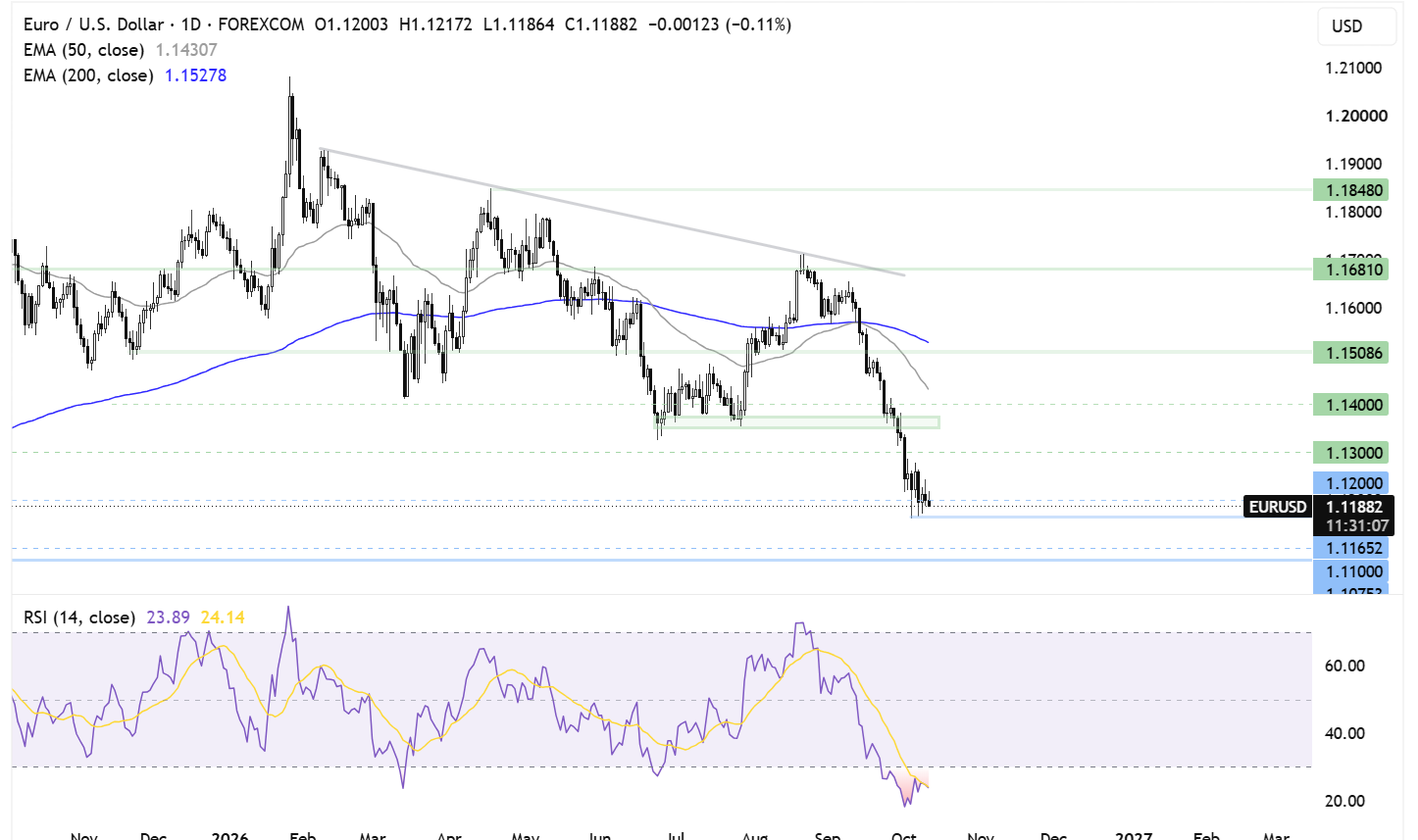

EUR/USD trades below its falling trendline and both the 50 and 200 EMAs, maintaining a bearish outlook. The pair has so far found support around 1.1200, while the RSI is in oversold territory, suggesting some consolidation could be on the cards.
Sellers will need to break below 1.1165, the 2026 low, to bring 1.1100 into focus, followed by 1.1000, the psychological level.
A significant recovery would be needed for EUR/USD to move back above 1.1300 and the 1.1350 resistance zone. The 50 EMA does not come into focus until 1.1430, with the 200 EMA around 1.1530.