



Australian 1H2022 earnings season overview
The equities reporting season takes place twice a year in Australia. As a guide, most companies report half-year earnings in February for the six months of the new financial year (July 1 to December 31) before full-year earnings are reported in August.
Share this:

The 2021 Financial Year (FY) witnessed a remarkable economic turnaround, supported by unprecedented central bank policy and government intervention, fostering a more robust rebound from the first wave of Covid than even the most optimistic forecasters predicted.
The last set of financial results (August 2021) now stands as the peak in post-Covid expectations for earnings, as a Covid outbreak in three states along the Eastern Seaboard, marked the first half of 2022.
Growth rates have continued to roll over as the consumer, spooked by the fast spreading Omicron variant, went into voluntary lockdown pre and post-Christmas, providing another hurdle for reopening reality.
Also thrown into the mix, supply-chain disruption as Omicron forced workers into home isolation. This left inventory levels low, compounded by unseasonal weather that affected the fresh food supply.
At the same time, wage and price pressures have become more persistent. Following recent hot employment and inflation data, the RBA will likely follow other central banks and lift cash rates in 2022, thereby putting further pressure on earnings momentum.
The trend to higher interest rates has supported growth stocks over value globally. According to U.S. investment bank Morgan Stanley, here in Australia, value has outperformed growth by ~13% since December 1. Elsewhere Consumer Discretionary and Staples sectors have underperformed the ASX200 by 5.4% and 9.1%, respectively, since the start of December.
The key dates to watch this reporting season will be Week 2 (February 7 – February 11), when the action begins to hot up with reports from companies including the Commonwealth Bank of Australia (CBA) and ASX Limited (ASX).
Week 3 (14th to 18th of February) will see reports from companies including mining heavyweights BHP Group Ltd (BHP), Fortescue Metals Group (FMG), as well as JB Hi-Fi Ltd (JBH) and CSL Limited (CSL).
Week 4 (21st to 25th of February) will see reports from companies including the a2 Milk Company (A2M), Rio Tinto (RIO), Flight Centre Travel Group (FLT), and Qantas Airways Limited (QAN).
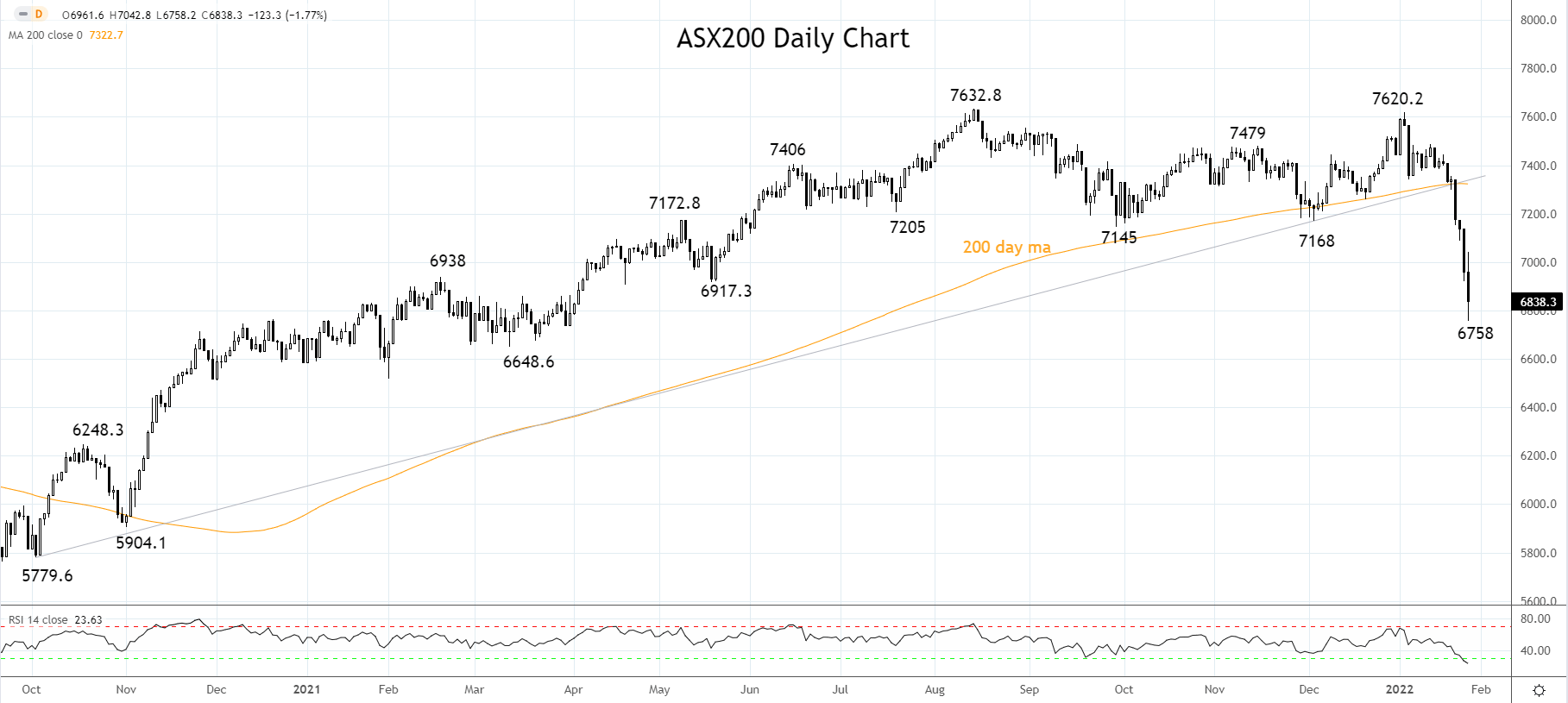
Australia's benchmark index, the ASX200, has fallen over 10% below the 2021 peak Index level. The bulk of the fall came after the ASX200 broke below critical support last week at 7300, consisting of the 200 day moving average and uptrend support from the October 5779 low.
Whether the savage repricing of the ASX200 to the end of lower interest rates and quantitative easing (QE) is complete for now remains to be seen. However, with reporting season just around the corner bringing with it earnings risk, the volatility episode of January looks set to extend into February.
Source Tradingview. The figures stated areas of January 27, 2022. Past performance is not a reliable indicator of future performance. This report does not contain and is not to be taken as containing any financial product advice or financial product recommendation
How to trade with City Index
You can trade with City Index by following these four easy steps:
- Open an account, or log in if you’re already a customer
• Open an account in the UK
• Open an account in Australia
• Open an account in Singapore
- Search for the company you want to trade in our award-winning platform
- Choose your position and size, and your stop and limit levels
- Place the trade
The 2021 Financial Year (FY) witnessed a remarkable economic turnaround, supported by unprecedented central bank policy and government intervention, fostering a more robust rebound from the first wave of Covid than even the most optimistic forecasters predicted.
The last set of financial results (August 2021) now stands as the peak in post-Covid expectations for earnings, as a Covid outbreak in three states along the Eastern Seaboard, marked the first half of 2022.
Growth rates have continued to roll over as the consumer, spooked by the fast spreading Omicron variant, went into voluntary lockdown pre and post-Christmas, providing another hurdle for reopening reality.
Also thrown into the mix, supply-chain disruption as Omicron forced workers into home isolation. This left inventory levels low, compounded by unseasonal weather that affected the fresh food supply.
At the same time, wage and price pressures have become more persistent. Following recent hot employment and inflation data, the RBA will likely follow other central banks and lift cash rates in 2022, thereby putting further pressure on earnings momentum.
The trend to higher interest rates has supported growth stocks over value globally. According to U.S. investment bank Morgan Stanley, here in Australia, value has outperformed growth by ~13% since December 1. Elsewhere Consumer Discretionary and Staples sectors have underperformed the ASX200 by 5.4% and 9.1%, respectively, since the start of December.
The key dates to watch this reporting season will be Week 2 (February 7 – February 11), when the action begins to hot up with reports from companies including the Commonwealth Bank of Australia (CBA) and ASX Limited (ASX).
Week 3 (14th to 18th of February) will see reports from companies including mining heavyweights BHP Group Ltd (BHP), Fortescue Metals Group (FMG), as well as JB Hi-Fi Ltd (JBH) and CSL Limited (CSL).
Week 4 (21st to 25th of February) will see reports from companies including the a2 Milk Company (A2M), Rio Tinto (RIO), Flight Centre Travel Group (FLT), and Qantas Airways Limited (QAN).
Australia's benchmark index, the ASX200, has fallen over 10% below the 2021 peak Index level. The bulk of the fall came after the ASX200 broke below critical support last week at 7300, consisting of the 200 day moving average and uptrend support from the October 5779 low.
Whether the savage repricing of the ASX200 to the end of lower interest rates and quantitative easing (QE) is complete for now remains to be seen. However, with reporting season just around the corner bringing with it a earnings risk, the volatility episode of January looks set to extend into February.
Source Tradingview. The figures stated areas of January 27, 2022. Past performance is not a reliable indicator of future performance. This report does not contain and is not to be taken as containing any financial product advice or financial product recommendation
Related tags:
Latest market news




The complete CFD trading experience
Award-winning platforms, competitive spreads, low commissions and dedicated support.
We live and breathe the markets and are dedicated to helping traders realise their ambitions as we continue to set the industry bar.
Economic calendar
Web Trader platform
Our sophisticated web-based platform is packed with features.
Related articles

GBP/USD, Dow Jones Forecast: Key Technical Scenarios to Watch
GBP/USD and the Dow Jones are approaching critical technical levels amid earning optimism, Fed rate hike expectations, US-Iran developments, and persistent geopolitical risks.


The U.S. Dollar Is Rising Again and Nasdaq Is Feeling It
Nasdaq, the U.S. Dollar Index and Federal Reserve expectations are driving market sentiment ahead of a pivotal FOMC meeting. Razan Hilal, StoneX Market Analyst, explains how rising expectations for a hawkish Federal Reserve, persistent U.S.-Iran tensions and key technical levels on the U.S. Dollar Index could influence currencies, equities and precious metals in the weeks ahead.
US Dollar and Nasdaq Forecast: Fed, Microsoft, Meta, and Iran Talks in Focus
The US Dollar Index (DXY) continues to hold above the 101.00 mark, reinforcing its bullish structure, while the Nasdaq remains capped below the 29,000 resistance and its June-July consolidation range, reflecting cautious risk appetite ahead of the Federal Reserve's policy decision and major earnings releases on Wednesday.
StoneX Europe Ltd may make third party material available on this website which may contain information included but not limited to the conditions of financial markets. The material is for information purposes only and does not contain, and should not be construed as containing, investment advice and/or investment recommendation and/or an investment research and/or an offer of or solicitation for any transactions in financial instruments; any decision to enter into a specific transaction shall be made by the client following an assessment by him/her of their situation.
StoneX Europe Ltd makes no representation or warranty and assumes no liability as to the accuracy or completeness of the information provided, nor any loss arising from any investment based on a recommendation, forecast or other information supplied. You should always seek independent advice as to your suitability to speculate in any related markets and your ability to assume the associated risks, if you are at all unsure. We are not under any obligation to update any such material. Any opinion made may be personal to the author and may not reflect the opinion of StoneX Europe Ltd.