




Dax Jumps On Hopes ECB Will Follow Fed
Dax jumps 1.3% amid growing hope that ECB will follow in Fed's footsteps
Share this:

As the dust settles on the Fed’s emergency 50 basis point rate cut the Dax is extending gains. The German index rallied 1% across the previous session and has added a further 1.3% this morning amid growing expectations of ECB stimulus, and despite mixed data.
Retail sales rebound
On the positive side, German retail sales rebounded strongly in January growing 0.9% month on month, a sharp contrast to December’s 2% decline. On a yearly basis, retail sales increased 1.8% in February, up from 1.7% and beating estimates of 1.5%. The data shows that household consumption remains solid and domestic demand is supporting the economy at the start of the year.
On the positive side, German retail sales rebounded strongly in January growing 0.9% month on month, a sharp contrast to December’s 2% decline. On a yearly basis, retail sales increased 1.8% in February, up from 1.7% and beating estimates of 1.5%. The data shows that household consumption remains solid and domestic demand is supporting the economy at the start of the year.
PMI points to trouble ahead
German PMI data showed signs of trouble. The IHS Markit service sector PMI fell to 52.5 in February down from 54.2 in the previous month. This was the weakest reading since November, significantly weaker than the 53.5 estimate. Delving deeper into the data, the slowdown was caused by a stalling of new business, with the figures revealing a sharp decline in demand from abroad.
Here we are seeing the clear impact of coronavirus outbreak on foreign demand. China is Germany’s biggest trading partner. Meanwhile, the domestic market is looking stable. However, this could all change very quickly given how fast coronavirus spreads.
German PMI data showed signs of trouble. The IHS Markit service sector PMI fell to 52.5 in February down from 54.2 in the previous month. This was the weakest reading since November, significantly weaker than the 53.5 estimate. Delving deeper into the data, the slowdown was caused by a stalling of new business, with the figures revealing a sharp decline in demand from abroad.
Here we are seeing the clear impact of coronavirus outbreak on foreign demand. China is Germany’s biggest trading partner. Meanwhile, the domestic market is looking stable. However, this could all change very quickly given how fast coronavirus spreads.
ECB to follow in Fed’s footsteps?
Yesterday’s surprise Fed cut is boosting expectations that the ECB will follow suit at the meeting next week. Whilst the ECB clearly has less ammunition that the Fed given how low interest rates already are, expectations of a 10-basis points rate cut are growing. Furthermore, following the G7 meeting yesterday so far just the Fed has acted. The Fed can’t support the global economy by itself, a more united response is expected. However, the ECB clearly want to buy themselves more time given how empty their ammunition cupboard is. A lower interest rate environment is more business friendly hence the jump in equities on the prospect of further easing.
Yesterday’s surprise Fed cut is boosting expectations that the ECB will follow suit at the meeting next week. Whilst the ECB clearly has less ammunition that the Fed given how low interest rates already are, expectations of a 10-basis points rate cut are growing. Furthermore, following the G7 meeting yesterday so far just the Fed has acted. The Fed can’t support the global economy by itself, a more united response is expected. However, the ECB clearly want to buy themselves more time given how empty their ammunition cupboard is. A lower interest rate environment is more business friendly hence the jump in equities on the prospect of further easing.
Levels to watch
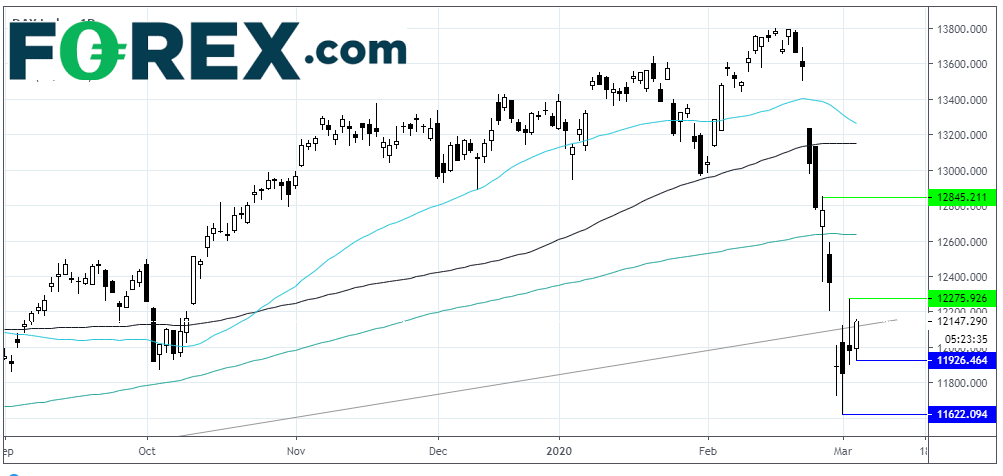
The Dax is trading up 1.35% at 12148, as it moves back above an ascending trend line support which it fell through in the previous session and that has been intact since early late 2018.
A close above this support could indicate more upside is to come.
Immediate support can be seem at 12125 (trendline) prior to 11929 (today’s low) before opening the door to 11624 (Monday’s low).
On the upside, resistance can be seen at 12272 (yesterday’s high) prior to 12642 (200 sma) and 12850 (high 26th Feb)
As the dust settles on the Fed’s emergency 50 basis point rate cut the Dax is extending gains. The German index rallied 1% across the previous session and has added a further 1.3% this morning amid growing expectations of ECB stimulus, and despite mixed data.
Retail sales rebound
On the positive side, German retail sales rebounded strongly in January growing 0.9% month on month, a sharp contrast to December’s 2% decline. On a yearly basis, retail sales increased 1.8% in February, up from 1.7% and beating estimates of 1.5%. The data shows that household consumption remains solid and domestic demand is supporting the economy at the start of the year.
On the positive side, German retail sales rebounded strongly in January growing 0.9% month on month, a sharp contrast to December’s 2% decline. On a yearly basis, retail sales increased 1.8% in February, up from 1.7% and beating estimates of 1.5%. The data shows that household consumption remains solid and domestic demand is supporting the economy at the start of the year.
PMI points to trouble ahead
German PMI data showed signs of trouble. The IHS Markit service sector PMI fell to 52.5 in February down from 54.2 in the previous month. This was the weakest reading since November, significantly weaker than the 53.5 estimate. Delving deeper into the data, the slowdown was caused by a stalling of new business, with the figures revealing a sharp decline in demand from abroad.
Here we are seeing the clear impact of coronavirus outbreak on foreign demand. China is Germany’s biggest trading partner. Meanwhile, the domestic market is looking stable. However, this could all change very quickly given how fast coronavirus spreads.
German PMI data showed signs of trouble. The IHS Markit service sector PMI fell to 52.5 in February down from 54.2 in the previous month. This was the weakest reading since November, significantly weaker than the 53.5 estimate. Delving deeper into the data, the slowdown was caused by a stalling of new business, with the figures revealing a sharp decline in demand from abroad.
Here we are seeing the clear impact of coronavirus outbreak on foreign demand. China is Germany’s biggest trading partner. Meanwhile, the domestic market is looking stable. However, this could all change very quickly given how fast coronavirus spreads.
ECB to follow in Fed’s footsteps?
Yesterday’s surprise Fed cut is boosting expectations that the ECB will follow suit at the meeting next week. Whilst the ECB clearly has less ammunition that the Fed given how low interest rates already are, expectations of a 10-basis points rate cut are growing. Furthermore, following the G7 meeting yesterday so far just the Fed has acted. The Fed can’t support the global economy by itself, a more united response is expected. However, the ECB clearly want to buy themselves more time given how empty their ammunition cupboard is. A lower interest rate environment is more business friendly hence the jump in equities on the prospect of further easing.
Yesterday’s surprise Fed cut is boosting expectations that the ECB will follow suit at the meeting next week. Whilst the ECB clearly has less ammunition that the Fed given how low interest rates already are, expectations of a 10-basis points rate cut are growing. Furthermore, following the G7 meeting yesterday so far just the Fed has acted. The Fed can’t support the global economy by itself, a more united response is expected. However, the ECB clearly want to buy themselves more time given how empty their ammunition cupboard is. A lower interest rate environment is more business friendly hence the jump in equities on the prospect of further easing.
Levels to watch
The Dax is trading up 1.35% at 12148, as it moves back above an ascending trend line support which it fell through in the previous session and that has been intact since early late 2018.
A close above this support could indicate more upside is to come.
Immediate support can be seem at 12125 (trendline) prior to 11929 (today’s low) before opening the door to 11624 (Monday’s low).
On the upside, resistance can be seen at 12272 (yesterday’s high) prior to 12642 (200 sma) and 12850 (high 26th Feb)
Related tags:




The complete CFD trading experience
Award-winning platforms, competitive spreads, low commissions and dedicated support.
We live and breathe the markets and are dedicated to helping traders realise their ambitions as we continue to set the industry bar.
Economic calendar
Web Trader platform
Our sophisticated web-based platform is packed with features.
Related articles

Oil Shock Hits Bond Yields and Squeezes the Consumer
U.S. 10-year and 30-year bond yields have moved higher as markets reopen after the Labor Day weekend, with the producer price index and the consumer price index landing within days of each other. The European Central Bank decision sits between them, where the economic projections and Christine Lagarde's press conference carry more market risk than the rate move itself. The DAX has also broken below its 21-day exponential moving average, a sign that momentum beneath a resilient index is starting to fade.


DAX, Crude oil forecast: Rising energy prices, yields threaten risk assets
Following a weak handover from Asia, European markets and US indices were under pressure this morning, as rising oil prices and elevated bond yields once again weighed on risk appetite. Among the major European indices, the German DAX will be in firm focus this week, with the ECB’s rate decision coming up on Thursday. That decision is likely to be a hike, as rising oil prices threaten to re-accelerate inflation.

German DAX Records Meet a Treasury Market Under Strain
The German DAX record high is back in reach after four straight higher sessions, helped by cheaper energy and resilient eurozone data.
StoneX Europe Ltd may make third party material available on this website which may contain information included but not limited to the conditions of financial markets. The material is for information purposes only and does not contain, and should not be construed as containing, investment advice and/or investment recommendation and/or an investment research and/or an offer of or solicitation for any transactions in financial instruments; any decision to enter into a specific transaction shall be made by the client following an assessment by him/her of their situation.
StoneX Europe Ltd makes no representation or warranty and assumes no liability as to the accuracy or completeness of the information provided, nor any loss arising from any investment based on a recommendation, forecast or other information supplied. You should always seek independent advice as to your suitability to speculate in any related markets and your ability to assume the associated risks, if you are at all unsure. We are not under any obligation to update any such material. Any opinion made may be personal to the author and may not reflect the opinion of StoneX Europe Ltd.