



EU inflation & US Core PCE in focus: Is further economic turbulence looming?
The largest economy in the Eurozone, Germany, announces its September unemployment rate figures today. More than ever, the unemployment rate is a key indicator of whether the economy still has sticky spots that need to cool
Share this:

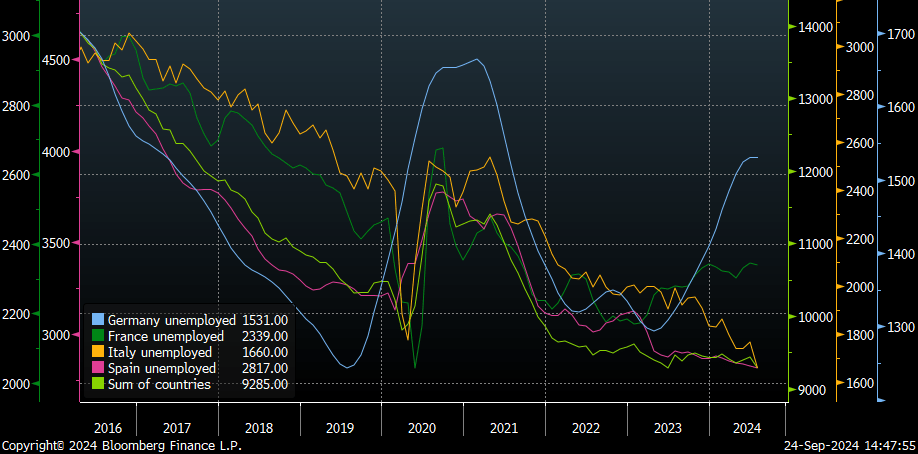
The unemployment rate in Germany as of September 2024
The largest economy in the Eurozone, Germany, announces its September unemployment rate figures today. More than ever, the unemployment rate is a key indicator of whether the economy still has sticky spots that need to cool.
In August 2024, Germany's seasonally adjusted unemployment rate held steady at 6.0%, well above the three-year high, both in line with market estimates and unchanged from the previous month. The number of jobless people increased by 2,000 to 2.801 million, which is much less than the 16,000 increase that was predicted. August had 699,000 job openings, a 72,000 decrease from the same month last year, suggesting a decline in the demand for labor. Unemployment increased by 63,000 to 2.872 million on an unadjusted basis, the highest level in three and a half years.
A further increase from these levels could fuel ongoing fears about a downturn in economic activity. This increase indicates weakness in the labor market and may be a reflection of the ongoing difficulties in Germany's industrial and export industries.
European Union: Anticipated Consumer Inflation (September 2024)
A key indicator of inflationary pressures that the European Central Bank (ECB) keeps an eye on is the Consumer Inflation Expectation for the Eurozone in September. Future salary negotiations, consumer purchasing, and price-setting practices may all be impacted by inflation forecasts.
Consumer Inflation Expectation for August stayed at 11.3 points, indicating that consumers' concerns regarding the continuous price hikes for necessities—food and energy in particular—remain unchanged.
A climb above might make it more difficult for the ECB to decide on future policy measures since persistently high inflation expectations could indicate that inflation is solidifying, which could breed uncertainty and force further monetary tightening.
Core PCE Price Index for the United States, August 2024
The Federal Reserve's favored inflation indicator, the Core Personal Consumption Expenditures (PCE) Price Index for August, is one of the most carefully monitored inflation indices in the United States.
In July 2024, the Federal Reserve's favored indicator of underlying inflation, the core PCE price index, continued to rise annually at a rate of 2.6% for a third consecutive month. From 1960 to 2024, the US Core PCE Price Index Annual Change averaged 3.24 percent; it peaked in February 1975 at 10.22 percent and fell to a record low of 0.63 percent in July 2009. The predicted 2.7% is still above the 2% objective set by the Federal Reserve, and it is expected to be higher than it was last month.
The Core PCE Price Index has somewhat eased, suggesting that inflationary pressures in the United States may be beginning to decrease, though not rapidly enough to calm down Federal Reserve worries. The anticipation is that today's report would indicate a number that is in line with forecasts, following the Fed's aggressive rate hikes to fight inflation. The rate was recently lowered by 50 basis points.
The equity markets would probably applaud the Fed's decision to keep cutting rates if inflation keeps slowing down. This is especially true for industries like consumer discretionary and technology that are sensitive to fluctuations in interest rates. When hopes for more aggressive rate hikes decline, bond markets might also see some respite.
The Fed may feel pushed to retain a hawkish attitude, though, if the market thinks inflation is still too high for comfort. This could result in increased volatility in the upcoming weeks.
Personal Spending in the United States (August 2024)
In July 2024, the Federal Reserve's favored indicator of underlying inflation, the core PCE price index, continued to rise annually at a rate of 2.6% for a third consecutive month. From 1960 to 2024, the US Core PCE Price Index Annual Change averaged 3.24 percent; it peaked in February 1975 at 10.22 percent and fell to a record low of 0.63 percent in July 2009.
Despite rising inflation and borrowing prices, consumer spending has remained mostly unchanged; the modest gain in July may indicate that consumers are growing more optimistic throughout the period as economic uncertainty lasts. High interest rates have increased the cost of borrowing, yet there are indications that consumer spending has not been significantly impacted.
Future patterns in inflation can also be inferred from the data on personal spending. Inflation can be maintained at high levels by robust consumer demand, which makes it more difficult for the Fed to rein in price growth. On the other hand, a sizable reduction in expenditure may lessen inflationary pressures and reduce the need for additional rate hikes by the Fed.
Related tags:
Latest market news




The complete CFD trading experience
Award-winning platforms, competitive spreads, low commissions and dedicated support.
We live and breathe the markets and are dedicated to helping traders realise their ambitions as we continue to set the industry bar.
Economic calendar
Web Trader platform
Our sophisticated web-based platform is packed with features.
Related articles

GBP/USD, DAX Forecast Two trades to watch 220926
GBP/USD struggles as UK government borrowing exceeds forecasts, putting pressure on Healey ahead of the Budget. DAX eases back after yesterday's gains as oil prices and political headwinds rise.


DAX Climbs After Fed Move, Eyes Break Above 26,000 Resistance
The DAX has opened significantly higher following the Federal Reserve's delivery of its first interest rate hike since 2023. Although the Fed signaled further tightening, the market reaction was surprisingly positive, as much of the hawkish expectation had already been priced in. Attention now shifts to the 25,900–26,000 point range, which will likely determine whether the current recovery evolves into a new upward wave or remains merely a short-covering rally.

USD/JPY, DAX Forecast: Two trades to watch 150926
USD/JPY rises as U.S. Treasury yields rise above 5%. DAX slumps as bond rout continues and oil prices surge.
StoneX Europe Ltd may make third party material available on this website which may contain information included but not limited to the conditions of financial markets. The material is for information purposes only and does not contain, and should not be construed as containing, investment advice and/or investment recommendation and/or an investment research and/or an offer of or solicitation for any transactions in financial instruments; any decision to enter into a specific transaction shall be made by the client following an assessment by him/her of their situation.
StoneX Europe Ltd makes no representation or warranty and assumes no liability as to the accuracy or completeness of the information provided, nor any loss arising from any investment based on a recommendation, forecast or other information supplied. You should always seek independent advice as to your suitability to speculate in any related markets and your ability to assume the associated risks, if you are at all unsure. We are not under any obligation to update any such material. Any opinion made may be personal to the author and may not reflect the opinion of StoneX Europe Ltd.