





EUR/USD forecast undermined as tariffs threats get louder
The dollar is going to remain in sharp focus with key data including non-farm payrolls to come this week. Ahead of the NFP report, the EUR/USD forecast remains bearish.
Share this:

Already under pressure from weakness in Eurozone data, weakness in China and ongoing dollar strength, the EUR/USD took another tumble just before mid-day in London. The single currency’s additional weakness came on the back of a CNN report citing sources that Donald Trump is considering a national economic emergency declaration to allow for new tariff program. The dollar is going to remain in sharp focus with key data including non-farm payrolls to come this week. Ahead of the NFP report, the EUR/USD forecast remains bearish.
Signs of weakness persist for Eurozone and China
The EUR/USD is being pressured from all sides: weakness in Eurozone and China economies are continuing to weigh on the euro, while the dollar finds support from rising US bond yields and strength in data. More on the latter below but concentrating on the euro-side of the equation, today we saw German factory orders suffered their steepest decline in three months, while French consumer confidence unexpectedly dropped.
German factory orders fell 5.4% month-on-month compared to -0.3% expected, while retail sales slipped 0.6% m/m when a 0.5% increase was expected.
Adding to the euro’s woes, China’s bleak economic outlook has sparked a surge in demand for Chinese bonds, causing their yields and yuan to drop. A weaker yuan reduces the buying power of the world’s second largest economy. This is not great given that China is a large exports destination for Eurozone goods, especially in the luxury sector.
Indeed, traders are increasingly turning pessimistic on China, driving yields to record lows amid fears of a deflationary spiral in the world’s second-largest economy. The 10-year Chinese bonds now yield an unprecedented 3 percentage points less than comparable US Treasury bonds. At these levels, they are significantly below those seen during the pandemic and the 2008 global financial crisis.
Tariff headlines udnermine EUR/USD forecast
The latest news about tariffs, and support for the dollar, comes after the greenback sold off on Monday, driven by reports suggesting that Trump’s aides may be contemplating a more lenient approach to tariffs. However, while Trump did say that he predicts he’ll get along with China’s Xi, he quickly issued a denial regarding a softer stance on tariffs. Given his tough rhetoric so far, it’s hard to envision him adopting a more conciliatory tone when he takes office later this month. With tariffs becoming the buzz word again, the dollar is going to remain more headline-driven, making active risk management even more important for traders.
US data maintains strength
As Europe struggles, the US economy continues to outperform. Both the ISM Services PMI and JOLTS job openings exceeded expectations yesterday, underscoring robust economic momentum at the world’s largest economy. JOLT job openings rose to 8.098 million in November compared to 7.730m expected and 7.839m in the previous month. This was the highest job openings since June 2024, pointing to continued strength in the labour market. What’s more, the dominant services sector saw growth expand at a faster pace as the ISM Services PMI climbed to 54.1 vs. 53.5 expected, up from 52.1 last month.
Today’s ADP payrolls data is unlikely to cause a major shift in the market, so the focus will remain on rising yields and tariff talks, before the focus turns to the official jobs report on Friday. Yesterday’s 10-year Treasury auction yielded its highest rate since 2007, with investors now eyeing 5% yields as a benchmark. Meanwhile, swap traders have pushed their expectations for a first Federal Reserve rate cut this year to July from June. We will need to see a major turnaround in data to bring those expectations forward again.
EUR/USD technical analysis
Source: TradingView.com
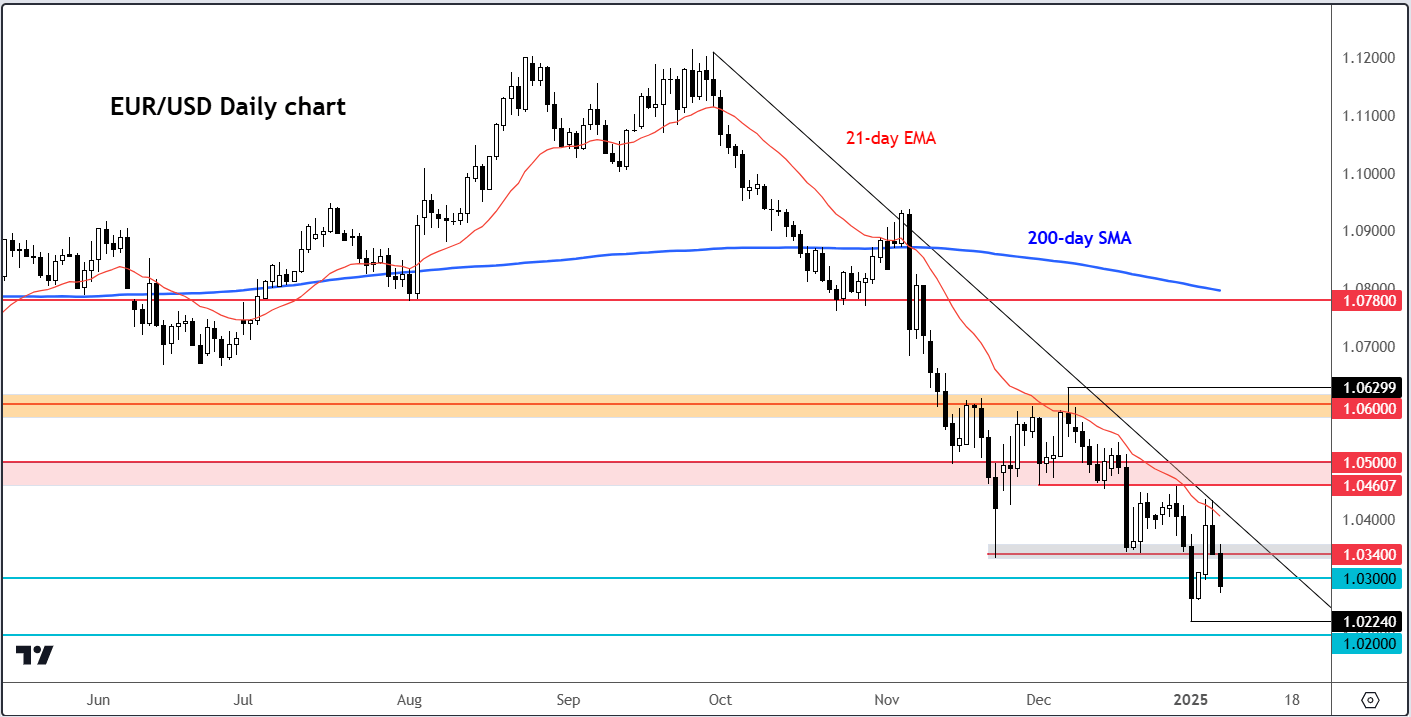
The EUR/USD remains rooted in a bearish trend, as characterised by a downward-sloping trend line connecting the recent highs, as well as both the 21- and 200-day moving averages pointing lower and being above market. Key support levels continue to break down. Unless resistance in the 1.0460-1.0500 range is reclaimed, the path of least resistance remains to the downside. The next bearish targets are liquidity below last week’s low at 1.0224, followed by the 1.0200 handle and then the next round handle at 1.0100.
-- Written by Fawad Razaqzada, Market Analyst
Follow Fawad on Twitter @Trader_F_R
How to trade with City Index
You can trade with City Index by following these four easy steps:
- Open an account, or log in if you’re already a customer
• Open an account in the UK
• Open an account in Australia
• Open an account in Singapore
- Search for the company you want to trade in our award-winning platform
- Choose your position and size, and your stop and limit levels
- Place the trade
Related tags:



The complete CFD trading experience
Award-winning platforms, competitive spreads, low commissions and dedicated support.
We live and breathe the markets and are dedicated to helping traders realise their ambitions as we continue to set the industry bar.
Economic calendar
Web Trader platform
Our sophisticated web-based platform is packed with features.
Related articles
British Pound Technical Outlook: GBP/USD Rebound Challenges September Downtrend 9 30 2026
Sterling has rallied sharply from key support, with GBP/USD at an inflection point that could determine whether a larger recovery is underway.

EUR/USD forecast: Eurozone stagflation risks mount as dollar holds firm ahead of data
The dollar was bouncing back at the time of writing, after it had eased overnight on the back of some weaker-than-expected economic data yesterday which had prompted markets to scale back expectations of an October Fed rate hike. However, with more significant US data due today and Friday, and with oil prices continuing to remain elevated, the dollar’s broader direction remains bullish.

NZD/USD pressure mounts as payrolls looms large
NZD/USD has fallen sharply as Fed rate expectations reset higher, but extreme downside stretch and major support raise the risk of a violent counter-trend rebound.

StoneX Europe Ltd may make third party material available on this website which may contain information included but not limited to the conditions of financial markets. The material is for information purposes only and does not contain, and should not be construed as containing, investment advice and/or investment recommendation and/or an investment research and/or an offer of or solicitation for any transactions in financial instruments; any decision to enter into a specific transaction shall be made by the client following an assessment by him/her of their situation.
StoneX Europe Ltd makes no representation or warranty and assumes no liability as to the accuracy or completeness of the information provided, nor any loss arising from any investment based on a recommendation, forecast or other information supplied. You should always seek independent advice as to your suitability to speculate in any related markets and your ability to assume the associated risks, if you are at all unsure. We are not under any obligation to update any such material. Any opinion made may be personal to the author and may not reflect the opinion of StoneX Europe Ltd.