




Sell in May and go away
An adage that refers to selling stocks in May and buying them in November
Share this:

Sell in May and go away is an age-old adage that refers to selling stocks in May and buying them in November. It basically says that the returns from November through April tend to outperform the returns from May through October. The theory suggests that returns are worse during the summer months because people are “out of the office” or on vacation. Therefore, returns are better in the winter months when people are “back in the office”. As a result, stock market indices would have lower or negative returns during the 6-month summer period than during the winter months.
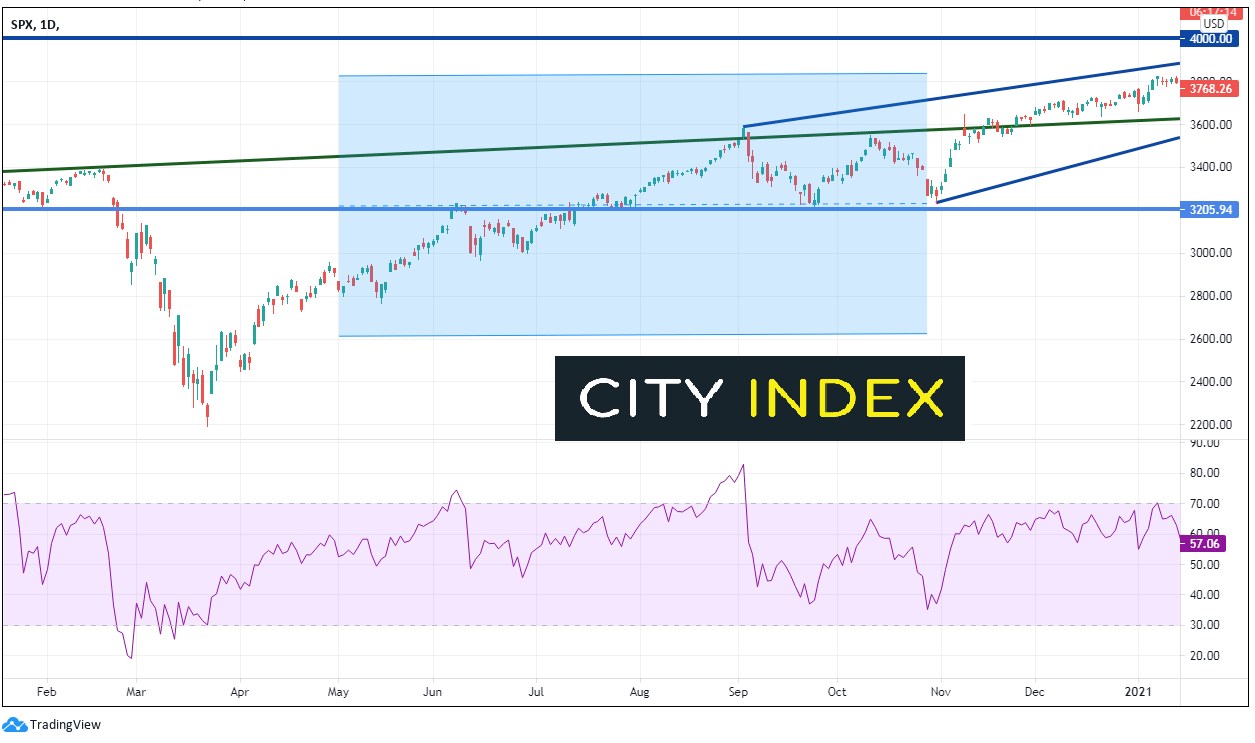
However, during a period of a global pandemic, it becomes a bit more complicated. Last year, stocks tanked during the initial crash in March 2020 at the beginning of the pandemic. Enter 0% interest rates and QE+++, and stocks have been on fire since, rising to at or near all-time highs. On May 1st, 2020, the S&P 500 opened at 2,869.09. On October 31st, 2020, it closed at 3,269.96, a gain of 400.87 points- quite an impressive gain!
Source: Tradingview, City Index
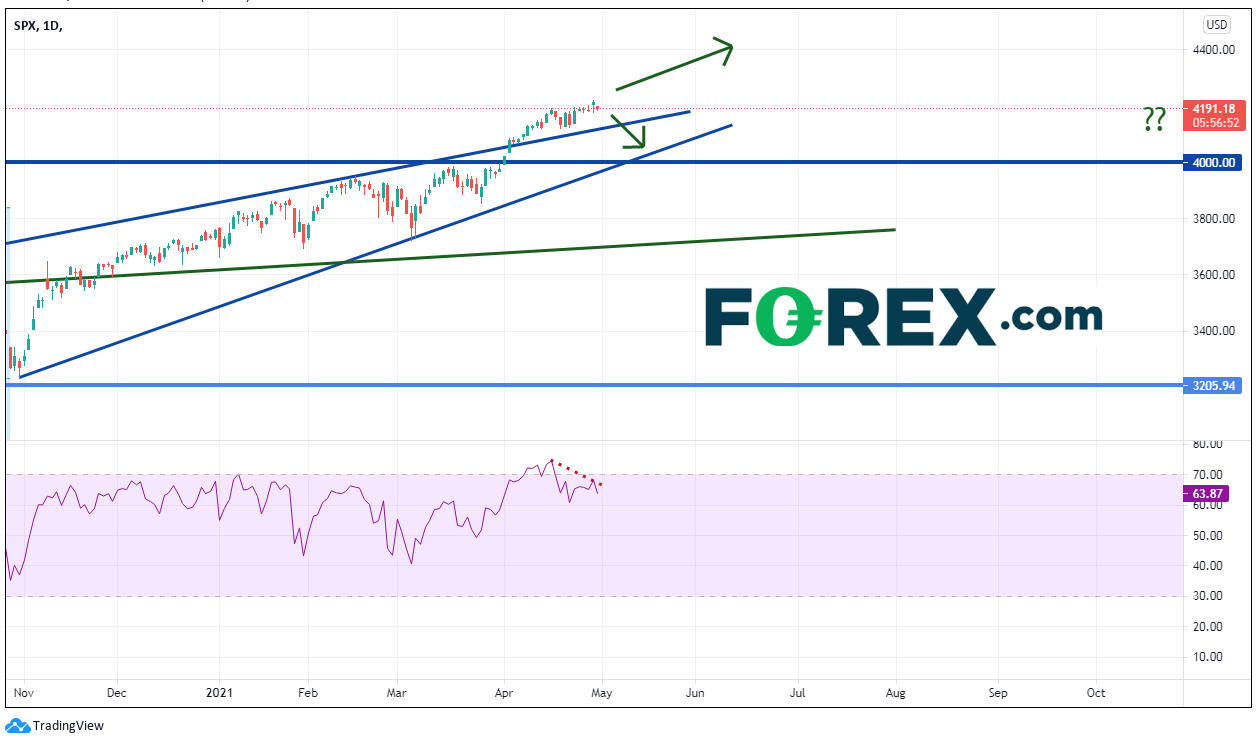
However, since then, the S&P 500 has moved from 3,296.20 to a high of 4,218.78 on April 29th, a gain of 922.58 points!
Source: Tradingview, City Index
But with inflation and yields rising, how much longer will it be before the Fed puts on the breaks and begins tapering? According to Jerome Powell from the FOMC press conference earlier this week, it will take some time to meet the substantial further progress that is necessary for the Fed to begin tapering. In addition, although there will be updated growth and inflation forecasts at the June and September meetings, the FOMC wants to see ACTUAL data, not forecasts.
How does the stock market work?
Currently, price is diverging from the RSI, so it is possible we see a near term pullback during the month of May. However, despite stellar Q1 earnings (thus far) and increased employment, the Fed is far from reaching its criteria (although on its way). Even if stocks pull back to 3,836, it is only a 38.2% correction from the October 30th lows to the April 29th highs, as well as, a 10% pullback off the highs.
But when could the Fed let the markets know that tapering is ahead? One guess is the Jackson Hole Symposium in August. Another is the September FOMC meeting. By the time these events roll around, if the data continues to be strong, the FOMC will has a “string of months” (Powell’s words) worth of data to decide. If they announce tapering, stocks should come off aggressively, as Powell noted they will let the markets know well in advance of any tapering.
So, will sell in May and go away work this year? Answer: It’s complicated.
Learn more about index trading opportunities.
Sell in May and go away is an age-old adage that refers to selling stocks in May and buying them in November. It basically says that the returns from November through April tend to outperform the returns from May through October. The theory suggests that returns are worse during the summer months because people are “out of the office” or on vacation. Therefore, returns are better in the winter months when people are “back in the office”. As a result, stock market indices would have lower or negative returns during the 6-month summer period than during the winter months.
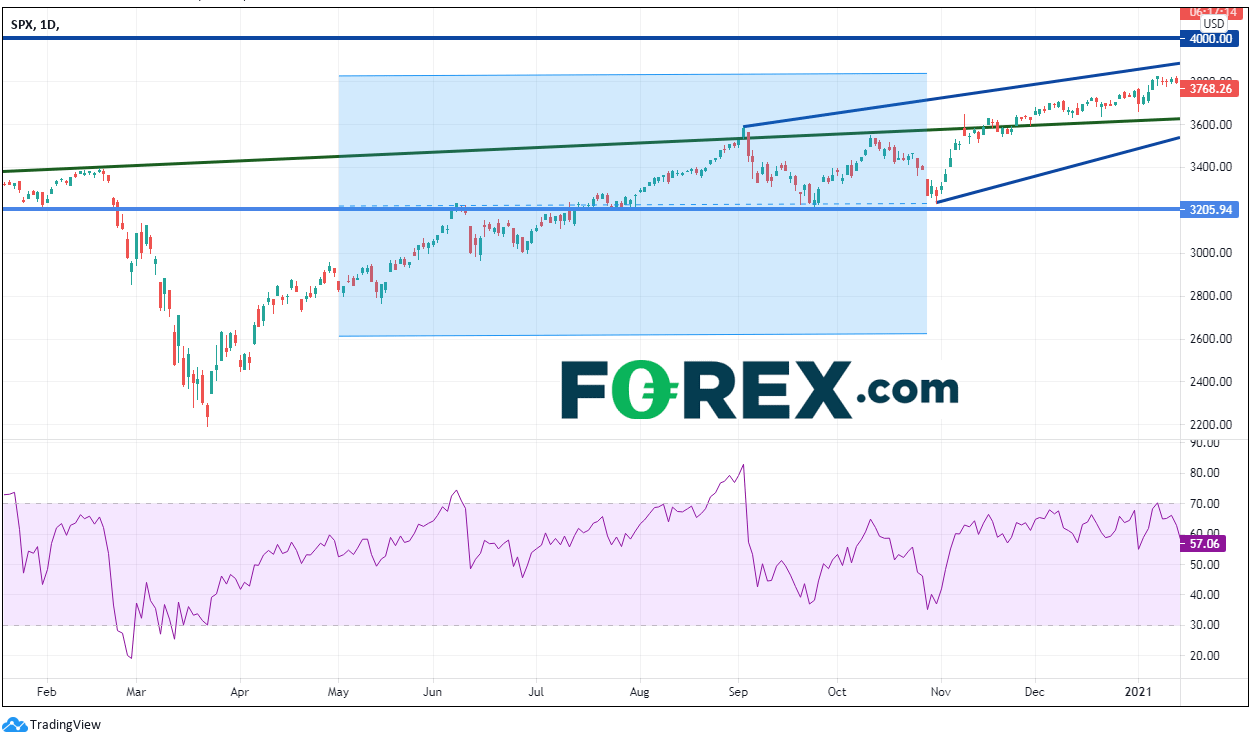
However, during a period of a global pandemic, it becomes a bit more complicated. Last year, stocks tanked during the initial crash in March 2020 at the beginning of the pandemic. Enter 0% interest rates and QE+++, and stocks have been on fire since, rising to at or near all-time highs. On May 1st, 2020, the S&P 500 opened at 2,869.09. On October 31st, 2020, it closed at 3,269.96, a gain of 400.87 points- quite an impressive gain!
Source: Tradingview, Forex.com
However, since then, the S&P 500 has moved from 3,296.20 to a high of 4,218.78 on April 29th, a gain of 922.58 points!
Source: Tradingview, Forex.com
But with inflation and yields rising, how much longer will it be before the Fed puts on the breaks and begins tapering? According to Jerome Powell from the FOMC press conference earlier this week, it will take some time to meet the substantial further progress that is necessary for the Fed to begin tapering. In addition, although there will be updated growth and inflation forecasts at the June and September meetings, the FOMC wants to see ACTUAL data, not forecasts.
How does the stock market work?
Currently, price is diverging from the RSI, so it is possible we see a near term pullback during the month of May. However, despite stellar Q1 earnings (thus far) and increased employment, the Fed is far from reaching its criteria (although on its way). Even if stocks pull back to 3,836, it is only a 38.2% correction from the October 30th lows to the April 29th highs, as well as, a 10% pullback off the highs.
But when could the Fed let the markets know that tapering is ahead? One guess is the Jackson Hole Symposium in August. Another is the September FOMC meeting. By the time these events roll around, if the data continues to be strong, the FOMC will has a “string of months” (Powell’s words) worth of data to decide. If they announce tapering, stocks should come off aggressively, as Powell noted they will let the markets know well in advance of any tapering.
So, will sell in May and go away work this year? Answer: It’s complicated.
Learn more about index trading opportunities.
Related tags:
Latest market news



The complete CFD trading experience
Award-winning platforms, competitive spreads, low commissions and dedicated support.
We live and breathe the markets and are dedicated to helping traders realise their ambitions as we continue to set the industry bar.
Economic calendar
Web Trader platform
Our sophisticated web-based platform is packed with features.
Related articles
S&P 500 forecast: Stocks extend drop as correction risks grow
US and global equity markets have extended Wednesday’s sell-off, with Wall Street opening lower after a weak handover from Asia and Europe. The deterioration in risk appetite has been spreading across global markets. The dollar was firmer, Treasury yields were holding onto yesterday’s gains, while gold, silver and bitcoin were all under pressure alongside equities and major currencies.
Gold forecast: XAU/USD could take a larger dive after the big rise in yields
Gold prices have been falling in the last few days after last week’s post-FOMC pop faded amid rising interest rate expectations, higher oil prices and a strengthening US dollar. As before, I wasn’t convinced gold would thrive in the current macro backdrop.

Gold, silver slammed as hawkish Fed repricing reignites dollar upside
Gold and silver had held up surprisingly well against surging US yields. Wednesday’s DXY breakout may have changed that equation.

StoneX Europe Ltd may make third party material available on this website which may contain information included but not limited to the conditions of financial markets. The material is for information purposes only and does not contain, and should not be construed as containing, investment advice and/or investment recommendation and/or an investment research and/or an offer of or solicitation for any transactions in financial instruments; any decision to enter into a specific transaction shall be made by the client following an assessment by him/her of their situation.
StoneX Europe Ltd makes no representation or warranty and assumes no liability as to the accuracy or completeness of the information provided, nor any loss arising from any investment based on a recommendation, forecast or other information supplied. You should always seek independent advice as to your suitability to speculate in any related markets and your ability to assume the associated risks, if you are at all unsure. We are not under any obligation to update any such material. Any opinion made may be personal to the author and may not reflect the opinion of StoneX Europe Ltd.