




WTI Coiling After OPEC Production Cut Agreement
The latest developments in the oil market cannot be ignored...
Share this:

Mirroring the likely path of a post-COVID-19 economic recovery, traders are gradually filtering back to their desks after a long holiday weekend. With volumes running far lower than usual and many major markets still closed, we’re cautious about reading too much into current prices, but the latest developments in the oil market cannot be ignored.
After a week-long marathon of negotiations, the world’s top oil producers agreed to a deal to cut global oil production by 9.7M bpd, about 10% of total output. The bulk of the promised cuts fittingly fall to Saudi Arabia and Russia, who kicked off the current oversupply issues by failing to reach an agreement back in early March.
When it comes to the oil market though, even these production cuts will not bring supply and demand into balance. The mass disruption from the COVID-19 outbreak has absolutely decimated demand (GasBuddy reported that demand for petrol has fallen by -55% from early February levels), and these cuts, especially relative to the inflation production figures over the last month, will not bring the market back into balance unless we see a dramatic “V-shaped” economic recovery in the coming weeks.
That said, the Saudi Oil Minister recently announced that the Kingdom is prepared to cut production further in June if necessary, so at least oil bulls can take solace in the fact that producers are taking the situation seriously. Even US President Trump hinted this morning that additional production cuts could be on the way.
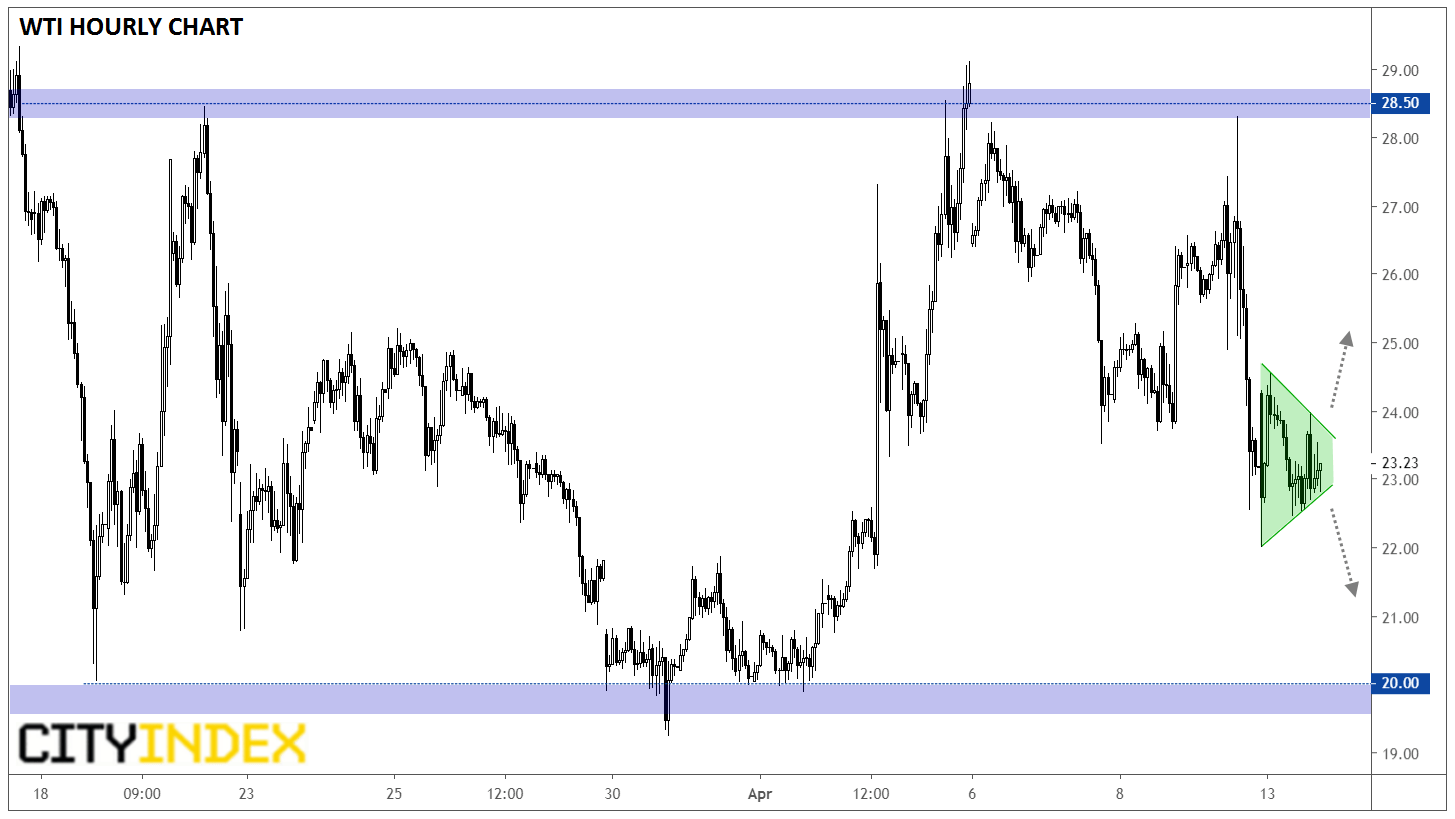
Turning our attention to the hourly chart, prices for West Texas Intermediate crude oil, the American standard blend, are trading smack dab in the middle of the 4-week range between support at 20.00 and resistance up near 28.50:
Source: TradingView, GAIN Capital
As we go to press, WTI is forming a short-term symmetrical triangle pattern. For the uninitiated, or the uninitiated, this pattern is analogous to a person compressing a coiled spring: as the range continues to contract, energy builds up within the spring. When one of the pressure points is eventually removed, the spring will explode in that direction.
It’s notoriously difficult to predict the direction of the breakout in advance, so short-term traders may want to wait for the breakout and trade in the same direction once its confirmed. For example, a downside breakout could open the door for a drop toward range support in the 20.00-21.00 zone, whereas a bullish break could set the stage for a continuation toward the 27.00 area, where we’ve seen resistance form earlier this month.
Mirroring the likely path of a post-COVID-19 economic recovery, traders are gradually filtering back to their desks after a long holiday weekend. With volumes running far lower than usual and many major markets still closed, we’re cautious about reading too much into current prices, but the latest developments in the oil market cannot be ignored.
After a week-long marathon of negotiations, the world’s top oil producers agreed to a deal to cut global oil production by 9.7M bpd, about 10% of total output. The bulk of the promised cuts fittingly fall to Saudi Arabia and Russia, who kicked off the current oversupply issues by failing to reach an agreement back in early March.
When it comes to the oil market though, even these production cuts will not bring supply and demand into balance. The mass disruption from the COVID-19 outbreak has absolutely decimated demand (GasBuddy reported that demand for petrol has fallen by -55% from early February levels), and these cuts, especially relative to the inflation production figures over the last month, will not bring the market back into balance unless we see a dramatic “V-shaped” economic recovery in the coming weeks.
That said, the Saudi Oil Minister recently announced that the Kingdom is prepared to cut production further in June if necessary, so at least oil bulls can take solace in the fact that producers are taking the situation seriously. Even US President Trump hinted this morning that additional production cuts could be on the way.
Turning our attention to the hourly chart, prices for West Texas Intermediate crude oil, the American standard blend, are trading smack dab in the middle of the 4-week range between support at 20.00 and resistance up near 28.50:
Source: TradingView, GAIN Capital
As we go to press, WTI is forming a short-term symmetrical triangle pattern. For the uninitiated, or the uninitiated, this pattern is analogous to a person compressing a coiled spring: as the range continues to contract, energy builds up within the spring. When one of the pressure points is eventually removed, the spring will explode in that direction.
It’s notoriously difficult to predict the direction of the breakout in advance, so short-term traders may want to wait for the breakout and trade in the same direction once its confirmed. For example, a downside breakout could open the door for a drop toward range support in the 20.00-21.00 zone, whereas a bullish break could set the stage for a continuation toward the 27.00 area, where we’ve seen resistance form earlier this month.
Latest market news




The complete CFD trading experience
Award-winning platforms, competitive spreads, low commissions and dedicated support.
We live and breathe the markets and are dedicated to helping traders realise their ambitions as we continue to set the industry bar.
Economic calendar
Web Trader platform
Our sophisticated web-based platform is packed with features.
Related articles

Crude Oil Analysis: Geopolitical Risk Continues to Drive the WTI Barrel Higher
During recent trading sessions, a new wave of buying momentum has continued to gain relevance around WTI crude oil price action. Over the last three trading sessions, the market has maintained a bullish streak and is now up more than 5.5%, highlighting significant buying pressure in the short term.


Crude Oil Forecast WTI Prices Come Under Pressure as Middle East Risks Ease
Over the last two trading sessions, WTI crude oil has once again displayed a notable bearish bias, with prices falling nearly 6%. Part of this renewed selling pressure has been driven by recent developments in the Middle East, which have helped temporarily ease the geopolitical tensions that had supported the oil risk premium in previous weeks.
Crude Oil Analysis WTI barrel remains weak after OPEC+ announcements
Crude oil continues to face difficult trading sessions in the short term. Over the last 5 trading sessions on average, WTI remains down close to -3.5%, with consistent movements below the 70-dollar area. This continues to highlight a selling bias that has remained in place for several weeks.
StoneX Europe Ltd may make third party material available on this website which may contain information included but not limited to the conditions of financial markets. The material is for information purposes only and does not contain, and should not be construed as containing, investment advice and/or investment recommendation and/or an investment research and/or an offer of or solicitation for any transactions in financial instruments; any decision to enter into a specific transaction shall be made by the client following an assessment by him/her of their situation.
StoneX Europe Ltd makes no representation or warranty and assumes no liability as to the accuracy or completeness of the information provided, nor any loss arising from any investment based on a recommendation, forecast or other information supplied. You should always seek independent advice as to your suitability to speculate in any related markets and your ability to assume the associated risks, if you are at all unsure. We are not under any obligation to update any such material. Any opinion made may be personal to the author and may not reflect the opinion of StoneX Europe Ltd.