
The Bank of Canada delivered its first rate hike of the cycle, as persistent inflation risks outweighed concerns over a weakening labour market. Substantial upgrades to its inflation outlook have kept further tightening on the table, while the Canadian dollar's broad-based strength could make AUD/CAD an interesting market to watch.
View related analysis:
- ECB Meeting Preview: EUR/USD Bears Face a Sentiment Test
- USD/JPY and EUR/JPY: Diverging Setups Ahead of ECB and BOJ
- Gold Bulls Treat $4,000 as a Bargain Once Again
- Canadian Dollar Defies CPI Miss as Inflation Expectations Rise: USD/CAD, AUD/CAD
Bank of Canada Hikes as Inflation Risks Intensify
The Bank of Canada (BoC) delivered its first hike of the cycle on Wednesday, raising rates by 25bp to a 13-month high of 2.5%. The statement leaned clearly hawkish, and they upgrade their inflation outlook notably - as the pass-through of higher energy prices remains a concern. While businesses have mostly absorbed higher costs so far, rising fuel, transportation and imported input costs could see inflation spread more broadly to consumer prices.
The BoC also believes that economic resilience justified the hike, despite excess supply in the economy and an unemployment rate of 6.5%. Governor Macklem said further hikes may be necessary, though decisions will be made on a meeting-by-meeting basis.
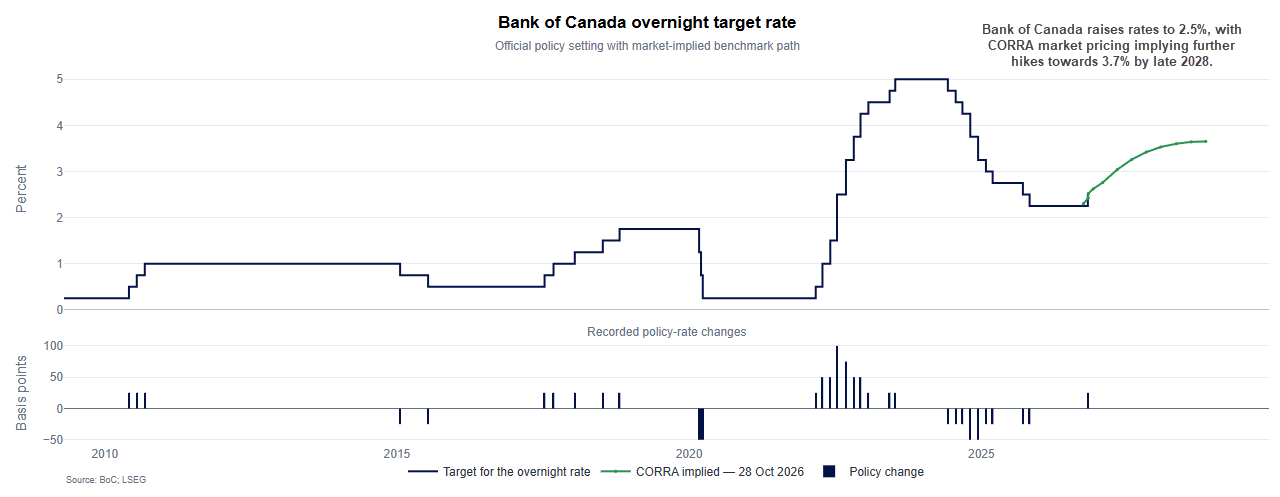
Summary of the BOC statement
- Global financial conditions have tightened since July, while the Middle East conflict enters its eighth month with no clear resolution.
- Economic growth exceeded expectations, with forecasts upgraded for 2026 and 2027. Consumer spending remains solid, business investment has rebounded and exports have strengthened despite US tariffs.
- CPI inflation has hovered around 3% since April and is expected to reach 3.5% by year-end, with inflation now seen as more persistent than projected in July.
- Near-term household and business inflation expectations have risen, although longer-term expectations remain anchored.
- Unemployment has remained around 6.5% for several months, reflecting continued labour market slack.
- Growth is expected to slow in Q4 2026 due to new US tariffs, before recovering in 2027.
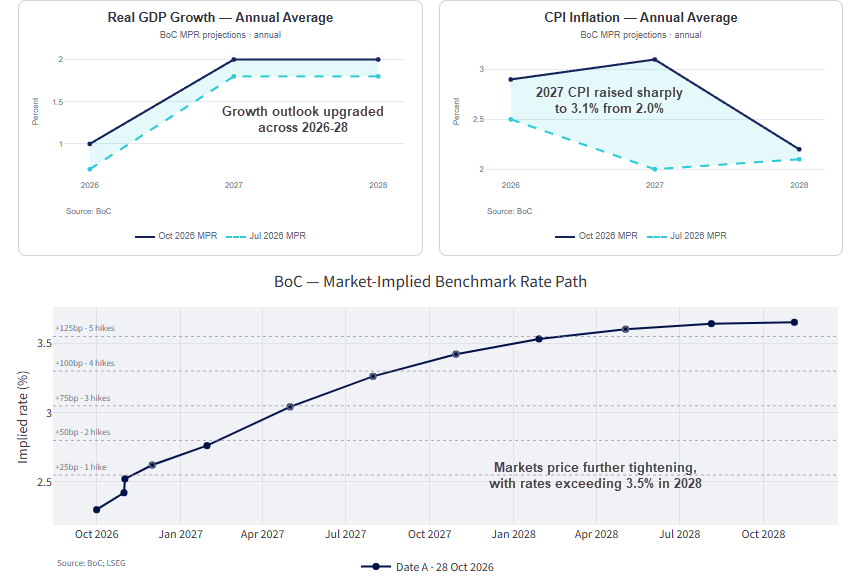
Stronger Growth and Persistent Inflation Keep BoC Hikes in Play
The BoC raised its annual inflation forecast for 2027 sharply to 3.1% from 2.0% in July, while its 2026 projection rose to 2.9% from 2.5%. Inflation is now expected to remain above 3% through much of 2027, before returning close to the 2% target by mid-2028.
Growth projections were also upgraded, albeit more modestly. GDP growth for 2026 was raised to 1.0% from 0.7%, while growth of 2% is expected in both 2027 and 2028. Stronger consumer spending, exports and business investment are expected to support the recovery and absorb the remaining economic slack.
Interestingly, the BoC considered holding rates, given that core inflation remains close to 2% and excess capacity persists. However, policymakers ultimately judged that the risks of higher energy costs spreading into broader inflation warranted a hike.
That leaves the door open to further tightening, although the BoC is not committing to consecutive hikes. Markets are pricing a gradual rise towards 3.7% by late 2028, suggesting traders also see scope for further action.
This content was created by an affiliate of FOREX.com and represents the views and opinions of the author/speakers, not the views and opinions of FOREX.com, StoneX Group Inc., or its subsidiaries. The content has not been independently reviewed by FOREX.com.
Labour Market Weakness Complicates the BoC's Inflation Fight
While a softer employment market has been looked past for now – and interestingly ignored from the statement – it could become a concern if the weakness persists or worsens.
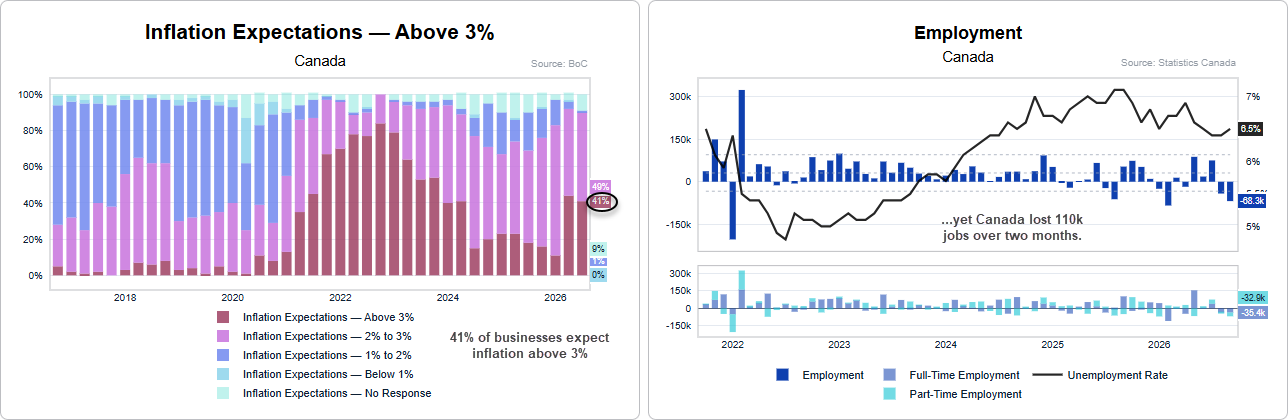
Employment fell by 42k in August and another 68k in September, marking a combined loss of 110k jobs. Unemployment also ticked higher to 6.5%, while core inflation remains close to 2%.
However, inflation expectations may have tipped the BoC's hand. Despite some easing in the broader Business Outlook Survey, 41% of firms still expect inflation above 3%, while renewed energy and tariff pressures have raised concerns about future price increases.
For now, the weakness in employment may not be enough to derail further hikes. But another round of disappointing jobs data could make consecutive hikes harder to justify.

Canadian Dollar Strength Broadens, AUD/CAD in Focus
The Canadian dollar has rallied against all FX majors this month, except the Australian dollar. Although the weekly CAD/AUD chart suggests a potential bullish structure could be forming.
CAD/NZD is on track for its strongest weekly gain since June, while CAD/EUR is trading at its highest level since May 2025.
Elevated oil prices have clearly been a factor behind CAD's strength. But the growing realisation that the BoC may not be as far behind the RBA in its tightening cycle as previously assumed could make short AUD/CAD one of the more interesting trades over the coming weeks or months.
It could be one to watch, particularly if CAD/NZD's recent strength is anything to go by.
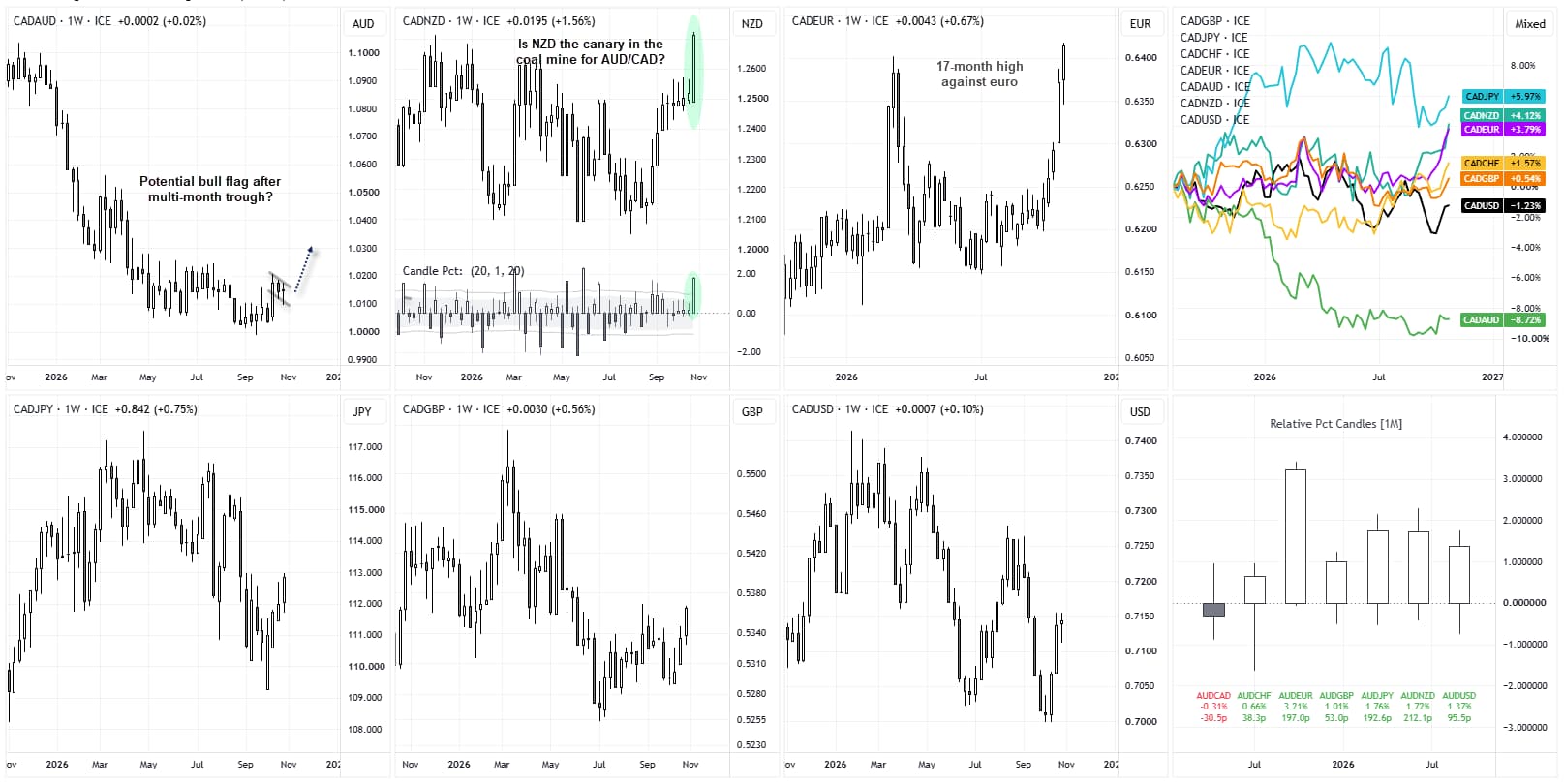
Source: ICE, TradingView