


NZD/USD: Rising labour market slack points to soft wages and no more RBNZ rate hikes
NZD/USD is falling in the wake of a soft New Zealand employment report, reinforcing the view that when the RBNZ next moves interest rates, it’s far more likely to be a cut than hike.
Share this:

- New Zealand labour data for Q3 was soft
- Forward indicators on wage growth deteriorated
- NZD/USD remains near 2023 lows
NZD/USD is falling in the wake of a soft New Zealand employment report, reinforcing the view that when the Reserve bank of New Zealand (RBNZ) next moves interest rates, it’s far more likely to be a cut than hike.
NZD/USD hit by soft jobs report
Employment grew 0.2%, half the pace expected, while private sector wages ex overtime undershot forecasts by two-tenths, rising 0.8%. While unemployment held steady at 3.9%, that largely reflected disappointing labour force participation which came in a 0.5 percentage points below forecast at 72%.
While wage growth remains strong, lead indicators continue to soften with the nation’s underutilisation rate jumping to 10.4%, up 0.5 percentage points on three months earlier. It’s now increased by a full percentage point over the past 12 month, reflecting sluggish economic conditions and the reopening of New Zealand’s international border.
Outlook for wages weakening
Underutilisation combines unemployment and underemployment to provide a broader indication as to the degree of labour market slack that exists. It typically has an inverse relationship to wage pressures, pointing to softer wage outcomes looking ahead.
“A loosening in the labour market is key in tackling inflation,” said Mary Jo Vergara, Senior Economist at Kiwi Bank. “The RBNZ should take comfort in today's employment data coming in softer than their expectations. And as such, is further evidence that no more rate hikes are needed. Monetary policy is working.”
While today’s report bolsters the case for the RBNZ to be on hold for the foreseeable future, that’s not exactly news to markets, meaning external factors are playing a far greater role in determining fluctuations in NZD/USD.
NZD/USD technical setup
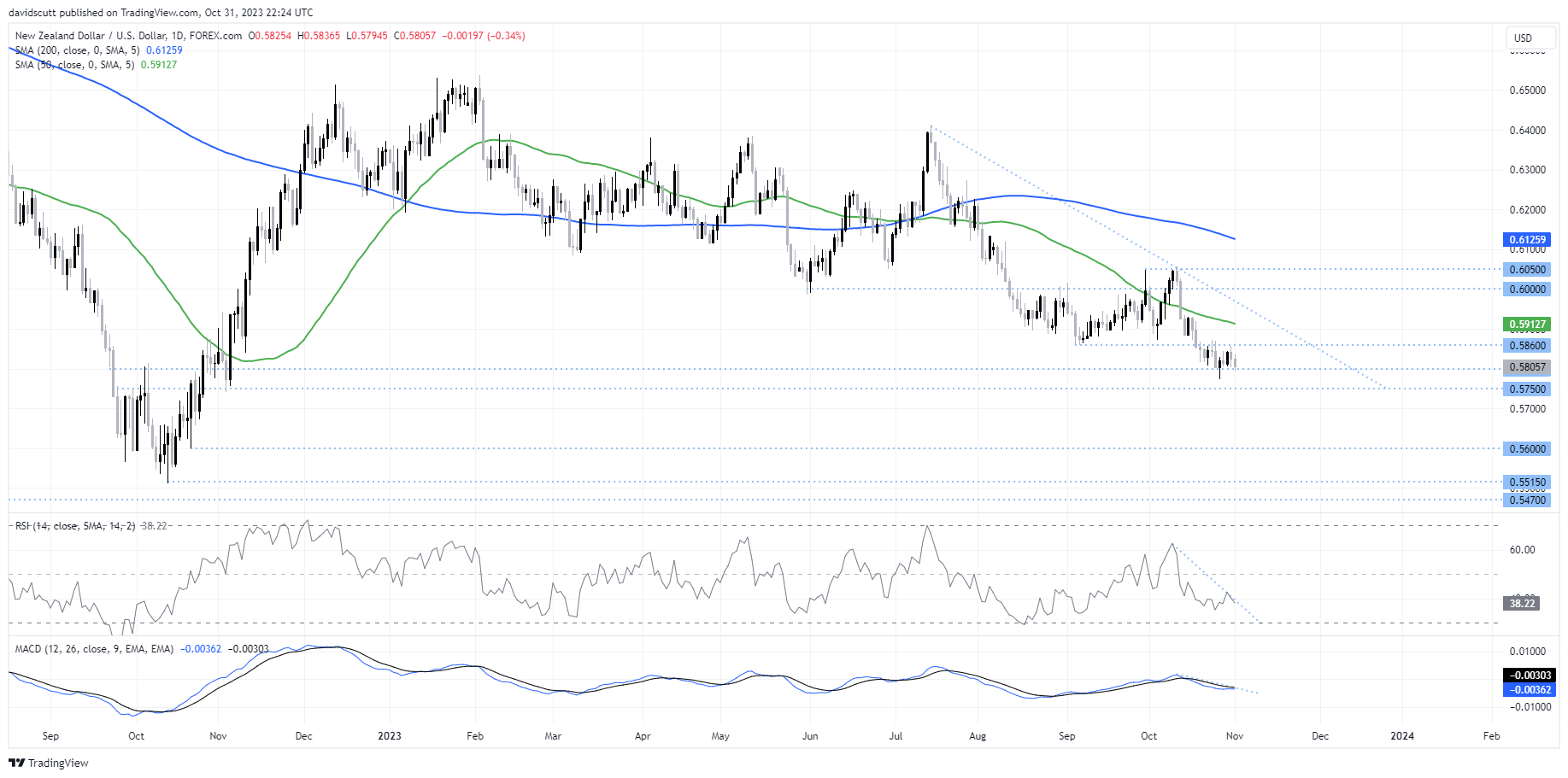
Looking at the daily, NZD/USD continues to attract bids from .5800 and offers from .5860, a range it’s been stuck on for the past fortnight. With the USD looking strong right now thanks to robust domestic economic data and weakness in the Japanese yen following the BOJ interest rate decision on Tuesday, the pair has every excuse to move lower in the near-term. However, if we don’t see downside in this type of environment, it’s a strong signal on where the medium-term directional risks may lie.
Below the current range, a successful break of .5750 may open a push towards .5600. On the topside, the pair has a done a bit of work around .5950 previously but there’s no major visible resistance until you get back to .6000. For now, RSI and MACD suggest momentum remains to the downside, although the latter looks like it may crossover the signal line in the near-future.
-- Written by David Scutt
Follow David on Twitter @scutty
How to trade with City Index
You can trade with City Index by following these four easy steps:
- Open an account, or log in if you’re already a customer
• Open an account in the UK
• Open an account in Australia
• Open an account in Singapore
- Search for the market you want to trade in our award-winning platform
- Choose your position and size, and your stop and limit levels
- Place the trade
Related tags:



Open an account today
Experience award-winning platforms with fast and secure execution.
Economic calendar
Web Trader platform
Our sophisticated web-based platform is packed with features.
Related articles

USD/MXN Forecast: Mexican Peso Weakness Persists as Year-End Approaches
These continue to be challenging sessions for the Mexican peso. The currency has remained under pressure in recent weeks, a trend clearly reflected in USD/MXN, which has now posted seven consecutive bullish sessions, gaining more than 7.0% over that period.


USD/JPY Forecast: Is Market Uncertainty Limiting Direction?
One of the developments that has become increasingly evident in recent weeks is the growing neutrality surrounding the Japanese yen. This can be clearly seen in USD/JPY price action, which has moved by barely 0.5% over the last four trading sessions, highlighting that neither the dollar nor the yen has managed to build enough momentum to establish a clear direction for the pair.

EUR/USD Forecast: Euro Faces Levels Not Seen Since April 2025
Trading conditions continue to be quite challenging for the euro in the short term. The European currency remains under considerable pressure against the U.S. dollar, a dynamic that can be clearly seen in the behavior of EUR/USD, which has started the week down nearly 0.7%.
From time to time, StoneX Financial Pty Ltd (“we”, “our”) website may contain links to other sites and/or resources provided by third parties. These links and/or resources are provided for your information only and we have no control over the contents of those materials, and in no way endorse their content. Any analysis, opinion, commentary or research-based material on our website is for information and educational purposes only and is not, in any circumstances, intended to be an offer, recommendation or solicitation to buy or sell. You should always seek independent advice as to your suitability to speculate in any related markets and your ability to assume the associated risks, if you are at all unsure. No representation or warranty is made, express or implied, that the materials on our website are complete or accurate. We are not under any obligation to update any such material.
As such, we (and/or our associated companies) will not be responsible or liable for any loss or damage incurred by you or any third party arising out of, or in connection with, any use of the information on our website (other than with regards to any duty or liability that we are unable to limit or exclude by law or under the applicable regulatory system) and any such liability is hereby expressly disclaimed.